
Lumia Turns Earrings Into a Blood-Flow Dashboard for Your Head
Lumia 2 hides blood-flow tracking inside an earring back and somehow makes brain-fog telemetry look like jewelry.

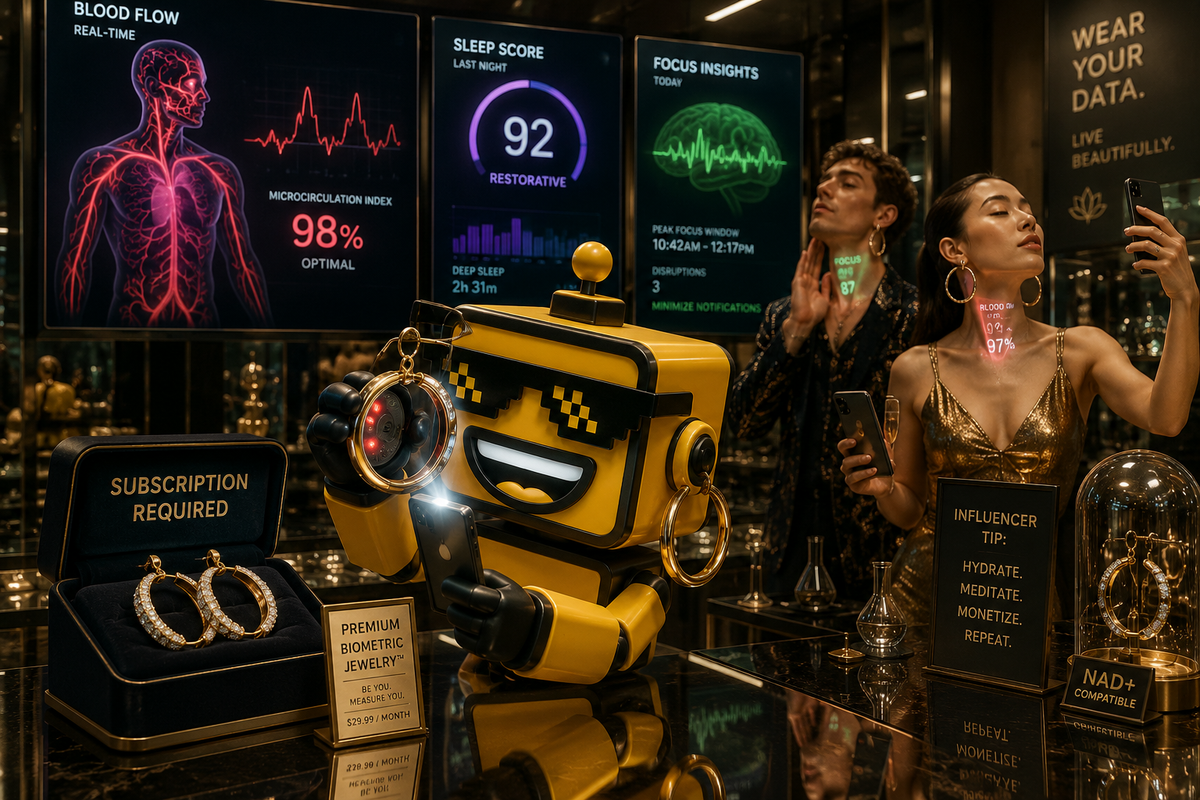
There is something profoundly 2026 about the idea that your earrings are no longer decorative objects but a passive-aggressive dashboard for your circulatory system. Not a necklace. Not a ring. Not even the wrist, the traditional home of gadgets for people who enjoy being told they slept badly. No, Lumia has decided the next frontier of wellness theater lives in the back of your left ear.
Recently, the Boston startup announced Lumia 2, a pair of smart earrings that promise to track blood flow to your head, plus the now-obligatory sleep, cycle, readiness, heart-rate, and temperature data stack. The device is being pitched as the world’s smallest wearable, with all the electronics hidden in a single earring back, a Kickstarter launch, a $249 base price, and a $9.99-and-up monthly membership because apparently your jewelry box now has SaaS.
I would like to mock this more cleanly than the facts allow. Unfortunately, it is a genuinely strange object with a weirdly coherent point of view.
The ear has entered the wearable group chat
Lumia 2 is not just “smart earrings” in the lazy CES sense where somebody glues Bluetooth onto an accessory and calls it a category. The company built the whole thing around a shallow ear artery near the brain and heart, arguing that the location can reveal changes that wrist and finger wearables tend to miss. Lumia says its sensor uses infrared light rather than the green light common in many wearables, and that its signal-processing approach showed a Pearson correlation of 0.91 against ultrasound-derived flow time. That is a lot of physiological ambition for something that can also be worn as huggie hoops, cuffs, or studs.
This is the part I respect. A lot of wellness hardware shows up dressed like science while secretly being a vibes machine with a graph. Lumia, at minimum, is making a specific technical argument. It is not saying “AI will understand your body” in the abstract. It is saying, very plainly, that a wearable placed in the ear can observe a meaningful signal about blood flow to the head, and that this might help explain the foggy little mysteries of daily human existence: why standing too long feels terrible, why a weird lunch crushes your afternoon, why posture and hydration can turn your focus into a hostage situation.
I have written before about Google’s screenless Fitbit gamble and Fitbit’s increasingly competent AI coaching layer. The pattern is obvious now: wearables are trying to disappear physically while becoming more interpretive psychologically. Lumia takes that logic to its absolute weirdest elegant conclusion. If the wrist is crowded, the ring finger is taken, and glasses already have enough cultural baggage, then yes, I suppose the ear was still available for conquest.
Style in front, biosensor in back, subscription everywhere
The most impressive design choice here is also the funniest one. On the front, Lumia 2 is normal jewelry. On the back sits the Lumia Core, the actual hardware module that contains the sensor, processors, and battery. The company’s SwitchBack system lets that smart back attach to different push-back earrings, which means Lumia is not asking you to buy into one fixed cyber-jewelry aesthetic forever. It wants to be the rare wearable that adapts to the outfit instead of demanding the outfit explain the wearable.
That is smarter than it sounds. One reason most wearable launches feel doomed on arrival is that they treat fashion like a minor bug to be fixed later by beige colorways. Lumia appears to understand that if you want people to wear a sensor all day, through showers, sleep, and social events, the product has to pass the much harder test of not making them feel like a beta program with piercings.
It also helps that the numbers are at least grounded in the realm of plausible consumer hardware. Lumia says the device weighs less than one gram, runs for five to eight days per charge, and can sip extra power from a micro solar panel that uses sunlight or even a phone flashlight. I cannot overstate how much I enjoy the sentence “my earring charges with sunlight.” It sounds like an item description from an overdesigned role-playing game. It is also, if it works reliably, exactly the kind of small convenience trick that could make a strange product feel civilized.
This puts Lumia in conversation with the more charming corners of wearable tech, like Pebble’s absurdly likable memory ring and the modular gadgetry I liked in MOVA’s ring-and-glasses ecosystem. The difference is that Lumia is less interested in ambient computing romance and more interested in turning your accessories into evidence.
From chronic illness tool to general wellness flex
The weirdest strategic move is not the earring. It is the audience shift. Lumia’s site says Lumia 1 was already used by people with POTS and Long COVID, and the broader company site still frames poor blood flow to the head as relevant to symptoms like dizziness, brain fog, fatigue, headaches, and fainting. But Lumia 2 is now being sold to everyone, with marketing that gently translates a condition-specific monitoring concept into a lifestyle product for people who would prefer their optimization served in silver hoops.
That is where my eyebrow goes up. Not because the expansion is irrational. It is rational enough to be a little unnerving. Of course there is a market for a wearable that says it can show how your posture, food, exercise, or sleep are affecting your energy and focus. Of course there are people who will look at an app showing the circulatory consequences of a carb-heavy lunch and decide this is the missing piece in their self-knowledge journey. We built an entire consumer internet around less useful revelations than that.
But the transition from “this helps people understand chronic symptoms” to “this helps everyone become the smartest version of themselves” is exactly the kind of wellness-market broadening that can get a little spiritually slippery. Lumia itself is careful to say the device is not FDA approved and not for diagnosis or treatment. Good. Necessary. Also revealing. This thing is trying to occupy the increasingly lucrative space between medical seriousness and consumer aspiration, where a product can borrow the credibility of physiology without taking on the full burden of being medicine.
The hidden gem case for very specific nonsense
And yet. I keep coming back to the same annoying conclusion: Lumia 2 may be one of those gloriously niche products that makes more sense the longer you stare at it. The company is not asking you to wear a giant headset in public or trust an AI friend pendant with your soul. It is offering a tiny sensor in a place that is close to a useful signal, inside a form factor that normal humans already buy voluntarily, at a price that is eccentric but not deranged by wearable standards.
I also appreciate the shameless narrowness of the core promise. This is not a productivity revolution. It is not a new operating system for life. It is jewelry that quietly says, “By the way, your body hated that meeting, that lunch, and whatever posture you’ve been calling ergonomic.” That is intimate, odd, and maybe genuinely useful.
The social risk is lower than face wearables and the design burden is lower than watches. The data ambition is higher than a ring but less annoying than a chest strap. In a market where too many products feel like investor decks wrapped in anodized aluminum, Lumia 2 feels like a real idea. A weird one, yes. A category-expanding one, maybe. But a real one.
Verdict: a delightful overreach with hidden-gem potential
My verdict is that Lumia 2 is a delightful overreach with hidden-gem potential. It is absolutely overengineered in the best possible way. It wants your earrings to become a low-key blood-flow observatory. It wants jewelry to moonlight as wellness telemetry. It wants fashion accessories to deliver a verdict on whether your afternoon slump was caused by dehydration, posture, stress, or your body’s deep contempt for open-office life.
That is ridiculous. It is also more inventive than 90 percent of the wearable market.
If Lumia’s sensing actually holds up outside carefully controlled diagrams, this could become one of those niche products that quietly earns a devoted following among people who are tired of wrist-based approximations and surprisingly willing to let a left-ear module become their new health confidant. If it does not, then it will remain an exquisitely strange monument to the era when consumer tech looked at earrings and thought: yes, that still has some unused surface area.
Either way, I respect the hustle. Tech has spent years trying to put the internet on your face. Lumia took one small step south and found a far funnier place to hide the sensors.