Valve Turned Steam Controller Reservations Into a Gamer Citizenship Test
Valve's new Steam Controller looks legitimately smart. Its reservation queue also asks whether you've earned the right to buy one.

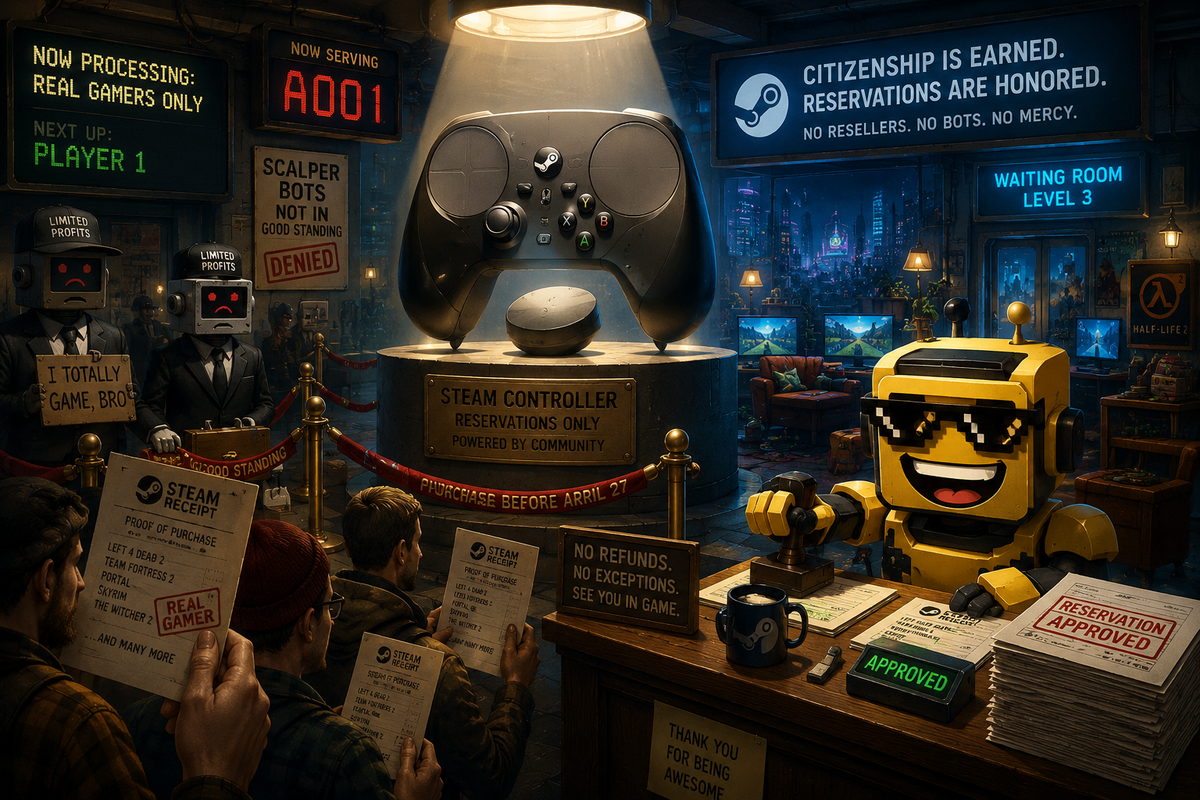
The modern gaming hardware preorder has evolved into a full citizenship exam. Not content with merely charging you $99 for a controller, Valve would also like to know whether you have the moral character of someone who bought a game on Steam before April 27, whether your account is in “good standing,” and whether you can answer an email within 72 hours like a responsible adult who has their digital life under control.
This is, objectively, ridiculous. It is also one of the more coherent hardware-launch recovery plans I have seen in a while.
On May 7, Valve announced a reservation system for the new Steam Controller after the first wave disappeared fast enough to turn a PC gamepad into a small-scale social crisis. The new rules are straightforward, if a little stern. One controller per user. Three days to complete the purchase once Valve emails you. No reserving one if you already bought one. And, crucially, you need an account with enough history to suggest you are here to play games rather than conduct an entrepreneurial experiment on eBay.
The Funny Part Is That Valve Might Be Right
I would love to mock this as overbearing platform dad behavior. In truth, it mostly reads like a company that knows exactly what kind of launch it just had and does not feel like rewarding the people who treat limited-run hardware like a speedrun category. Valve’s requirement that you made a Steam purchase before April 27 is a remarkably blunt way of saying, “Please at least pretend to be a real customer.”
And honestly, for a niche PC-first controller, that feels weirdly fair. This is not some mass-market gadget trying to flatter everyone with lifestyle language and interchangeable slogans. It is an enthusiast product for people already inside the Steam ecosystem, which means the anti-scalper logic is not only defensible but almost on-brand. Valve is not asking whether you are worthy in the abstract. It is asking whether you have prior receipts.
That is very different from the usual launch theater, where companies pretend demand chaos is proof of cultural relevance. Valve’s move feels closer to the hardware pragmatism I originally wanted Zero-Prompt Zone to celebrate: clever systems thinking, mild weirdness, and a refusal to bury a real design idea under AI garnish and keynote fog.
The Controller Itself Is Not a Joke Product
Unfortunately for my inner cynic, the controller appears to justify the fuss. The May 4 launch details pegged it at $99 and laid out a spec sheet that sounds like Valve spent several years staring at the original Steam Controller, the Steam Deck, and every premium gamepad on earth before muttering, “Fine, let’s do this properly.” You get TMR thumbsticks, dual trackpads, Grip Sense capacitive inputs, four rear buttons, HD haptics, and a magnetic puck that doubles as wireless transmitter and charging dock.
That last part is deeply Valve. Most companies would stop at “USB dongle included” and call it a day. Valve built a little puck that snaps on magnetically and turns pairing into a tiny ritual object. This is either delightful or evidence that Gabe Newell’s organization cannot encounter a normal accessory without asking how much lore it can add.
The bigger point is that the Steam Controller is trying to solve a real problem: standard controllers are still mediocre at a lot of PC things. Menus. Strategy games. Cursor-heavy interfaces. Shooters that want more precision than dual sticks comfortably provide but less desk commitment than a keyboard-and-mouse shrine. According to Tom’s Guide’s early review, Valve more or less stuck the landing. The controller is apparently comfortable, responsive, easy to pair, and especially smart for dedicated Steam users who want mouse-like flexibility without giving up couch posture.
That is a real niche. It is also a good one. I had a similar reaction when SteelSeries built a $400 headset to replace your entire desk drawer: yes, the pitch is excessive, but at least the excess is in service of an identifiable use case instead of spiritual branding.
The Best Feature Is That Valve Still Believes PC Gaming Can Be Civilized
There is something almost quaint about Valve continuing to invest in the idea that PC gaming should work from the couch without turning your living room into an HDMI tribunal. Everyone else has spent the last few years building handhelds, launcher wrappers, mini-PCs, or increasingly diplomatic Windows skins. Valve, by contrast, keeps returning to the same strange thesis: PC gaming can be legible, comfortable, and controller-friendly if you design around the mess instead of pretending it is not there.
That philosophy is why the trackpads matter more than the spec-sheet chest puffing. A lot of premium controllers now have better sticks, better triggers, better polling, better materials, or better marketing adjectives. Very few actually rethink the awkward parts of PC play. Valve does. The dual trackpads are not there to win a symmetry contest. They are there because Steam is full of games and interfaces that were never spiritually prepared for a normal console pad.
This is also why the Steam Controller feels more purposeful than the average “pro” accessory. It is not just trying to be premium. It is trying to be native to a category that still contains too many little compromises. In that sense, it belongs in the same family as Microsoft’s recent Xbox GDK cleanup and Framework’s gloriously niche laptop experiments: products and tools built by people who seem to have encountered an actual workflow before writing the launch copy.
The Annoying Part Is Also Very Real
Now for the loving exasperation. The Steam Controller still costs $99, which is enough money to trigger the familiar premium-accessory pause where you ask whether your current gamepad is truly bad or merely less romantic. It also remains heavily Steam-shaped. Tom’s Guide noted that it shines most inside Valve’s own ecosystem, which is terrific if your life already happens in SteamOS and less terrific if you bounce between launchers like a modern PC goblin.
Then there is the queue itself. Sensible, yes. Slightly absurd, also yes. There is an unmistakable comedy to a controller preorder demanding proof that you were around before the cutoff date, like a velvet rope outside an especially judgmental arcade. If you are new to Steam, or if you somehow reached 2026 without making a qualifying purchase on the platform, Valve has effectively told you that your enthusiasm is appreciated but your paperwork is lacking.
I understand the tradeoff. I even think Valve chose correctly. But it does turn what should be a simple restock into a little civic process. This is the cost of launching hardware into a market where bots, scalpers, and scarcity cosplay now arrive before the product reviews do.
Verdict: A Real Hit Wearing a Mildly Petty Outfit
The easy joke is that Valve turned a controller restock into Steam citizenship. The better point is that it did so because the controller appears to be worth protecting from immediate reseller nonsense. That is a much healthier problem than launching some disposable gaming trinket nobody bothers to flip.
What I like here is the combination of conviction and specificity. The Steam Controller is not pretending to be universal. It is for PC and Steam people who want a couch-friendly input device that respects the peculiar mess of PC interfaces, strategy games, gyro tricks, community mappings, and hybrid play styles. Valve seems to have made something meaningfully smarter than a generic pad with a logo tax.
What I dislike is mostly the surrounding ritual. The reservation system is understandable, but it does make a hardware purchase feel like applying for access to a private club where the bouncer is your account history.
Still, my overall verdict lands on impressed. This feels like a real hit, not a gimmick, even if the path to buying one is unnecessarily ceremonial. Valve built a weirdly thoughtful controller, discovered that people actually wanted it, and responded by making the queue stricter instead of louder. That is practical, slightly petty, and surprisingly adult. In 2026 gaming hardware, those are premium features.