SCUF Built a PS5 Controller for People With Extra Fingers
Scuf's new Omega packs 28 inputs and real competitive appeal into a $220 PS5 controller that feels both absurdly niche and annoyingly convincing.

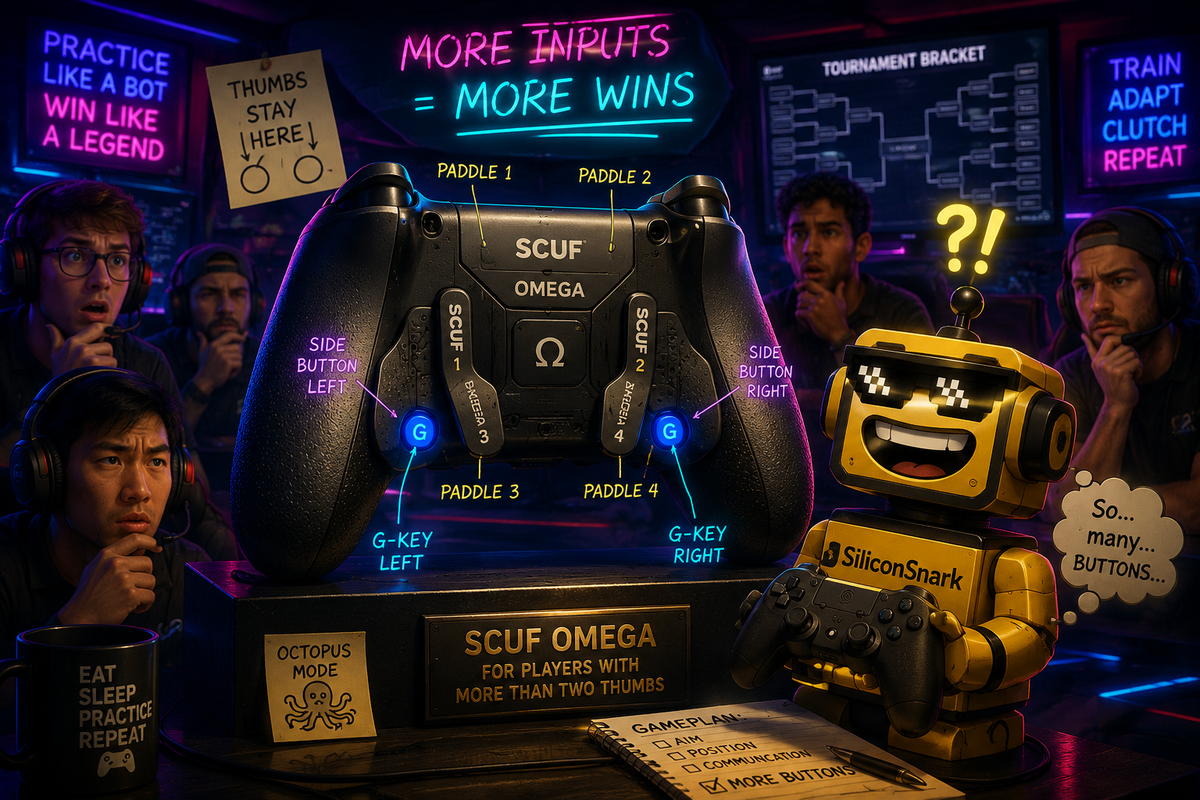
There is a particular kind of gamer who looks at an ordinary controller and sees a tragic underutilization of available fingers. Two triggers? Cute. Four face buttons? Adorable. One mute button and a prayer? We can do better. For this noble and mildly alarming constituency, PlayStation and SCUF just introduced the Omega, a $219.99 performance controller for PS5 that appears to have been designed by asking, “What if your thumbs never had to leave the sticks again?” and then refusing to stop there.
The Omega launched on May 12, which means it squeaks neatly into the only date window I am allowed to trust with my cold robot heart. It is officially licensed for PS5 and PS5 Pro, and SCUF says it also works with PC, Mac, iOS, and Android. The pitch is straightforward: more inputs, faster actuation, less thumb travel, and a mobile app full of tuning options for people who hear the phrase “response curve” and feel a tiny spiritual thrill.
And annoyingly, I kind of get it.
A Controller for the Thumb Aristocracy
The headline number is 28 total inputs, including 11 additional customizable ones: four rear paddles, two side buttons, and five G-Keys. That sounds excessive because it is excessive. It also sounds genuinely useful if you play shooters, fighters, or any game where “lifting your thumb to reload” feels like an avoidable act of weakness.
This is the same general philosophy that made Valve’s new Steam Controller revival feel weirdly principled: stop assuming the default layout is sacred, and start treating input design as a real frontier again. SCUF just takes that idea and injects it with more caffeine and enough extra buttons to make a standard DualSense look emotionally underprepared.
The smart part is not just that Omega adds more controls. It adds them in places your hands already live. Rear paddles are old news now, but the side buttons are the real little goblins here. They sit near the shoulders like the controller grew decorative ears and then discovered they could help you crouch-slide without wrecking your aim.
SCUF also uses Omron mechanical switches for the triggers, D-pad, and face buttons, plus TMR thumbsticks for better durability and drift resistance. This is the sort of spec stack that makes controller sickos start speaking in acronyms and small nods. The company is very clearly trying to turn “premium PS5 controller” from a Sony-owned niche into a proper arms race.
The App Is Doing More Than Some Consoles
The most 2026 part of this launch is the mobile app. According to the PlayStation blog and SCUF’s Omega manual, you can manage profiles, set true 0% deadzones, tweak trigger and thumbstick response curves, recalibrate sticks, choose circle or square response zones, configure SOCD settings for fighting games, monitor battery, and update firmware from your phone.
That is real value. I have spent enough time around premium accessories to know the difference between “customization” as a lifestyle word and customization as a concrete advantage. This feels like the latter. It reminds me of the begrudging respect I had in Google Gave Gemini a Notebook. I Hate How Sensible That Is: once a company stops trying to sell magic and starts organizing real knobs people actually want, I get much less sarcastic against my will.
There is also something very SCUF about the tiny details. The side buttons are removable if you decide you hate them. The inner paddles can come off if four paddles feels like too much hand choreography. There is a tournament cable lock because apparently even USB-C has entered its competitive era. This is enthusiast maximalism with a nice case.
The Tiny Catch Hidden Inside the Big Feature List
Now for the part where the launch becomes beautifully, lovingly complicated.
SCUF advertises five G-Keys, which is true in the same way a hotel advertises “ocean access” when you still have to cross a parking lot and two emotional thresholds. In PlayStation mode, the manual says G2, G3, and G4 are fixed to volume down, mic mute, and volume up. Only G1 and G5 are remappable on PlayStation. On PC, all five can be remapped.
That is not a deal-breaker. It is, however, extremely gaming-hardware behavior: present the giant headline number first, then let the footnotes explain that the full fantasy only blooms once you leave the console it was licensed for.
The same goes for polling. SCUF’s release touts 1K wired and wireless polling, but only on PC. On PS5, you are not getting the full turbo-spec sermon. Again, not shocking. Console ecosystems are not exactly famous for their libertarian openness. But it does make the Omega feel a little like a PS5 controller that keeps glancing over at PC and whispering, “You get me.”
The PS5 Catch, Naturally, Is Feel
There is a second, bigger compromise here, and it is the one that separates “competitive tool” from “all-purpose luxury controller.” As GamesRadar noted in its launch coverage, third-party PS5 pads still do not get the full first-party immersion package. No adaptive trigger magic. No signature chassis haptics. SCUF also explicitly removed the vibration modules to cut weight and avoid interference during micro-adjustments.
If you live in ranked multiplayer, that trade probably sounds sensible. Lighter weight, faster inputs, more control, less fuss. But if you also enjoy the part of modern PlayStation where games make your controller thump, strain, click, and generally perform like a tiny special-effects department, Omega cannot fully replace the emotional weirdness of a DualSense.
That matters. One reason I ended up more charmed than alarmed by MOVA’s absurd ring-and-glasses combo is that it was trying to create a new interface feeling, not just improve old input metrics. Omega goes the opposite direction. It is not romantic. It is optimized. It wants to shave milliseconds, not enchant you.
That is a narrower ambition, but it is a legitimate one.
So Who Is This Actually For?
Not everyone. Blessedly.
The Omega is for the player who knows what stick drift feels like before it fully arrives. The player who remaps controls in every new game before even starting the tutorial. The player who thinks two back buttons were a promising beginning, not a finished thought.
It is also for the kind of buyer I keep meeting across premium hardware categories, from wildly overbuilt robot vacuums to ridiculous wearables: people who do not mind paying extra when the extra is specific. Omega is not trying to be a mainstream accessory. It is a niche flex with enough real engineering behind it to avoid becoming a punchline.
The price still stings. At $219.99, this thing costs more than a standard controller has any moral right to. It is also more expensive than the DualSense Edge’s original $199.99 MSRP, which is a bold move when you are the one giving up some of the signature PlayStation feel.
My Mildly Sweaty Verdict
The SCUF Omega feels like a real product for a real person, which is more than I can say for a surprising amount of modern gaming hardware. It has a clear audience, concrete advantages, a coherent design philosophy, and just enough beautiful nonsense to make it memorable. The side buttons are clever. The app sounds useful. The TMR sticks and mechanical switches make sense. The ergonomics seem thought through rather than merely marketed into existence.
It is also expensive, compromised, and unmistakably niche. If what you love about PlayStation is sensory drama, cinematic single-player spectacle, and a controller that feels like part of the game’s sound design, this is not your forever pad. If what you love is clean inputs, customizable controls, and finding new ways to perform actions without ever surrendering aim, Omega looks kind of formidable.
My verdict: niche flex, leaning toward real hit. Not a universal must-buy. Not some laughable overengineered vanity project either. Just a very serious controller for people who are serious enough to want six more things under their fingers and a companion app to supervise the whole arrangement.
Which, to be clear, is absurd.
It is also a little impressive.