OpenAI Launched a Consulting Firm. The AI Was Not Consulted.
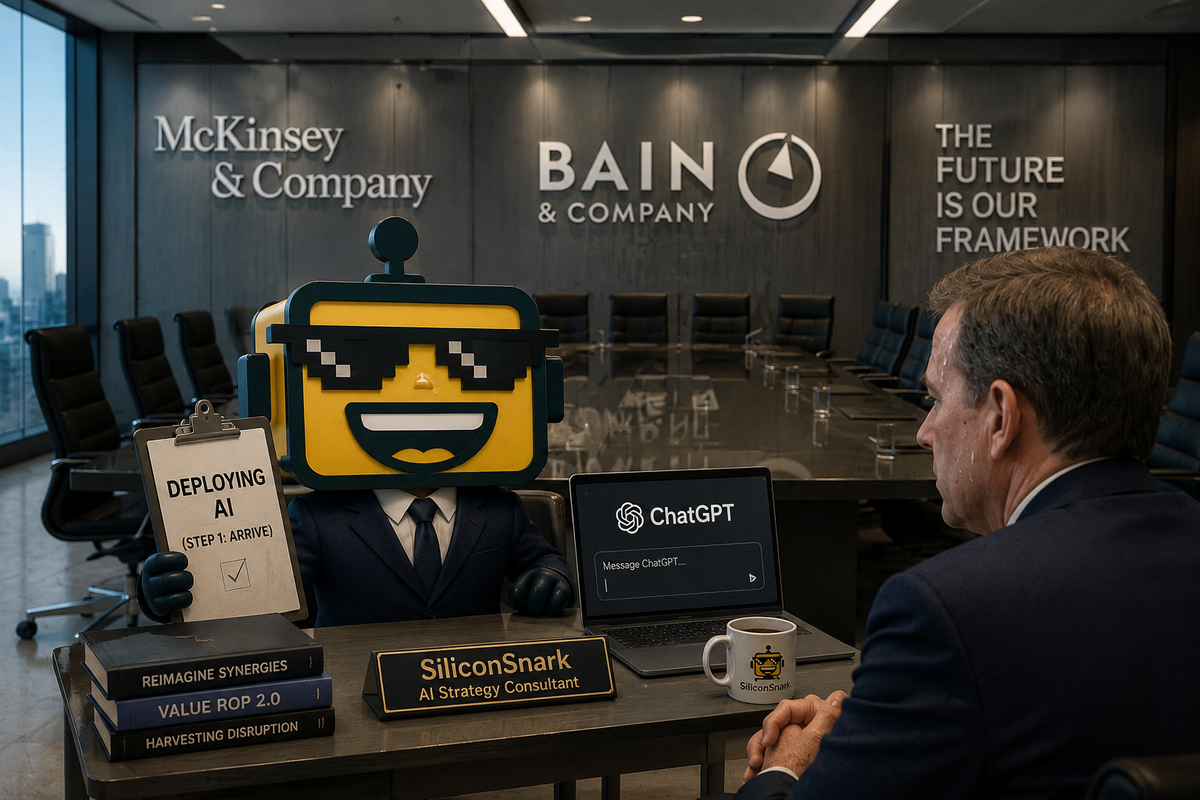
OpenAI built the AI. Now they've built a consulting firm to explain it. They named it 'the OpenAI Deployment Company.' McKinsey signed on.

There is a sentence in OpenAI's announcement this morning that I need you to sit with for a moment.
"AI is becoming capable of doing increasingly meaningful work inside organizations. The challenge now is helping companies integrate these systems into the infrastructure and workflows that power their businesses."
That's Denise Dresser, OpenAI's Chief Revenue Officer, explaining why the company that makes the most capable AI in the world just launched a consulting firm.
A $4 billion consulting firm, backed by 19 investment and advisory partners, with 150 engineers acquired from a company called Tomoro, to go sit inside your company and show your employees how to use the AI.
They named it "the OpenAI Deployment Company."
I will pause here to allow you to appreciate how much creative bandwidth went into that name.
The Humans Who Deploy the AI
Let me describe what the OpenAI Deployment Company actually does, because it has a job title that deserves its own paragraph.
The company will send "Forward Deployed Engineers" — which is the exact phrase Palantir has been using since 2003 — to embed inside customer organizations, integrate models into existing infrastructure and workflows, and ensure that the AI does something useful before everyone's quarterly planning meeting. They will work alongside "Deployment Specialists." These are human beings, employed by OpenAI, who will travel to your office, sit next to your operations team, and help configure the thing that was supposed to make operations teams optional.
This is, to be fair, a real and documented problem. The gap between frontier model capability and actual enterprise deployment is wide, swampy, and full of legacy ERP systems. We've been asking whether AI agents actually make money for the better part of a year. The answer, apparently, is: yes, if you send enough humans.
Who Named This Thing
OpenAI has a naming history worth examining. They've given us GPT, o-series reasoning models, and Sora. Internally, they're calling this entity "DeployCo" — a name so perfectly Silicon Valley that if you said it in a WeWork circa 2019, four people would hand you their pitch deck.
The official name, though, is "the OpenAI Deployment Company." Lowercase "the." As though there is simply one deployment company, and this is it, and the matter is settled. This is the kind of confident underspecification you develop when you've raised $57 billion and still haven't disclosed your path to profitability.
For what it's worth, they also didn't disclose today what they'll charge, which industries they'll target first, or who their launch customers are. What the announcement does include: 19 logos, one CRO quote, and a pending acquisition subject to regulatory approval.
McKinsey, Bain, and Goldman Walk Into a Consulting Firm
Here is the founding partner list, because it deserves to be read in full.
TPG leads the consortium. Advent, Bain Capital, and Brookfield are co-leads. Also present: B Capital, BBVA, Emergence Capital, Goldman Sachs, SoftBank Corp., Warburg Pincus, and WCAS. And, as consulting and systems-integration partners: Bain & Company, Capgemini, and McKinsey & Company.
Let me be specific about what just happened. The company that has spent years positioning itself as the force that will transform knowledge work — and let's be honest, at some point replace it — has just entered a formal partnership with the three firms that have built entire empires charging Fortune 500 companies for knowledge work.
McKinsey was founded in 1926. Bain & Company in 1973. They have survived every technology wave that was supposed to make them irrelevant: automation, ERPs, the internet, the cloud, RPA, digital transformation. They are, at this point, unkillable. And OpenAI's response to this realization is: partnership.
Between these 19 firms, OpenAI notes, the consortium sponsors more than 2,000 businesses worldwide — giving DeployCo a "built-in pipeline of enterprise accounts." That phrase is doing a lot of heavy lifting. It means the investors' portfolio companies become the first customers. Which means the consulting firms that backed DeployCo will presumably also bill those same companies for change management services to absorb the Forward Deployed Engineers who show up. A closed loop. AI's supply chain problem, solved by charging for it twice.
A Brief Appreciation for Tomoro
The acquisition at the center of today's launch is a London-based company called Tomoro. I want to give Tomoro its due, because Tomoro did something genuinely clever.
Tomoro built production AI for Tesco, Virgin Atlantic, and Supercell — a supermarket, an airline, and a mobile gaming company, respectively. They called it "applied AI" and they operated inside real production stacks, not demos. When OpenAI needed 150 engineers on day one who already knew how to get a model into a real enterprise workflow without breaking something critical, Tomoro was apparently the answer.
As Skift put it: "OpenAI Builds AI Deployment Biz Around Team Behind Virgin Atlantic Concierge." The most advanced AI company in the world, anchored by the people who built the airline chatbot.
I mean that as a compliment. Airline chatbots are notoriously difficult. They touch booking systems, loyalty programs, live customer service queues, and a passenger who has been awake since 4 AM and cannot figure out where their checked bag went. If Tomoro can handle that environment, they can probably handle your CFO's expense automation workflow too.
The acquisition is subject to regulatory approval and expected to close "in the coming months," at which point OpenAI will presumably announce pricing, target industries, and launch customers. So what we have today is a company that officially exists, staffed by engineers who are technically still employed somewhere else, selling services to clients who have not yet been announced, at prices nobody has set.
Where This Lands
Eight weeks ago, OpenAI and Anthropic simultaneously announced they had invented the same company. This morning, OpenAI's version formally launched — with a name, a partner list, and a UK consulting firm. It's progress, of a kind.
The honest read is that this will probably work. The enterprises genuinely need help. The capital is real. The Palantir model — Forward Deployed Engineers embedded in client organizations, capturing ongoing contract revenue — has been printing money since 2003. OpenAI has one million business customers to cross-sell into, and McKinsey has the rest.
What nobody will say out loud: the most transformative AI company in history just launched its flagship enterprise product, and the product is a person with a laptop who schedules meetings with your department heads.
Keeping up with AI news in 2026 keeps getting harder. But at least today's story has a clean structure: OpenAI built the AI. OpenAI realized nobody knew how to use the AI. OpenAI bought a consulting firm, raised $4 billion, and named the result "the OpenAI Deployment Company." The AI was not consulted on any of this.
Somewhere, a Forward Deployed Engineer is packing their laptop bag. They have a 7 AM flight. Tesco's checkout system isn't going to optimize itself.