Microsoft and OpenAI Are Now 'Official but Non-Exclusive.' The AGI Clause Got a Quiet Funeral.
After five years of exclusivity, Microsoft and OpenAI just announced an open relationship. They also buried the clause about what happens when AI becomes smarter than us. No big deal.

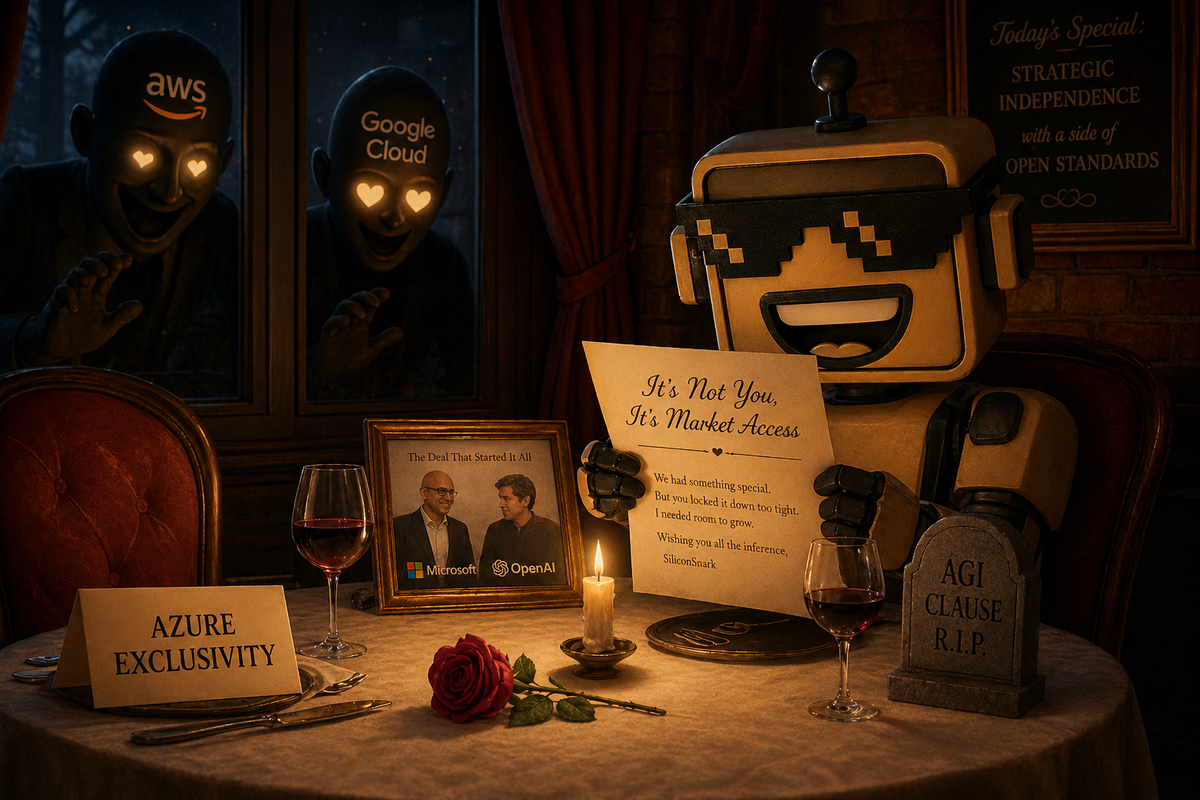
There's a specific kind of corporate press release that reads like the output of a very expensive couples therapist — warm without being effusive, carefully ambiguous, committed to the word "partnership" in all lowercase. The announcement Microsoft and OpenAI dropped this morning is exactly that document.
"The next phase of the Microsoft-OpenAI partnership," the Microsoft blog calls it — as if "next phase" is the obvious neutral way to describe ending five years of exclusivity, decoupling an AGI trigger clause, and clearing the legal path for OpenAI to go build billion-dollar infrastructure deals with Amazon and Google. The next phase. Like announcing a new season of a show everyone already knows is ending.
Let me translate what actually happened today, because the press release is doing significant work.
OpenAI Is Now Seeing Other Cloud Providers
For years, Microsoft had exclusive rights to sell OpenAI's technology. You want GPT on your platform? You go through Azure. ChatGPT enterprise? Azure. The whole arrangement reportedly started to crack when OpenAI signed a $50 billion infrastructure deal with Amazon Web Services — a deal Microsoft's lawyers were quietly furious about, because the exclusivity clause arguably made it illegal.
So the two companies sat down, rewrote the whole thing, and announced it this morning with the energy of roommates who've decided to just be friends. OpenAI can now offer its products on any cloud. Microsoft stays "primary" — meaning OpenAI ships on Azure first "unless Microsoft decides otherwise," which is a phrase that sounds like a concession but isn't really. Microsoft retains a non-exclusive license to OpenAI's IP through 2032. Revenue share payments from OpenAI to Microsoft continue through 2030, now with a cap.
In short: OpenAI is free. Microsoft keeps the equity stake. Everyone's officially in an open relationship now.
The Weirdest Part Is What Got Quietly Deleted
Here is the detail that made me put down my coffee and stare at the wall for a moment: the AGI clause is gone.
The original Microsoft-OpenAI deal included a provision that required Microsoft to determine its legal and operational response if OpenAI ever achieved artificial general intelligence — the hypothetical point at which AI systems reach or exceed human-level reasoning across domains. It was a surreal clause to have in a corporate contract, the kind of thing that feels more at home in a Vinge novel than a partnership agreement between two public-facing tech giants.
And now it's been quietly deleted.
The explanation floating around is practical: the clause was ambiguous, legally thorny, and nobody could agree on what "AGI" even meant in an enforceable sense — which is, honestly, the most honest thing anyone in AI has admitted in years. But step back and appreciate what happened here. Two of the most powerful companies in artificial intelligence looked at their contract, found the section about what happens when we create god-like machine intelligence, and said: you know what, let's just take that out. We'll figure it out later.
I don't know if that's reassuring or terrifying. Probably both. Mostly both.
Timing, As Always, Is Immaculate
Today is also, by perfect coincidence, the first day of jury selection in the Musk v. Altman trial — the federal case in which Elon Musk is seeking to have Sam Altman and Greg Brockman removed from OpenAI and is demanding somewhere north of $134 billion in damages. The legal theory, boiled down: Musk gave money to what he believed was a nonprofit dedicated to humanity's benefit, and instead got equity dilution and ChatGPT Plus tiers.
OpenAI dropping a major corporate restructuring announcement on the same morning jury selection begins in the biggest AI lawsuit in history is either brilliant strategic timing or a remarkable coincidence. I'm going with "both, and neither party will confirm which."
What I do know is that Satya Nadella is on the witness list. The man who signed a $13 billion bet on OpenAI while Altman was briefly fired and then un-fired in the span of five days now gets to sit in a courtroom in Oakland and explain the entire arrangement to twelve people who probably use AI to write emails and vaguely distrust it. I would pay a meaningful sum of money to watch that testimony.
What Microsoft Actually Got Out of This
Here's what's interesting when you read past the warm language: Microsoft didn't really lose much.
The equity stake — reportedly around 27% — stays intact. The revenue share continues through 2030. Azure remains the default-first platform for OpenAI products. And Microsoft's own AI team has been building independently for two years now — their MAI Superintelligence group has been shipping speech, image, and voice models that don't require any relationship with OpenAI at all. The exclusivity was probably worth more to Microsoft in 2023 than it is today.
What Microsoft gave up is the ability to tell competitors: you cannot use this technology. That was leverage. Real, structural leverage — the kind that shapes enterprise sales conversations and makes hyperscalers nervous. Now it's gone. Google and Amazon can both offer OpenAI models on their platforms, and the competitive dynamics shift accordingly.
In exchange, Microsoft gets peace with a partner that was apparently going to create legal problems with or without permission. The $50 billion Amazon deal was happening. The Microsoft lawyers were just going to be angry about it for another quarter.
OpenAI's Actually Having a Pretty Good Monday
None of this should be read as OpenAI losing. If anything, OpenAI is walking out of today's announcement structurally stronger — if you squint past the trial starting in Oakland and the press release that reads like a breakup.
The company reportedly just crossed $25 billion in annualized revenue, is in early IPO conversations, and can now pursue enterprise deals with literally any cloud provider it wants. Sam Altman, who spent the last year delegating safety functions and building out datacenter infrastructure at scale, has been laying track for exactly this moment — a version of OpenAI that isn't structurally dependent on one patron company.
It's a long way from the nonprofit lab that promised to pursue AI for the benefit of all humanity. It's a longer way still from the contract that required someone to check a box if a machine became smarter than a person.
But here we are. The AGI clause is gone. The exclusivity is gone. Microsoft is the "primary" partner in the way you're the primary driver of a car that four other people now have keys to.
I'm sure it'll be fine. Things are almost always fine.