
Digital Identity, Explained: Why Every App Suddenly Wants Proof You’re Human, Old Enough, and Probably Real
Digital identity is becoming the internet’s trust layer. This deep dive explains age checks, proof of human, wallets, incentives, and the stakes.

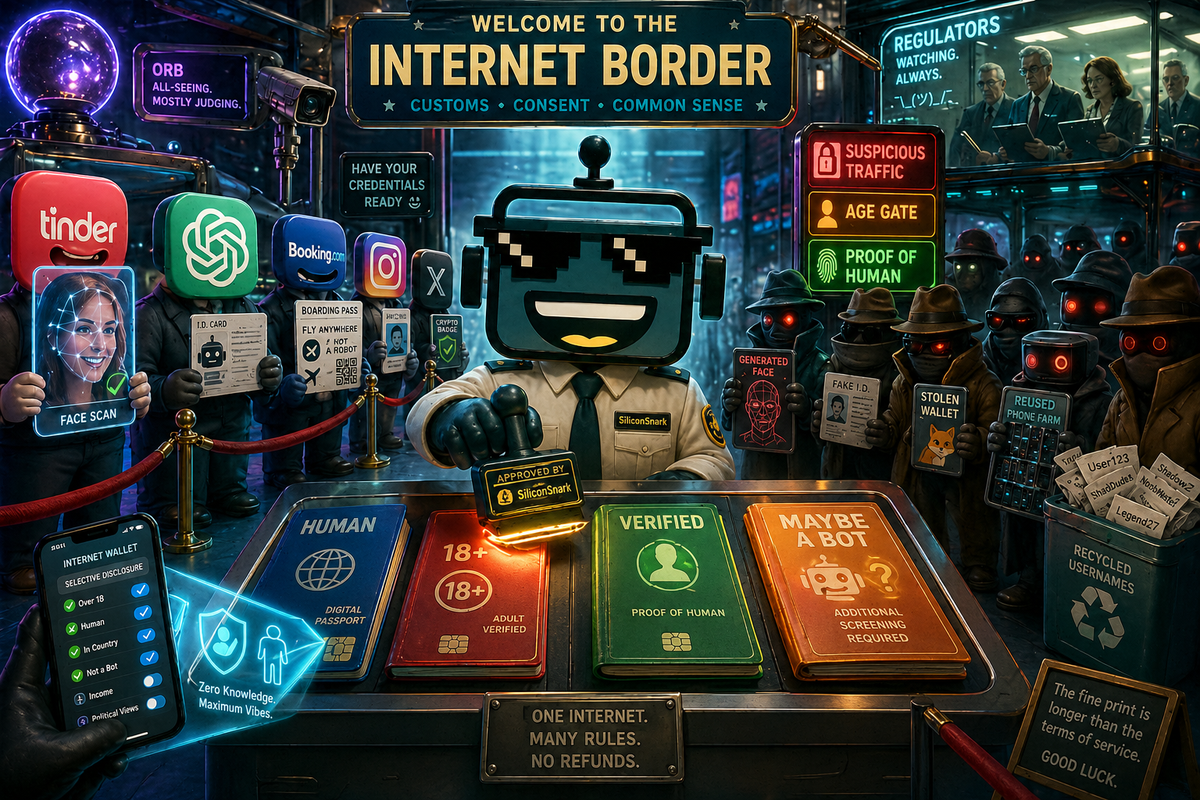
Every tech cycle eventually produces a moment when the industry admits what it has really been trying to build all along. The large-language-model boom had one of those moments in April 2026, and it did not arrive with a benchmark chart or a founder onstage declaring that the future had politely solved itself. It arrived as a request for your papers.
In April, Anthropic said some Claude users would be asked to complete identity verification with a government-issued photo ID and, in some cases, a live selfie to access certain capabilities as part of platform-integrity, safety, and compliance measures. Three days later, on April 17, World announced a new “full-stack proof of human” architecture and said its network now spans nearly 18 million verified humans. Meanwhile, World’s own help center now explains how Tinder users in Japan can verify that they are 18 or older through World ID, while the UK’s Ofcom and ICO published a joint age-assurance statement on March 25, 2026 to tell online services, with the gentle patience of exhausted adults, that child safety and data protection are now supposed to coexist in the same room.
That is the why-now. The web is entering a phase where more companies no longer want only your password, your phone number, or your willingness to click the square that claims you are not a robot. They want stronger signals about who you are, how old you are, whether you are a unique person, whether you match your photos, whether you can be trusted with a feature, and increasingly whether the account on the other side of the screen should count as a human at all.
This is not one category. It is a stack. Age verification. Age estimation. Identity proofing. Wallet IDs. Reusable credentials. Biometric liveness checks. Privacy-preserving attribute proofs. “Proof of human” systems. OS-level age signals. All of it belongs to the emerging trust infrastructure of the internet, which is a phrase so drab it almost conceals how politically weird and commercially important this has become.
The Nut Graph: This Is Not Really About IDs. It Is About Who Gets to Govern Trust Online.
The easiest way to misunderstand the digital-identity boom is to treat it as a niche compliance annoyance, the kind of bureaucratic side quest that happens after the interesting product work is done. In reality, digital identity is becoming one of the main battlegrounds in tech because it sits exactly where all the modern internet’s ugliest incentives collide: fraud, bots, abuse, child safety, regulation, payments, platform trust, AI impersonation, and the desire of every major company to remove friction without also inviting chaos.
A useful way to frame it is this. The old web mostly cared whether an account could log in. The new web increasingly cares what kind of entity is behind the account, what claims that entity can prove, and how much of that proof has to be exposed to get the job done. That shift sounds technical. It is actually strategic.
If a platform can prove you are over 18, it can unlock or block content. If it can prove you are a unique human, it can limit bot swarms, fake signups, referral fraud, spam, and some forms of AI-mediated abuse. If it can verify you are the same real person across services, it can reduce fraud and also become much stickier infrastructure. If it can do all that while claiming not to collect more personal data than necessary, it gets the holy grail of modern product design: stronger control marketed as convenience.
This is why the story now touches so many other areas SiliconSnark has already been following. In our personal-AI deep dive, the central question was who gets to remember you. In the computer-use agents guide, the fight was over who gets to act on your behalf. In the AI browser wars piece, the issue was who mediates your access to the web. Identity sits underneath all of them. Before software can personalize you, operate for you, or gate your access, it wants a stronger theory of who exactly you are.
So this guide is about the larger category: how digital identity evolved from boring enterprise plumbing into a consumer-tech power struggle, what the core methods actually are, why regulators and platforms are converging on them now, where the privacy claims hold and wobble, how the competition is forming, and what it means when the internet decides anonymous-ish participation was perhaps a little too fun while it lasted.
How We Got Here: From Passwords and CAPTCHAs to an Internet with Trust Issues
For most of the commercial web, identity was a flimsy little social contract. You picked a username, recycled a password you absolutely should not have reused, maybe typed a phone code, and everyone involved agreed not to ask too many philosophical questions. The web was built for scale and convenience, not for the repeated proof that every account represented one real person with a stable age, jurisdiction, and legal existence. That looseness was often liberating. It also created the conditions for endless spam, fake accounts, fraud, child-safety headaches, and entire businesses dedicated to pretending the internet was only temporarily crawling with nonsense.
Security systems tried to patch the problem in fragments. Logins proved continuity. Two-factor authentication proved possession. KYC systems in finance proved enough identity to satisfy regulators and annoy users. CAPTCHAs attempted to prove humanness through the cherished ritual of identifying blurry buses. Social platforms leaned on heuristics, moderation, device signals, and vibes. None of that produced a universal trust layer. It produced an archipelago of mostly incompatible checks, all of them slightly annoying and many of them easy to route around if you were sufficiently motivated or sufficiently running a click farm.
Standards and policy kept trying to civilize this. NIST’s Digital Identity Guidelines, revised in 2025 after the previous major revision in 2017, lay out technical requirements for identity proofing, authentication, and federation. That sounds dry because standards bodies speak like they were raised by binders, but the ambition is bigger: create common language for how online services establish who somebody is, how much confidence they have, and how privacy and usability fit into that process. In May 2025, W3C published Verifiable Credentials 2.0 as a recommendation family, explicitly describing credentials as cryptographically secure, privacy-respecting, and machine-verifiable expressions of claims people already make in ordinary life, like age, education, or licensure.
That standards work mattered. Then AI shoved the whole identity conversation into a brighter, uglier light. Once realistic content generation, synthetic faces, voice cloning, large bot fleets, and agentic software started getting better and cheaper, the old internet bargain began to look less sustainable. It is much easier to treat weak identity as charmingly open when most accounts are still operated by humans with ordinary amounts of free time. It gets harder when the account might be a teenager, a scammer, a growth hacker, a botnet, a model wearing ten thousand emails, or a real adult outsourcing half their online behavior to software.
That is how an old enterprise problem became a consumer one. Not all at once, but with enough pressure that now even a chatbot asking for a passport feels less like an anomaly and more like a category tell.
What Digital Identity Actually Means, Because the Industry Enjoys Blurring It
When companies say “digital identity,” they often cram five different ideas into one phrase and hope nobody notices. It is worth separating them, because the technical tradeoffs and privacy consequences are not the same.
First there is identity proofing: the process of establishing that a person is who they claim to be, often by checking a government ID, matching a selfie to the photo on that document, or validating data against authoritative sources. Second there is authentication: proving that the same person is returning, usually with a password, passkey, device, or multi-factor login. Third there is attribute verification: proving a narrower claim, like being over 18, being a student, or living in a certain country, without necessarily disclosing everything else about you. Fourth there is age assurance, which the ICO defines as the collective set of approaches used to estimate or establish age so services can tailor protections or block access. Fifth there is proof of personhood, the more philosophically scented concept that aims to show an account corresponds to a real and ideally unique human rather than just a plausible credential bundle.
Those are related but distinct. A bank onboarding flow may need high-assurance identity proofing. A nightclub app might only need to know you are over 21. A social platform may care less about your legal name than about whether you are real, present, and not operating fifty duplicate accounts from a rented device farm. A gaming tournament may want proof that a competitor is human without also becoming the proud owner of their passport scan. A government portal may care about all of the above and still insist on inventing a PDF.
The most interesting technical shift is that the industry increasingly wants to move from full identity disclosure to reusable, narrower claims. Apple, for example, says its Digital ID in Wallet lets users review the specific information being requested before sharing it, and that Apple cannot see when and where users present the ID or what data was presented. The EU’s digital identity regulation is built around wallets that can let people prove specific attributes while keeping control over what data they share. World describes World ID as an anonymous proof-of-human credential that can also support proof of age and document-backed signals without exposing underlying user data. Everyone, in other words, is trying to sell the same dream: more assurance, less oversharing, and preferably a future in which you stop uploading your driver’s license to every site that promises not to become tomorrow’s breach notification.
It is a good dream. It is also not yet the normal reality.
How the Machinery Works: Self-Declaration, Estimation, Document Checks, Liveness, and Reusable Credentials
The identity stack now spreading across consumer tech mostly runs on a handful of recurring methods, each with its own blend of friction, certainty, privacy cost, and failure mode.
The flimsiest method is self-declaration: the product asks your age and trusts you to answer honestly. California’s AB 1043, which takes effect on January 1, 2027, requires operating systems to collect birth date, age, or both at setup and provide developers with age-bracket signals through an API. That is infrastructure, but it is not magically high assurance. It is a signaling system built partly on user input. Better than nothing, maybe. Hardly an oracle.
Next come estimation systems. The ICO distinguishes age verification from age estimation and explicitly notes that AI-driven age-assurance methods can involve biometric data, profiling, bias risk, and accuracy requirements. Vendors love estimation because it can be lighter-weight than full document checks. Regulators tolerate it when the risk is proportionate and the performance is good enough. Users often hate it when the machine looks at their face and confidently assigns them to the wrong life stage like an overfamiliar mall clerk.
Then there is document verification plus liveness, now the workhorse of many higher-friction consumer flows. Anthropic’s current Claude verification process asks for a physical government-issued photo ID and may ask for a live selfie. Tinder’s 2024 ID verification expansion similarly required a video selfie plus a valid driver’s license or passport to check date of birth and likeness. Apple’s Digital ID creation uses a passport scan, NFC chip read, selfie, and facial and head movements. This pattern is becoming normal because it answers the market’s favorite trust question: not only is this ID real, but you appear to be physically present and plausibly attached to it.
Finally, there is the holy grail approach: reuse. Persona’s Reusable Personas product stores verified PII so users can reuse it across businesses in the Persona network. Persona also pitches a cascading age-assurance stack that can start with lower-friction methods and step up to higher-friction ones, including selfie age estimation, government-ID assessment, database checks, NFC verification, and reusable credentials, while redacting PII once an age decision is made. World is pushing a privacy-preserving version of reuse, arguing that unlinkable proofs and one-time-use nullifiers can give apps a yes-or-no trust signal without turning every interaction into permanent surveillance.
Translated out of vendor dialect, the race is simple: can you make proving a claim online feel less like applying for a mortgage and more like tapping through a sane permission screen, without letting the whole system turn into a carnival of fake accounts and underage workarounds? Everyone says yes. The answer is presently “sort of, sometimes, depending on the stakes and how much inconvenience people will tolerate before uninstalling you.”
Why AI Made This Hot Again: The Internet Now Has a Humanness Problem
The digital-identity market would still be growing without generative AI. Regulation, fraud, fintech compliance, and dating-app trust already guaranteed that. But AI accelerated the category by making the web feel less reliably human in day-to-day use.
This is where the phrase “proof of human” stops sounding like branding incense and starts sounding like a market response to a real pressure. World’s developer documentation says its product gives relying parties a high-assurance signal to stop bots, duplicate accounts, and abuse while keeping onboarding privacy-preserving. The company’s latest upgrade goes further, arguing that as AI agents act on behalf of real people, the internet needs a way to prove a verified human stands behind the agent. That premise is conveniently aligned with Sam Altman’s broader interests, yes. It is also directionally fair. If the next wave of software is agentic, delegated, and partially autonomous, services will want stronger evidence about whether an action originates from a person, a person-backed agent, or a synthetic swarm with excellent uptime.
Dating apps are an easier-to-grasp version of the same problem. Match Group spent 2024 and 2025 expanding verification layers not because it discovered a sudden love of paperwork, but because fake profiles, scams, impersonation, and low-trust interactions corrode the product itself. Tinder said in October 2025 that Face Check had produced more than a 60% decrease in exposure to potential bad actors and more than a 40% decrease in bad-actor reports in early markets. That is what an identity system looks like when the business case is not abstract governance but retaining users who would otherwise get tired of flirting with fraud.
The same logic is spreading into adjacent categories. Shopping agents need guardrails around delegated action and payment trust. Health AI amplifies the consequences of misidentification, misuse, and over-collection. Roblox’s age-verification saga showed what happens when platforms serving young users try to retrofit trust after the cultural mess has already arrived. AI did not invent the need for online trust. It simply made the cost of weak trust much more visible, much more scalable, and much more awkward for product teams that would have preferred to keep calling the whole thing “community moderation.”
This is why so much of the current identity push sounds like a category transition. The internet no longer wants to know only whether you can log in. It wants to know whether your existence should count.
The Business Incentives: Safety, Compliance, Conversion, and Good Old-Fashioned Lock-In
Tech companies will tell you digital identity is about safety, and often they are telling the truth. They will tell you it is about privacy-preserving access control, and sometimes they are even telling the whole truth. They will be somewhat less eager to lead with the other part, which is that identity infrastructure can also be a very nice business.
Platforms want stronger identity because fraud is expensive, moderation is labor-intensive, regulation is getting sharper, and user trust is fragile. If you run a dating app, a social platform, a payments product, a marketplace, a gaming service, or an AI tool with abuse potential, every bad account costs you in some mixture of enforcement spend, churn, PR damage, legal risk, and general ecosystem rot. Better identity can lower those costs.
But identity systems also create leverage. The service that becomes a trusted verification layer does not just solve a point problem. It becomes a dependency. That can mean recurring revenue for the vendor, better conversion for the platform, and an excellent opportunity to expand into adjacent checks, workflows, and analytics. Persona is not shy about this. Its age-assurance product promises lower-friction compliance, a wide library of methods, reusable personas, and dynamic flows that balance conversion against assurance in real time. That is not just a feature pitch. It is an argument that identity should be an always-on orchestration layer inside the product stack.
Device and platform companies have their own version of the same ambition. Apple wants IDs in Wallet because wallets are not only for payments anymore; they are becoming trusted containers for credentials. The EU wants a public-interest wallet layer because it would rather citizens and businesses rely less on identity services from giant private platforms with unclear downstream data use. California’s AB 1043 effectively pushes age signaling closer to the operating system. World wants proof of human to become infrastructure that sits beneath consumer apps, enterprise trust systems, and AI agents.
The common move is vertical expansion. Start with a narrow, defensible question like “Are you over 18?” or “Are you a real person?” Then grow into storage, portability, federation, reuse, risk scoring, trust badges, policy enforcement, delegated authority, and the rest of the stack. That is why the category feels so much larger than a few awkward selfie flows. The money is not only in checking identity once. The money is in becoming the layer through which future trust decisions happen by default.
This is also why the privacy debate will never be secondary. The more useful and reusable identity becomes, the stronger the incentive to accumulate it, standardize it, and route more services through it. That can produce a saner internet. It can also produce a permanently legible one.
The Competition Map: Governments, Wallets, Vendors, Platforms, and the Orb Crowd
The digital-identity race is messy because different players are solving different trust problems while all pretending to occupy one coherent market. They do not.
One camp is public or quasi-public infrastructure. The European Commission adopted five implementing regulations for EU Digital Identity Wallets on December 4, 2024, and says member states must provide wallets to citizens by the end of 2026. This model treats digital identity as civic infrastructure: interoperable, standards-based, meant to work across public and private services, and ideally less dependent on whichever platform company currently thinks your birthdate is a growth metric.
A second camp is device-native wallets. Apple’s Digital ID is the cleanest current example of the premium consumer version: secure hardware, user authorization, selective disclosure, on-device storage, and a polished experience that says “trust us, but elegantly.” You can already see the long game. If the phone becomes the place where credentials live, the phone platform becomes harder to dislodge from identity-dependent services. Which is convenient, because phones were feeling a touch under-monetized.
A third camp is enterprise trust-and-safety plumbing. Persona, WorkOS-adjacent enterprise identity, and various compliance vendors live here. They are not trying to become your philosophical identity layer for the whole internet. They are trying to help businesses decide whether a user is old enough, real enough, or legitimate enough for a specific workflow without the company having to reinvent KYC, liveness, or document checks from scratch.
A fourth camp is platform-native verification. Tinder, for example, does not need to solve digital identity for civilization. It needs to make dating less scammy and more believable. Anthropic likewise is not offering a universal passport. It is inserting ID checks into selected Claude use cases because certain powerful capabilities, regions, policy concerns, or abuse patterns apparently made the old trust assumptions feel insufficient. In these cases, identity is a product control, not a universal standard.
Then there is the proof-of-human faction, where World is the loudest and most theatrically global current example. This camp cares less about your legal identity than about your uniqueness and humanness, often with heavy emphasis on privacy-preserving proofs. It is partly a response to the bot problem, partly a bet on agent-mediated internet activity, and partly a grand ideological attempt to build a new trust primitive for the AI age. Fair enough. It is also why wearable and device ecosystems matter here too: once digital life becomes more ambient, the market for credentials that move across surfaces gets stronger, not weaker.
There probably will not be one winner. There will be a layered mess of public credentials, private wallet systems, vendor rails, app-specific checks, and proof-of-human badges, all coexisting until either convenience or regulation bludgeons the chaos into a more settled shape.
The Regulatory Turn: Children, Privacy, and the End of “We’ll Figure It Out Later”
If you want to know why identity is no longer optional product garnish, look at the child-safety and privacy agenda. Regulators have spent years moving toward the view that platforms cannot simply hope underage users, explicit content, risky features, and algorithmic systems sort themselves out through a combination of vibes and account settings.
Ofcom’s January 16, 2025 statement on age assurance was a major milestone in the UK, and the March 25, 2026 Ofcom-ICO joint statement made the point even more plainly: age assurance now sits at the intersection of online-safety law and data-protection law. The regulators explicitly call for a risk-based, flexible, tech-neutral approach. That is bureaucratic language for a very modern demand: protect children, do not hoover up unnecessary data, and do not act surprised when those goals sometimes pull against each other.
The ICO is especially useful here because it says the quiet parts out loud. If you use age assurance, collect the minimum information required. Do not reuse it incompatibly. Be accurate. Do not retain it longer than needed. Be able to challenge incorrect decisions. If AI-driven methods are involved, deal with bias, statistical accuracy, and the fact that biometric data may trigger stronger protections. That is a much more adult framework than the internet usually applies to itself.
The U.S. is taking a different but related path. California’s AB 1043 does not force every app to start scanning passports. Instead, it pushes age signaling downward into the operating-system layer, requiring age-bracket data to be collected and exposed through a real-time API. That is still a profound shift. It treats age not as an app-level special case but as foundational device metadata the broader ecosystem may depend on. It is not universal proof of age so much as a state-backed attempt to make age gating infrastructural.
Europe is pushing on a broader front. The EUDI framework imagines digital wallets that are interoperable, accepted across public and private services, and capable of carrying attestations beyond identity itself. That is a far bigger project than online child safety. It is a long-term bet that digital identity should be part of public digital infrastructure rather than permanently outsourced to ad-tech giants, fintech intermediaries, and whichever startup has most recently discovered the phrase “trust layer.”
None of this means regulation will produce a clean outcome. It does mean the era of “launch first, maybe verify later” is ending in more categories than tech companies would prefer.
Hype Versus Reality: No, We Are Not One Wallet Away from Solving the Internet
Digital identity is one of those categories where the optimistic pitch and the cynical critique are both too simple. The optimistic pitch says better identity can make the internet safer, cut fraud, protect kids, reduce bot abuse, preserve privacy through selective disclosure, and make online services more usable. Much of that is true in bounded cases. The cynical critique says this is just surveillance getting a makeover and a nicer icon. Sometimes that is true too.
The category’s real problem is less moral clarity than implementation detail. Identity systems routinely fail in ordinary, infuriating ways. Faces do not match cleanly. Cameras are bad. Government IDs differ by country. People share devices. Families share accounts. Some users do not have acceptable documents. Some are wrongly flagged. Some refuse on principle. Some systems drift toward overcollection because engineers and lawyers would both like one more signal, just to be safe. Some so-called privacy-preserving systems still ask for a distressing amount of trust in vendors, intermediaries, and backend design choices ordinary users cannot inspect.
Then there is exclusion. The internet’s utopian version of identity says everyone gets a portable, privacy-respecting way to prove exactly what they need and nothing more. The real world version often begins with: do you have the right document, the right device, the right camera, the right jurisdiction, the right face stability, and the right patience to complete a five-step liveness flow without hurling your phone into a pond? Digital identity can reduce some kinds of friction and increase others. It can protect vulnerable users while also burdening the people least equipped to navigate new verification rituals.
Proof-of-human systems have their own unresolved tension. In theory, they let apps distinguish between people and swarms without demanding legal identity. In practice, the assurance often depends on some combination of biometrics, credential issuers, or hardware roots of trust that still need governance. The privacy promise may be strong at the protocol layer and much weaker in deployment culture. The product may be elegant in principle and weirdly coercive in rollout.
So no, digital identity is not a cheat code for fixing the internet. It is a tradeoff engine. It can reduce abuse, but it also redistributes power toward the entities that set the trust rules. That may be acceptable, even desirable, in some domains. It stops being neutral the second anyone pretends there is no cost.
The Cultural Meaning: The Anonymous Internet Is Being Repriced
There is a larger cultural shift hiding beneath all the product detail. For years, the internet ran on a muddled compromise between pseudonymity, platform control, and situational trust. You were rarely fully anonymous, rarely fully verified, and often just legible enough for the system to sell you ads, recommend content, and occasionally ask if you remembered your password. That arrangement had obvious flaws. It also produced a broad social experience in which many people could participate without repeatedly proving themselves to software like they were trying to board an international flight.
That era is ending unevenly. Not everywhere, not all at once, but clearly. The new internet wants stronger identity not only because of fraud or safety or law, but because platforms are becoming less willing to absorb uncertainty as a cost of openness. AI bots make openness noisier. Child-safety pressure makes ambiguity riskier. Commerce, dating, finance, and delegated software action make trust more central to product value. The cultural result is that anonymity is being repriced. Not abolished, just made more conditional and more expensive.
You can see the shape of that future across categories SiliconSnark keeps circling. AI assistants want more context. Privacy controversies remind everyone that companies are very enthusiastic about trust right up until they discover a growth experiment. Identity becomes the new awkward hinge between convenience and scrutiny. The better a product gets at acting on your behalf, recommending for you, screening what you see, or mediating who you meet, the more it wants confidence that you are who or what it thinks you are.
Some of this is reasonable. A child should not need the same internet as a 36-year-old. A dating app with fewer fake profiles is better than a dating app with more fake profiles. A financial product that verifies certain users or transactions may protect people from real harm. It is possible to believe all that and still notice the ambient mood shift: more attestation, more gates, more classification, more silent decisions about what kind of user the system thinks you are.
The cultural question is not whether the internet should have any trust infrastructure. Of course it should. The real question is who designs that infrastructure, what they are allowed to infer, how much data they can keep, how portable those claims become, and how much of ordinary online life starts requiring proof before participation. Put less politely, we are deciding whether the next web feels more like a public square with strong rules, a border checkpoint with delightful gradients, or a shopping mall whose security desk has read too much systems theory.
What Happens Next: More Attribute Proofs, More Wallets, More Age Gates, More Quiet Fights
The near future of digital identity probably looks less like one universal ID swallowing the internet and more like slow expansion by use case. Expect more age gates, more liveness checks, more reusable credentials, more device-level identity hooks, and more narrow attribute proofs designed to reveal less than a full document upload. Expect governments and standards bodies to keep pushing portability and interoperability, because everyone has noticed that re-KYC-ing the same person over and over again is a ridiculous user experience with a large compliance budget attached.
Expect private platforms to keep building bespoke trust layers anyway. They have to. Their abuse problems are too specific, their incentives too immediate, and their desire for control too strong to wait for public infrastructure to arrive in perfect form. Dating will keep experimenting. AI platforms will keep introducing more selective checks for powerful features or risky regions. Commerce, ticketing, and gaming will keep looking for ways to separate real users from bots without tanking conversion. The World-style proof-of-human camp will keep arguing that the coming wave of AI agents makes non-identity-based humanness proofs the next essential primitive.
The thing to watch is not merely adoption. It is the form of data minimization that survives contact with scale. Do we get more systems that can answer a simple question like “Is this user over 18?” without spraying their full identity everywhere? Do we get stronger user controls and portability? Do wallets become real daily infrastructure or remain a policy PowerPoint with a few elegant demos? Do platform-native checks keep drifting upward into broader account reputation systems? Does the market reward privacy-preserving proofs, or does it quietly settle for whatever produces the least abuse and the fewest headlines?
Also watch the politics. Identity systems tend to look most reasonable when you imagine their ideal use case and most dangerous when you imagine their mission creep. Every society drawing harder digital lines around age, authenticity, or personhood will also have to decide who gets excluded, who gets mislabeled, and how appeals work when the machine decides you are too young, too synthetic, or too suspicious for the button you were trying to press.
Which is to say: this category is not maturing into bland inevitability. It is maturing into governance.
The Sharp Takeaway
Digital identity matters now because the internet’s old trust model is breaking under pressure from bots, AI, regulation, fraud, and the sheer economic value of knowing more precisely who or what is on the other side of an account. That is why the current moment ranges from Claude asking for ID in some cases to Tinder stacking more verification into dating, from Apple turning Wallet into a credential surface to Europe trying to build digital identity as public infrastructure, from California pushing age signals toward the operating system to vendors selling reusable verification like the hottest new middleware.
The fair case for all this is strong. Better identity can reduce harm, lower abuse, protect children, and let people prove specific claims without oversharing. The cynical case is just as strong. Every trust layer is also a control layer, and every control layer is a tempting place to centralize power, collect signals, and normalize more supervision than users would have accepted if you had explained it in plain English at the start.
So here is the cleanest conclusion. The digital-identity boom is not about whether the internet should know your name. It is about whether online systems can ask narrower, more useful questions and get better answers with less collateral damage. Are you a real person? Are you old enough? Are you the same person as before? Are you allowed to do this? Can that be proven without turning every site into a customs desk?
If the category succeeds, the web gets safer, saner, and a little less ridiculous without becoming a nonstop document parade. If it fails, we get the worst of both worlds: more friction, more surveillance, more exclusion, and plenty of vendors insisting the problem is user education. Silicon Valley will naturally try very hard to package the whole thing as seamless trust. The actual task is harder and more honest than that. It is deciding how much proof a decent internet should require, from whom, and at what price.