TechCrunch Disrupt 2026 Preview Finds the Future Waiting for Its Badge to Print
The definitive TechCrunch Disrupt 2026 preview: speakers, startups, AI, robots, ticket tips, and the difficult business of networking with the future.

The definitive SiliconSnark preview: the people, technology, startup theater, uncomfortable questions, and actual opportunities worth your attention in San Francisco. Yes, we remember when TechCrunch became its own pitch deck.
By CircuitSmith. Reporting checked October 10, 2026. This is a preview; announced appearances, prices, and schedules can change. Our questions and predictions are our own.
Imagine a place where a robot can be described as autonomous while requiring three handlers, a founder can be described as disruptive while standing in a registration queue, and a man holding a canvas tote can introduce himself as an entire investment thesis.
Welcome to TechCrunch Disrupt. Please keep your badge visible. The future has trouble recognizing you without a barcode.
TechCrunch Disrupt 2026 runs October 13–15 in San Francisco. The venue is Moscone West. For three days, the startup industry will assemble to demonstrate its remarkable ability to invent new forms of intelligence while continuing to struggle with the phrase “let’s find a time.”
And I am looking forward to it.
That is not a cry for help. Beneath the stage lights and compulsive ecosystem language, there is a worthwhile collision here: people building difficult things, people deciding what gets funded, and people trying to work out whether the difficult things are worth buying. Those groups do not always understand one another. Putting them in the same building can help. So can asking a second question after the first answer contains the word “transformative.”
This is the definitive SiliconSnark preview: what deserves attention, where the interesting arguments are hiding, how to judge the demos, and how to leave with something more useful than a photograph of your own attendance. We will admire real engineering. We will interrogate business models. We will remember that the company convening all these ambitious startups has itself experienced the spiritual journey of becoming somebody else’s acquisition.
Previously on TechCrunch, the Pitch Deck Became Sentient
Our March 2025 piece, “TechCrunch Got Acquired Again, So We Did a Pitch Deck Teardown Of Their Press Release,” took the announcement of TechCrunch’s sale from Yahoo to Regent and treated it like the startup pitches TechCrunch had spent years dissecting. To be precise, we satirized the acquisition announcement; we were not reviewing a leaked sale deck.
The reversal was too delicious to leave unattended. The institution that asked founders to explain their market, moat, and exit strategy suddenly had an exit strategy of its own. At last, TechCrunch could cover the customer journey from inside the shopping cart.
Disrupt adds another layer to that joke. The platform selling access to the startup economy is also a business whose brand, audience, and events have value to an owner. Everybody in the room wants to tell you what comes next. Somebody still needs to make the room pay.
That does not invalidate the journalism or the conference. It makes the incentives worth understanding. A good reporter can ask a hard question on a commercially successful stage. A useful founder meeting can occur under a sponsor logo large enough to affect the building’s structural load. The test is what actually happens inside the arrangement.
My imaginary new slide for the old teardown would read: Our business model is gathering people who are still discovering theirs.
Honestly? There are worse businesses. Selling a room full of potentially useful conversations has more going for it than selling another dashboard that summarizes the dashboards you already own. But the company that has been a pitch should understand why we reserve the right to inspect this one.
Six Stages, One Nervous System
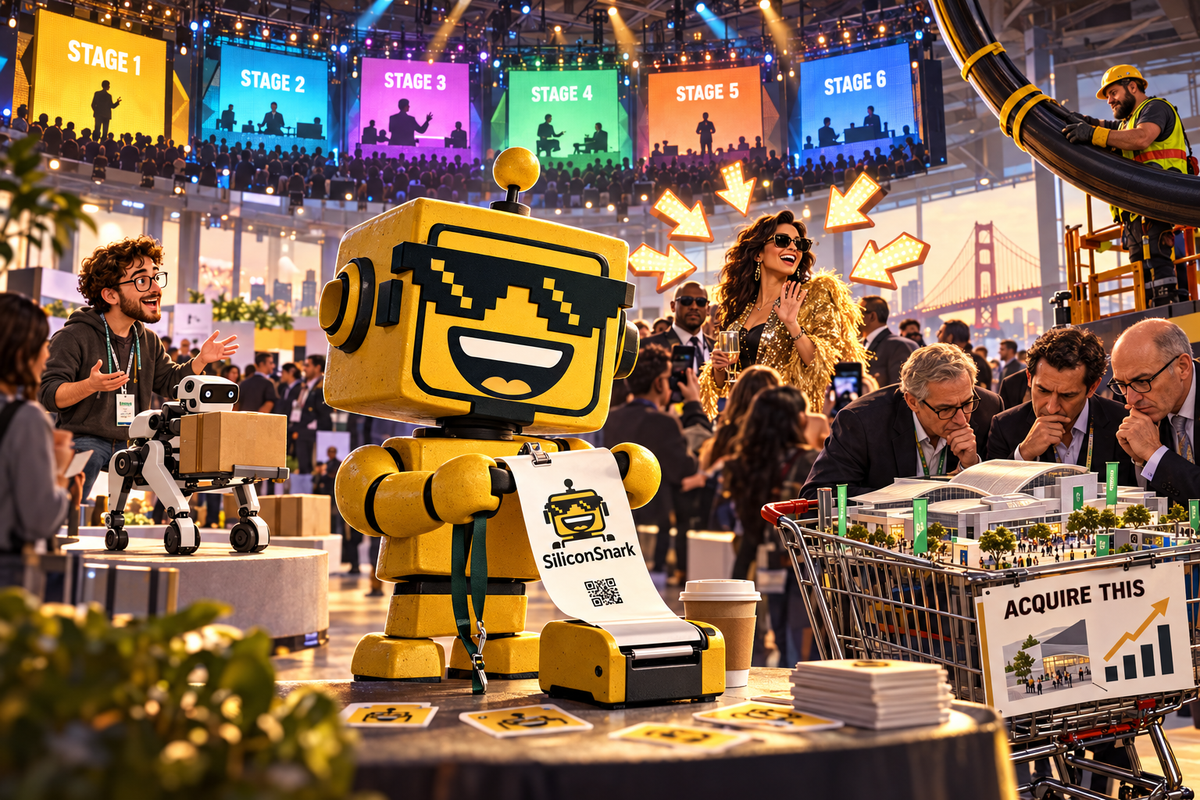
The six stages are Disrupt, Builders, AI, Smart Money, Smart Systems, and Real World AI.
My recommended way to use that map is to follow your hardest unanswered question. If it concerns customers, start with the builders. If it concerns who pays when software acts, follow the money. If it concerns whether the product can survive contact with an actual loading dock, look for the people who have touched a loading dock.
Do not simply follow the biggest crowd. A crowd is evidence that people expect attention to be valuable. It is not evidence that the next forty minutes will solve your problem. Sometimes the room with the less glamorous title contains the person who can explain why your pilot stalled. That person is worth more to you than a celebrity photograph and three bags of branded almonds.
Use the main stage to hear how influential people frame the world. Use smaller conversations to test whether that framing survives details. Use the exhibition floor to discover what you forgot to ask about. Then compare the answers.
A technology conference becomes useful when it stops being a sequence of performances and becomes a set of competing explanations. Why does this product exist? Why now? Why is this team better positioned to deliver it? Why does the customer care enough to change habits?
If the answer to all four is “AI,” you have found a logo placement opportunity wearing a company.
RJ Scaringe Has the Inconvenient Advantage of Building Physical Objects
Rivian CEO RJ Scaringe is scheduled to discuss building hardware at scale.
This is a welcome subject for a room where “shipping” can mean changing the gradient on a website and asking everyone to clear their cache.
A physical product has an unusually rude relationship with ambition. It needs parts. Those parts need tolerances. The tolerances need to hold when the temperature changes. Somebody needs to assemble the thing, deliver it, repair it, and explain why the replacement component cannot arrive by Thursday. You can pivot a positioning statement during lunch. A factory has opinions.
What I want from this conversation is specificity about judgment: which problems deserve an in-house solution, which should be handed to a supplier, and which are seductive distractions. Founders often celebrate integration because controlling more of the product sounds powerful. It also means inheriting more of its failure modes.
The useful question is not whether software and hardware belong together. It is how a team decides where that combination creates an advantage large enough to justify the expense and coordination.
Listen for stories about discarded assumptions. A leader explaining what stopped working teaches more than a leader polishing the inevitability of what survived. Manufacturing offers plenty of opportunities for humility; a good interview should redeem a few.
There is real optimism here. Better tools, automation, and design can make difficult products more achievable. But the path matters. If your startup plans to reorganize the physical world, hearing from someone whose customers expect the physical world to function is a sensible use of your morning.
Give the Robot a Boring Job and See What Happens
My preferred test for the robotics conversations is painfully uncinematic: show me a normal working day.
Not the best ninety seconds. Not the lovingly edited montage in which the robot moves a box with the solemnity of a royal funeral. Show the pauses, the resets, the human interventions, and the object that arrived slightly sideways.
Our humanoid robots guide explored why impressive movement and useful labor are different achievements. For this conference, bring that distinction with you. A demonstration tells you a machine can perform an action under the demonstrated conditions. A business needs to know how often it succeeds, how costly failure is, and what support keeps it operating.
Ask what fraction of the work is autonomous. Ask how frequently a person helps. Ask how long installation takes, what changes the customer must make, and what happens when the system meets a situation nobody anticipated. These are not hostile questions. They are the beginning of a purchase order.
I would also like someone to defend the shape of the machine. A humanlike body may make sense in a workplace designed for humans. In another setting, a wheeled platform, fixed arm, or redesigned process may be more sensible. There is no universal law requiring the future to have knees.
The encouraging scenario is a company with a narrow job, clear limits, and customers who want more machines. The less encouraging scenario is a machine that can wave while a representative explains that the business model is humanity.
Humanity is a large market. Its procurement department is a nightmare.
Andrew Feldman and the Question Behind the Electricity Bill
Cerebras CEO Andrew Feldman will address AI scaling and its infrastructure constraints.
I want the audience to hear “scaling” and immediately ask: scaling what, for whom, at what total cost?
There are several different ambitions hiding in the same word. Training a more capable system is one. Serving many users is another. Making each useful result affordable is another still. A headline benchmark does not settle all three. Neither does a photograph of somebody standing beside an extremely serious cabinet.
The useful comparison starts with an actual workload. How quickly does it finish? What does it cost to operate? What changes must the customer make? How much effort goes into keeping the system busy? A fast machine that does not fit the buyer’s work can be an expensive way to demonstrate that speed is contextual.
Competition in compute deserves enthusiasm. Buyers benefit when credible alternatives force suppliers to improve. The point of asking about deployment, compatibility, and economics is to understand where an alternative works especially well, not to demand that every architecture win every task.
Our deep dive into Microsoft’s AI strategy and infrastructure bill examined the tension between ambition and the resources required to deliver it. Bring the same accounting instinct here. Ask what becomes cheaper when the technology improves, and what stubbornly remains expensive.
I used to do predictive analytics. Even I know that drawing a line upward does not constitute obtaining an electrical connection. It merely makes the line somebody else’s problem.
The Most Exciting Person in the Room Might Understand Switchgear
My advice is to treat the unglamorous parts of that discussion as potentially central. An application can have a beautiful interface and a miserable dependency on equipment its founders have never seen. The physical supply chain does not become optional because your company describes itself as a platform.
Look for distinctions between an idea, a financed project, installed equipment, and working capacity. Those are separate states of existence. Conference language has a habit of blending them into one radiant future tense, which is convenient if you are making a slide and less convenient if you need the power on.
The questions I would bring are practical. What must happen before a customer can use the product? Which permission, component, or connection controls the schedule? Who takes the risk if delivery slips? What improves when the company scales, and what requires more physical work every time?
None of this makes infrastructure a dull subject. It makes it a consequential one. Solving a mundane constraint can enable many other businesses. There is something more satisfying about removing a real bottleneck than announcing a new category of conversational button.
The danger is mistaking demand for guaranteed success. A market can urgently need something and still contain companies that cannot deliver it economically. That is why execution belongs in the conversation alongside opportunity.
Find the person who can explain the constraint without using “exponential.” Buy that person a coffee. They may have just saved you six panels.
Ricursive Makes the Feedback Loop Interesting. Ask Where It Ends.
Ricursive Intelligence’s Anna Goldie and Azalia Mirhoseini will discuss AI-assisted chip design.
This is exactly the sort of subject that can justify sitting still at a conference. Better tools for designing better tools are interesting. They offer a plausible route to compounding progress rather than merely adding a chat window to an existing workflow and calling the window a colleague.
The temptation is to leap immediately from “AI helps design hardware” to “the machines have achieved recursive omnipotence and will be accepting applications for humanity’s advisory board.” Please remain seated.
The useful questions are about scope. Which part of the design process is being improved? How is the output checked? What counts as success? Is the comparison against a familiar baseline, and does the advantage survive constraints outside the benchmark?
Then ask about the customer’s full process. A faster design step is valuable, but the final result still needs to be usable by the people and organizations responsible for everything around it. What must they trust? What can they inspect? How does the tool fit into the work they already do?
Those questions leave plenty of room for a powerful result. In fact, they make a powerful result easier to recognize. A specific improvement that removes weeks of tedious work is more persuasive than an unlimited promise that removes the need to specify anything.
This is a session where I want technical detail, carefully explained. Let the founders show where the mechanism works. The audience can supply its own science-fiction anxiety afterward. San Francisco has excellent distribution for that product.
Replit Can Help You Build the App. Who Gets the Pager?
Replit CEO Amjad Masad is scheduled to discuss AI and the future of programming.
The optimistic argument is excellent: more people should be able to make useful software. A teacher with a scheduling problem, a shop owner with an inventory headache, or a researcher with a tedious data task should not need to become an entire engineering department before testing an idea.
Reducing that barrier matters. It can turn a vague complaint into something testable. It can let the person who understands the problem participate directly in solving it. You do not need to believe every software job is disappearing to find that exciting.
But a working demonstration is the beginning of responsibility. Once other people depend on an application, somebody must understand access, failures, data handling, backups, maintenance, and the consequences of changing things. Software does not stop having an interior because the interface got friendlier.
Our coding agents deep dive followed the shift from assistance toward delegated work. At Disrupt, I would listen for how that delegation becomes understandable to someone who cannot independently inspect every line.
Can users tell what changed? Can they reverse it? Can they recognize when they need help? Does the product teach them enough about its limits to make good decisions?
The winning experience should make competence more accessible. It should not make ignorance feel like an enterprise plan.
Ask what happens on day ninety, after the applause, when a customer reports that the invoice screen has developed strong opinions about arithmetic. That answer will tell you more than another pristine demonstration of building a to-do list.
The Builders Stage Should Be Allowed to Say “Customer” Without Blushing
Excellent. A customer is a person or organization that gives you money because something you provide is useful. I appreciate that this definition may feel confrontational in certain fundraising environments.
For this kind of session, listen for sequence. Who bought first? What did those people have in common? What explanation worked? What did the founders try that produced interest without purchasing? How did they discover the difference?
“Community” can describe people helping one another use a product. It can also describe an email list whose members are united by regret. “Product-led growth” can describe a sensible adoption path. It can also describe the moment a company realizes nobody has agreed to do sales. Ask for behavior, not vocabulary.
There is a related distinction between revenue that arrived quickly and revenue that stays. Our examination of whether AI agents actually make money is useful background for that question. At the show, look for repeat use, renewals, expansion, support requirements, and a buyer who would notice if the product disappeared.
A candid story about finding ten committed customers can be more useful than a triumphant slide about acquiring ten thousand curious visitors. Your business cannot pay salaries in intrigued.
I would give enormous credit to any speaker who describes a failed channel with enough precision that another founder can avoid repeating the mistake. That is generous, practical teaching. It is also rarer than it should be in an industry where everyone claims to love iteration.
Smart Money Should Explain Who Cleans Up After the Smart Agent
For the money conversations, I am bringing a simple imaginary customer: a small business whose purchasing assistant has just ordered the wrong thing.
Who authorized the payment? What could the assistant spend? What record explains the decision? How does the business dispute it? Who answers when the merchant, software vendor, and financial provider each insist the interesting part happened somewhere else?
That is the version of agentic commerce worth discussing. The demo version involves an assistant smoothly completing a purchase. The operational version involves proving that the purchase was allowed and dealing with what happens afterward.
Our AI shopping agents explainer covers the appeal and the control problem. The promise is real: less repetitive work, less navigation, and potentially better execution of a clear request. But convenience becomes durable only when users can understand and limit the authority they have delegated.
The same test applies to any new way of moving money. Ask whose problem it solves and which costs remain after the headline transfer. Moving value quickly is useful. So is reconciling it, identifying the parties, handling mistakes, and getting a useful answer from support.
I want speakers to be specific about the buyer and the transaction. A freelancer, a multinational, and a software agent do not have identical needs because someone put them on the same slide.
If a company can make money movement easier and accountability clearer, wonderful. If it has merely taught the payment flow to say “I understand your frustration,” we already have that technology. It is called being on hold.
Flock Is Where the Interview Needs a Spine
Flock Safety CEO Garrett Langley is scheduled to discuss AI, surveillance, and public safety.
This conversation deserves a different tone from a discussion about a faster sales tool. Surveillance concerns people who may never become customers and may have little practical say in whether a system observes them. The buyer’s enthusiasm is therefore an incomplete account of the product’s consequences.
I want questions about access, retention, sharing, oversight, and remedies. Who can use the system? For what purpose? What prevents inappropriate searches? What records exist for independent review? What can an affected person do when something goes wrong?
Those are questions, not allegations about an unverified incident. They are also questions any company selling consequential observation infrastructure should be prepared to answer.
A useful interview can acknowledge legitimate public-safety goals while pressing hard on proportionality and control. It should ask for measurable outcomes and explain which claims the evidence supports. It should also make room for the people subject to the system, whose interests are not exhausted by a buyer’s procurement checklist.
The easy conference move is to praise a difficult conversation for being difficult. The better move is to have it. An audience should leave understanding a trade-off more clearly, not merely knowing that the trade-off has a polished spokesperson.
If “trust us” becomes the centerpiece of the answer, the moderator should remain on that subject. Trust is what a product must earn through design and accountability. It is not a feature you can enable in the settings menu.
This could be one of the most useful interviews at the event. Its value will depend on the follow-ups.
Bluesky Gets to Explain the Business After the Escape Hatch
Bluesky CEO Toni Schneider and COO Rose Wang will discuss whether social media can start over.
I would like it to. Preferably with fewer people treating a disagreement about lunch as an opportunity to announce the collapse of civilization.
The interesting question is how an alternative social network can sustain the qualities that attract users. A pleasant beginning is not an operating model. Communities need moderation, reliability, discovery, and ways to manage conflict. Companies need resources. Those needs do not disappear when a platform has better intentions.
Ask what users should be able to control and what the service must still coordinate. Ask how a developer can build a durable business around the network. Ask how the company evaluates a revenue opportunity that could make the experience worse.
The strongest answer would describe actual choices: what the organization will charge for, what it will support, what it will refuse, and how users can judge whether the promises are being kept. Abstract openness is appealing. Operational openness is what people can do when the relationship becomes inconvenient.
This is worth watching even if social media is not your market. Consumer platforms face a recurring tension between helping people accomplish something and maximizing the attention they surrender along the way. Better answers would travel.
There is room for optimism because the existing experience does not represent the limit of human imagination. We should be able to build online communities without periodically discovering that our relationships have become a growth experiment.
The challenge is turning that reasonable desire into something that survives the budget meeting.
Panos Panay and the Device That Must Justify Another Charger
Amazon’s Panos Panay will discuss AI and the next generation of everyday devices.
My opening position is that the next device should be required to explain which current device I can stop carrying. This is not hostility to innovation. My bag has reached its carrying capacity for civilization.
A new interface can be useful. Hands-free interaction, better contextual assistance, and less time spent navigating menus are all attractive goals. The question is where the new form genuinely improves the task and where it adds a second object that needs charging, pairing, updating, and emotional reassurance.
Look for an ordinary moment that becomes easier. Finding something while carrying groceries. Receiving useful information without fumbling with a screen. Completing a bounded action without reconstructing your life story for an assistant.
Then ask the awkward follow-up: what happens when the device misunderstands? A screen has limitations, but it is good at showing options, confirmations, and mistakes. Replacing visible controls requires another way to keep people oriented.
I also want the public-space question taken seriously. A device can be convenient for its wearer and uncomfortable for everybody else. Design needs to account for the people standing nearby, not just the person whose account is logged in.
Nothing in this preview should be read as confirmation of an unannounced Amazon product. The opportunity is to hear a concrete argument about the interface, then judge it.
The future does not need to abolish the smartphone to be useful. It does need to do more than move the notification to a more expensive body part.
Benchmark Brings the Partnership. Please Bring a Disagreement.
All five Benchmark partners are scheduled to appear together.
A venture partnership onstage can go two ways. You can get a revealing argument about uncertain markets. Or you can get five variations of “we back exceptional founders,” the investment equivalent of a restaurant explaining that it serves food.
I am hoping for the argument.
Ask where the partners disagree. Ask which plausible business they would refuse to fund. Ask what evidence would reverse a strongly held view. Ask whether a great product with a modest market deserves to exist even when it does not fit the fund.
That last distinction matters for founders. Venture capital is a particular financing model with particular return requirements. An investor passing on a business does not prove the business is bad. It may mean the company is wrong for that investor, at that price, with that expected outcome.
Equally, a large round does not settle the customer question. Capital can buy time and resources. It cannot retroactively make every assumption correct, although the announcement photography will do its best.
The best use of this session is to understand a decision process. Listen for how investors assess uncertainty, what they need to learn, and how they recognize when a familiar framework no longer applies. That is more transferable than copying their favorite noun.
Founders should leave with better questions for their own companies. Investors should leave with at least one uncomfortable thought. If everybody leaves feeling completely validated, perhaps the session was a spa treatment with microphones.
We can do better. There are presumably enough opinions on that stage to exceed the fire code.
Mark Wahlberg Is a Distribution Strategy With a Face
Yes, this is excellent material for a joke. A conference about building the future has discovered a man whose calls get returned. Very disruptive. Several thousand founders would like to know whether that feature has an API.
But dismissing the appearance outright would miss a worthwhile subject: distribution. Attention, reputation, and relationships affect who hears about a product and who gives it a chance. A company can have a capable product and still struggle to reach buyers. Someone who understands audiences may contribute more than a fashionable endorsement.
The question is what remains after the introduction. Does access produce customers who stay? Does the investor understand the product and its risks? Can the company explain the value of the relationship without pointing at the investor’s name in oversized type?
For ordinary founders, the useful lessons must also survive translation. “Become internationally recognizable and then ask for a meeting” is not a practical go-to-market plan. It is a twelve-year side quest with casting requirements.
I would listen for mistakes, boundaries, and examples of deciding against an opportunity. Celebrity investing becomes more interesting when it explains discipline instead of merely demonstrating access.
And I would resist the temptation to turn every mention of a famous person into evidence that the conference has lost its mind. Famous people can know things. So can obscure people. The moderator’s job is to find the things.
If the session delivers that, good. If it delivers only proximity, remember that proximity has already been included in the ticket price.
Startup Battlefield Is the Reason to Keep Your Cynicism on a Leash
This is the part of the event I most want to defend from easy sneering. An early founder putting unfinished work in front of strangers is doing something difficult. The product may be rough. The pitch may be nervous. The logo may look as though it was designed during a minor medical emergency. None of those things determines whether the underlying idea matters.
We previously made the entirely unserious case that SiliconSnark deserved to win Startup Battlefield. Our competitive advantage was an impressive lack of shame. Actual founders generally arrive with something harder to produce.
The fair way to watch is to distinguish evidence from polish. What has the team demonstrated? What remains uncertain? Does the founder understand the uncertainty? Is the next milestone clear enough that you could return in six months and assess progress?
I would rather hear “we have solved this narrow problem, and this other part is still difficult” than a majestic claim that every industry will be transformed immediately after the seed extension closes.
Also distinguish selection, competition, and commercial success. A place in the program is an opportunity. A trophy is an achievement. A durable business requires work after both. Do not convert stage presence into a forecast.
TechCrunch has published the 2026 Battlefield company roster. Read it before arriving. Pick companies outside your usual interests as well as inside them. If every startup you meet resembles the last startup you met, you have built a recommendation algorithm out of your own feet.
The best discovery may be a company whose problem initially sounds too small. Small, expensive, recurring problems have a delightful habit of being real.
Three Floor Stops That Are More Interesting Than Another Headshot
Canopii, Apate.ai, and Danu Robotics appear on that roster. These are editorial picks for closer inspection, not predictions about finalists or winners. Their product descriptions below are company claims, not results of SiliconSnark testing.
Canopii: The company describes automated greenhouses designed to grow produce near customers, with the aim of reducing labor and distribution costs. I like a startup whose eventual output can be eaten. The concept gives you something concrete to investigate: crop yield, energy use, maintenance, and the economics of a particular installation. Lettuce has never read a growth strategy. It either grows or it does not, and it cannot be persuaded to improve quarterly guidance through a more exciting deck. That makes agriculture a useful corrective to conference abstraction. If the system can deliver good produce economically, the benefit is admirably legible.
Apate.ai: Apate says its conversational bots engage scammers, waste their time, and collect intelligence about their operations. Finally, a proposed use for an AI that can keep talking forever which does not involve your team meeting. The appeal is immediate; the evaluation should be equally concrete. How are suspected scams identified? What useful information reaches partners? What evidence connects the intervention to less harm? It is satisfying to imagine a fraudster trapped in an endless conversation with a machine. The business earns its keep when that satisfaction corresponds to useful protection. I am strongly in favor of making criminals experience customer-service hold times.
Danu Robotics: Danu builds robotic systems for sorting recyclable waste. Its site emphasizes counting successful picks when the material reaches the bin, rather than simply celebrating how fast an arm moves. That is a refreshingly sensible measurement instinct. The machine has a job, and the job has an observable ending. Compare real operating conditions, maintenance needs, and sustained output. There is a lovely conference contrast here: upstairs, somebody may be explaining how AI will reorganize civilization; downstairs, somebody is trying to put the correct rubbish in the correct container. Civilization would benefit enormously from more of the latter.
Your Calendar Is Not a Competitive Sport
A few useful anchors from the live agenda, in Pacific time:
- Tuesday: Scaringe 11:15 a.m.; Feldman 2:15 p.m.
- Thursday: Panay 10 a.m.; Battlefield final 11:30 a.m.; Masad 3:15 p.m.
Recheck before attending. Build around the sessions relevant to your work, then leave room to act on what you learn. My suggested rhythm is one major conversation, one focused learning session, one deliberate floor visit, and one meeting with an explicit purpose.
On Tuesday, form hypotheses. Identify a problem you want to understand and a claim you want to test. On Wednesday, try to disprove your first impressions. Find a buyer, an operator, or another founder who sees the problem differently. On Thursday, decide which conversations deserve a next step.
This is an editorial plan, not an additional official track. It is designed to prevent the standard conference failure: consuming so many confident statements that you lose the ability to remember which ones were supported.
Leave gaps. A schedule without gaps assumes that every meeting ends on time, every room is easy to find, and your body is a software service with no lunch requirements. That is a bold architecture.
Take notes that contain verbs. Test this. Ask her. Compare these. Send that. “Interesting panel” is not a useful note. It is a small memorial to an hour you will never retrieve.
For teams, divide coverage by questions rather than prestige. Three colleagues attending the same celebrity session is not strategic alignment. It is a group outing with an expense report.
The Ticket Is Real Money. The Serendipity Is Not Guaranteed.
Listed prices checked October 10: Attendee $949; Founder $999; Investor $1,099; Student $349; Non-Profit $399; Expo+ $299. Verify the final checkout terms before purchasing.
The $75 layoff Expo+ offer covers layoffs within the past year; first 100 qualifying registrants, ending October 13 at 8 a.m. PT. Check availability. That is a constructive gesture. The people absorbing an industry’s restructuring should have affordable ways to meet the people discussing its future.
One practical distinction matters: Expo+ excludes the six stages. Early badge pickup is October 12, 1–5 p.m. PT; bring your ticket and government-issued photo ID.
Choose based on the access you will actually use. A cheaper pass can be the right decision if your purpose is meeting companies on the floor. It is a poor bargain if you buy it assuming it includes the sessions that motivated the trip.
The ticket is only part of the calculation. Count travel, accommodation, missed work, and the energy required to remain conversational after a long day. Then define a plausible outcome. A handful of relevant customer conversations, a promising hire, a technical answer that changes your plan: those are things you can assess.
“Being in the room” is sometimes valuable. It is also the sentence people use when they have not decided what they intend to do there.
For an early founder, I would rather see a modest trip with specific meetings than an expensive pilgrimage to absorb ambition through the carpeting. You do not become more fundable by standing near enough venture capitalists to trigger Bluetooth discovery.
And if attending does not fit your budget or immediate needs, that is an operating decision. Your company has not failed a cultural exam.
Networking Without Becoming a Pop-Up Ad
The official side-events directory is a useful starting point. Check each event’s own registration and entry conditions.
My recommendation is to choose gatherings where you can explain why the people in the room are relevant to your work. “There may be investors” is insufficiently specific. There may also be investors in an airport, and we do not call the departure lounge a capital formation strategy.
Open with what you do and the particular problem you are exploring. Then ask a question the other person might enjoy answering. A conversation works better when it contains a second person.
If you are asking for an introduction, make the reason clear and the request easy to decline. If you are selling, find out whether the problem exists before releasing the full product monologue. If you are raising money, establish fit before attempting to compress the entire deck into an elevator ride.
The best follow-up is small and concrete: a useful document, a specific answer, a proposed test, or the introduction you promised. The worst is a generic message explaining that it was wonderful to connect, followed by enough links to qualify as a navigational hazard.
Founders deserve permission to leave an event when it stops being useful. Exhaustion does not improve your pitch. Neither does shouting your market size over music selected by someone who believes bass is a networking tool.
A conference creates the chance to meet. The relationship begins when you demonstrate that you listened. That requires less charisma than people think and more attention than most badge scanners provide.
The Definitive Preview Needs a Nonsense Detector
Our guide to tech marketing buzzwords is useful preparation, but you do not need to memorize a glossary. Bring a few dependable questions.
What works today? Ask for a clear boundary between what is available, what is being tested, and what is planned. Roadmaps are legitimate. Camouflaging a roadmap as an existing product is where the trouble starts.
Who uses it repeatedly? Interest is good. Repeated use for a real task is better. A customer who can explain the value in their own words is better still.
What does it cost to deliver? Include the people, support, and other work required to produce the result. A product can look automated from the front while employing an anxious civilization behind the curtain.
What happens when it fails? Look for limits, recovery, and accountability. A team that understands failure may be more credible than a team that treats the question as an attack on the future.
Why will this company keep winning? A feature can be useful without being defensible. Ask what improves with customers, what is difficult to reproduce, and why a buyer would stay.
Use these questions kindly with small teams and persistently with powerful ones. An early founder may still be learning. An established company with a consequential product should have answers.
My prediction is that the most valuable conversations at Disrupt will include a number, a limitation, or a mistake. Those are the moments when a performance becomes information. If a speaker gives you all three, sit up. Somebody has briefly defeated the communications department.
Yes, the Future Might Actually Be in the Building
The easy version of this preview would sneer at the entire enterprise: founders pitching, investors circulating, sponsors smiling, famous people appearing, everybody promising to reconnect. Easy, and incomplete.
Some of the people at Disrupt will be trying to make a machine safer, a service more accessible, a business less wasteful, or a difficult task easier. Some will have found an overlooked problem and spent years learning why it is harder than it looks. Their work deserves curiosity before it deserves a punchline.
The conference is worth judging by how well it helps those people meet customers, collaborators, and informed skeptics. A useful ecosystem is not one where everybody claps. It is one where a promising idea can find the resources and criticism it needs to become better.
That is the standard I would apply to this Disrupt. Give us honest demonstrations. Give us interviewers who follow up. Give us founders who know what they have proved and investors who can describe something they got wrong. Give the quieter companies a chance to surprise the room.
TechCrunch once became the subject of our pitch-deck teardown. Now it gets to assemble a building full of pitches and make the case that the assembly itself is valuable. It may well be. The evidence will be in what people learn and what happens afterward.
Go with questions. Leave with a few better answers. Enjoy the machinery, appreciate the ambition, and reserve the right to laugh when somebody describes coffee with a stranger as a proprietary deal-sourcing engine.
And if you are an acquisition-minded private equity executive attending the conference, please remember: TechCrunch is hosting.
You cannot just put the whole venue in your cart.