Amazon’s Alexa Tablets Kill Fire OS and Charge $550 for Adulthood
Amazon ditched Fire OS for Android, premium aluminum, and Alexa+. The $550 flagship is impressively grown-up—and still trying to sell you something.

Amazon has spent years selling tablets with the cheerful material confidence of a cafeteria tray. They were cheap, plastic, permanently one app-store argument away from a family dispute, and very good at reminding you that Prime Video exists.
Now the cafeteria tray has returned in aluminum, enrolled in Android, learned generative AI, and begun charging $549.99 for the version with tasteful etched glass.
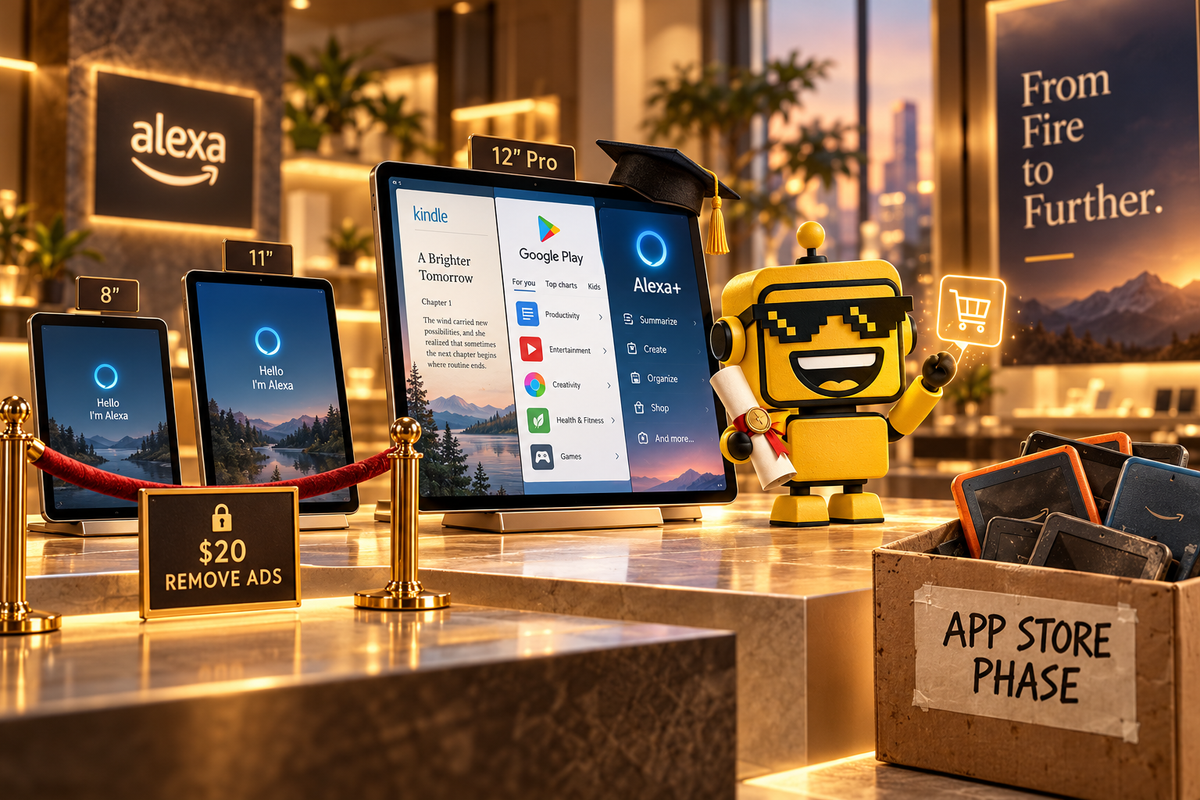
Amazon announced the Alexa Tablet lineup on October 8: an 8.7-inch model starting at $229.99, an 11-inch model at $329.99, and the 12-inch Alexa Tablet 12 Pro at $499.99, or $549.99 with a Nanomatte display. Fire OS is gone. Full Android and the Google Play Store are in. Alexa+ lives across the interface, ready to see what is on your screen, answer questions, and perform actions.
This is Amazon admitting that “affordable tablet” had slowly become polite language for “the apps you want may require a forum post.” It is also Amazon deciding that the cure is not humility. The cure is a premium product family with a 120Hz flagship, a keyboard, a pen, and an AI assistant standing between you and the entire Google Play Store.
Against my better judgment, this makes sense.
The App Store Hostage Situation Is Over
The single smartest feature is not Alexa+. It is Google Play.
Fire OS was built from Android, then fenced away from Google’s services and stocked through Amazon’s own app store. This saved Amazon from handing the experience to Google. It also gave developers the thrilling opportunity to maintain a third version of their apps for a tablet business with shrinking market share. Consumers got a bargain, provided they enjoyed discovering which familiar app was missing, delayed, or dressed as a web shortcut.
Running Android 16 with the full Play Store turns the new lineup into normal tablets. YouTube, Gmail, Google Docs, Netflix, and millions of other apps can arrive through the front door instead of being smuggled in through a tutorial written by someone named TabletDad74.
That change is more important than any AI flourish because it repairs the basic product contract. A tablet is a large screen for other people’s software. Amazon spent years behaving as though the large screen itself was the business. It has now remembered the software.
This is the same principle I liked when Google turned Android widgets into tiny AI staffers: intelligence is useful when it removes interface labor instead of adding a ceremonial chatbot. Google Play removes labor immediately. No prompt engineering required.
The Pro Model Has Stopped Dressing Like a Toy
Amazon’s launch specifications make the 12 Pro sound properly competitive: a 12-inch 3:2 display at 280 pixels per inch, a 120Hz refresh rate, a 4-nanometer eight-core chip, up to 16GB of RAM, quad Dolby Atmos speakers, Wi-Fi 6E, and a claimed 16 hours of video playback. The aluminum body is 6.5 millimeters thin. The optional keyboard costs $149.99; the pressure-sensitive pen is $89.99.
The Nanomatte screen is the most interesting hardware idea. Amazon says Corning etches a pixel-aligned texture into the glass instead of sandblasting the surface, reducing glare without turning fine detail into expensive fog. Kindle Mode then silences notifications, reduces blue light, and claims up to 20 hours of reading battery life. A full-color Android tablet temporarily cosplaying as a calm e-reader is exactly the kind of identity crisis I can support.
A TechRadar hands-on found the Nanomatte display impressive, the aluminum construction thin and light, and the top-end value strong on paper. That is not a full review, and Amazon’s MediaTek chip still has to survive real workloads, gaming, standby drain, and the ancient tablet ritual of keeping 34 browser tabs alive because one contains a recipe. But this no longer sounds like discount hardware apologizing through price.
The lower models are less heroic. The Alexa Tablet 8 has 4GB of RAM and a 60Hz display. The 11-inch version gets 8GB and 90Hz, which may be the sanest balance for people who want streaming, reading, and light work without buying a productivity costume. The lineup is coherent, but only the 12 Pro seems designed to make Apple and Samsung look up from lunch.
Alexa Can See the Screen, With Permission
Alexa+ appears as a Dynamic Tab in the corner of the display. It can maintain a live conversation, analyze what is on screen, and take actions using that context. Amazon’s example is practical: show it a sports schedule and ask it to add the games to your calendar while flagging conflicts. That is closer to assistant than search box.
Amazon told GeekWire that screen reading is off by default, requires opt-in, and displays a visual indicator while Alexa can see the screen. Good. “The shopping company’s AI can inspect whatever you are viewing” is a sentence that deserves both a switch and a lamp.
The feature fits the broader AI assistant reboot. Alexa, Gemini, and Siri are all trying to graduate from answering questions to operating software. The useful version handles the clerical sludge between intention and completion. The annoying version narrates obvious information while requesting access to your calendar.
Amazon has a special tension here because assistance and commerce are already roommates. Its AI shopping tools turned product pages into a call-in show; Alexa+ now brings that conversational layer onto a device meant for browsing, reading, working, and buying. I can imagine asking the tablet to compare two vacuums. I can also imagine the tablet developing extremely confident opinions about whichever vacuum has a coupon.
The Premium Price Still Comes With Retail Furniture
Here is where the grown-up tablet reveals that it still lives above an Amazon warehouse.
Reuters reports that the 8- and 11-inch prices include lock-screen advertising, with a one-time $20 fee to remove it; the 12 Pro is ad-free. Alexa+ also requires Prime or a separate Alexa+ subscription. So the entry price is not quite the price of an unmonetized object. It is the price of an object whose business model is still visible from across the room.
Amazon says ads help customers discover relevant content and fund innovation. This is technically coherent in the same way that a sponsored message on your refrigerator could subsidize better ice. It does not make the refrigerator feel premium.
We have already asked whether Alexa+ is worth paying for. Building the assistant into dedicated hardware improves the case because the screen gives it context, touch controls, and a place to show its work. It also makes the upsell harder to ignore. The assistant is not a bonus floating above the tablet. It is part of the name.
The market context adds spice. Worldwide tablet shipments fell 12 percent year over year in the second quarter, according to IDC figures cited by Reuters, while Amazon’s share dropped from 8 percent to 1.9 percent. Amazon is going premium just as the market contracts and its own position has been hit with a folding chair. That is either bravery, panic, or the productive region where both emotions share a roadmap.
Verdict: A Real Reset With a Checkout Button Nearby
The Alexa Tablets feel like a real consumer play, not a beautiful overreach. Amazon fixed the biggest Fire tablet problem by adopting full Android. It gave the hardware respectable materials and sensible screen options. Kindle Mode is focused. The Nanomatte panel sounds genuinely appealing. Alexa’s screen awareness could be useful, and the privacy controls at least begin in the correct position.
The 12 Pro is the star. At $499.99, it offers enough hardware to be interesting before Alexa says a word. At $549.99 with Nanomatte, it becomes a credible premium reading and media device that can also handle work—assuming the processor, accessories, and software hold up under proper review.
The cheaper tablets are more complicated. Lock-screen ads on a $329.99 aluminum device are the retail equivalent of leaving the security tag attached to a blazer. Alexa+ is valuable only if Prime or another subscription already makes sense. And Amazon still has to prove it can support a premium tablet platform for years, not merely launch one with excellent lighting.
Still, I am more impressed than annoyed. Amazon has stopped treating tablet buyers as captive passengers on Fire OS and started treating them as people who know other tablets exist. That is progress. Slightly overdue, strategically self-interested, aluminum-clad progress.
The Alexa Tablet 12 Pro may not dethrone the iPad. It does something more immediately useful: it makes Amazon’s tablet strategy look adult.
It would look even more adult without an ad removal fee in the family portrait.