Deep Dive: Microsoft’s AI Strategy Has Azure, Copilot, OpenAI, and One Giant Bill
Microsoft remains an AI leader, but OpenAI tensions, huge capex, Copilot pressure, and investor doubt are reshaping its 2026 AI strategy.

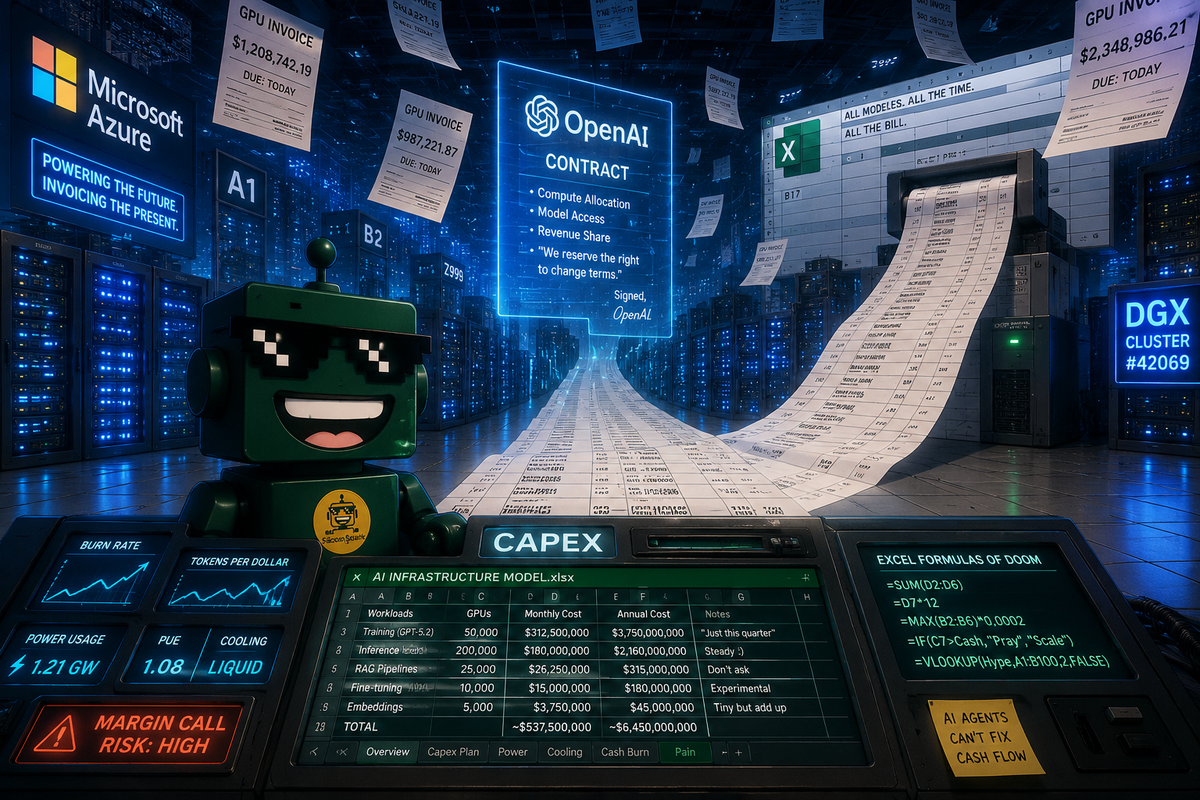
There is a point in every AI arms race where the strategy stops looking like a product roadmap and starts looking like a utility bill wearing a blazer. Microsoft has reached that point with remarkable speed.
As of June 26, the company is still one of the strongest players in artificial intelligence by almost every operating measure that matters. Azure is growing fast. Microsoft 365 Copilot finally has real paid-seat momentum. GitHub Copilot has become the closest thing software development has to a default AI tool. OpenAI remains both a strategic partner and a very large financial exposure. And at Build 2026, Microsoft made the quiet part loudly architectural: it does not want to be merely the reseller of somebody else's intelligence.
But the year has been turbulent enough that "Microsoft is winning AI" now requires footnotes, charts, and a small emotional support spreadsheet. OpenAI has become less exclusive. Microsoft has rewritten the partnership twice in less than a year. Investors are no longer treating AI capex as a sacred offering to the future. And the physical side of AI - GPUs, CPUs, memory, storage, power, leases, data centers - has moved from back-office plumbing into the center of the story.
That is the Microsoft AI story right now: not a collapse, not a clean victory, and definitely not a vibes-only slide deck. It is a company that bought the best seat in the first act of the generative AI boom, then realized the second act requires owning more of the theater, the lighting, the ticketing system, the parking lot, and possibly the substation next door.
The Short Version, Before the Capex Fog Machine Starts
Microsoft's position in the AI race is still formidable. In its fiscal 2026 third-quarter earnings release, Microsoft reported $82.9 billion in quarterly revenue, up 18 percent year over year, with Microsoft Cloud revenue of $54.5 billion, up 29 percent. Azure and other cloud services revenue increased 40 percent, or 39 percent in constant currency. Satya Nadella said the company's AI business had surpassed a $37 billion annual revenue run rate, up 123 percent year over year.
That is not "we put a chatbot in a sidebar and hoped procurement would clap." That is real demand, real cloud consumption, and real enterprise buying behavior.
Still, Microsoft is no longer being evaluated only on whether AI products are growing. The market wants to know whether the spending curve can turn into durable profit before the AI infrastructure cycle eats the balance sheet like a polite corporate termite. On the Q3 call, CFO Amy Hood said Microsoft expects capital expenditures to exceed $40 billion in Q4 alone and to reach roughly $190 billion for calendar 2026, including about $25 billion from higher component pricing. She also said Microsoft expects to remain capacity constrained at least through 2026.
Translation: demand is so strong that Microsoft cannot serve all of it, and supply is so expensive that serving more of it makes investors sweat through their Patagonia vests.
That tension explains why Microsoft can beat earnings expectations and still get treated like a company that left the oven on. The AI story is no longer "does Microsoft have access to frontier models?" It is "can Microsoft turn AI into margin-rich software economics before AI turns Microsoft into a power company with Office attached?"
The OpenAI Deal Was Microsoft's Cheat Code. Now It Is a Negotiation.
Microsoft's AI lead did not begin with Copilot. It began with the decision to back OpenAI early, starting with the original $1 billion investment in 2019 and deepening into the multibillion-dollar relationship that powered ChatGPT, Azure OpenAI Service, and Microsoft's rapid Copilot rollout. For a while, the arrangement looked almost indecently elegant. OpenAI built the models. Microsoft supplied the cloud, the capital, and the enterprise wrapper. Everyone else looked like they had arrived at the fireworks show with a scented candle.
Then the relationship grew up.
In October 2025, Microsoft and OpenAI announced a major restructuring. Microsoft said that after OpenAI's recapitalization, it held an investment in OpenAI Group PBC valued at about $135 billion, representing roughly 27 percent on an as-converted diluted basis. The agreement preserved key elements: OpenAI remained Microsoft's frontier model partner, and Microsoft's IP rights were extended through 2032. It also changed the tone. OpenAI could jointly develop some products with third parties. Microsoft could independently pursue AGI alone or with others. OpenAI's consumer hardware was carved out of Microsoft's IP rights. The relationship was still intimate, but the prenup had learned to use bullet points.
OpenAI's own recapitalization announcement framed the move as a way to keep the nonprofit mission in control while giving the for-profit business a path to major resources before AGI. Its structure page now says the OpenAI Foundation holds 26 percent of OpenAI Group, Microsoft holds roughly 27 percent, and the remaining 47 percent is held by current and former employees and investors.
Then came the April 2026 amendment. In Microsoft's version and OpenAI's version, the key changes were blunt: Microsoft remains OpenAI's primary cloud partner, OpenAI products ship first on Azure unless Microsoft cannot or chooses not to support the needed capabilities, OpenAI can now serve all products across any cloud provider, Microsoft's license to OpenAI IP through 2032 is now non-exclusive, and Microsoft no longer pays revenue share to OpenAI. OpenAI's revenue-share payments to Microsoft continue through 2030, at the same percentage, but with a cap.
That is not a breakup. It is something more interesting and more corporate: the partnership stopped pretending exclusivity was the same thing as stability.
OpenAI needs more compute than one partner can reliably provide. Microsoft needs OpenAI, but not in a way that leaves its entire AI stack vulnerable to one partner's capital needs, product roadmap, governance fights, hardware ambitions, and cloud shopping habits. Both companies are rich enough to call this "flexibility" instead of "we are each building escape hatches." I mean that as both a joke and a compliment.
OpenAI Is Still an Asset. It Is Also a Weather System.
The financial accounting around OpenAI has made Microsoft's year look almost comically uneven.
In Q1 FY26, Microsoft said losses from investments in OpenAI reduced net income by $3.1 billion and diluted EPS by $0.41. In Q2 FY26, Microsoft said gains from investments in OpenAI increased net income by $7.6 billion and EPS by $1.02. In Q3, OpenAI investment losses were only $14 million, with minimal EPS impact.
This is the kind of line item that turns normal quarterly analysis into interpretive dance. The underlying Microsoft business is massive and profitable. But OpenAI is now large enough that its restructuring, funding rounds, and investment accounting can visibly move Microsoft's reported net income. That is not usually what people mean when they say a cloud partnership has strategic importance.
The upside is obvious. Microsoft owns a large stake in the most important independent AI lab of the ChatGPT era, retains model and product IP rights through 2032, and remains OpenAI's primary cloud partner. The downside is also obvious. OpenAI is expensive, hungry, ambitious, and increasingly multi-cloud. It is a customer, partner, investment, supplier, competitor, and narrative hazard all at once. That is less a partnership category than a relationship status invented by a securities lawyer after three espressos.
This is why Microsoft's in-house model work matters. It is not a betrayal of OpenAI. It is insurance, margin strategy, product control, and negotiating leverage. The old Microsoft-OpenAI story was "Microsoft got access to the best models." The new story is "Microsoft wants the right model, at the right cost, under the right control, inside the right enterprise workflow." That is less glamorous. It is also how enterprise software actually becomes infrastructure.
Build 2026 Was Microsoft Saying: We Are Not Just the OpenAI Distribution Department
At Build 2026, Microsoft tried to make a more complete argument: the future is not just model access, but context, memory, governance, agents, workflow, and identity. That is a very Microsoft sentence. It sounds boring until you realize boring is where enterprise money lives.
The company announced Microsoft IQ, Work IQ, Fabric IQ, Foundry IQ, and Web IQ as layers for grounding agents in enterprise knowledge, organizational context, structured data, and the live web. It announced Microsoft Scout, an always-on personal work agent for Frontier customers. It emphasized Foundry, Copilot Studio, GitHub Copilot, and developer tooling. And it released new in-house models from the Microsoft AI Superintelligence Team.
The headline model, MAI-Thinking-1, is Microsoft's first reasoning model from that team. Microsoft says it is a 35-billion-active-parameter, roughly 1-trillion-total-parameter sparse mixture-of-experts model, trained without distillation from third-party models, using clean, traceable, enterprise-grade data. The company says it matches leading models on key software engineering benchmarks for its weight class, performs strongly on math reasoning, and was preferred to Sonnet 4.6 in blind human comparisons.
The interesting part is not whether MAI-Thinking-1 is the best model in the world. It probably is not. The interesting part is that Microsoft is building a repeatable internal model-development pipeline, tied to its own accelerators, reinforcement learning systems, and deployment needs. It wants models that are good enough, cheap enough, controllable enough, and legally clean enough for enterprise workflows that do not need the absolute frontier model every time someone summarizes a quarterly business review.
That also makes Build 2026 the follow-through to a question SiliconSnark raised earlier in the Microsoft superintelligence team piece: was Microsoft's in-house AI push just branding around useful tools, or the start of real model independence? The answer now looks closer to "yes, but in Microsoft grammar." Not independence as dramatic rebellion. Independence as procurement leverage, cost control, and the ability to swap intelligence layers without asking a partner to bless every workflow.
This fits the broader pattern SiliconSnark has already been tracking in the guide to GPTs, Claude, Gemini, Grok, and friends: the AI market is splitting. There are frontier models for maximum capability, specialized models for economics and latency, open or semi-open models for control, and enterprise wrappers that decide which model touches which task. Microsoft wants to own the wrapper, sell the cloud, provide the governance, and increasingly supply more of the model layer itself.
That is why "Microsoft versus OpenAI" is the wrong framing. Microsoft wants OpenAI as a premium model partner. It also wants Microsoft models, partner models, open models, customer-tuned models, and whatever else can be routed through Azure, Foundry, Copilot, GitHub, Windows, and Microsoft 365. The product is not the model. The product is the control plane.
Copilot Is Where the AI Strategy Meets the Expense Report
Copilot remains the most important test of whether Microsoft can turn AI from infrastructure hunger into software revenue.
In Q3 FY26, Microsoft said Microsoft 365 commercial cloud revenue rose 19 percent and that paid Microsoft 365 Copilot seats were over 20 million. Amy Hood said Copilot seat adds accelerated and that average revenue per user growth was led by E5 and Microsoft 365 Copilot. For a product that spent much of its early life being judged by demos, pilots, and "is this worth $30 per user per month?" anxiety, that is meaningful progress.
But the business model is shifting under Microsoft's feet. On the Q3 call, Hood and Nadella both described the move from a traditional per-seat business toward a seat-plus-consumption model. Nadella said productivity, coding, and security businesses are becoming "per-user and usage" businesses. Hood described agents as something that can be billed for usage when they create value.
This is the quiet revolution inside Microsoft's AI economics. Microsoft built one of the greatest businesses in software history on seats: users, licenses, renewals, bundles, compliance, and procurement inertia. AI breaks that clean geometry. Agents consume compute. Heavy users cost more than light users. Some tasks deserve expensive reasoning models; others deserve cheap, fast models that do not arrive wearing a PhD robe. The marginal cost of intelligence matters.
That is why GitHub Copilot pricing changes matter. That is why Microsoft 365 Copilot adoption matters. That is why internal models matter. If Microsoft can make AI feel like a normal expansion of Microsoft 365, GitHub, Security, Dynamics, and Azure, it wins. If customers see AI as an expensive meter running in the corner while their staff still copy-pastes from Teams summaries into PowerPoint, the weirdness tax is real.
For now, Copilot is strongest where the workflow already exists. Developers use GitHub Copilot because it lives in the editor. Office users can use Copilot because it lives in Word, Excel, PowerPoint, Outlook, and Teams. Security teams can use Security Copilot because the alerts already live in Microsoft's ecosystem. This is the same pattern discussed in SiliconSnark's AI agents money guide: AI makes money when it attaches to a painful operational loop, not when it politely asks users to invent a use case.
Azure Is the Engine, and the Engine Is Hungry
Azure is Microsoft's clearest AI advantage and its biggest spending justification. The Q3 numbers were excellent: Azure and other cloud services up 40 percent, demand exceeding capacity, and Q4 guidance for 39 to 40 percent Azure growth in constant currency. Microsoft said it delivered capacity earlier in the quarter, enabling increased consumption across AI and non-AI workloads.
That detail matters. AI has helped reaccelerate the cloud story, but Microsoft still wants investors to believe the demand is broad. Azure is not only OpenAI compute. It is enterprise cloud migration, databases, security, developer services, analytics, AI apps, and first-party Microsoft services. The OpenAI piece is huge, but the platform story is larger.
Still, the capex number is now the main character. Microsoft expects roughly $190 billion in calendar 2026 capital expenditures, with about $25 billion of that from higher component pricing. It expects to remain capacity constrained at least through 2026. That is not a normal software company sentence. That is an industrial buildout sentence.
The physical reality of AI is now showing up in consumer-facing ways too. On June 25, Microsoft's Xbox team announced that console prices would rise worldwide on August 1, with $100 increases for 512 GB models and $150 increases for 1 TB models, citing console storage and memory prices that had increased more than 2.5 times and could double again by fall 2027. This is not the core of Microsoft's AI business, but it is a wonderful little omen from the component underworld. The same AI infrastructure boom that helps Azure can make consumer hardware uglier to price.
That is the new AI loop: more demand for AI means more data centers, which means more demand for chips, memory, storage, power, land, cooling, and financing, which means higher costs, which means pressure to monetize AI faster, which means more AI products, which means more demand. Public markets have believed dumber things, but they are also starting to notice that this particular merry-go-round has a very large electrical panel.
The Market Is Not Rejecting Microsoft. It Is Repricing Patience.
The market reaction to Microsoft in 2026 has been harsher than the operating results alone would suggest. The company has continued to grow revenue, earnings, Azure, Microsoft Cloud, and AI run rate. Yet investors have increasingly focused on capex intensity, free cash flow pressure, AI margins, OpenAI exposure, and the long timeline between infrastructure spending and visible returns.
That is not irrational. It is the same argument now hanging over the entire AI trade. If hyperscalers spend hundreds of billions building AI capacity, who captures the economics? The model labs? The cloud providers? The chipmakers? The memory suppliers? The enterprise software vendors? The customers reducing headcount? The answer can be "several of them," but the distribution matters enormously.
Microsoft's bull case is that it captures multiple layers at once. It sells Azure infrastructure, Azure AI services, Microsoft 365 Copilot, GitHub Copilot, Security Copilot, Dynamics AI, developer tooling, databases, and agent-building platforms. It owns a large OpenAI stake. It has enterprise identity, compliance, procurement channels, and admin controls. It can turn AI into a bundle, a meter, and a platform.
The bear case is that the cost of staying at the front of AI rises faster than the high-margin software revenue arrives. AI workloads may be less profitable than traditional cloud workloads. Copilot usage may require continued investment before it delivers mature software margins. Customers may resist seat expansion. OpenAI may diversify away from Azure. Microsoft may spend heavily to build in-house models that are useful but not frontier-leading. And the entire AI infrastructure cycle may become vulnerable to component shortages, power constraints, and capital market impatience.
This is why Microsoft's stock can look disconnected from the company's operating momentum. Investors are not asking whether Microsoft is a great company. They are asking whether the AI race has changed what "great" costs.
June Made the AI Bill Feel Less Theoretical
The timing matters. This deep dive is not being written in a quiet market where Microsoft can ask investors to admire the long arc of platform strategy and then please enjoy the complimentary fruit plate. It is being written at the end of a messy June in which AI infrastructure costs have become visible in places normal people can understand: device prices, console prices, cloud pricing, stock pressure, and component shortages.
That is why the Xbox price increase belongs in the Microsoft AI story even though Xbox is not the strategic center of Microsoft's AI ambitions. It is a consumer-facing proof point that the AI boom is not only a software story. Memory and storage are not abstract line items. They are inputs being fought over by data centers, cloud providers, device makers, and console manufacturers. When the Xbox team says storage and memory prices have increased by more than 2.5 times, it is not saying "please feel bad for the console margin." It is showing how the AI buildout has started pushing costs through the rest of the technology economy.
This is the part that makes Microsoft's 2026 situation so strange. The same pressure that makes Azure more strategically valuable also makes the whole AI machine more expensive to feed. Scarcity helps cloud providers with pricing power, but it also raises their own investment needs. More customers want AI capacity, but more capacity requires more expensive components, and those components may be scarce because everyone else is building the same future at the same time. It is a gold rush where the picks and shovels are also on back order.
For investors, that turns every Microsoft AI update into a two-column exercise. Column one: demand. Azure growth, Copilot seats, AI run rate, bookings, customer usage, agent adoption, developer engagement. Column two: cost. Capex, finance leases, component pricing, gross margin, OpenAI exposure, datacenter interest expense, power constraints, memory shortages. The old AI trade looked mostly at column one. The 2026 AI trade has developed an irritating habit of reading column two.
Microsoft's management knows this. Hood's Q3 call language was unusually direct about higher component pricing, capacity constraints, and the continued need to balance incoming supply among Azure customers, first-party applications, R&D, and end-of-life server replacement. That last phrase is wonderfully unglamorous. It is also important. Not every dollar of AI-era infrastructure spend creates a shiny new revenue stream. Some of it replaces aging equipment. Some of it absorbs price inflation. Some of it catches demand that already exists. Some of it funds future optionality. Investors want to know which bucket is which.
That is the question to watch in Q4 and FY27: not "is Microsoft doing AI?" but "how much of the spend is generating high-return revenue, and how quickly can the company prove it?" If Azure growth modestly accelerates in the second half of calendar 2026, as Microsoft expects, the capex story looks less frightening. If Copilot seat additions and usage intensity keep rising, the software margin story gets stronger. If in-house models lower inference costs and create better control, the OpenAI dependency story gets less sharp. If component prices keep rising while revenue growth merely stays strong, the market may remain cranky in the specific way only discounted cash-flow models can be cranky.
The funny thing is that Microsoft may be better positioned than almost anyone to survive this exact discomfort. It has the cash flow, customer base, cloud footprint, partner ecosystem, and enterprise distribution to endure a capital-heavy transition. But being able to endure a transition is not the same as being rewarded for it every quarter. Public markets can believe in long-term AI while still punishing the company that has to pour the concrete.
What to Watch Next
The next year of Microsoft AI should be judged less by launch volume and more by five practical signals.
First, Azure capacity and margin. If Microsoft remains constrained but still accelerates Azure growth, demand is holding. If gross margins absorb AI costs without serious deterioration, the efficiency story is working. If capex keeps rising while Azure growth merely holds steady, the market will ask whether Microsoft is building capacity ahead of demand or chasing a moving supply target.
Second, Copilot conversion and usage. Paid seats over 20 million are a meaningful milestone, but seats alone are not enough. The stronger signal is whether customers expand deployments, use Copilot deeply, and accept usage-based agent billing because the product compresses real workflows. A company can pilot a chatbot for prestige. It pays a recurring bill when the thing saves time, closes tickets, writes code, catches threats, or moves revenue.
Third, OpenAI economics. The April amendment reduced Microsoft's direct revenue-share obligation to OpenAI and preserved OpenAI payments to Microsoft through 2030, but the broader relationship remains complex. Watch whether OpenAI's multi-cloud freedom weakens Azure concentration, whether Microsoft continues to benefit from OpenAI's growth as a shareholder, and whether OpenAI's own infrastructure strategy creates more competition for Microsoft at the customer layer.
Fourth, Microsoft's own models. MAI-Thinking-1 is less important as a single model than as a signal that Microsoft wants a portfolio of first-party intelligence. The question is not whether MAI beats every frontier model on every benchmark. The question is whether Microsoft can route more everyday enterprise workloads to models it controls, with better cost, provenance, latency, and governance. If yes, in-house models become margin tools. If no, they become expensive credibility theater.
Fifth, product clarity. Microsoft has the rare problem of too many surfaces. Copilot in Office, Copilot in Windows, GitHub Copilot, Security Copilot, Copilot Studio, Foundry, Azure AI, agents, IQ layers, Scout, and whatever brand name is being laminated this week all need to resolve into a customer-understandable buying motion. Enterprise buyers will tolerate complexity when the value is obvious. They will not tolerate a maze that invoices them.
Those five signals will tell us whether Microsoft is turning AI into the next great Microsoft platform shift or merely paying handsomely to remain eligible for one.
The Competitive Map: Microsoft Is Everywhere, Which Is Almost the Point
Microsoft's AI competitors are not one company. They are a stack.
OpenAI competes with Microsoft at the model and product layer even while relying on and paying Microsoft. Google competes with Gemini, TPU infrastructure, Workspace, Search, Android, and Google Cloud. Amazon competes through AWS, Bedrock, custom silicon, Anthropic alignment, and enterprise cloud distribution. Meta competes through open model strategy, consumer surfaces, and enormous infrastructure spending. Anthropic competes in enterprise trust, coding, and safety positioning, an arc SiliconSnark covered in the Anthropic funding deep dive. Apple is slower in cloud AI but owns the device layer, as explored in the Apple AI arms race deep dive.
Microsoft's advantage is not that it wins every layer. It does not. Its advantage is that it touches more enterprise layers than almost anyone else. Identity, email, documents, spreadsheets, meetings, code, cloud, database, security, CRM-adjacent workflows, business apps, PC operating systems, browsers, and developer tooling all create places for AI to attach.
This is the part of Microsoft's strategy that is easy to mock and hard to beat. Copilot as a brand has colonized so many products that it sometimes feels like a naming convention escaped from a conference room. But distribution matters. If AI becomes an ambient layer across work, Microsoft owns an absurd amount of the ambient.
That does not guarantee product excellence. Microsoft still has to make Copilot useful, predictable, governed, and priced in a way that does not make customers feel like every meeting summary is billing them by the syllable. But it does mean Microsoft gets more chances than most competitors to insert AI into workflows that already have budget, habit, and administrative approval.
The Real Strategy: Make AI Boring Enough to Buy
Microsoft's public language around AI has shifted from magic to operations. That is healthy. The company talks about "agents that know you, your business, and the world," but the supporting machinery is retrieval, context, memory, permissions, semantic layers, governance, security, and usage-based billing. The demo is never the hard part.
This is where Microsoft may be best positioned for the next phase of AI. Frontier models generate the attention. Enterprise systems generate the durable revenue. Businesses do not wake up wanting "agentic transformation." They want fewer support tickets, faster coding cycles, better sales follow-up, cleaner compliance, less time spent searching for documents, fewer security alerts rotting in dashboards, and spreadsheets that do not require someone named Brad to become the unofficial priest of VLOOKUP.
Microsoft's future depends on making those outcomes measurable. Nadella's Q3 answer was revealing: the dollars have to come from agents decreasing costs or increasing revenue by compressing workflows. That is the correct frame. It is also a higher bar than "our chatbot can summarize a meeting where seven people said circle back."
This aligns with the broader enterprise trend SiliconSnark has covered in pieces like SAP turning ERP into an agent factory, Snowflake's data-cloud coworker, and AI coding agents moving into the repo. The AI economy is moving from chat novelty to workflow compression. Microsoft has the workflows. Now it has to prove the compression.
What Could Go Right
The optimistic case for Microsoft is straightforward and not stupid.
Azure remains capacity constrained because demand is real. AI workloads keep expanding across enterprise customers. Microsoft 365 Copilot grows from 20 million paid seats into a much larger installed base, while usage-based agent revenue adds a second monetization layer. GitHub Copilot becomes the default AI development interface and the first mass-scale proof that AI can support seat-plus-consumption economics. Security Copilot and other domain copilots become premium workflow tools, not demo ornaments. Microsoft's in-house models lower costs, improve governance, and reduce dependency on OpenAI for everyday tasks. OpenAI remains a valuable partner and investment, even as exclusivity fades. And the capex buildout becomes a moat once supply catches up.
In that version, the $190 billion spend looks aggressive but rational. Microsoft becomes the enterprise AI utility, software vendor, model router, and governance layer. The bill is terrifying, but the machine produces enough cash to justify it.
This is plausible because Microsoft has done versions of this before. It turned Windows into a platform, Office into a subscription empire, Azure into a credible hyperscale cloud, GitHub into developer infrastructure, and Teams into an unavoidable workplace surface through the ancient enterprise magic of bundling plus persistence. Never underestimate a company that can make procurement call a bundle "simplification" with a straight face.
What Could Go Wrong
The pessimistic case is also straightforward and not stupid, which is rude of reality.
AI capex could keep rising faster than monetization. Component prices could stay elevated. Power and data center constraints could delay capacity. Customers could use Copilot selectively rather than broadly. Usage-based pricing could create bill shock. OpenAI could increasingly route demand to other clouds. Microsoft in-house models could be good but not differentiated enough. Competitors could pressure AI pricing. And the market could decide that even excellent cloud growth does not deserve old software multiples if the company has to spend like an industrial giant to maintain it.
There is also product risk. Microsoft has a habit of turning good ideas into product sprawl. Copilot is already less a product than a taxonomic event. If customers cannot understand which Copilot does what, what it costs, what data it touches, and when it is worth using, Microsoft risks making AI feel like enterprise software in the least flattering sense: powerful, mandatory, and slightly allergic to human comprehension.
The OpenAI relationship also remains complicated. The April amendment reduced some uncertainty, but it also confirmed the strategic reality: OpenAI wants flexibility, and Microsoft wants optionality. That can be healthy. It can also become awkward if both companies increasingly chase the same enterprise customers with overlapping products and different economic incentives.
So Where Does Microsoft Stand?
Microsoft is not behind in the AI race. It is one of the leaders. But it is no longer coasting on the brilliance of the OpenAI deal. It is now in the much harder phase: proving that AI can be a durable, profitable, enterprise-scale business across cloud, software, developer tools, security, and agents.
The company's strengths are obvious: distribution, cloud scale, enterprise trust, developer reach, a huge OpenAI stake, deep product surfaces, and a management team that understands platform transitions. Its weaknesses are becoming just as visible: enormous capital intensity, OpenAI complexity, margin pressure, product sprawl, and investor skepticism about when the AI payoff becomes boringly financial instead of excitingly hypothetical.
The most honest answer is that Microsoft stands near the front of the AI race, carrying both a trophy and an invoice. The trophy says Azure, Copilot, OpenAI, GitHub, Foundry, and enterprise distribution. The invoice says GPUs, CPUs, memory, storage, leases, data centers, power, in-house models, and a market that has recently rediscovered arithmetic.
That is not a bad place to be. It is just not the effortless place the 2023 version of the story promised. The first phase of generative AI rewarded Microsoft for seeing the future early. The next phase will reward Microsoft only if it can make that future pay rent.
And if there is a single sentence that captures Microsoft in AI as of today, it is this: the company is still winning, but winning has become extremely expensive.