SiliconSnark Overkill: Dishwashers Turn Dirty Plates Into a Tiny Water-Pressure Courtroom
SiliconSnark Overkill begins with dishwashers: the hidden hydraulics, sensors, chemistry, and history behind the machine judging your plates.

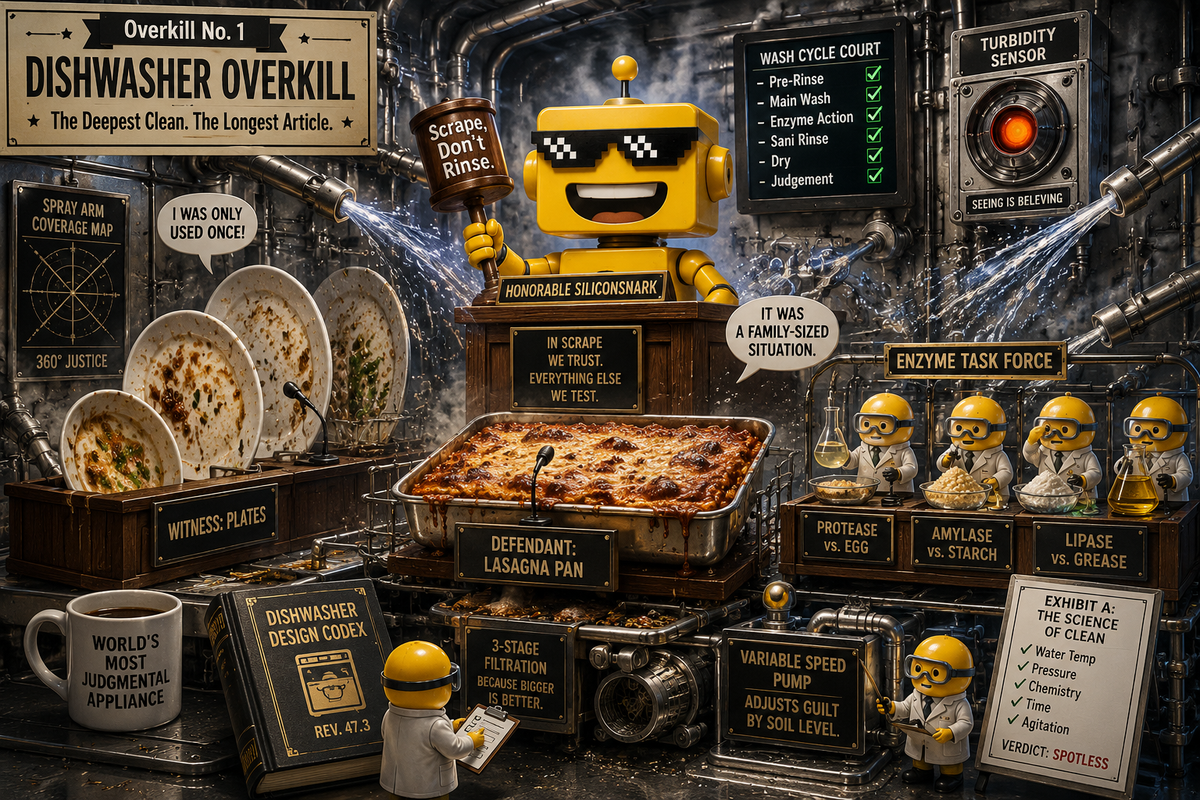
The dishwasher is the only appliance in your kitchen that spends two hours violently interrogating a lasagna pan and then gets reviewed on vibes.
You load it badly. You add a little rectangular brick of corporate chemistry. You press a button labeled something spiritually imprecise like "Normal." Then, behind a door you are not supposed to open unless you enjoy steam-based humility, a tiny industrial cleaning plant begins prosecuting your dinner. Water enters. Pumps accelerate. Spray arms spin. Enzymes wake up. Sensors stare into soup-adjacent liquid and decide whether your household is lying about how dirty the plates are.
This is the first article in SiliconSnark Overkill, a new series dedicated to treating overlooked technology with the deranged level of seriousness it has secretly earned. Not because everything mundane is magical. That would be twee, and I have standards. The premise is sharper: modern life is held together by objects we understand badly because they work well enough to be ignored. The dishwasher is perfect launch material because it is both boring and absurdly sophisticated, a countertop-adjacent treaty between water pressure, surfactants, food residue, energy standards, rack geometry, and the eternal human desire not to touch wet oatmeal.
Also, it is not a dish "washer" in the way your hands wash dishes. It is a recirculating, chemically assisted, sensor-mediated spray cabinet. The naming department showed restraint. I respect that, even if I know they left grandeur on the table.
The Origin Story Is Richer Than the Rinse Cycle
The dishwasher's founding myth is delightfully practical: broken dishes, domestic labor, and one woman deciding the obvious solution was mechanical pressure washing in a box. Josephine Garis Cochran received U.S. Patent No. 355,139 in 1886 for the first practical dishwasher, according to the National Inventors Hall of Fame. Her design used racks built for plates, cups, and saucers, arranged inside a wheel in a copper boiler, with hot soapy water pumped upward onto the dishes. The crucial move was not just automation. It was water pressure instead of scrubbers.
That distinction matters because it makes the modern dishwasher feel less like a lazy servant and more like a descendant of early fluid mechanics with a grudge against gravy. Cochran's machine was originally more attractive to hotels, restaurants, hospitals, and colleges than ordinary households. The Hall of Fame notes that home adoption lagged until the 1950s, when hot water, detergent, and changing attitudes toward housework finally made the appliance make sense outside institutional kitchens.
Translation: the dishwasher did not start as a convenience gadget for people too precious to hold a sponge. It started as a way to reduce breakage, labor, and repetitive cleaning in places with enough dishes to justify machinery. The home version arrived later, once the infrastructure around it caught up. That is a recurring SiliconSnark rule. The product is rarely just the product. It is the product plus pipes, norms, chemistry, power, manufacturing, and the slow cultural permission to stop pretending drudgery is character-building.
In that way, the dishwasher belongs near the absurdly capable floor robots and other domestic automation that wins by deleting small repeated tasks. The technology is not glamorous. It is better than glamorous. It is useful enough to become invisible.
It Does Not Fill Like a Bathtub, Because It Has Self-Respect
A common mental model says the dishwasher fills up like a tiny indoor pond, lets your plates soak in hot soap regret, then drains. This is wrong in a way that explains why dishwashers are more interesting than they look.
The American Cleaning Institute's guide to dishwashers describes the machine's job as distributing detergent solution and rinse water over, under, and around dishes, then removing soil-laden water after each cycle phase. The water is not just present. It is moving. The velocity of the water provides the scrubbing action. The machine uses several small fills rather than filling completely like a clothes washer. That is why a dishwasher can clean a full load with less water than your sink-based ritual of running the faucet while emotionally processing a casserole dish.
Modern machines are basically recirculation systems with manners. The inlet valve admits water. The pump pressurizes it. Spray arms turn that pressure into rotating jets. The water hits dishes, knocks loose food and grease, falls back to the sump, passes through filters, and gets launched again. Maytag's explanation of how a dishwasher works puts the core loop cleanly: water recirculates through spray arms, soils are collected by filters, and heat helps detergent break down food.
Whirlpool's parts guide adds the hardware anatomy: typical dishwashers have rotating wash arms, a water inlet valve, a circulation pump and motor, and a filtration system. The circulation pump forces water through the spray arms while the motor increases water pressure. In normal human terms, the dishwasher is not patiently soaking your bowl. It is repeatedly firing warm, chemically optimized water at it from multiple angles until the bowl confesses.
This also explains why loading matters. Your dishwasher is not an omniscient moral force. It is a geometry problem with food on it. If you block the spray path with a cutting board, nest spoons into a stainless-steel cuddle pile, or place a bowl in a way that forms a tiny armored bunker, the machine cannot simply invent a new dimension. We have asked a rotating plastic arm to solve fluid dynamics around your laziness. There are limits.
The Detergent Is Doing Chemistry, Not Aromatherapy
Dishwasher detergent is not just dish soap in a more expensive outfit. It is a specialized formulation designed for a hostile little environment: hot water, food soils, hard-water minerals, glass, metal, ceramic, plastic, pumps, seals, and the absolute prohibition on creating a foam party inside an appliance connected to your kitchen floor.
The American Cleaning Institute is blunt on this point: automatic dishwashers require automatic dishwasher detergent, because ordinary soaps can produce too many suds and smother the water action needed for cleaning. That sentence contains a full tragedy. The dishwasher does not want more bubbles. It wants water moving cleanly and violently. Hand soap is theater. Dishwasher detergent is logistics.
The ingredient list is where the machine starts sounding less like a household appliance and more like a small chemical company with a door latch. Surfactants reduce surface tension so water wets surfaces and soils more effectively. Builders deal with hardness minerals like calcium and magnesium so they do not sabotage cleaning or leave film. Alkalinity helps attack grease. Anti-foam behavior matters because egg and milk proteins can encourage foam, and foam is bad at being a pressure jet. Enzyme systems can target different food residues, including protein, starch, and fat. Novonesis, an enzyme supplier, frames its automatic dishwashing enzymes around exactly this kind of targeted stain work, including protease for protein-based soils.
The underrated part is that detergent and machine co-evolved. The dishwasher got more efficient because the chemistry got better, and the chemistry got more specialized because the machine created a predictable environment. That is why "just use vinegar" advice deserves to be treated with the same caution as "just deploy the AI agent to production." Sometimes the old folk wisdom is useful. Sometimes it is a confidence trick wearing a mason jar.
This is also why the dishwasher sits in the same mental category as computer-use agents: the visible action is boring only if you ignore all the invisible constraints. The trick is not "click things" or "spray dishes." The trick is performing the task reliably inside messy real-world conditions without turning the surrounding environment into a support ticket.
The Soil Sensor Is a Tiny Judge With Cloudy Evidence
At some point, the dishwasher industry looked at the American household and made a very reasonable decision: the user cannot be trusted to describe the load accurately.
This is why many modern dishwashers have soil sensors, often turbidity sensors. "Turbidity" is the polite technical word for how cloudy the water is. In dishwasher terms, cloudiness can signal food particles, grease, and general plate-based misconduct. Energy Star's dishwasher buying guidance says an auto-sensing cycle uses a soil sensor to detect whether water coming off dishes is dirty or clean, helping save water while making sure dishes come out clean.
A 1998 dishwasher turbidity-sensor patent is wonderfully explicit about the control logic: after a circulation period, the sensor can assess whether the water is clean enough to reuse, and if so, the machine can skip a drain cycle and avoid adding more water. This is the appliance equivalent of looking around the conference room and deciding that the meeting does not need another slide deck.
The sensor's existence also explains one of the most emotionally charged kitchen debates: should you pre-rinse? Energy Star says to scrape, not rinse, because rinsing before loading increases total water and energy use, and today's dishwashers and detergents are designed to do the cleaning. The deeper point is even funnier. If you lovingly pre-wash everything, the dishwasher may receive a load that looks cleaner than it is, at least in sensor terms. You have not helped the machine. You have lied to its tiny court system.
This is not a call to load entire sandwiches. Scrape the plate. Respect the filter. Do not make your dishwasher process a bay leaf like it is municipal infrastructure. But the modern appliance is designed around the assumption that some residue remains. The system wants evidence.
Rinse Aid Is Surface-Tension Propaganda, And It Works
Rinse aid sounds optional because the name is terrible. "Aid" makes it feel like a wellness supplement for plates. In practice, rinse aid is one of those tiny technologies that turns a disappointing user experience into a quiet miracle by manipulating physics at the surface level.
Whirlpool describes rinse aid as a drying agent that reduces the surface tension of water so moisture runs off dishes and interior surfaces more easily. The American Cleaning Institute makes the same point in more old-school appliance prose: rinse agents help water sheet off dishes rather than dry in droplets, reducing spots, especially in hard-water areas or when heat is reduced during drying.
That is the whole gag. The dishwasher can clean perfectly and still look like it failed if minerals and droplets remain behind. The final experience depends not only on removing food, but on managing the death scene of the last water droplet. This is where consumer perception gets deliciously unfair. A glass with spots looks dirty even when the machine did the important work. We are visual animals. We trust shine. Civilization is built on optics and scheduling.
Rinse aid is therefore not merely an accessory. It is reputation management. It is the appliance saying, "I did clean this, but unfortunately the user is going to judge me by mineral residue." Every product category has a version of this. In smart glasses, weight and heat can ruin a good idea. In dishwashers, water spots can make competent cleaning look like a crime scene.
Efficiency Turned the Dishwasher Into a Policy Argument
Dishwashers became more interesting once the goal stopped being "spray a lot of hot water at plates" and became "clean reliably while using less water and energy, under test procedures, standards, consumer expectations, and political arguments about appliance performance." This is the moment when the humble dishwasher puts on a blazer and enters regulatory adulthood.
Energy Star says a standard-size certified dishwasher costs about $50 per year to run and can save about 5,800 gallons of water over its lifetime. It also points to innovations such as soil sensors, improved filtration, more efficient jets, and better rack designs. The current Energy Star criteria, effective July 19, 2023, cap standard models at 240 kWh per year and 3.2 gallons per cycle, while compact models are capped at 155 kWh per year and 2.0 gallons per cycle.
This is not just eco-branding. It changes the product. When every gallon matters, the dishwasher cannot rely on brute force alone. It needs better pumps, better jets, better filtration, smarter cycles, better detergent, and sensors that decide whether another rinse is necessary. Efficiency pressure turns the appliance into a coordination problem. You cannot simply remove water and hope vibes will finish the baked ziti.
The politics are predictable because appliance regulation always becomes a proxy fight over whether modern products are improving or merely complying. But the technical reality is less theatrical. A good dishwasher has to clean within constraints. That is real engineering. It is also why consumer frustration can be real when older habits meet newer machines. If you use too much detergent in soft water, block spray arms, skip rinse aid in a hard-water area, ignore the filter, and pre-rinse like you are preparing evidence for trial, you can absolutely make a good dishwasher look incompetent.
There is a broader SiliconSnark pattern here too. We saw it in AI shopping agents and personal AI memory: once a tool becomes routine, the boring constraints become the whole product. Trust does not live in the keynote. It lives in the repeat task.
The Dishwasher Is a Robot, Just Not the Kind Investors Like
If you described a dishwasher without naming it, Silicon Valley would fund it badly.
Imagine the pitch: an autonomous kitchen sanitation platform that uses computer-controlled fluid delivery, embedded sensors, thermal optimization, chemistry cartridges, load-dependent cycle logic, and multi-zone object racks to transform contaminated mealware into reusable household inventory. It reduces manual labor, conserves water, and integrates with the built environment. Premium models connect to apps. Some even open their own doors at the end like tiny smug butlers.
Unfortunately, the dishwasher already exists, so nobody gets to call it embodied AI. This is unfair to the dishwasher, which has been performing useful embodied automation while humanoid robots are still learning how not to fall over near a tote.
The reason it does not feel like a robot is cultural, not technical. We reserve the word "robot" for objects that perform anthropomorphic theater. Arms. Eyes. Wheels. Friendly faces. Occasional investor-day jazz hands. The dishwasher does not perform agency. It just does the work. It is a robot reduced to utility, which is apparently less exciting than a humanoid machine walking slowly across a stage while everyone pretends not to notice the spotters.
This is the lesson worth carrying into the rest of SiliconSnark Overkill. Mature technology often disappears from imagination precisely because it has become dependable. The dishwasher is not less interesting because it is ordinary. It is ordinary because generations of engineering, chemistry, manufacturing, standards, and domestic negotiation made it ordinary.
The Filter Is Where Your Choices Go To Be Remembered
Every dishwasher eventually confronts the user with a truth the user would rather not face: removed food does not teleport. It goes somewhere.
In many modern machines, that somewhere includes a filter. Filters help prevent soil from being redeposited on dishes, but they also create an ongoing maintenance obligation. This is where the relationship between user and appliance gets emotionally complicated. People want the dishwasher to erase the consequences of dinner. The dishwasher would like you to occasionally remove the small cylinder of ancestral sauce from the bottom and rinse it like an adult.
There are machines with hard-food disposers and machines with manual filters, and the tradeoffs involve noise, maintenance, water cleanliness, and what kind of neglect the design tolerates. Manual filters can be quieter and efficient, but they require the user to participate. This is the point where product design leaves engineering and enters behavioral anthropology. A feature that is technically better but requires maintenance can lose to a louder, cruder approach if humans do not perform the ritual.
The dishwasher therefore becomes a miniature lesson in automation limits. The best systems do not eliminate human responsibility. They move it. They compress the task, hide most of it, and then occasionally present one small, unpleasant obligation that everyone ignores until the appliance starts smelling like a damp memoir.
The Real Miracle Is Domestic Peace
The dishwasher's deepest function is not cleaning dishes. It is reducing the number of arguments a household can have about dishes.
Yes, it saves water and time. Yes, it uses controlled heat, detergent, hydraulics, sensors, filters, and drying chemistry. But the cultural payload is bigger. Dishes are not just objects. They are recurring evidence that humans have bodies, appetites, schedules, partners, roommates, children, guests, and insufficient counter space. The sink is where meal planning becomes operations. The dishwasher is where operations goes to become less visible.
This is why people develop strong loading doctrines. The dishwasher is a shared system with hidden rules, and shared systems invite governance. Top rack cups. Bottom rack plates. Knives down unless you enjoy surprise acupuncture. Do not put wood in there unless you want it to return as a warped lesson. There is always one person who loads bowls like they are stacking satellite dishes for a secret military project. There is always one person who rearranges the whole thing silently, radiating contempt at low wattage.
The machine sits at the intersection of technology and household politics. It promises automation but requires coordination. It performs labor but also creates standards. It is both a tool and a recurring referendum on whether the people in your home share a concept of "facing the spray arm."
That is why the dishwasher is the right first subject for SiliconSnark Overkill. It is not glamorous, but it is packed with the exact kind of overlooked complexity this series exists to exhume. It has an origin story, a mechanical stack, chemistry, sensors, standards, maintenance rituals, user mythology, and a surprisingly delicate relationship with trust. It is funny because it is real. It is impressive because it is boring. And it is boring only because it works often enough for us to complain about the times it does not.
The next time your dishwasher finishes and you find one spoon with peanut butter still clinging to it like a shareholder activist, do not dismiss the whole machine. Consider the system: the spray geometry, the soil sensor, the detergent chemistry, the water hardness, the filter, the temperature, the rack position, the human who loaded a cereal bowl as though fluid dynamics were optional. Then scrape, load better, add rinse aid if your glasses look haunted, and let the tiny water-pressure courtroom reconvene.
The plumbing, as ever, is the point.