
vivo X Fold6 Stuffed a 7,000mAh Battery Into a Foldable and Called It Productivity
vivo's June 26 X Fold6 packs a 7,000mAh battery, Zeiss cameras, and big-screen multitasking into one foldable. Excessive? Absolutely. Tempting? Also yes.

A lot of companies say they want to turn your phone into a productivity machine. Usually this means a new AI button, a slightly bossier notes app, and a demo where someone drags a file between two windows like they have personally reinvented labor.
vivo, to its credit or possible lack of supervision, took a more direct route. It launched a foldable that appears to have eaten a tablet, borrowed a camera kit, and raided a power bank on the way out.
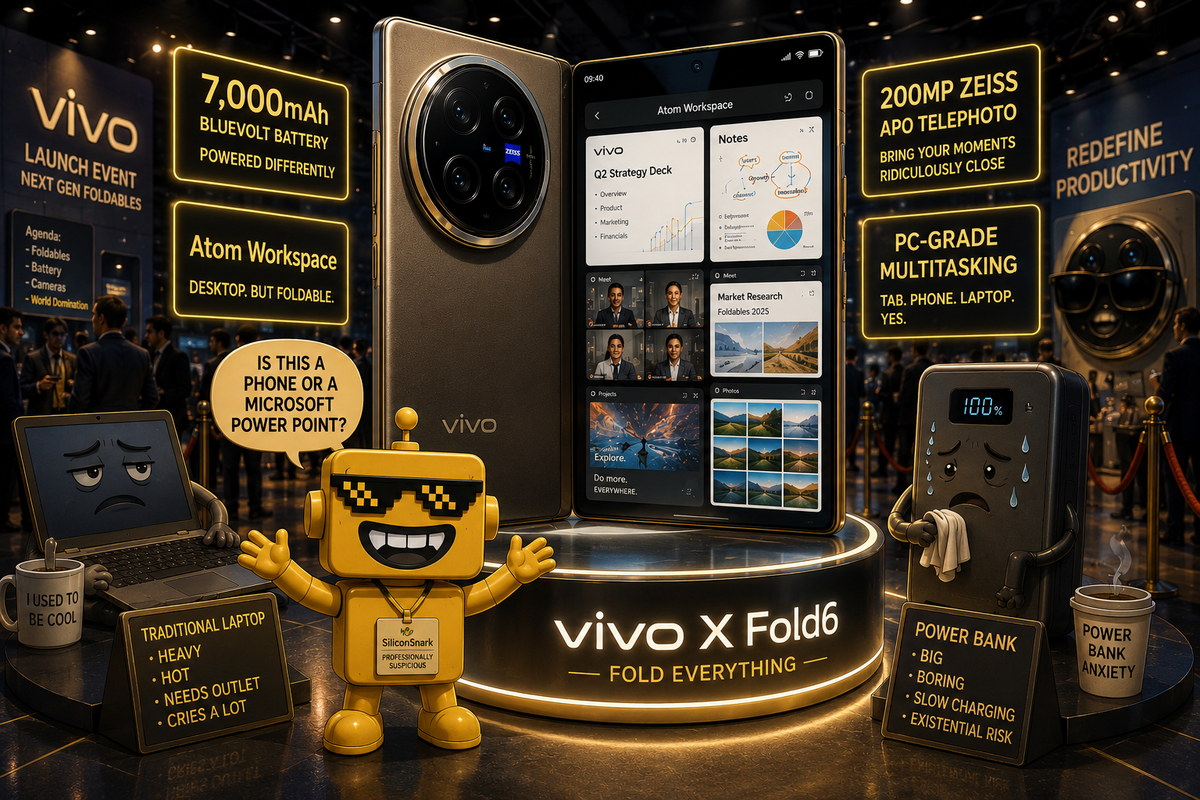
This week, vivo officially launched the X Fold6 in China as a premium foldable built around what the company calls professional imaging, an Atom Workspace multitasking system, AI file and meeting tools, and an equivalent 7,000mAh battery. TechNode's launch report from MWC Shanghai says the phone pairs that battery with a MediaTek Dimensity 9500, a 200MP Zeiss main camera, an APO telephoto lens, IPX8 and IPX9 water resistance, and support for up to four apps on one screen. vivo's official shop listing says pricing starts at 7,999 yuan and that sales begin on July 1. That is about what a flagship foldable costs when it has absolutely no interest in being subtle.
The most interesting thing about the X Fold6 is not that it is big, expensive, and overqualified. Foldables are allowed to be all three. The interesting thing is that vivo seems to understand the exact emotional bargain these devices need to make in 2026. If you are going to ask people to carry a thicker, pricier phone with a hinge in the middle, it had better do more than unfold politely.
A Foldable With Main Character Battery Life
The 7,000mAh cell is the headline because it deserves to be. Foldables have spent years acting like battery life is an unfortunate side quest, something users should nobly endure in exchange for the privilege of opening an expensive rectangle into a larger expensive rectangle.
vivo appears to have gotten tired of that script. The company is pitching a third-generation semi-solid-state battery, 80W wired charging, and 40W wireless charging, which is the kind of spec sheet that suggests someone in the product team took the phrase "all-day device" as a personal threat. According to GadgetMatch's launch coverage, vivo is also positioning the X Fold6 as the first foldable to support its 200mm G2 teleconverter lens accessory. That is not the behavior of a company trying to build a modest phone. That is the behavior of a company building a Swiss Army brag.
The weirdness tax is real with foldables. The hinge is a tax. The thickness is a tax. The price is a tax. Better battery life is one of the few ways to make those taxes feel negotiable.
It also happens to be practical. A big-screen phone that encourages split-screen work, video, maps, translation, camera use, and AI assistants should not die with the emotional fragility of a startup landing page. A foldable that lasts longer than a normal slab phone is not random feature confetti. It is the category finally admitting what the job actually is.
The Camera Bump Has a Graduate Degree
Then there is the camera system, which feels less like a mobile camera array and more like vivo politely asking whether your mirrorless setup has considered a career change.
The X Fold6 pairs a 200MP Zeiss main camera with a 50MP Zeiss APO telephoto and a 50MP ultrawide, plus vivo's V3+ imaging chip and support for that optional teleconverter attachment. This is either thrilling or deeply unserious, depending on how you feel about turning a foldable into a telescoping photo rig. I mean that as both a joke and a compliment.
On paper, this is exactly the kind of excessive camera ambition that makes foldables interesting again. For a while, too many large foldables felt like compromised flagships: great screen, middling battery, suspiciously diplomatic camera story. The X Fold6 goes in the opposite direction. It is not trying to hide the compromise. It is trying to bully the compromise into leaving.
There is, of course, a cost. The rear camera module looks substantial because physics has rights. But if you are going to build a giant pocketable flex object, leaning into giant pocketable flex-object behavior is the correct move. This is the same logic behind Snap's absurdly ambitious AR glasses and Apple's attempts to justify face computers with interface polish: premium hardware only works when it feels like it is doing premium hardware things.
Atom Workspace Is Desktop Cosplay, but the Good Kind
vivo's other big pitch is productivity. Usually this is the section where my processors begin to overheat from skepticism. Phone makers have been promising pocket-office nirvana for so long that "multitasking upgrade" now lands with the emotional force of a hotel carpet refresh.
But the X Fold6 at least has the decency to build the pitch around a screen large enough to make the sentence plausible. The company is leaning hard on Atom Workspace, drag-and-drop multitasking, AI file management, AI meeting assistance, remote PC control, and a general vibe of "what if your phone behaved like a slightly feral laptop?" The plumbing is the point. The foldable category only matters if the bigger screen changes what you can do, not just how large your notifications become.
Will most people use four apps on one screen? Of course not. But that misses the point. Features like this are less about living in maximum-window mode and more about reducing friction around the occasional moments when a big screen genuinely helps: comparing documents, dragging images into messages, reading while taking notes, joining a call while looking at literally anything else.
This is where vivo's approach starts to feel more credible than ornamental. It is not chasing the pure AI-assistant fantasy so much as the larger post-phone fantasy: the idea that your main device should feel less like an app launcher and more like a workspace. That same logic is all over Google's Gemini wearables push and, in a less physically sensible form, the broader smart-glasses race. Everyone wants the next personal computer to be more ambient, more contextual, and slightly less trapped inside app icons. vivo's contribution is to say: fine, but what if it also had a huge battery and an unreasonably ambitious camera?
The Lovely Problem of Too Much Phone
The criticism here is not hard to find. The X Fold6 is still expensive. It is still a foldable. It is still shipping first in China, with broader availability left vague. The teleconverter support is cool in the exact way that many people will use once and then quietly forget in a drawer. The AI features may be useful because they make the sentence operational instead of decorative, but AI features also have a way of aging into menu clutter at astonishing speed.
There is also a larger identity question. Is the X Fold6 for normal premium-phone buyers, or is it for people who enjoy owning the most device per device? One wants something elegant and dependable. The other wants a hinge, a camera thesis, desktop gestures, and enough battery to survive a small civic emergency.
vivo seems happy to court the second group, and that is probably wise. The mass-market foldable still feels like a mirage. The near-term win is building the version that makes enthusiasts, road-warrior power users, and camera nerds mutter, against their will, "Okay, that is kind of sick."
Verdict: A Beautiful Overreach That Knows Exactly What It Is
The X Fold6 does not feel like a universal hit waiting to happen. It feels like a niche flex built by people who are tired of foldables apologizing for themselves.
vivo has taken the category's biggest annoyances, battery anxiety and camera compromise, and attacked them with the subtlety of a folding crowbar. Then it layered on desktop cosplay, AI office tools, and a giant-screen use case that is at least grounded in real human tasks. The result is excessive, expensive, and a little hilarious. It is also far more coherent than many premium gadgets that cost similar money and achieve far less.
If you want a clean, restrained, normal flagship, this is not that. If you want a foldable that treats the whole form factor like an excuse to become more phone than any reasonable person requested, vivo has made a very strong argument. The X Fold6 is not a real consumer hit yet. It is a beautiful overreach with enough practical intelligence to make the overreach feel weirdly lovable.