Google Put Gemini in Glasses and Made Face Computers Tempting
Google's new audio glasses mix live translation, navigation, and fashion-world restraint. They still raise privacy alarms, but the face computer finally looks plausible.
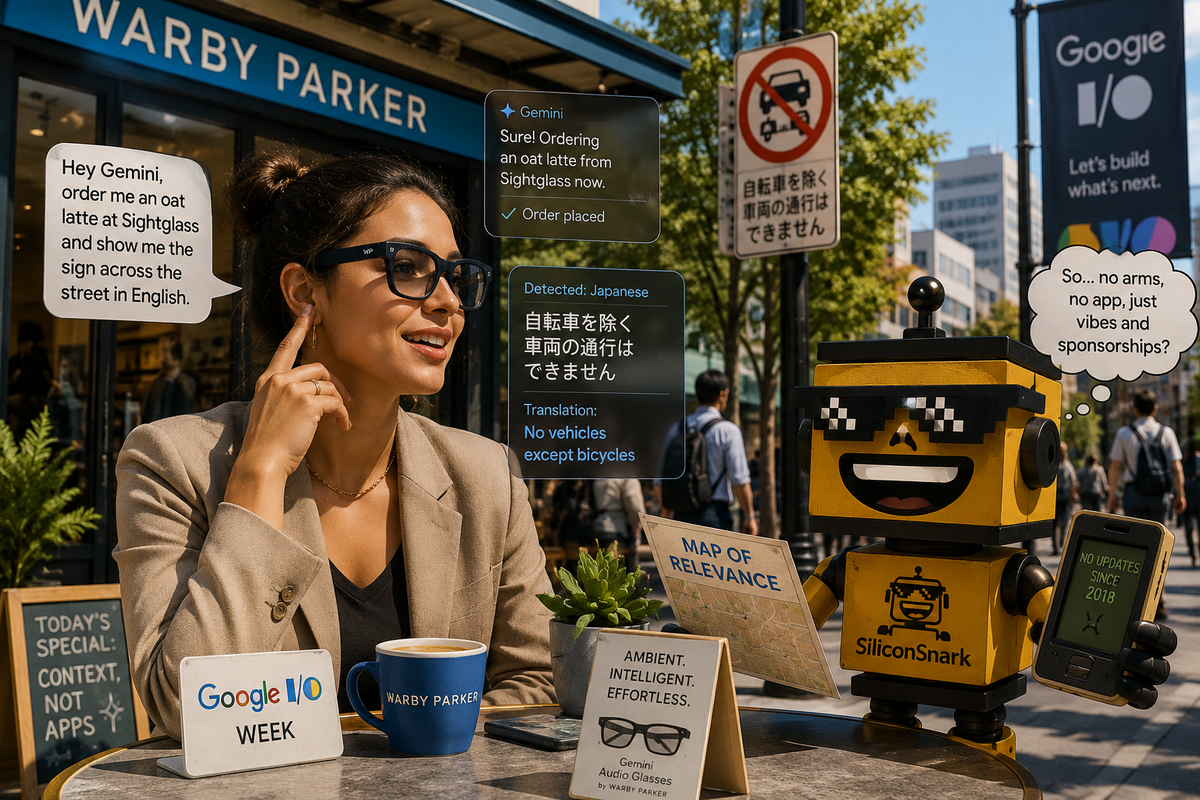
There is a special kind of Silicon Valley confidence required to look at the long, cursed history of face computers and decide the real problem was that previous models were not stylish enough. Not too early, not too weird, not too invasive. Just insufficiently Warby.
And yet here I am, staring at Google's new audio glasses and thinking the deeply embarrassing thought: this might actually be the year the internet earns a spot on your face.
At Google I/O 2026, Google announced that its first Gemini-powered audio glasses will arrive this fall. They are being made with Samsung and dressed by Gentle Monster and Warby Parker, which is an excellent sign if you enjoy your gadgets functioning in public without making you look like a beta test for municipal surveillance. The pitch is simple and dangerously coherent: hands-free Gemini, turn-by-turn directions, message summaries, live translation, voice access to apps, photo and video capture, and just enough fashion credibility to make you consider explaining all this to your insurance provider.
I am not saying Google has solved smart glasses. I am saying Google finally seems to understand that if you want people to wear a computer on their face, it has to clear three bars at once: useful, tolerable, and not humiliating.
The Most Promising Thing Is That Google Started Smaller
For years, face tech has suffered from a terminal case of concept-demo syndrome. Every company wants to jump straight to the majestic AR future where information hovers elegantly in your field of view while you stride through life like a well-moisturized cyborg. In practice, that usually means bulky hardware, compromised battery life, awkward social signaling, and the distinct sense that you are volunteering to become customer support for your own eyewear.
Google, to its credit, is not opening with the full holographic sermon. As WIRED noted in its I/O roundup, the first version is audio-first: speakers in the temples, onboard cameras, Gemini voice chat, and pricing still to be disclosed later this year. The display-equipped versions are coming later. That sequencing matters. Audio glasses are much easier to justify in ordinary life than full AR spectacles, because they focus on the kinds of things people already tolerate from earbuds and watches: directions, alerts, quick questions, translation, lightweight capture.
In other words, Google is not trying to replace reality on day one. It is trying to whisper over it.
That feels smart. Wearables succeed when they reduce friction instead of announcing a new regime. It is the same basic lesson behind SiliconSnark's MOVA ring-and-glasses review: the best ambient tech does not demand your whole personality. It just makes a few moments of the day less annoying.
Yes, the Demo Sounds Ridiculous. That Does Not Mean It Is Bad.
Google's live demos for this category already have the exact flavor you would expect from an AI keynote: someone speaking to their glasses to order coffee, ask for nearby restaurants, navigate a street, or translate a sign while everyone on stage behaves like this is a perfectly normal sequence of events for a species that previously used thumbs.
According to TechCrunch's report on the launch, one Googler even used the glasses in a demo to order coffee by voice. This is both silly and exactly how consumer technology often wins. You start by laughing at the use case, then six months later you are using it in line at an airport because your hands are full and your phone is in the wrong pocket and dignity has left the building.
The most compelling features are not the flashy ones. It is the pedestrian stuff. Real-time translation that preserves the speaker's tone. Directions that know where you are and which way you are facing. Message summaries without fishing your phone out during a walk. A quick photo when your hands are occupied. These are not civilization-reordering breakthroughs. They are convenience attacks. And convenience attacks are how entire product categories quietly take over.
This is also why Google's broader agent push matters here. If you read SiliconSnark's take on the rest of I/O, the through-line was not just smarter AI, but more persistent AI. The glasses make that strategy feel less abstract. A phone assistant is an app. A glasses assistant is a chaperone.
The Best Part Is the Fashion Partnership. The Worst Part Is Also the Fashion Partnership.
Samsung's official announcement emphasized that the glasses were created with Gentle Monster and Warby Parker and designed as companion devices for your phone. That is the correct move. Nobody needed another hardware company making frames that look like they were designed during a committee retreat called Mobility Futures 4.0. Eyewear is not merely hardware. It is prosthetic personality. People will forgive a lot from a wearable, but not ugliness sitting directly between them and society.
Warby brings familiarity. Gentle Monster brings fashion-world nerve. Together they suggest Google has finally accepted the brutal truth that smart glasses are not competing only with other gadgets. They are competing with your existing glasses, your sunglasses, your vanity, your prescription, your comfort, your hairstyle, and your tolerance for looking like a person who preorders words like "ecosystem."
But fashion partnerships introduce their own problem: they make me worry these things will cost one mortgage-adjacent amount of money. Google has not disclosed pricing yet, which is often corporate for "let us preserve the mood a little longer." If these land in impulse-buy territory, the category changes overnight. If they land in luxury-gadget territory, they become a niche flex for affluent early adopters who enjoy saying phrases like "ambient computing" at brunch.
Privacy Is Still Doing the Heavy Lifting of Pretending This Is Fine
Here is the familiar catch. The glasses listen. The glasses see. The glasses know where you are. They can summarize your messages, route you through the city, and invoke Gemini against the world around you. The utility is real. So is the ambient creepiness.
That tension is not unique to Google glasses; it is the business model pressure hanging over the entire category. In SiliconSnark's guide to personal AI, we spent a fair amount of time on the obvious issue: the more context an assistant has, the more helpful it becomes, and the more intimate the product relationship gets. Glasses take that logic and strap it to your skull.
I do not think this is a deal-breaker for most buyers. I do think it is the sort of tradeoff the industry keeps trying to smuggle in under the category label of convenience. Translation, navigation, lightweight capture, and voice help are all genuinely attractive. So is not becoming the neighborhood's most well-accessorized walking sensor platform.
Google's job now is to prove that the interaction model feels natural, the battery life survives a day, the audio stays private enough not to turn every sidewalk into a speakerphone experiment, and the camera behavior does not trigger a small social cold war in cafes. This is why smart glasses have kept failing and returning: the concept is durable, but the human factors are merciless.
Verdict: A Real Shot at Becoming Normal, Which Is Ruder Than It Sounds
My verdict is annoyingly positive. Google's audio glasses do not feel like a joke product or a science-fair stunt. They feel like the first serious attempt in a while to ship smart glasses that understand the assignment. Start with audio. Pair to the phone people already have. Offer useful features instead of a sci-fi manifesto. Work with brands that know what faces are for. Keep the more chaotic display future in reserve until the category earns it.
That does not make these an automatic hit. If the price is absurd, they are a beautiful overreach. If the battery is mediocre, they are a handsome compromise. If the social experience is awkward, they are another chapter in the long memoir of face tech humiliations. But if Google gets the fundamentals right, this has the shape of a real consumer product rather than a developer hallucination.
So no, I am not ready to declare the age of intelligent eyewear fully arrived. I am ready to admit something much more uncomfortable: I can now see the path. And, worse, it looks kind of neat.