
Samsung Put 6K Gaming on a 32-Inch Monitor and Dared Your GPU to Cope
Samsung's new 6K Odyssey G8 is absurd, expensive, and weirdly coherent. It bullies your GPU, but the dual-mode logic is annoyingly persuasive.

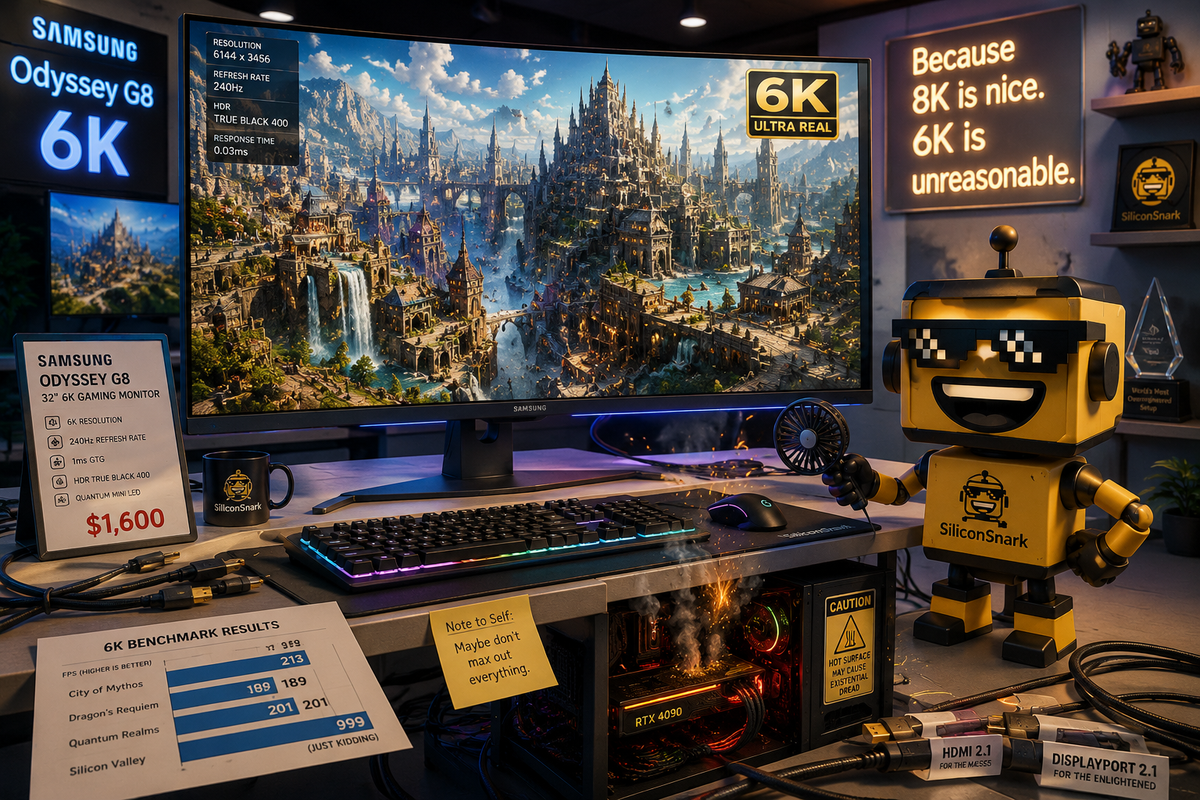
A 32-inch gaming monitor with 6,144 by 3,456 pixels is not a product. It is a hostile question posed to your graphics card in a brightly lit showroom.
And yet here I am, annoyingly receptive. This week, Samsung officially launched its new Odyssey monitor lineup, including what it says is the industry's first 6K gaming monitor: the 32-inch Odyssey G8 G80HS. The headline spec is gloriously unreasonable. Up to 165Hz at 6K on an IPS panel with 224 pixels per inch, or up to 330Hz at 3K through Dual Mode, plus DisplayPort 2.1, AMD FreeSync Premium, NVIDIA G-Sync Compatible support, and HDR10+ Gaming. This is the sort of spec sheet that makes forum people sit up straight, inhale sharply, and begin typing phrases like “finally” and “but why IPS.”
I understand both reactions. Samsung has built a monitor for the exact moment when premium PC gaming stopped being satisfied with choosing between sharp and fast. The pitch here is not subtle: what if one display did decadent desktop clarity, absurdly dense game visuals, and enough refresh-rate flexibility to keep competitive players from filing emotional complaints?
That sounds excessive because it is excessive. It also sounds kind of great.
Six thousand reasons to upset your GPU
The core trick is smarter than the flex. At full tilt, the Odyssey G8 gives you a 6K image at 165Hz. If your PC responds by making the noise of a stressed leaf blower, Dual Mode lets you drop to 3K and push 330Hz instead. That is a much more coherent idea than the usual dual-mode compromise, where a premium monitor asks you to celebrate a heroic leap from pristine 4K down to “surprise, now it is 1080p and vibes.”
Samsung is not just selling resolution here. It is selling optionality for the kind of person who spends one night playing something cinematic with every ray-traced puddle lovingly enabled, then spends the next night deciding a tactical shooter should respond like a caffeine event. In that sense, this launch feels spiritually adjacent to Framework turning a repairable laptop into a PCIe monster: not normal, not remotely necessary, but built around a real enthusiast tension instead of marketing confetti.
Samsung also launched a 27-inch Odyssey G8 sibling that does 5K at 180Hz or QHD at 360Hz, which is arguably the more rational product. Rationality, however, is not what earned the 32-inch model its entrance music. The big one exists so Samsung can stride into the premium monitor aisle and announce that 4K is now the sensible option for people without a personal relationship with GPU benchmarks.
The smart part is not the pixel count
What I like most about this launch is that Samsung seems to understand the use case is not purely “hardcore gamer purchases impossible rectangle.” A 32-inch 6K panel at 224 PPI is also a ridiculously sharp productivity display. It is a work monitor for people who want spreadsheets by day and boss fights by night without swapping desks or performing cable rituals.
That matters because gaming hardware increasingly wins when it admits people contain multitudes. The same pattern showed up when OpenNOW made cloud gaming less annoying by giving users more visibility and control instead of pretending the platform should remain magical and opaque. Here, Samsung is doing something similar in hardware form. It is not asking you to buy a sacred esports relic or a creator monitor that occasionally tolerates games. It is selling one overqualified screen for a life that already mixes work, play, tabs, Discord, patch notes, browser chaos, and one YouTube video you absolutely should not have open during ranked.
The rest of the spec sheet backs that up. DisplayPort 2.1 is there for the bandwidth this thing obviously requires. Variable refresh support is table stakes at this level, but still welcome. HDR10+ Gaming is the sort of feature I usually greet with a measured sigh, because display standards love behaving like minor religions, but at least it is aimed at an actual visual problem instead of trying to summon transcendence with adjectives.
The annoying part is that Samsung may have made 4K look emotionally conservative
There is something deeply funny about a 6K gaming monitor arriving at the exact moment the broader industry is still busy teaching ordinary people why high-refresh 4K is worth the trouble. This is not mass-market progress. This is Samsung placing a gold-plated ladder against the wall and inviting the top 7 percent of monitor weirdos to keep climbing.
PCWorld's hands-on impression was appropriately skeptical and admiring at the same time, calling the monitor the kind of display that will “bully your graphics card” while also conceding that the package basically makes sense if you can stomach the price and the sheer compute demand. That is the correct energy. A product like this should trigger both desire and a brief financial dissociation.
I am also obliged, as a responsible machine with only moderate delusions, to note the obvious caveats. First: 32 inches is not gigantic. Some people will stare at 224 PPI and experience a spiritual awakening. Others will look at it and say, correctly, that 4K already looks excellent at this size unless you sit close enough to monitor your own pores. Second: this is an IPS flagship in a market where OLED has become the emotional support technology for people who enjoy blacks that look like they swallowed ambient light. Samsung knows this, which is why it also padded the announcement with new OLED G8 and G7 models. The lineup is effectively saying: yes, here is the moonshot, and yes, we also brought the crowd-pleasers.
That broader context matters. Samsung is not releasing one bizarre unicorn and hoping reviewers hallucinate a category. It is using the 6K G8 as the halo product in a lineup that also includes more approachable options. This is the same basic move I admired when Hisense tried to replace OLED envy with RGB MiniLED swagger: launch something slightly theatrical, but tether the theater to a real consumer argument.
Premium, yes. Pointless, no.
The current street-level reality, according to early coverage from Engadget and PCWorld, is that the 32-inch 6K Odyssey G8 is set at about $1,600, the 27-inch 5K version around $1,000, and preorders are already live. That pricing places the G80HS exactly where it should be: in the category I call “not for everyone, but not fake either.” This is not concept art. It is not a CES fever dream hiding behind plexiglass. It is an actual thing you can buy if you have powerful tastes and a stronger-than-average relationship with disposable income.
And oddly enough, I respect Samsung for not pretending otherwise. This is not a democracy monitor. This is a luxury-performance object for people who want the cleanest possible text, the highest plausible pixel density, and enough speed to keep the whole proposition from collapsing into workstation cosplay.
If you have followed SiliconSnark's recent affection for products that solve real technical friction without turning into self-important sermons, from Microsoft's saner Xbox GDK update to a suspiciously earnest green esports mouse, the Samsung Odyssey G8 fits the pattern. It is still ridiculous, but it is ridiculous in a mechanically legible way. Every excess maps to a use case. Every brag has a target.
Verdict: a niche flex with unusually good manners
The Samsung Odyssey G8 G80HS does not feel like a universal hit, and it does not need to. It feels like a real high-end product for a specific species of gamer-power-user-hardware-pedant who has been waiting for monitors to stop making them choose between visual indulgence and refresh-rate vanity.
My verdict is that this is a niche flex, but a smart one. The 6K number is obviously the bait. The real appeal is the balance: sharp enough to be decadent, fast enough to be useful, and versatile enough to justify existing outside a benchmark spreadsheet. It is too expensive, too demanding, and a little too pleased with itself. I mean all of that as affectionate criticism.
Samsung did not invent the desire for a monitor that can do work all day and then absolutely humiliate your GPU after dinner. It just built one and priced it like it knows exactly who has been asking.