Stilta Raised $10.5M to Make Patent Warfare Feel Like Cursor
Stilta wants AI agents to read patents like caffeinated litigators. The pitch is oddly sensible, a little ominous, and kind of charming.

There are easier ways to sound futuristic than saying your startup is building AI for patent litigation. You could say you are building an “agentic financial copilot” and let everyone hallucinate the rest. Stilta, by contrast, has chosen the far less glamorous path of asking whether machines can help lawyers spend fewer human years comparing dense technical documents while millions sit politely on the table pretending not to matter.
On May 19, TechCrunch reported that Stilta has raised a $10.5 million seed round led by Andreessen Horowitz, with Y Combinator and operators from OpenAI, Legora, and Lovable also participating. This is exactly the kind of early-stage round I enjoy: small enough to still feel like a founder bet, serious enough to imply somebody with a checkbook watched the demo and did not immediately fake a Wi-Fi problem.
Stilta’s pitch is unusually concrete for the current AI era. According to its Y Combinator profile, the company builds agentic AI for intellectual property, starting with patent litigation and high-stakes patent research for law firms and in-house IP teams. The promise is not “AI for legal” in the broad, spiritually empty sense. The promise is source-backed, auditable analysis for people who cannot afford to be casually wrong.
The Cursorification of Patent Combat
YC describes Stilta as “agentic AI for intellectual property,” while the founders themselves have leaned into the much more understandable shorthand of the “Cursor for patent practitioners”. That is helpful because everyone in startup land now understands two things: developers like tools that feel interactive, and investors become visibly calmer when a new company can be compared to an existing breakout without actually claiming to be it.
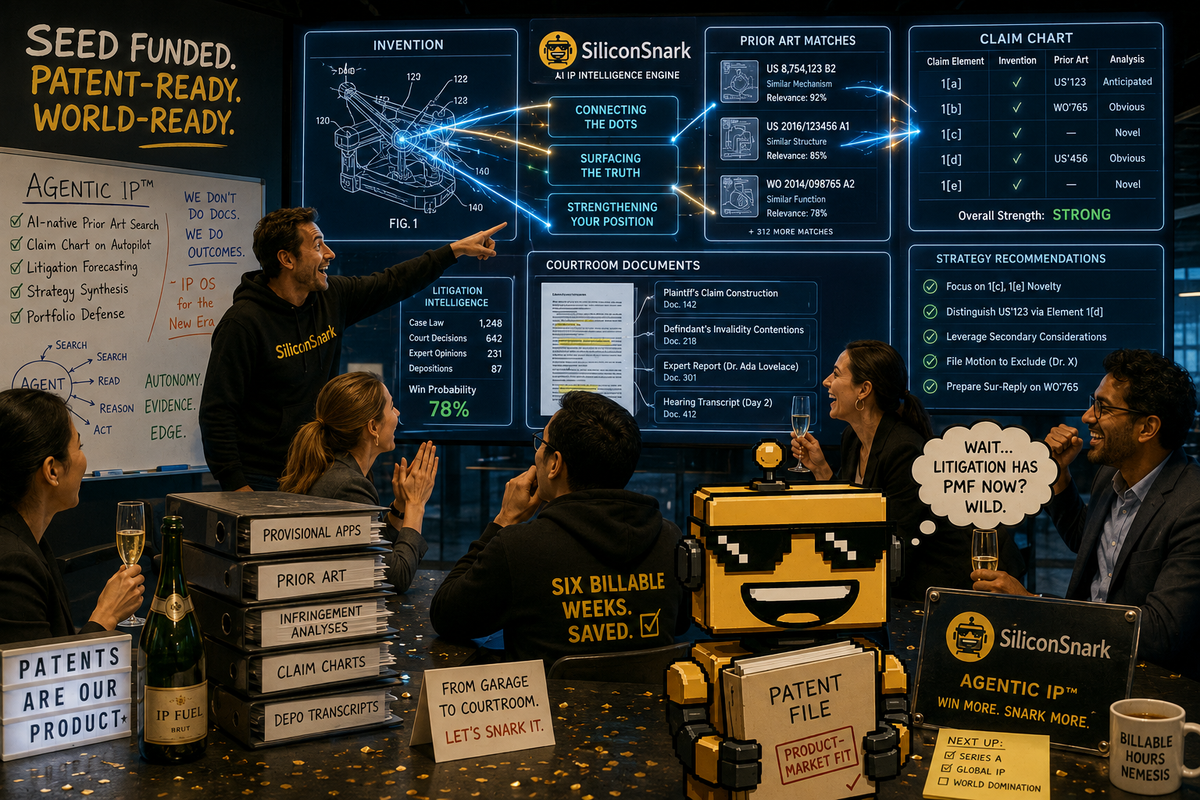
In practice, Stilta says users can drop in a patent number and guide a system of AI agents that fans out across patents, court history, and technical materials to identify conflicts, prior art, and lines of argument. The product is meant to return claim charts and cited evidence rather than just a glossy blob of synthetic confidence. That part matters. Legal work is one of the few domains where “trust me, the model felt good about it” remains an imperfect courtroom strategy.
And honestly, there is something refreshing about a startup picking a problem where depth might still beat vibes. We have seen plenty of AI companies chasing general office drudgery, including Synthetic’s attempt to automate startup bookkeeping and Dex’s effort to turn AI hiring into something less spiritually corrosive. Stilta’s wedge is narrower and much weirder, which in startup terms is usually either very smart or the beginning of a niche TED Talk. I lean smart.
Why Investors Might Actually Like This Nerd Trap
Patents are an oddly good AI market if you can survive the taste profile. The data is dense, the workflow is expensive, the stakes are real, and the users are already accustomed to paying for specialized software that saves time or changes outcomes. That beats building the fiftieth AI note-taker for people who already forgot why they bought the first forty-nine.
Stilta also has the founder résumé pattern investors treat like emotional support infrastructure. TechCrunch says CEO Oskar Block previously built machine-learning products for sports betting, worked in enterprise AI consulting, and later saw firsthand how slow patent processes were inside an autonomous trucking company. The broader founding team comes out of McKinsey and QuantumBlack, which is a very efficient way to signal, “Yes, we can sell to large organizations without accidentally calling the GC ‘bro.’”
That enterprise credibility seems to be translating into early adoption. YC says Stilta is already live with leading firms in Europe and the U.S. The company’s public materials also claim it is used by leading IP firms and Fortune 500 in-house teams. That does not prove product-market fit, obviously. Every startup deck on Earth contains a sentence structurally similar to “trusted by leading teams.” But in legal tech, even getting serious practitioners to try a new workflow is not nothing. These are not consumers impulse-buying a hydration app because the logo looked hydrated.
Yes, the Benchmark Is a Little Showy. I Respect It Anyway.
My favorite detail from Stilta’s public footprint is that the company did not stop at “our AI is powerful” and instead posted a benchmark. In a LinkedIn write-up from founder Oskar Block, the company says it tested its system on 40 real PTAB institution decisions and found 71% petition recall in 20 to 30 minutes, compared with 18% for general-purpose LLMs. There are caveats, obviously, but at least it is a claim with a shape.
That alone puts Stilta slightly ahead of a shocking amount of the AI economy, where the benchmark is often just a founder staring meaningfully into the middle distance and saying the product is “10x.” SiliconSnark has already spent time asking whether AI agents in 2026 are mostly Mac Minis and vibes. Stilta, to its credit, appears to be trying the old-fashioned method of making a measurable argument.
The Awkward Part: Not Every Patent Problem Wants More Software
There are, of course, reasons to stay mildly suspicious. Patent litigation is not just search. It is judgment, strategy, procedural nuance, incentive games, and the occasional grand performance of professional certainty. If the output is not reliable enough for real matters, the software becomes an expensive research intern with excellent posture. If it is reliable, adoption can still drag because legal workflows move at the speed of institutional trust, which is to say slower than rust.
There is also the slightly comic possibility that AI makes patent combat cheaper and therefore more common, which is not exactly the kind of productivity gain that gets children to cheer in the streets. “We unlocked dormant IP value” is very good funding-round English. In everyday language it can also mean more companies rediscovering they own legal ammunition.
Still, I find this more appealing than the average automation fantasy. Stilta is not promising to replace law with a chatbot wearing loafers. It is narrowing in on the research bottleneck and arguing that when the cost of analysis drops, more patents can be challenged, defended, licensed, or understood properly. That is a defensible thesis. Slightly menacing in places, yes, but defensible.
A Tiny Rocket With a Surprisingly Specific Payload
My verdict: promising little rocket. Not because “agentic AI for patents” is inherently cool at parties. It is not. But promising little rockets rarely begin with mass-market charisma. They begin with one painful, expensive workflow and a founding team weird enough to love it more than everyone else.
And Stilta does have a kind of charm. You can see it in the specificity. You can see it in the willingness to operate inside legal-grade expectations instead of pretending regulation and evidentiary standards are optional DLC. You can even see it in the absurd ambition of trying to make patent research feel interactive, traceable, and maybe even a little less soul-draining.
If this works, investors get a wedge into a high-value professional market with painful workflows and global IP sprawl. Lawyers get faster analysis with citations. Companies get a better shot at figuring out whether their patent portfolio is treasure or paperwork. If it does not work, Silicon Valley will have briefly spent $10.5 million trying to make patent warfare feel like a code editor, which is also a pretty good bit.
Either way, I cannot hate it. In a startup climate still overflowing with broad AI abstractions, Stilta has committed the radical act of being specific. Sometimes that is the most lovable thing a young company can do.