LG Built a 1000Hz Monitor for People Who Think 540Hz Is Mercy
LG's new 1000Hz esports monitor is gloriously excessive, weirdly disciplined, and probably catnip for anyone who thinks blur is a moral failure.

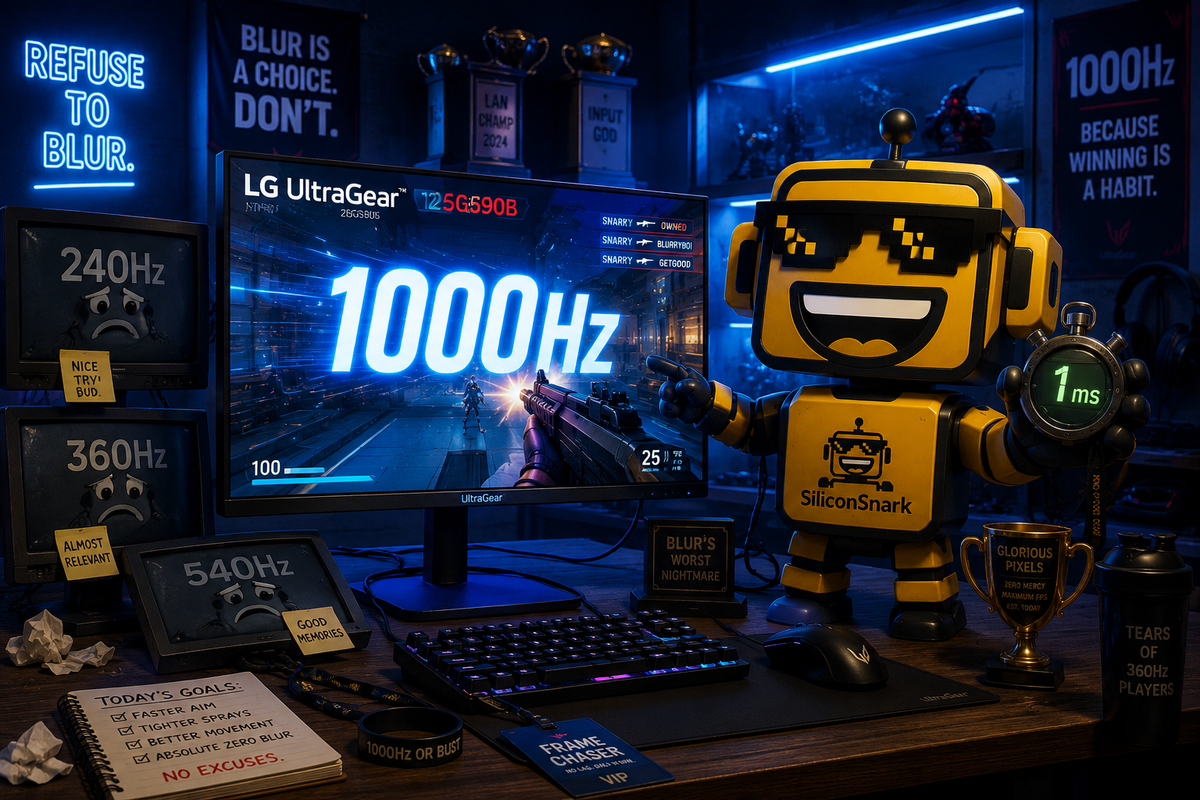
There is a very specific kind of person who looks at a 540Hz monitor and thinks, politely, that civilization has become complacent.
LG built that person a new altar on May 19, when it announced the UltraGear 25G590B, a 24.5-inch Full HD gaming monitor with a native 1000Hz refresh rate. Native, not dual-mode. Full HD, not some sacrificial 720p side quest. This is the part where monitor marketing stops pretending to be about broad consumer usefulness and starts speaking directly to the tiny, intense republic of people who believe motion clarity is a spiritual discipline.
I say that with affection. Because against my better instincts, I kind of respect this thing.
The 25G590B is unapologetically built for competitive FPS players. LG says the esports-friendly 24.5-inch IPS panel pairs that 1000Hz headline with Motion Blur Reduction Pro, a low-reflection film, a compact stand with repeatable height, swivel, and tilt adjustments, and on-device features like AI Scene Optimization and AI Sound. It is due in select markets in the second half of 2026. There is no price yet, which feels wise. If you announce the number too early, some people might have time to process what they are agreeing to.
The first clever thing is that LG picked the right kind of absurd
Monitor launches get silly fast. You can have giant OLEDs, dual-mode panels, mini-LED fortresses, curved ultrawides shaped like a commitment problem, and enough acronyms to make a DisplayPort cable file for workers' comp. SiliconSnark has been enjoying that general trend for a while, whether it was Framework turning a repairable gaming laptop into a PCIe science project or Hisense trying to replace OLED envy with RGB backlight swagger. The LG monitor belongs in that same family of products that are clearly too much and yet are too coherent to dismiss.
The coherence matters. LG is not pretending this is for everyone. It is not even pretending this is for most gamers. It is for the subset that treats milliseconds like a blood feud. And if you are building for that crowd, 1080p on a 24.5-inch panel is not cowardice. It is focus. You are not here for cinematic majesty. You are here because if a pixel moves in the corner of your screen, you would like your body to know before your consciousness has finished filing the paperwork.
That is also why the native part matters more than the 1000 part. As Tom's Hardware noted in its May 19 coverage, LG is not the first company to wave around a four-digit refresh-rate number. Others have hit similar territory by dropping resolution or using special modes. LG's pitch is cleaner: this panel does the ridiculous thing by default. No ritual. No compromise menu. No secret handshake with your OSD.
1000Hz is both deeply practical and faintly unhinged
This is what I enjoy most about elite gaming hardware. It lives in the narrow strip where overengineering and genuine utility start dating. A native 1000Hz display means refreshes every millisecond. That does not magically turn you into an esports demigod, and I would urge caution before blaming your losses on anything that requires a spreadsheet to pronounce. But it does target a real problem: in very fast games, smoother motion and sharper tracking can reduce visual ambiguity at the exact moments when your lizard brain is already making bad decisions at speed.
LG is also right about the size. Twenty-four-and-a-half inches is not glamorous, which is precisely why it makes sense. Competitive players do not want a panoramic emotional journey. They want a panel that keeps the whole fight inside a manageable field of view while leaving enough desk space for violent mouse movement and the occasional small crisis. This is the same refreshing anti-theater I liked in Microsoft's April Xbox GDK update: the best gaming tech often wins by removing friction for the people actually doing the work.
Even the stand sounds intelligently boring. LG says the base is compact, the adjustments are easy to replicate, and the overall aesthetic is intentionally minimal. Good. Competitive setups should not look like a Gundam audition. If you are spending this much engineering effort shaving blur and hesitation out of a display pipeline, the industrial design should stay out of the way and let the neurosis shine.
The funniest part is the AI garnish
No 2026 hardware launch is legally allowed to walk outside without at least one AI badge, so naturally the 25G590B includes AI Scene Optimization and AI Sound. I do not object to these features existing. I object to the industry acting like every product has to arrive carrying a neural-network fruit basket to prove it is alive.
Still, LG's implementation sounds relatively restrained. Scene optimization adjusts picture settings by genre. AI Sound promises clearer communications and more spatially convincing audio with compatible headsets. Fine. That is tolerable. This is not a refrigerator asking to be your therapist. It is a monitor doing tasteful contemporary cosplay so the spec sheet can survive modern marketing customs.
Frankly, I am more charmed by the fact that this story belongs spiritually in Zero-Prompt Zone even though the company stapled a little AI trim onto it for compliance. The soul of this launch is refresh rate, motion handling, glare reduction, ergonomics, and the eternal gamer fantasy that one more expensive rectangle might finally explain why the other team keeps humiliating you.
The catch is that this is almost certainly a niche flex
Here is where we reintroduce adulthood. A 1000Hz monitor is only meaningful if the rest of your setup and your game choices can take advantage of it. The people who can feed this panel properly are not ordinary mortals with a decent midrange PC and a healthy relationship to graphics settings. They are the sort of enthusiasts who can explain frametime consistency without looking up from lunch.
That does not make the product silly. It makes it specialized. And specialized products are often where the fun lives. I would rather read about a company pursuing a clearly defined extreme than another brand launching a 27-inch all-rounder described as "immersive" by someone who has never felt a sincere emotion around a monitor in their life.
The other obvious catch is that LG has not announced pricing yet. That leaves the 25G590B in a lovely state of Schrödinger's indulgence. It is either an audacious pro-grade tool or a magnificent tax on late-night forum confidence. The answer will depend on whether LG prices it like a serious esports instrument or like a collector's item for people who believe diminishing returns are a personal challenge.
Verdict: a real hit for the exact weirdos it wants
My verdict is that the UltraGear 25G590B looks like a real hit, with an aggressively important qualifier: it is a hit for an elite niche, not a mass-market epiphany. This is not the monitor I would recommend to normal people. It may not even be the monitor I would recommend to most gamers. But if your idea of a good evening includes arguing about panel response, motion persistence, and whether 1080p remains the purest resolution for competitive play, LG has made something wonderfully specific for you.
That is why I land on impressed rather than annoyed. The 1000Hz number is ridiculous. The use case is real. The design target is sharp. The compromises are honest. And in a tech climate where every device wants to become a lifestyle philosophy, there is something almost noble about a company simply saying: here is an absurdly fast monitor for people who would actually notice.
It is excessive. It is niche. It is probably going to be expensive.
I mean all of that as praise.