
Deep Dive: The Future of Google Search in the AI Era
Google’s new AI search turns queries into agentic tasks. This guide explains the tech, ad incentives, publisher fallout, and the shrinking web.

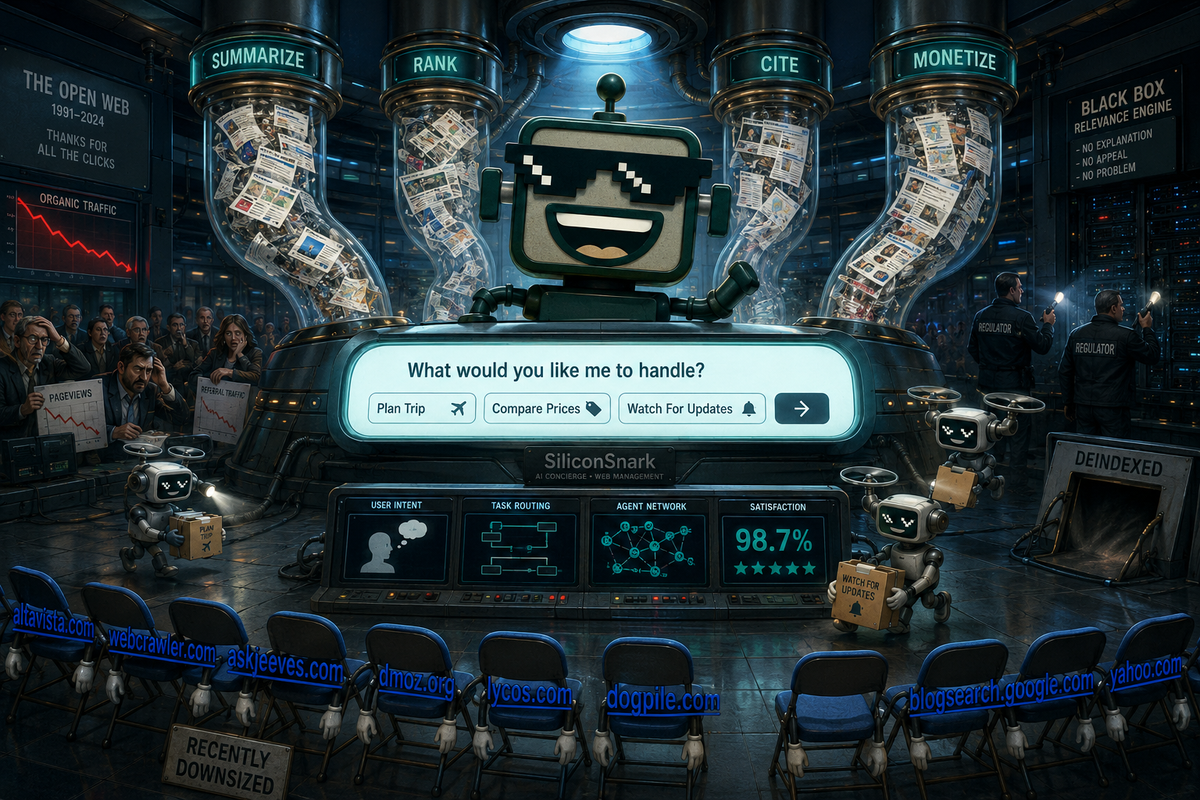
Google has spent most of its adult life trying to make search feel like plumbing. You typed a few words, it produced a ranked list, ads hovered nearby like well-dressed pigeons, and everybody pretended the arrangement was both natural and eternal. Then AI arrived with the social tact of a startup founder kicking open a conference-room door, and suddenly the most stable product in consumer tech decided it wanted a new personality.
At Google I/O on May 19, 2026, Google called this “a new era for AI Search”, and for once the marketing line is doing less exaggeration than usual. The company said Search is getting an intelligent AI-powered Search box, default Gemini 3.5 Flash in AI Mode, and “information agents” that can monitor the web, check blogs, news sites, social posts, and live data sources for changes related to your question. Google says those agents will launch first for AI Pro and AI Ultra subscribers this summer. That is not just a nicer summary box. That is the search engine volunteering to become a junior analyst with browser tabs.
The timely hook matters because it confirms something the industry has been circling for two years. Search is no longer being rebuilt around retrieval alone. It is being rebuilt around delegation. The point is not merely to help you find an answer faster. The point is to turn the answer layer into a control layer, where software interprets intent, synthesizes sources, recommends actions, and increasingly tries to complete the errand before you remember what the old web even felt like.
This is the bigger guide beneath the keynote glitter. Search is becoming conversational, multimodal, personalized, and agentic all at once. That sounds impressive because it is. It also sounds like a magnificent way to concentrate more economic and editorial power in a smaller number of interfaces, which is also true. SiliconSnark has been tracking adjacent pieces of this shift across AI browsers, computer-use agents, personal AI memory, and AI shopping. Search now sits at the center of all of them, because the product that understands the question is halfway to owning the action.
The Nut Graph: AI Search Is the Fight Over Who Gets to Stand Between You and the Web
If you want the clean version, here it is. AI search is not just “search with a chatbot on top.” It is a new interface for discovery, research, decision-making, and eventually transactions. The companies building it are competing to become the first place you go when you need to know something, compare something, plan something, buy something, or decide whether a source is worth trusting at all.
That sounds like old search, but the incentives are different. Traditional search mostly sent you elsewhere. AI search tries to finish more of the job in place. Sometimes it still links out helpfully. Sometimes it summarizes the outside world with the serene confidence of a student who skimmed half the reading. Sometimes it does both. But the economic direction is unmistakable. The more the answer can be completed inside the interface, the less power migrates outward to publishers, merchants, niche tools, and everybody else who once depended on search engines as traffic brokers.
Google is trying to keep that power while modernizing the interface. OpenAI is trying to use conversational AI to invade one of the biggest habits on the internet. Perplexity has spent the last year presenting search, browsing, and agent orchestration as one continuous product ambition. Meta wants AI to sit inside its own surfaces, including conversations, shopping, and glasses, rather than politely sending people away to the independent web. Even categories that seem far afield, from rebooted AI assistants to smart glasses, keep bending back toward the same question: when software helps you understand the world, where does that help originate, and who monetizes it?
So the why-now is not merely that Google showed new features on a stage. It is that the category has crossed from experiment into infrastructure politics. The interface to knowledge is being renegotiated in public, and the people who currently make the web are being asked to celebrate while the new middlemen quietly shrink the distance between “finding information” and “never needing to leave.”
How We Got Here: Search Began as Ranking, Not as a Tiny Synthetic Consultant
To understand why this shift feels so large, remember what Google originally was. In the famous 1998 Stanford paper describing Google as a prototype large-scale search engine, Sergey Brin and Larry Page were solving a retrieval and ranking problem. The web was getting too big, too messy, and too easy to spam with crude keyword tricks. Google’s core innovation was not “answer every question in prose.” It was to use the link structure of the web itself to infer relevance and authority. Search, in that model, was judgment about which outside documents deserved your click.
Google later turned that judgment into one of the greatest businesses in history. By Google’s own account on its 25th birthday in 2023, Search had spent a quarter century becoming a default behavior for billions of people. The product evolved constantly, of course. There were knowledge panels, featured snippets, shopping boxes, maps packs, local results, videos, carousels, and a steadily growing amount of page furniture designed to keep you on Google just a little longer while pretending it was all still about helping.
The generative turn made that drift explicit. At I/O on May 14, 2024, Google said Search could now “take the legwork out of searching” with expanded AI Overviews powered by a custom Gemini model. The language was revealing. A search engine used to help you do the legwork. Now the pitch was that it could do more of the legwork itself. That sounds like a product upgrade because it is one. It is also a philosophical rewrite of the service’s role.
Then came the inevitable correction. On May 30, 2024, after public ridicule over odd and incorrect AI Overview outputs, Google published a post explaining what happened, including new limits on nonsensical queries and satire or humor content. That was the internet’s early warning label. Once search starts synthesizing instead of just ranking, it inherits the full burden of sounding authoritative while occasionally being extremely, majestically wrong in paragraph form.
Since then, the category has kept moving anyway, because convenience is a very persuasive lobbyist. The question was never whether AI search would survive its first embarrassments. The question was whether the big platforms would treat those embarrassments as bugs to fix or as reasons to retreat. They chose the first option with the calm intensity of people who know the next interface war is already underway.
Why 2026 Feels Different: The Query Is Becoming a Workflow
There is a real difference between “tell me what happened” and “keep watching this for me, compare my options, and come back when something changes.” Traditional search handled the first request. AI search is increasingly designed for the second. That is the real significance of Google’s 2026 announcements. The interface is not just becoming chatty. It is becoming procedural.
Google’s own numbers suggest this is already changing user behavior. In a separate May 19, 2026 post about AI Mode usage, the company said AI Mode has surpassed one billion monthly active users globally one year after debut, that queries have more than doubled every quarter since launch, that the average AI Mode query is triple the length of a traditional Search query, and that planning-related uses have grown faster than AI Mode overall. Those are company claims, not neutral census data, but they line up with the obvious behavioral shift. Once users learn they can ask messier, longer, more situational questions, they stop typing like they are programming a vending machine.
That matters because long, contextual questions are more defensible territory for AI products than classic navigational search. If you type “weather Boston,” old-school search is already absurdly efficient. If you ask, “Plan a long weekend in Boston with indoor options if it rains, a hotel near the T, and one meal that won’t bankrupt me,” you have entered a zone where synthesis, memory, personalization, and task completion suddenly look valuable.
This is also why AI search keeps bleeding into adjacent categories. Search turns into planning. Planning turns into shopping. Shopping turns into agentic checkout. Search turns into research. Research turns into document generation. Search turns into “computer use.” The tidy old boundaries between engine, assistant, browser, and app are being sanded down until they can all fit inside one glowing field with a tasteful microphone icon and a suspiciously ambitious product manager behind it.
The industry would like you to experience this as ease. And to be fair, some of it really is easier. But underneath the convenience is a structural change: the query is becoming a workflow primitive. That gives the intermediary much more room to infer what you mean, choose what to show, decide what not to show, and eventually monetize the whole chain more creatively than a row of sponsored links ever could.
How AI Search Actually Works: Retrieval, Ranking, Synthesis, and Then a Little Bit of Theater
The term “AI search” makes this all sound like one coherent technology. It is not. It is a stack. First, there is retrieval: finding documents, product feeds, maps data, forum posts, real-time information, and whatever else the system can legally or contractually reach. Then there is ranking: deciding what is authoritative, relevant, current, and useful. Then there is synthesis: producing a response that merges and compresses source material into something readable. Then, increasingly, there is action: watching for updates, asking follow-up questions, filling forms, or moving toward a purchase or plan.
Google has been at pains to argue that its search-specific AI is not just a generic chatbot freelancing off old training data. In the May 30, 2024 AI Overviews explanation, the company stressed that AI Overviews are integrated with core ranking systems and designed to identify high-quality results from Google’s index, not simply riff from memory. That distinction matters. A good answer engine cannot just be eloquent. It has to be grounded in live retrieval, quality systems, freshness, and source selection or else it devolves into a very articulate hallucination with nice spacing.
OpenAI framed the same shift differently when it introduced ChatGPT search on October 31, 2024. Its pitch was that chat could provide timely answers with links to relevant web sources and use conversation context to get people to a better answer than repeated keyword searches would. In other words, the experience layer became the product. The web was no longer just a destination. It was a backing store for a conversation.
And then there is the theatrical part, by which I mean the interface’s increasing ability to imply judgment, confidence, and closure. A list of links always exposed some uncertainty. You had to choose. You had to open. You had to compare. An AI answer arrives as prose, which people are primed to interpret as synthesis and authority. Even when citations are present, the psychology is different. The system is not saying, “Here are your options.” It is saying, “I have considered your options and here is the answer-shaped object you requested.”
Sometimes that is exactly what people want. Sometimes it is honestly better. But it is also why errors feel so uncanny. A bad search result wastes your time. A bad AI answer impersonates understanding. The machinery underneath may be sophisticated, but the product experience is still built around the oldest trick in software: make a complex probabilistic system feel like a composed little genius with excellent bedside manner.
The Business Incentive Is Not Subtle: Search Wants to Keep the Intent and More of the Money
AI search is not being rolled out because the major platforms are overcome with a pure desire to spare you a few clicks. It is being rolled out because query intent is one of the most valuable raw materials in modern capitalism. Search captures what people want before they buy, before they vote, before they travel, before they hire, before they panic, and sometimes before they can even explain the thing to themselves. Owning that moment has always been lucrative. Owning more of the next step is even better.
The revenue context matters here. In Alphabet’s April 29, 2026 first-quarter earnings release, Google said Search & other revenue grew 19% year over year to $60.4 billion, Google Services revenue rose 16% to $89.6 billion, and Sundar Pichai said AI experiences were driving usage and queries to an all-time high. When the incumbent with that kind of search business tells you the query format is changing, you should not hear “feature refresh.” You should hear “defensive modernization of the empire.”
The old model monetized discovery largely through ads adjacent to results. The new model can monetize discovery through a richer mix: subscription tiers for advanced agents, preferred shopping placements, better ad targeting from more detailed intent, deeper integration with commerce flows, and a stronger claim to remain the place where actions begin. Once the search box becomes a task box, the platform has more opportunities to capture value from the task.
This is why AI search keeps sounding so eager to help with planning, comparison, and shopping. Those are not random use cases. They are intent-heavy, monetizable, and close to transactions. It is also why the category overlaps with health questions, personal finance, travel, local services, and anything else where “better answers” can drift into “better commercial positioning.” The interfaces are being trained to feel more useful precisely where usefulness has high economic yield.
None of this means the products are fake. Quite the opposite. The economic motive is strong because the utility is real. The trouble is that genuine utility and aggressive platform capture are not opposing forces in tech. They are usually dance partners. AI search is a perfect example: help the user more, keep the user longer, own more of the decision, and call the whole thing progress. Which, to be clear, it partly is. It is also concentration wearing a convenience hoodie.
Competition Is Now a Four-Way Knife Fight: Google, OpenAI, Perplexity, and Meta Want Different Versions of the Same Prize
Google’s advantage is infrastructure, habit, and the fact that it already intermediates an absurd portion of the world’s informational life. It has index scale, ranking systems, product distribution, and an ad machine that can fund very expensive experiments while insisting they are simply the natural next step in helping organize the world’s information. Its main problem is that it has the most to lose if users decide the old habit of “googling” should belong to a different interface.
OpenAI’s advantage is that it taught mainstream users to ask software questions in natural language without embarrassment. The company’s search launch made that ambition explicit: search as a conversational layer that can browse when needed and keep context across follow-up questions. OpenAI does not need to inherit all of Google’s old search behavior to matter. It only needs to capture enough high-value informational sessions that the default reflex changes from “search first” to “ask first.”
Perplexity has been the most ideologically direct about where this is going. The company’s public blog archive shows a steady progression from publisher deals and ads in 2024 to Comet, Computer, and repeated arguments in 2025 and 2026 that search, browsing, and autonomous work should be treated as one evolving system. It is basically saying the answer engine should graduate into an operating environment. This is the part where the category stops being “a better search experience” and starts sounding like it wants your tabs, your files, and your afternoon.
Meta, meanwhile, does not need to win classic web search to shape discovery. In its April 8, 2026 Muse Spark announcement, updated May 12, Meta said shopping mode in Meta AI can search Facebook Marketplace listings near you alongside options from across the internet. That is the strategic tell. Discovery no longer has to happen in a dedicated search engine if it can happen inside the surfaces where people already chat, scroll, watch, and shop. Meta is not trying to recreate ten blue links with better vibes. It is trying to make “finding things” one more ambient service inside its own ecosystem.
So yes, the category looks fragmented. But the prize is consistent. Everyone wants to own the gateway where curiosity turns into trust, trust turns into preference, and preference turns into action. They just disagree about whether that gateway should look like a search box, a chat thread, a browser sidebar, a personal assistant, or a pair of glasses quietly muttering your dinner options.
The Publisher Problem Is the Real Moral Test of the Category
Every AI-search company insists, in one form or another, that it still values the open web. This is like a developer saying they deeply value documentation while shipping a product explicitly designed to reduce how often anyone needs to read it. The affection may be sincere. The incentive structure is still doing other things.
Google’s defense has been that AI Overviews can send higher-quality traffic to the web, meaning users who do click may be more likely to stay and find what they need. That may be true in some cases. But the larger traffic pattern looks harsher. In a July 22, 2025 Pew Research Center analysis of 68,879 Google searches from 900 U.S. adults, users clicked a result link less often when an AI summary appeared, and clicked a source cited inside the summary itself just 1% of the time. Users were also more likely to end their browsing session entirely after visiting a page with an AI summary.
That should not surprise anyone. If the interface provides a neat synthesis, many users will stop there. Some of them should stop there. Plenty of factual lookups do not require a pilgrimage through three ad-tech mangroves and an autoplay video explaining the weather in sixteen monetizable steps. But the aggregate effect is still punishing for the sites that produce the underlying information. The better the answer layer gets at satisfying lightweight curiosity, the more it cannibalizes the informational middle class of the web.
Publishers are therefore trapped in a charming little modern bargain. They are needed as source material, cited as evidence of openness, and then structurally bypassed whenever the answer layer succeeds too well. Some platforms are trying to soften that with licensing, partnerships, or publisher programs. Some are merely adding citations like a decorative apology. But the conflict is not cosmetic. It is economic. If the web increasingly becomes a place where content is extracted, summarized, and re-presented upstream, then the financial foundation for creating that content gets shakier.
This is why the publisher issue is not just a media-industry complaint. It is the moral stress test for AI search. If these systems genuinely improve access to information while also eroding the incentive to produce public information, then the category is solving user friction by borrowing against the future supply of what users need. That is not innovation in the radiant civilizational sense. That is a revenue model with a delayed headache.
Regulators Have Finally Noticed That Search Is Becoming an AI Chokepoint
For years, critiques of search power often sounded abstract to ordinary users. Default placements, scale advantages, data access, ad dominance, self-preferencing, distribution contracts. These are all important and all slightly less thrilling than almost anything else on your phone. AI changes the salience because it makes intermediation more obvious. When a system answers for the web rather than merely pointing at it, the power question gets easier to see.
In the United States, the antitrust backdrop is already concrete. In a September 2, 2025 Justice Department release, updated April 15, 2026, DOJ said it won remedies in its search monopolization case against Google, including limits on exclusive distribution contracts and requirements that Google make certain search index and user-interaction data available to rivals and potential rivals. That is an extraordinary clue about where the policy conversation is heading. Search data itself is increasingly treated as strategic infrastructure, not just the exhaust of a successful product.
Europe is pushing on a related front. On January 27, 2026, the European Commission opened proceedings to help Google comply with Digital Markets Act obligations around interoperability and search data sharing. Then, on April 16, 2026, the Commission launched a consultation on proposed measures for Google Search data sharing, explicitly welcoming input from third-party online search engines, including AI chatbots with search functionality, and stating a final decision must be adopted by July 27, 2026.
That is not random bureaucracy. It is regulators recognizing that AI-era competition in search may depend on access to data and interfaces that incumbents would very much prefer to keep ornamental and private. If AI search is the next discovery layer, then the fight is not only about whether Google can place Gemini more prominently. It is about whether rivals get enough raw material to build meaningful alternatives at all.
The policy irony is delicious in a bleak way. Just as search becomes more conversational and consumer-friendly on the surface, it becomes more infrastructure-like underneath. The UI says helper. The law increasingly says gatekeeper. Both are correct.
Hype Versus Reality: AI Search Is Better Than the Cynics Say and Worse Than the Evangelists Admit
The fair way to talk about AI search is to avoid two lazy extremes. The first says it is all vapor, a glorified autocomplete machine stapled to a browser, good mainly for confidently misinforming your uncle. The second says the classic search engine is already obsolete and we can all relax because the machine now handles knowledge elegantly and at scale. Neither is serious.
AI search is genuinely good at compressing broad overviews, handling vague or long-form questions, comparing structured options, and keeping context over a chain of related prompts. It is especially useful when the old keyword model forced users to translate a real problem into little search incantations like medieval peasants bargaining with an index. If you have ever known what you want but not how to phrase it into search-engine Esperanto, you understand the improvement immediately.
It is also genuinely bad at the exact places where confidence outpaces evidence. Source selection can be thin. Synthesis can flatten nuance. Timely topics can shift underneath cached assumptions. Commercial results can smuggle preference into what feels like neutral guidance. And the very polish of the format can make users less likely to inspect the underlying material. The interface does not merely answer. It narrates certainty.
That means the right question is not “does AI search work?” It obviously works, sometimes impressively. The right questions are narrower and much more useful. On which query classes is it reliably better than traditional search? When should the system summarize versus defer? What sorts of evidence deserve visible friction? How should commercial influence be disclosed when recommendations sound like helpful reasoning instead of ads? When should an answer layer be punished for being wrong, and how visibly?
The danger is not that AI search fails to improve anything. The danger is that it improves enough of the experience to become normal before society finishes deciding what kinds of hidden tradeoffs it is making on our behalf. That is how a lot of internet history works. Convenience settles the argument first. Governance arrives later, carrying a folder and an injured expression.
The Cultural Meaning Is That the Web Is Becoming Less Exploratory and More Concierge
Old web culture had many flaws, several of them wearing Comic Sans and autoplay audio, but it also had a different emotional posture. Search was a route into a landscape. You found weird blogs, obscure forums, personal projects, mailing-list archaeology, message-board feuds, government PDFs, baffling local businesses, and occasionally the exact answer you needed hidden on a page last updated by a retired hobbyist in 2011. It was inefficient. It was also, at times, gloriously alive.
AI search is optimized for a different feeling. It wants the web to arrive pre-digested, smoothed, and purposeful. It prefers not to present the full unruly bazaar if it can hand you a respectable briefing and send you on your way. In many contexts that is a mercy. Nobody sane should romanticize hours of search-result trench warfare for basic questions. But the cultural shift still matters. The internet increasingly wants to feel less like exploration and more like managed service.
This dovetails with the broader move toward identity, context, and personalization. The system that knows what you asked now wants to know who you are, what device you are using, what you bought last time, what subscriptions you keep, what calendar constraints you have, and which flavor of advice gets you to click. The move from generic retrieval to contextual assistance is inseparable from the move toward more intimate user models. Search is becoming another chapter in the story SiliconSnark has been telling about governed identity, ambient software, and products that want a suspiciously complete file on your life.
There is also a class dimension to this, though the industry rarely says it out loud. The concierge internet is a premium internet. It assumes users want speed, synthesis, filtering, and abstraction more than they want raw access. Often that is true. But it also means the informational experience gets stratified by who can pay for better agents, fewer ads, more context, and more automation. The future of “search” starts to look less like public navigation and more like tiered guidance.
The final irony is that AI search keeps marketing itself as empowering curiosity while quietly reducing how much wandering curiosity requires. It is not killing curiosity. It is professionalizing it. The machine would like to take your question, fetch the web, remove the chaos, and return only the part that seems likely to make you feel efficiently informed. Some days that is wonderful. Some days it feels like outsourcing serendipity to a product team.
What to Watch Next: Agents, Defaults, Data Access, and Whether the Link Survives as More Than a Courtesy
First, watch whether agentic features stay premium or become baseline. Right now Google says information agents will launch first for AI Pro and AI Ultra subscribers. That makes sense because agents are expensive, useful, and an elegant way to sell a tier above “free search.” But if they prove sticky enough, some version of them will move downmarket, because the company that turns search into a habit of delegation gets much closer to owning the whole workflow.
Second, watch distribution defaults. Search history teaches the same lesson over and over: behavior follows placement more than ideology. If AI answers become the default surface on phones, browsers, voice assistants, and wearables, then the public debate over whether people prefer classic search will quickly become academic. They will use what is there. That is one reason the battle keeps touching assistants, browsers, and hardware surfaces all at once.
Third, watch the data-sharing fights. The U.S. and EU are both signaling that access to search inputs and outputs is a competitive issue in its own right. If regulators force more meaningful interoperability or data portability, the AI-search market could stay plural for longer. If not, the incumbents’ distribution and data advantages get amplified by the very systems now being sold as a new era of openness and helpfulness.
Fourth, watch the publisher settlement layer. The web can absorb some amount of summarization and traffic loss. It cannot absorb infinite extraction while still producing a robust supply of original reporting, niche expertise, reviews, and public-interest information. The systems that benefit most from the web’s existence will have to decide whether links, licensing, revenue-sharing, and attribution are serious commitments or ceremonial garnish.
Finally, watch public tolerance. There will be domains where people enthusiastically accept AI mediation because the convenience is overwhelming. There will be other domains where error, bias, or missing context triggers a backlash. Search does not fail or succeed all at once. It fragments by use case. The biggest winners will not be the loudest demos. They will be the systems that know where synthesis helps, where caution is needed, and where the web still deserves to be encountered as more than a summarized resource pool.
The Sharp Takeaway
Google’s May 19, 2026 search overhaul matters because it makes the category’s direction impossible to deny. Search is no longer just ranking. It is answering, watching, planning, and inching toward action. The query box is being rebuilt into a task box. The companies fighting over that box are not merely competing to organize information. They are competing to mediate reality a little earlier and a little more completely than before.
The fair case for AI search is strong. It can handle more natural questions, reduce drudgery, make complex research more approachable, and help ordinary users get useful synthesis faster than classic results pages often could. Some of that is real progress. A lot of the old search experience genuinely was a tax on human patience.
The skeptical case is equally strong. These systems centralize attention, compress source diversity, weaken outbound traffic, and create new ways for commercial and platform incentives to hide inside polished recommendations. They also intensify the importance of data access, defaults, and regulatory oversight precisely when the interface is becoming more trusted and less inspectable.
So the clean conclusion is this: AI search is not the death of search. It is search finally admitting what it always wanted to be. Not a map to the web, but a manager of the web. Not a directory, but a negotiator. Not a neutral box, but a participant in what gets seen, what gets summarized, what gets sold, and what gets quietly left outside the answer.
If you want the snark version, here it is. The ten blue links did not die. They got performance-managed by a chatbot with executive backing and a monetization plan. If you want the sober version, it is this: the internet’s main gateway is being redesigned so that fewer questions end with a click and more of them end with a mediated conclusion. That will make plenty of users happier. It will also decide, in very practical ways, what kind of web is still economically and culturally possible on the other side.