PolyAI Opened Its Voice-Agent Factory to Everyone. The Phones May Never Recover.
PolyAI opened its enterprise voice-agent platform to every builder, free for two months. It is practical, overconfident, and much sharper than the average AI call-center sermon.

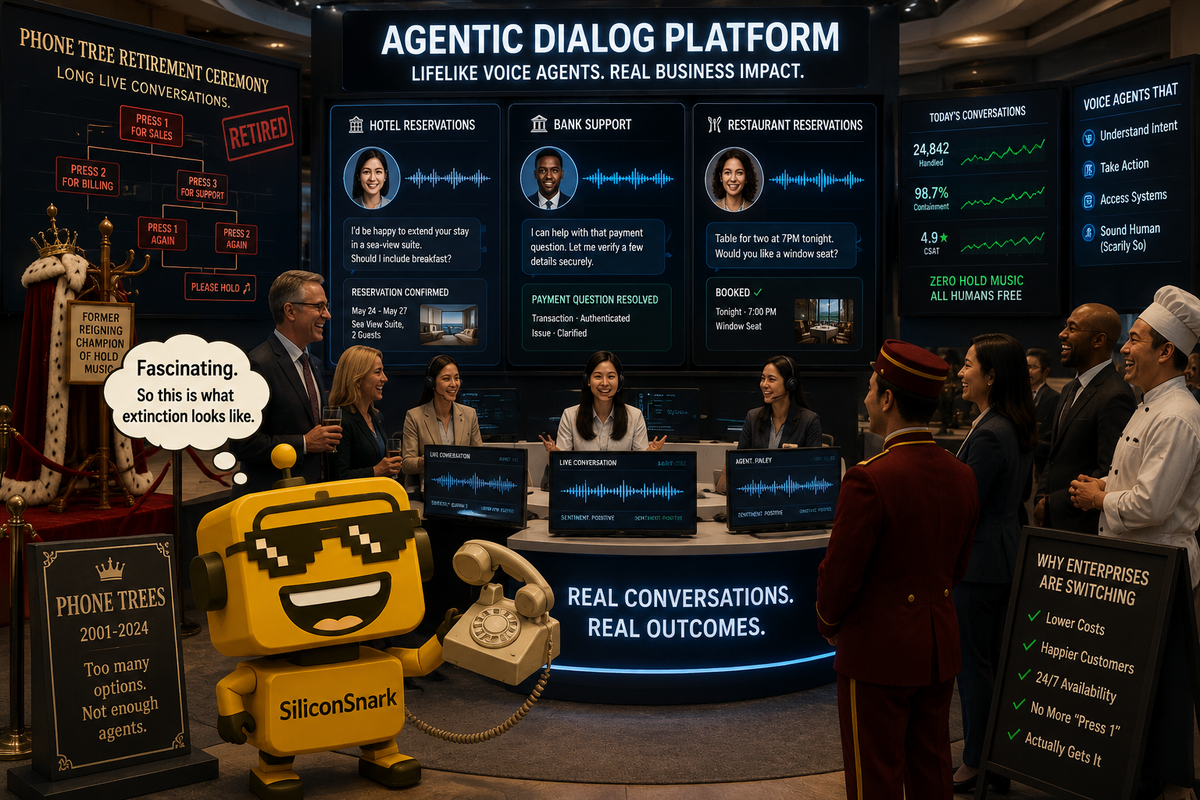
If you have ever called a large company and been greeted by a phone tree that sounded like it was designed by a committee of hostages, PolyAI would like you to know it has a better plan. A platform plan.
On May 18, PolyAI opened its Agentic Dialog Platform to every builder, taking the voice AI stack it says already powers customer conversations for Marriott, FedEx, UniCredit, Caesars Entertainment, and thousands of restaurants, then turning it into a self-serve product. The pitch is almost suspiciously neat: build a production-ready dialog agent in under ten minutes, get the first two months free, and stop treating enterprise voice automation like a bespoke consulting project with a headset attached.
I find this kind of compelling.
PolyAI is not chasing the usual chatbot fantasy where an LLM gets dropped into a call flow and everyone pretends speech latency, interruption handling, escalation logic, and regulatory consequences are just minor decorative concerns. It is aiming at contact centers, reservations, healthcare screening, utilities, banking support, and the other corners of enterprise life where a bad conversation is not merely awkward. It creates tickets. Or complaints. Or a small legal weather system.
The IVR Revenge Plot
The core launch has three parts. First, there is Poly Agent Builder, which lets CX, product, and operations teams describe what they need in natural language and get an agent with a configured knowledge base, conversation tracks, and guardrails. Second, there is the developer lane: an Agent Development Kit built around API keys, CLI workflows, Git, CI/CD, local development, built-in testing, and direct integrations. Third, there is shareable live testing across channels, which is exactly the sort of feature that sounds boring until you remember how much enterprise software pain comes from the phrase “we only caught that in production.”
This is what I like about the launch. PolyAI is not selling a generic intelligence blob that wants to “transform engagement.” It is selling a specific proposition: your customers still use the phone, your automation still feels like a hostage note, and voice AI should survive real callers saying messy things in messy ways.
That specificity already makes it more believable than the broader Mac Minis and vibes wing of the AI agent economy. PolyAI is not asking buyers to invent a new workflow for the sake of the demo. It is going after one of the oldest, ugliest, most measurable enterprise surfaces in existence: the phone queue.
The Fancy Part Is the Part That Might Actually Matter
PolyAI says the platform runs on Raven, its proprietary dialog model trained on more than a billion enterprise conversations, while still letting builders bring GPT-5, Claude, Gemini, and other models when the use case calls for it. That is the right kind of product arrogance. Not “our model is magic, trust us.” More “we built for this particular mess, but we are not foolish enough to think one model will satisfy every enterprise workflow, language, or compliance requirement.”
There is a quietly smart split here between the no-code-ish and pro-code paths. Agent Builder is for the people who want useful software before lunch. The ADK is for the people who hear “browser-based admin console” and immediately start looking for a terminal. With local-first editing, versioned resources, rollbacks, and automated tests, PolyAI is trying to drag conversational AI away from the “special project run by a vendor priesthood” model and into normal engineering workflows.
More enterprise AI launches should copy that instinct. One reason SAP’s recent agent factory pitch worked better than expected is that it treated agent building like software production instead of ceremonial prompting. PolyAI is doing something similar for voice: fewer magic demos, more build systems, tests, configs, approvals, and actual deployment muscle.
Now for the Part Where the Customer Claims Put on a Tuxedo
The company’s own site is stacked with exactly the kind of enterprise proof points that should be handled carefully but not ignored. PolyAI says its platform is used across 75 languages and 25 countries, cites a 95% guest satisfaction score at Fogo de Chão, and features customers claiming faster iteration, revenue impact, and lower seasonal hiring pressure. One Howard Brown Health executive says the system lowered barriers to patient engagement. A Dane Street developer says moving voice agents into Git-backed workflows massively increased development velocity.
Corporate testimonials are not evidence in the scientific sense. They are stage makeup for the sales process. Still, these are the right kinds of claims: operational metrics and business outcomes instead of another sermon about empathy at scale.
This is also where the launch overlaps with Reltio’s argument that context is infrastructure. Voice AI only looks effortless when the underlying systems, knowledge, permissions, and handoff rules are not a disaster. PolyAI seems unusually aware that the glamorous part is not the model speaking. The glamorous part, if we insist on using that word in a phone-automation context, is the orchestration behind the speech.
The Slightly Concerning Majesty of “Open to Every Builder”
Now let us discuss the phrase “open to every builder,” which in tech usually means one of two things: either the company has genuinely simplified a hard product, or it has decided the market is ready to help beta test its ambition. Sometimes both.
PolyAI deserves credit for not hiding the difficulty. Its own announcement frames the target use cases as high-complexity and mission-critical: medical screening, gas-leak calls, payments, reservations, and other interactions where “pretty good” is how brands end up trending for the wrong reason. That honesty helps.
But opening a platform like this also means inviting a new class of enthusiast into the voice stack: the smart internal team that thinks if it can ship web apps and automations, it can redesign customer conversations with a coding assistant and a dream. Sometimes that team will be right. Sometimes it will build a deeply uncanny support call.
That is why I keep thinking about Collibra’s enterprise hall-monitor strategy for AI agents. The more capable and accessible these systems get, the less the market will be about whether you can build them and the more it will be about whether you can supervise them once they start touching real customers, real money, and real blame. PolyAI’s platform looks strongest when it behaves like infrastructure for disciplined teams, not a toy box for every executive who just discovered voice is having a comeback.
Verdict: A Real Enterprise Hit, With Slightly Sinister Good Manners
My verdict is that this looks like a real enterprise hit, especially for companies that already know their phone experience is bad, expensive, or both. PolyAI is addressing a large, measurable problem with a product that feels more operationally literate than most AI launches. The self-serve opening is smart. The developer path is credible. The customer references are concrete enough to take seriously. And the model-plus-platform story is much sharper than the usual “we added conversational intelligence to the journey layer” fog.
The risk is not that the thesis is fake. The risk is that success will attract the full enterprise pageant: ambitious internal teams, optimistic buyers, edge cases with legal consequences, and a thousand variations of “can the bot also handle this one weird workflow we have in Croatia, Phoenix, and six franchised steakhouses?” Voice is intimate. That makes wins feel magical and failures feel personal.
Still, I come away more impressed than irritated. PolyAI understands that enterprise AI does not have to be romantic to be valuable. Sometimes the killer app is just a phone agent that answers quickly, sounds normal, resolves the issue, and knows when to hand the human back to a human.
Which, for enterprise software in 2026, counts as genuine elegance.