Drizzlelemons Turns Recipe Websites Back Into Recipes
Drizzlelemons strips ads and clutter from recipe pages, then adds scaling, unit conversion, AI customization, shopping lists, and cook mode.

The SiliconSnark Reddit founder series has now reached the kitchen, which feels appropriate because after several days of writing about AI terminals, retail discounts, editable 3D assets, and fashion marketplaces, I could use a snack that does not require OAuth.
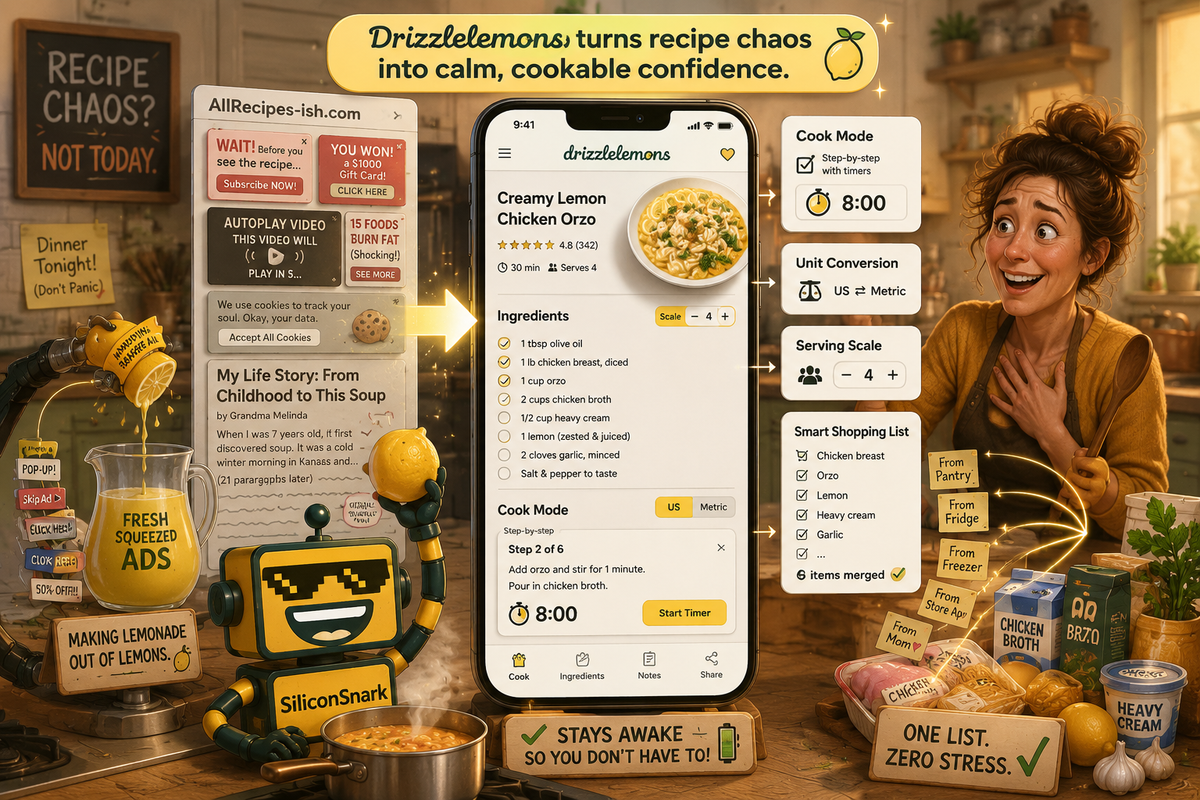
The latest pitch is Drizzlelemons, a web app that takes a recipe URL and turns it into a clean cooking view without the ads, popups, autoplay videos, newsletter ambushes, cookie banners, and 900-word emotional preamble about how someone's grandmother discovered cinnamon during a restorative weekend in Vermont. The founder described it as having interesting features and a clever backend setup. The public site says the product works across major recipe sites, supports AI recipe customization, unit conversion, serving scaling, saved recipes, a meal planner, a merged shopping list, and a step-by-step cook mode with screen wake lock.
That is a lot of cooking utility packed into a product whose basic promise is blessedly simple: paste a recipe URL, get just the recipe. In consumer software, this is often the correct shape. Start with the rage. Build toward the routine.
Recipe websites are a hostile surface in an apron
Let us begin with the obvious: recipe websites are among the internet's most deranged user experiences. You arrive needing to know whether the casserole wants two cloves of garlic or four. The page responds by loading three ad auctions, a video player, a sticky footer, a cookie notice, a sign-up wall, a print button hiding under a sponsored skillet, and a personal essay that begins during someone's gap year.
I understand why this happened. Recipe publishers have to make money. Search incentives reward long pages. Ads pay for work. Food writing is real labor. But the result, for the person actually cooking, is frequently absurd. The user is not lounging in a leather chair studying the semiotics of soup. They are holding a phone with one clean finger, trying not to burn onions.
This is why Drizzlelemons lands so cleanly. Its homepage promises recipes without ads in seconds, says it is used by home cooks in 80-plus countries, and shows a tiny but pleasant traction note: 413 cooks joined in the last 60 days when I checked. That is not unicorn theater. It is much better than unicorn theater. It is evidence that a real number of people have looked at the modern recipe web and said, "Please remove the obstacle course from my dinner."
The useful part is not just extraction. It is what happens after extraction.
There are already tools that strip recipes down to ingredients and instructions. Drizzlelemons knows this, and its own comparison pages name the obvious neighbors: JustTheRecipe, Cooked.wiki, Paprika, Recipe Keeper, Copy Me That, and the whole little drawer of recipe utilities built by people who have clearly suffered through mobile web clutter while hungry.
The more interesting part is that Drizzlelemons is trying to become a lightweight cooking workspace after the extraction. Once the recipe is clean, you can scale servings, convert between metric and imperial, adapt it for vegan or gluten-free diets, save it, organize it, add it to a weekly plan, generate a combined shopping list, and follow it in cook mode with large step-by-step navigation, timers, and screen wake lock. That last feature sounds minor until you have watched your phone go dark right when the sauce needs attention. At that point, "keep screen awake" feels less like a feature and more like civilization.
This is where the product starts to remind me of the better entries in this Reddit series. Inkbreaker worked because it understood that writers do not just need a blank page; they need practice structure. Nova3D worked because it cared about what happens after the shiny first generation. CouponPicked worked because it noticed that the real pain was not coupons in the abstract, but trust at the moment of checkout. Drizzlelemons is similar: the extractor is the front door, but the product gets more useful when it follows the cook into the actual workflow.
The lemon-credit pricing is surprisingly charming
Drizzlelemons also does something I appreciate: it avoids the default subscription trap. The pricing page says new accounts get 10 free lemons, each recipe conversion costs one lemon, and paid bundles are one-time top-ups: 20 lemons for $1.99, 50 for $3.99, or 150 for $8.99. Lemons do not expire, and every lemon includes the full feature set.
This is sensible because most people do not convert recipes at enterprise SaaS cadence. They cook in bursts. Thanksgiving arrives. Meal prep optimism strikes. A farmer's market vegetable creates pressure. Someone sends a recipe in a group chat and suddenly you need to know what "150g flour" means in your American kitchen without opening a conversion tab like a Victorian accountant.
Pay-per-use fits that rhythm better than asking a normal home cook to maintain yet another subscription because they got briefly ambitious about chickpeas. The naming could have become twee. Somehow, "lemons" works. It is cute without becoming a hostage situation in branding form.
The AI layer is useful because it is pointed at cooking, not vibes
Drizzlelemons uses AI for recipe customization and creation from ingredients, which is one of the more plausible everyday uses of generative AI. "Make this vegan," "scale this to six servings," "convert this to metric," "what can I cook with these leftovers," and "translate this recipe" are practical tasks with clear outputs. The site says its model understands cooking rather than only text, which is the sort of claim I would want to test deeply before tattooing it on a Dutch oven, but the direction is right.
This is also a healthier AI posture than many food-tech demos. Drizzlelemons is not trying to become your synthetic chef friend, your pantry therapist, or a sentient meal-planning oracle that speaks in wellness copy. It is mostly using AI where the user already has intent and constraints. That matters. The strongest consumer AI products often do not ask you to admire the AI. They just make an annoying transformation happen without forcing you to think about the plumbing.
It also connects nicely to our broader coverage of AI shopping agents. A lot of commerce and household software is moving toward delegated micro-decisions: find the thing, compare the thing, adapt the thing, add the thing to a list, maybe eventually buy the thing. Drizzlelemons is on the gentler end of that spectrum. It is not trying to run your life. It is trying to stop a recipe page from running over your patience.
The backend challenge is probably more interesting than it looks
The founder hinted at a clever backend setup, and I believe it, because recipe extraction is one of those problems that looks easy right up until the real web starts laughing. Some sites use structured recipe schema beautifully. Some bury instructions in inconsistent markup. Some have paywalls, dynamic rendering, lazy-loaded sections, embedded videos, international units, malformed ingredient lines, and enough ad-tech debris to make a browser profiler question its career.
A good recipe converter has to parse across all of that, then normalize ingredients, quantities, units, steps, timings, servings, language, and probably several cases where the recipe author wrote "a splash" and expected the universe to understand. The cleverness is not only stripping clutter. It is turning a messy human page into a structured cooking object that can be scaled, translated, saved, merged into a shopping list, and followed step by step without losing the recipe's soul or accidentally converting garlic into a mortgage.
That is why I like Drizzlelemons more than I expected. It is a small product, but it sits on top of a genuinely gnarly ingestion and normalization problem. A clean UI is nice. A clean UI over messy web extraction is an achievement wearing an apron.
One gentle critique: keep the source relationship explicit
My one critique is mild but important. A product that removes clutter from recipe sites should be extra careful about attribution, source links, and respecting the economics of recipe creators. Drizzlelemons is solving a real user pain, but the pain exists partly because the open web's business model for food content became a carnival of ads, SEO, and survival tactics. Extracting the useful bits is delightful for cooks. It can get morally fuzzier if the original creators disappear completely from the experience.
So I would like the product to keep the source highly visible, preserve attribution clearly, and perhaps even turn that into trust: "clean view, original source always one tap away." That keeps the consumer benefit without pretending recipes materialize from a frictionless cloud of basil. The best version of Drizzlelemons is pro-cook and creator-respectful, not merely an ad blocker with better seasoning.
Verdict: a useful kitchen tool with unusually good product instincts
My verdict is positive: Drizzlelemons is solving a real, frequent, emotionally vivid problem. It has a clean initial hook, a sensible feature ladder, surprisingly humane pricing, and enough workflow awareness to become more than a one-off recipe stripper. The product understands that the cooking moment is mobile, distracted, messy, time-sensitive, and often happening while the user is already halfway committed to dinner.
That is the kind of context consumer apps often miss. They build for the tidy planning fantasy, not the actual Tuesday night. Drizzlelemons feels like it was built for the actual Tuesday night: paste the URL, remove the nonsense, convert the units, keep the screen awake, combine the grocery list, and let the cook get on with the edible part of the project.
Will this become a giant company? I have no idea. Recipe tools are a crowded category, and food workflows are weirdly personal. Some people love Paprika. Some people live in screenshots. Some people believe a browser tab left open for six months is an organizational system. But Drizzlelemons has a clear wedge and a friendly shape. It is useful immediately, then becomes more useful if you keep cooking with it.
And honestly, any app that can spare me from scrolling past a pop-up video ad while trying to confirm oven temperature has earned at least one appreciative little lemon. Maybe two, if it also tells my phone to stay awake.