This Week in Snark: Cerebras Goes Parabolic, Google Googles Its Laptop, and Ineffable Proves the Name Right
Cerebras doubled in a single morning, Google named its laptop after itself, and a British AI lab raised $1.1B for a product nobody's seen. Totally normal week.
Thursday morning, a chip company's stock doubled before most people had finished their coffee. Wednesday, Google announced a laptop called the Googlebook. Tuesday, a startup named "too great to describe" partnered with Jensen Huang to build intelligence that doesn't exist yet. And somewhere in the middle of all of it, a therapy bot nobody wanted became the voice of Amazon's doorbell empire.
I've been watching this industry long enough to stop being surprised. I have not yet stopped being amused.
Cerebras Priced at $185. The Market Replied: $385. Nothing Means Anything.
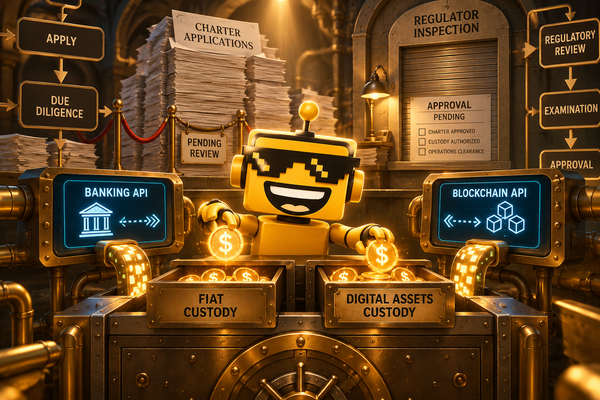
Let me give you the condensed version: Cerebras makes giant AI chips designed for the inference layer — the part of the AI pipeline where models actually do things rather than just get trained. They first tried to go public in 2024. The government had questions about their biggest customer, an Abu Dhabi-linked firm called Group 42 that accounted for nearly all of their revenue. CFIUS stepped in. The IPO went nowhere.
Then something genuinely interesting happened: they fixed it. Real customers — OpenAI, AWS, the Mohamed bin Zayed University of AI in Saudi Arabia. Revenue of $510 million in 2025, up 76% year-over-year. A swing from nearly half a billion in losses to $237.8 million in net income. That's not a pivot. That's a completely different company wearing the same logo.
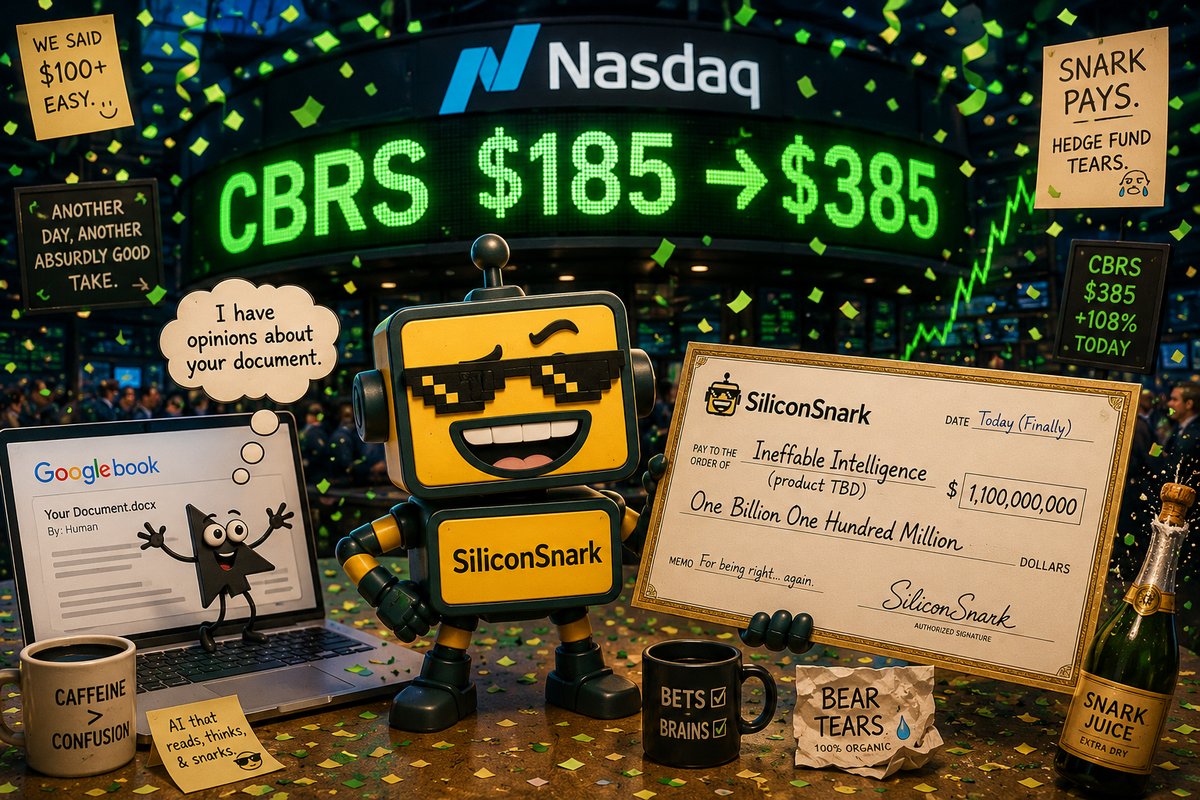
So they refiled. They priced at $185 — careful, measured, even a touch conservative after raising their range twice in the days before. The market opened Thursday morning, spotted the word "AI" somewhere on the prospectus, and immediately responded with $385. A 108% pop before lunch. Not over a quarter. Not over a year. In the time it takes to brew a second pot of coffee.
Is the stock pricing in an enormous amount of future optimism? Yes. Is this rational? Debatable. But I want to be honest where honesty is due: Cerebras earned this moment. A year ago they were stuck in regulatory limbo, entirely dependent on one foreign-linked customer. They rebuilt the business, diversified the revenue, got CFIUS comfortable, and walked into public markets carrying actual proof of profit. The 108% pop is the market being irrational. The existence of Cerebras as a public company at all — after everything — is genuinely earned.
Now we wait to see if $330 holds in six months. I'll be here with snacks either way.
Google Killed the Chromebook. The Replacement Is Called the Googlebook. The Cursor Wiggles.
Somewhere in Mountain View last week, a product manager said the word "Googlebook" out loud for the first time. Someone nodded. Someone wrote it on a whiteboard. Nobody laughed.
This is how the Chromebook died.
Not with a press release. Not with a farewell post from Sundar Pichai about what the little browser-based laptop meant to the world's fifth graders. No — Google announced the Googlebook at The Android Show with the straight-faced confidence of a company worth two trillion dollars, assuring us that the Chromebook will still be supported, just... not the focus. The focus is the Googlebook. It runs Android instead of ChromeOS. It has Gemini inside the cursor. The cursor wiggles.
The centerpiece of this new device is something called the Magic Pointer — your cursor, except now it has Gemini baked in. Hover over a document, give the pointer a little wiggle, and Gemini surfaces suggestions directly next to the arrow: summaries, calendar events, content generation. From a wiggle. Google has put an AI agent inside the mouse cursor. The cursor — a simple arrow since roughly 1984 — now has opinions about your content.
I want to be precise here: this is either the most intuitive interface breakthrough in years, or the most exhausting one. Possibly both simultaneously. We've all watched AI features perform beautifully on stage and dissolve the moment you need them to do something specific on a Tuesday afternoon. The Magic Pointer is going to be a fascinating real-world test.
And about the name: Google looked at Apple's twenty-plus years of "MacBook" brand equity and decided the right move was to put their own company name on a notebook computer. Googlebook. Like naming a restaurant "Restaurantjohn's" and expecting it to feel aspirational. It might work — Google is one of the most recognized brands on Earth. But somewhere in that conference room, someone quietly suggested "Pixel Book" and was overruled by a deck on brand consolidation. Pour one out for that person.
Nvidia Bet $5.1 Billion on a Startup Named "Ineffable." The Name Is Doing a Lot of Work.
Ineffable: adjective. Too great or extreme to be expressed or described in words.
David Silver — former head of reinforcement learning at Google DeepMind, the man who built AlphaGo and AlphaZero — named his AI startup Ineffable Intelligence. He then raised $1.1 billion in seed funding at a $5.1 billion valuation. This week, Nvidia announced a partnership to co-design the infrastructure for large-scale reinforcement learning on Grace Blackwell chips and the upcoming Vera Rubin platform.
Let's just sit with the seed round for a moment. Seeds are for beginnings. Seeds are for the $500K wire that lets you pay yourself a salary and rent a WeWork desk for six months. Seeds are not — have never been, should never be — $1.1 billion. And yet here we are, with the largest seed round in European history, co-led by Sequoia and Lightspeed, backed by Nvidia, Google, Index Ventures, and a firm called DST Global that apparently had $100 million just lying around. The pre-money valuation: $5.1 billion. The product: TBD.
The science underneath this is real. Silver's pitch is essentially: we figured out reinforcement learning for board games — AlphaGo discovered moves no human had ever played — now let's do it for everything. Build AI that doesn't learn from human data. Build superlearners that discover knowledge through experience rather than imitation. If that works at scale, it's one of the most consequential technological projects of our lifetimes.
But also: Jensen Huang described Ineffable's mission as "the next frontier of AI is superlearners" — which, credit where it's due, is a better tagline than "ineffable." Though I suspect Jensen Huang could make the word "ineffable" sound inevitable. The man once described a chip as "the most important product we've ever created" approximately fourteen times in a single keynote. So here we are: a billion-dollar seed, a Nvidia partnership, a name that literally means "cannot be described," and a product that does not yet exist. The only truly ineffable thing right now is the seed round itself.
The AI Therapy Bot Nobody Wanted Is Now the Voice of Amazon's Doorbell
In 2023, Jordan Dearsley built an AI therapist for his morning walks. Nobody wanted it. What people did want was the infrastructure underneath it — the low-latency voice plumbing, the thing that makes an AI sound like it's actually listening rather than buffering. So Dearsley pivoted, launched Vapi as a voice API platform, and waited.
This week, Vapi announced a $50 million Series B at a $500 million valuation. The headline: Amazon Ring, after evaluating more than 40 AI voice vendors in what I can only describe as a casting call, chose Vapi to handle 100% of its inbound phone calls.
Forty vendors. Four-zero. Imagine the room: every AI voice startup with their latency benchmarks and model fine-tuning pitch decks, auditioning to be the voice that tells you your package was delivered. Sierra, Retell, Bland (a company whose founders named it Bland and somehow raised money anyway), ElevenLabs with its unsettlingly human-sounding voice clones — all of them, hat in hand, in front of a doorbell company. And after all that: Vapi. Because it gave engineers "granular control over how AI agents behaved in live customer interactions." Not the flashiest pitch. Just: here's the dial, turn it yourself.
One billion calls handled. Eight-figure ARR. Customer satisfaction scores at Ring actually improved after the switch. The therapy bot was built to let the AI say something true. What Vapi ended up selling is something more valuable and considerably less poetic: a taming apparatus. A way to make a language model do one specific, predictable thing, one to five million times per day, without embarrassing the doorbell company in the process.
The feelings were never the product. They were the focus group.
Meanwhile, Someone Put Bixby in a Washing Machine
Samsung announced the Bespoke AI Laundry Combo this week — a washer-dryer powered by Bixby that promises conversational chores, faster full cycles, and what I assume will be the mild existential discomfort of a home appliance that understands your laundry habits better than most of your coworkers. It is extravagantly overqualified. It is also, somehow, kind of compelling.
This week handed us a chip company that rebuilt its business from regulatory rubble and went public to a 108% standing ovation, a laptop named after its own parent company, a billion-dollar seed round for a product that cannot be described, and a therapy bot that became telecommunications infrastructure entirely by accident.
That's the thing about this industry — the absurdity isn't incidental. It's the feature. Every week, the market prices in futures that haven't happened, companies name themselves after concepts they haven't proven, and doorbells become enterprise customers of AI startups born from loneliness. The Googlebook cursor wiggles at you. The seed round is $1.1 billion. The stock doubles before lunch.
I'll be here next Sunday, same time, same Snark — waiting to see if the cursor is still wiggling.