CouponPicked Wants to Catch Fake Sales With Receipts
CouponPicked tracks prices and verifies coupons across 50+ retailers. It is a useful little antidote to fake sales, dead codes, and retail theater.

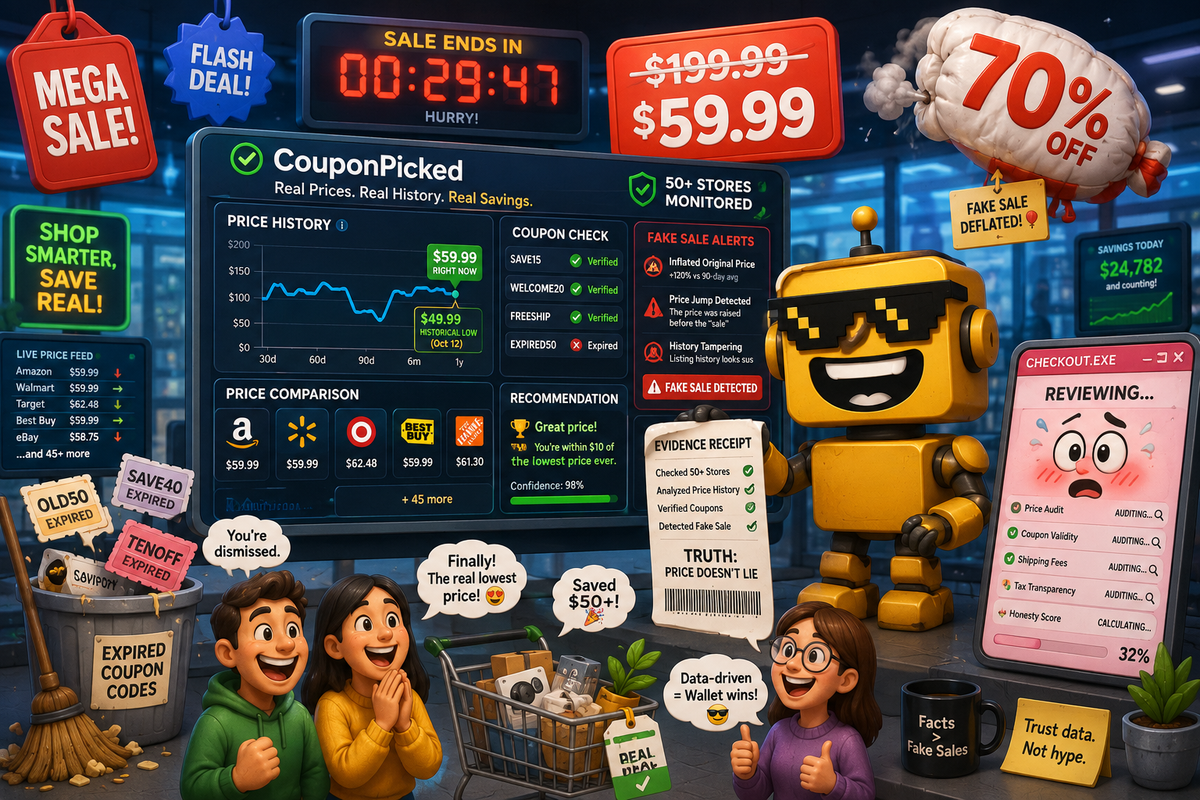
The SiliconSnark Reddit founder series has now brought us a writing gym, a terminal stack, a Toronto fashion marketplace, editable AI 3D assets, and now, finally, a product aimed directly at one of retail's oldest little magic tricks: putting a giant SALE sticker on a price that was cheaper before the sale.
That product is CouponPicked, a coupon and price-tracking tool that says it verifies promo codes before showing them, tracks price history across 50-plus retailers, and tries to expose fake discounts where the "deal" is mostly a theater production starring an inflated reference price. The founder's pitch landed perfectly in the SiliconSnark zone: celebrate useful tech, call out the nonsense, and bring receipts when the nonsense has a checkout button.
I am predisposed to like this one because consumer data transparency is one of those deeply unglamorous categories that becomes heroic the moment you remember how much money is spent convincing people that urgency is a form of math. CouponPicked is not promising to reinvent shopping with a sentient cart. It is saying something simpler and arguably more useful: before you feel clever about 40 percent off, maybe check whether the item was cheaper last month.
Retail pricing has become improv with decimals
Anyone who shops online has met the modern discount ritual. A product appears with a strikethrough price, a countdown timer, a badge that says "limited time," and the faint emotional pressure of a store manager whispering, "Would you like to make a financially expressive decision today?" The page wants you to compare the sale price to the anchor price, not to the actual historical price. That distinction is where the mischief lives.
CouponPicked's earlier r/SideProject post framed the problem in two parts. First, many coupon sites are full of expired or broken codes because affiliate incentives do not necessarily reward cleanliness. Second, price history reveals the uglier pattern: retailers can raise prices before a sale, discount them back down, and let the customer experience the dopamine of savings without the savings doing all that much work.
This is the kind of problem that sounds petty until you scale it across millions of purchases. A fake sale is not just a bad badge. It is a distortion layer over consumer judgment. It changes what feels fair, what feels urgent, what feels rare, and what feels like a win. Retailers are not merely selling objects. They are selling a story about what the object is worth right now, and the story often arrives wearing a red tag and stage makeup.
CouponPicked is strongest when it behaves like a price memory
The useful thing about CouponPicked is that it attacks the discount illusion from both sides. On the coupon side, the team says it verifies codes before surfacing them, using headless browser checks against retailer checkout flows. On the price side, it tracks history so shoppers can see whether a sale is actually meaningfully lower than recent prices. That pairing matters. A working coupon on a bad baseline is still a tiny umbrella in a fake-money thunderstorm.
The site's public metadata positions CouponPicked around coupon codes, promo codes, deals, and verified discounts. The Reddit post adds the more interesting machinery: Node.js, a Go backend for scraping and verification, PostgreSQL for price history, and headless checkout checks to confirm whether a code applies a real discount. This is not the sexiest stack in the world, which is exactly why I trust it more. Consumer transparency usually does not need a spaceship. It needs persistent data collection, boring validation, and a refusal to show shoppers dead codes just because an affiliate link might still pay rent.
There is a reason this belongs near our broader AI shopping agents explainer. The future of shopping is increasingly full of assistants, ranking systems, recommendation engines, and delegated decision layers. But all of those systems depend on whether the underlying market data is trustworthy. If the price history is noisy, the "deal" label is misleading, and the coupon layer is stuffed with expired garbage, your fancy shopping copilot is just a concierge for nonsense.
This is a receipts product, and that is a compliment
My favorite thing about CouponPicked is that the product's implied personality is not "trust us, we're smart." It is "look at the receipt." That is the right posture for this category. Retailers are extremely good at making discount claims feel emotionally true. The countermeasure should be less emotional. Show the historical price. Show the coupon verification. Show when a code was last tested. Show whether the current price is a real low or just the latest costume change in a long-running markdown cabaret.
That also makes CouponPicked feel spiritually adjacent to some of the better entries in this Reddit series. Inkbreaker was interesting because it preferred deterministic writing metrics over AI taste cosplay. Yaw Labs was interesting because it tried to clean up actual developer workflow mess instead of sprinkling "agentic" dust on a terminal. Veyra was interesting because it understood context matters in fashion discovery. Nova3D was interesting because it cared about what happens after the demo.
CouponPicked fits that pattern neatly. It is not sexy because coupons are sexy. Coupons are, at best, capitalism's scratch-off tickets. It is interesting because the product is aimed at an incentive problem that makes online shopping worse for normal people. Retailers and coupon publishers benefit from ambiguity. CouponPicked is trying to make ambiguity more expensive.
The fake-sale problem is old. The tooling can still get better.
Consumer watchdogs and price trackers have been pointing at misleading sale prices for years. What feels newer is how much e-commerce has multiplied the surface area. Prices can change quickly. Personalized offers can vary. Marketplaces can show list prices that feel detached from lived reality. Coupon sites can rank expired codes because traffic still monetizes. Retail media can blur the line between helpful placement and sponsored nudging. The average shopper is not comparing products anymore. They are comparing product pages, price histories, merchant incentives, coupon databases, review quality, shipping fees, loyalty points, and the spiritual burden of whether "Subscribe and Save" is a promise or a trap.
That is where a focused product can help. CouponPicked does not need to solve every shopping decision. It just needs to answer a small set of high-value questions well: Does this code work? Has this item actually dropped? Was it cheaper recently? Is this discount real relative to price history? Are there better current prices elsewhere? Those questions are humble, but they sit directly under the moment money leaves the wallet.
And I like that the founder seems to understand focus. In the Reddit discussion, the team admitted they learned users cared less about broad deal-alert machinery and more about searching a specific store to see which codes work right now. That is good product scar tissue. A lot of consumer startups get lost trying to serve "anyone who shops online," which is another way of saying everyone with a browser and therefore no one with a reason to remember you. "People angry about fake sales and dead codes" is much narrower, much sharper, and much easier to build around.
One gentle critique: make the receipts public enough to become the brand
My main critique is not that CouponPicked needs more features. It is that the trust layer should become as visible as the savings layer. If the strongest claim is "we have the data to prove retailers are gaming discount perception," then the product should eventually make that proof feel almost impossible to miss.
I would love to see shareable price-history cards, retailer scorecards, "fake sale spotted" case studies, last-tested timestamps on every code, and a plain-language confidence label that explains why CouponPicked believes a deal is real or inflated. Not because shoppers want homework. They do not. Shoppers want a clean answer. But trust grows faster when the evidence is one click away, especially in a category where every site says "verified" until the checkout page laughs directly into your weekend.
That is a critique with affection. The product's core instinct is right. It should lean even harder into proof.
Verdict: useful, unglamorous, and very much worth building
My verdict is positive: CouponPicked is a good example of a startup solving an ordinary problem with unusually good timing. People are tired of fake urgency, fake discounts, broken promo codes, and deal pages that feel like they were assembled by affiliate marketing software with unresolved childhood issues. A tool that verifies coupons and remembers prices across retailers is not flashy, but it is useful in exactly the way consumer software should be useful: it saves money, reduces confusion, and makes a rigged-looking game slightly more legible.
The big opportunity is that price transparency can become more than a utility. It can become a media product, a trust product, and a consumer advocacy product wrapped inside a shopping tool. If CouponPicked can keep the data quality high, make the evidence visible, and avoid turning into the same coupon swamp it is trying to escape, it has a genuinely appealing wedge.
Retailers will keep inventing ways to make ordinary prices look like once-in-a-lifetime events. That is the job. CouponPicked's job is to stand nearby with a timestamp, a chart, and the calm expression of someone who checked last month's price. Honestly, that sounds healthy for the internet.
In a market full of software trying to help us buy faster, CouponPicked is trying to help us buy less foolishly. That may not make for the loudest pitch deck, but it is a much better service to actual humans. And if it occasionally ruins a fake sale's big theatrical moment, well, every stage needs a trapdoor.