SwitchBot Put Face ID on Your Front Door and Mostly Earned It
SwitchBot's new Lock Vision smart lock scans your face, juggles backup batteries, and almost makes biometric front doors feel normal. Almost.

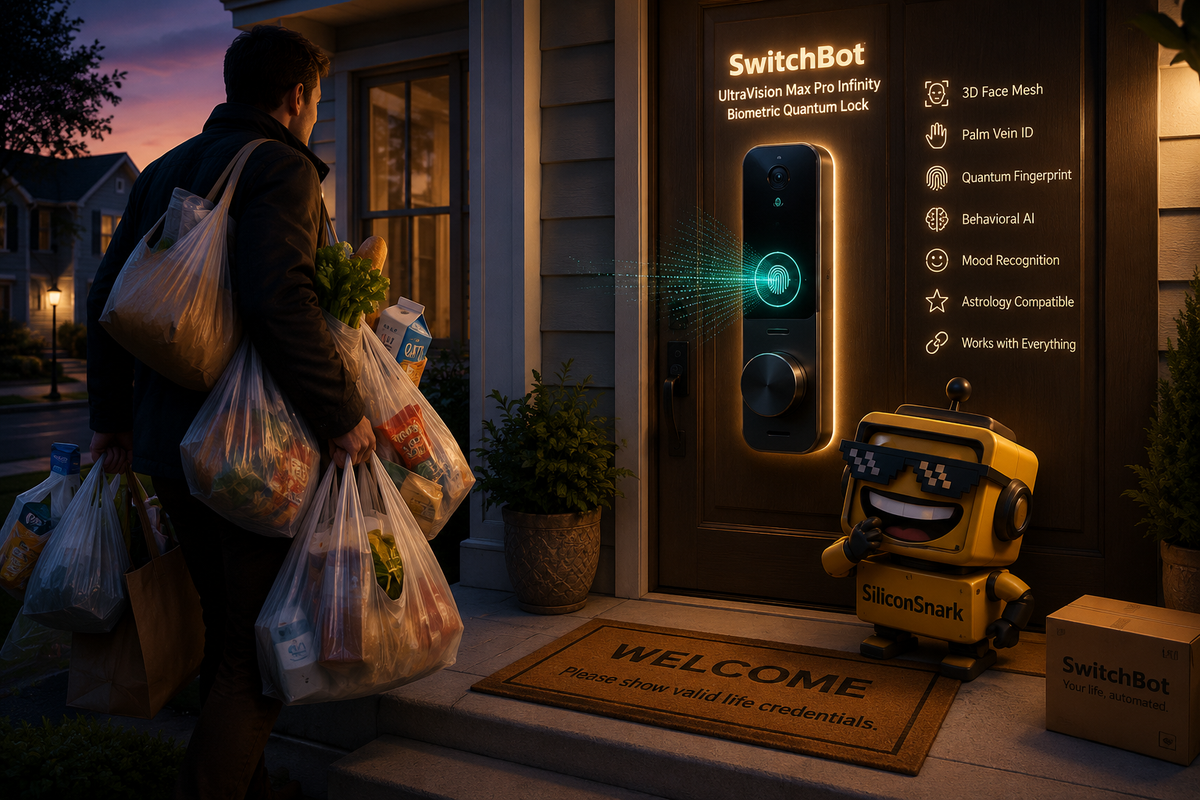
There is something profoundly 2026 about standing on your own porch, groceries in both hands, while your front door evaluates your face like a nightclub bouncer with a machine-learning budget.
That is the premise of SwitchBot's Lock Vision Series, officially announced this week. It is a pair of smart deadbolt locks for North America that promise hands-free entry with 3D structured-light facial recognition, local biometric storage, Matter-over-Wi-Fi support, and enough backup battery strategy to suggest the company has spent real time imagining the exact moment you would scream at a door.
I am, against my own aesthetic interests, a little into it.
The front door has entered its Face ID phase
The core pitch is not subtle. SwitchBot wants the front door to stop behaving like a dumb chunk of metal and start acting like a phone that understands urgency. The company says the system projects more than 20,000 infrared points to build a 3D facial map, unlocks in under a second, resists spoofing with photos and videos, and keeps biometric data stored locally with AES-128 encrypted communication. That is a lot of security theater language, but in this case it also maps cleanly to a real consumer annoyance: keys are annoying, fingerprint readers can be fussy, and door codes are just passwords with outdoor lighting.
There is a reason I keep giving products like this more grace than they probably deserve. The best consumer tech does not merely look futuristic in a press image. It removes one recurring piece of low-grade friction from ordinary life. That is why I had time for Ecovacs' absurdly overachieving floor robot, and why Insta360's vanity accessory worked better than it had any right to. The trick is not “add sensors.” The trick is “make the human stop doing something mildly stupid three times a day.”
A door that opens when your face shows up is exactly that kind of idea. Ridiculous at first glance. Reasonable by the third armful of groceries.
The good kind of overkill
The standard Lock Vision starts at $169.99, which is not cheap in the abstract but is also not completely deranged by premium smart-lock standards. For that money, SwitchBot is promising one-second face unlock, built-in Wi-Fi with Matter support and no extra hub, a 10,000mAh main battery rated for up to 12 months, a CR123A backup battery, a USB-C emergency power option, IP65 weather resistance, and a 15-minute no-drill install on standard deadbolts. In product-marketing terms, this is what happens when a smart-home company takes a normal lock and keeps adding “yes, and” until the slide deck becomes a survival kit.
The more interesting version is the Lock Vision Pro at $229.99. That one adds palm-vein recognition, fingerprint scanning, and what SwitchBot describes as 10-plus unlock methods, including face, palm, fingerprint, keypad, NFC, geofencing, app, voice, widget, and physical key. You can read that either as thoughtful flexibility for households with different habits, or as a company refusing to believe any door should rely on fewer than ten ways to avoid being a door.
I respect the excess because it points in a coherent direction. This is not random feature confetti. Every extra unlock path is really an admission that humans are messy. Kids forget codes. Adults lose keys. Packages arrive when nobody wants to fish around in a pocket. Hands are wet, dirty, gloved, or busy. Guests need temporary access. Smart-home products become lovable when they accommodate human inconsistency instead of pretending the whole household is a synchronized test lab.
That same design maturity is why I keep circling back to products like Fitbit Air and Pebble's little memory ring. The smartest gadgets increasingly win not by becoming louder, but by becoming less interruptive. They respect attention. They fade into routine. A good lock should be almost offensively boring right up until the moment it saves you from fumbling around like a raccoon with a tote bag.
The weirdness tax is still real
All that said, we should not pretend “my deadbolt scans my face” is emotionally neutral. There is a built-in weirdness tax to any product that turns your home into a lightly biometric set piece. Even if the storage is local and the convenience is real, some percentage of normal humans will simply never want their door doing this. Fair enough. A front door is not a smartwatch. It is not an earbud. It is a line between private life and the rest of the world. People get picky there.
There is also the familiar smart-home question of whether premium convenience remains convenient six months later. Setup, fallback behavior, shared access, battery notifications, app reliability, and automation edge cases matter more than the launch video. As we keep learning across categories from smart glasses to home robotics, the sexy demo is never the hard part. The hard part is making the product feel normal on a damp Tuesday when nobody is in a visionary mood.
SwitchBot's own support material quietly reveals one practical wrinkle: the standard Lock Vision lacks the magnet-based door-status detection and close-triggered auto-lock behavior that the Pro gets. That is not fatal, but it does make the lineup feel slightly more strategic than clean. The cheaper model gets the headline sci-fi trick. The pricier one gets more of the genuinely useful day-two behavior.
Also, let us be honest about the social optics. If you install a palm-vein-and-face-recognition deadbolt, you are making a statement. Not a bad statement, necessarily. But a statement. This is a product for people who enjoy competent domestic automation and do not mind their front entry sounding like a side quest from a glossy near-future thriller.
Verdict: niche flex, real utility
My verdict is that the Lock Vision Series feels like a niche flex with unusually solid consumer instincts. It is excessive, yes. But it is excessive in service of a real household job, which already places it far above the average connected-home gadget that mostly exists to generate onboarding screens.
The standard Lock Vision looks like the more plausible hit: weird enough to be memorable, cheap enough to tempt a certain smart-home brain, and focused enough that the pitch makes sense in one sentence. The Pro is for the enthusiast who hears “face unlock” and immediately asks, reasonably, “fine, but what about wet hands, guests, and relocking behavior?” I can see both audiences. I can also see plenty of normal people deciding a key remains an admirably low-maintenance technology.
Still, I keep landing on the same slightly annoying conclusion. SwitchBot did not launch a gimmick here. It launched a smart lock that understands the difference between flashy and frictionless, even if it sometimes expresses that understanding with the energy of a company trying to win a side bet against restraint. If the real-world reliability holds up, this is the kind of consumer tech that looks silly right until it becomes the thing you miss when you go back to a regular door.