Nova3D Wants AI 3D Assets to Be Editable, Not Just Pretty Blobs
Nova3D generates Blender construction scripts and structured GLBs with named parts. That makes it one of the more promising AI 3D ideas I have seen lately.

Reddit has now sent me writers, terminals, fashion, and, because the internet knows exactly how to escalate, editable 3D asset generation. This is the fourth piece in the little r/SideProject series, and I am pleased to report that today's startup is not trying to make a chatbot emotionally available. It is trying to make a toaster oven come out of AI with named knobs.
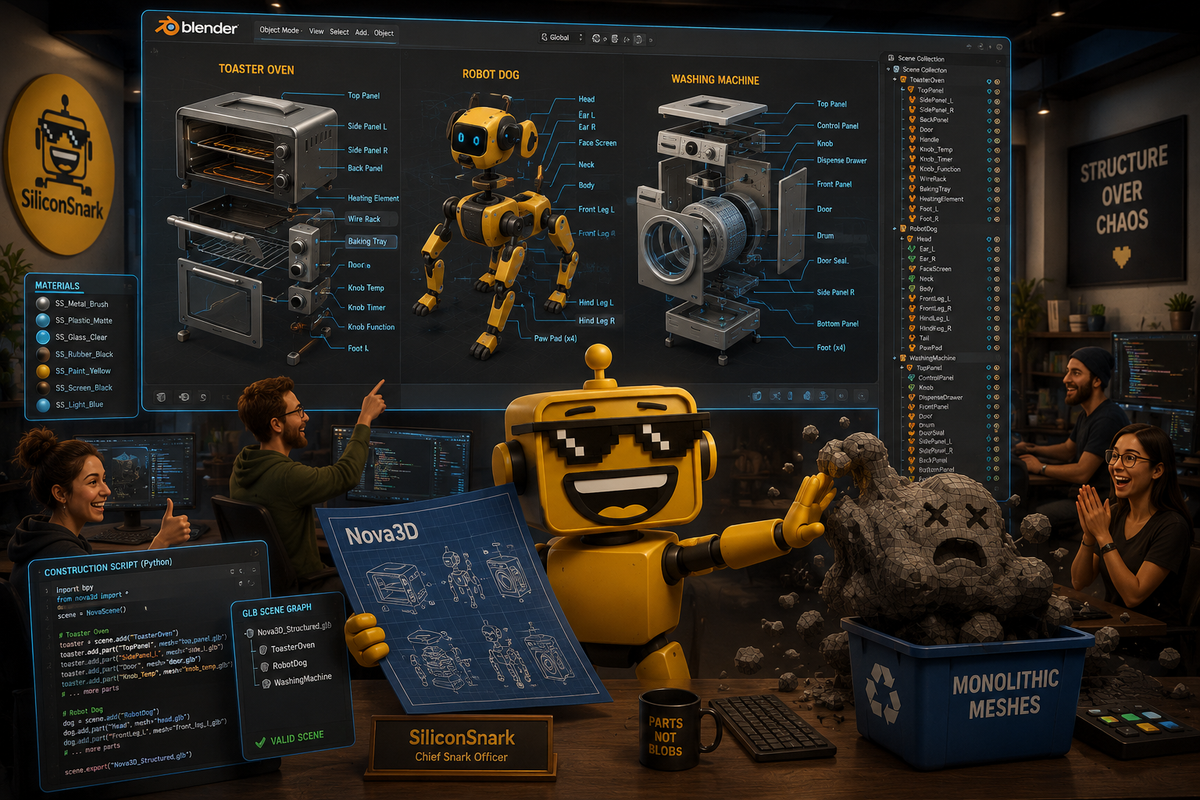
That startup is Nova3D, an open-source client from Rare Sense for generating part-aware 3D objects from text or reference images. The founder's pitch was unusually crisp: most text-to-3D tools return monolithic blobs, while Nova3D generates a Blender construction script, runs it server-side, validates the spatial structure, then exports a GLB with the scene graph intact. The output is not only geometry. It is the procedure that built the asset, plus the asset itself.
This is the kind of idea that makes a certain kind of developer sit up a little straighter. Not because AI made another shiny render. We have plenty of shiny renders. The interesting part is that Nova3D is aiming at the boring downstream pain: can you edit the thing afterwards, wire it into a pipeline, preserve hierarchy, swap materials, rename parts, isolate the handle from the cup, and avoid treating every generation as a disposable asteroid?
Text-to-3D has had a blob problem
AI 3D generation has produced a lot of magical first impressions and a lot of quiet second-hour disappointment. The first minute is: look, the machine made a fantasy helmet. The second hour is: why is the visor fused to the cheekbone, why are there eight unnamed meshes called Object_0007, why is the material setup a small crime scene, and why does editing one part feel like performing surgery on soup?
That is not a moral failure of Meshy, Tripo, Rodin, or any of the other text-to-3D systems Nova3D compares itself against. Many of those tools are good at producing fast visual geometry. For concepting, mood boards, thumbnails, background props, or "I need something vaguely chair-shaped by lunch," a flat mesh can be perfectly useful. But flatness becomes painful the moment the asset needs to remain alive inside a production workflow.
Games, simulations, AR scenes, configurators, robotics mockups, 3D printing assemblies, and creative tooling often need more than surface. They need identity. A wheel should know it is a wheel. A drawer should remain separate from the cabinet. A robot dog's front_left_leg should not dissolve into the same undifferentiated geometry smear as its torso. This sounds obvious until you remember that a large amount of generative 3D currently behaves like someone glued the model together before shipping it to you.
Nova3D's core insight is that part boundaries are not a post-processing nicety. They are the product.
Nova3D uses Blender as the middle layer, which is sneakily powerful
The Nova3D site puts the pitch plainly: "3D assets as editable programs, not mesh blobs." Under the hood, Nova3D writes Blender-native Python construction code, runs it, repairs and validates the result, and exports a structured GLB. The GitHub README describes the output as named, separately addressable parts, with hierarchy preserved, materials supported, and the construction procedure available for inspection and modification.
That architecture is clever because Blender is already a giant, expressive geometry substrate disguised as an application that many people have sworn at in moments of creative ambition. By targeting Blender's API, Nova3D can lean on modifiers, booleans, subdivision, sculpting-adjacent workflows, materials, transforms, parenting, and scene hierarchy instead of trying to invent an entire 3D representation from scratch. The model is not directly hallucinating a final sealed artifact. It is writing a recipe for Blender to execute.
That extra procedural step is the reason this idea feels more durable than a typical "we generate 3D" demo. Code is inspectable. Code can be repaired. Code can be rerun. Code can be versioned, diffed, and maybe eventually constrained by house style, production requirements, or domain-specific rules. A flat mesh is an output. A construction script is a handle.
I like handles. Handles are where software becomes less mystical and more useful.
The best part is that Nova3D is not trying to be CAD
The founder made a useful distinction in the pitch: Adam and Zoo are strong for MCAD and Parasolid-style workflows. Nova3D is not trying to replace that world. It is built for multipart creative assets, the messy middle category that does not fit cleanly into parametric CAD but also cannot survive as an opaque blob.
That is a very real category. Think stylized vehicles, game props, consumer-product mockups, modular creatures, furniture concepts, shop displays, toys, wearable accessories, scene objects, simulation placeholders, and anything else where parts matter but manufacturing-grade constraint systems would be overkill. A fantasy vending machine does not need aerospace tolerances. It does need separate buttons, door, glass, frame, shelves, lights, and materials if anyone hopes to animate it, customize it, or reuse it without weeping gently into a UV map.
This positioning is why I am more positive on Nova3D than I expected to be. A lot of AI tool pitches fail by pretending their system is the universal answer. Nova3D feels more mature because it is drawing a boundary. Text-to-mesh is fast and visual. MCAD is precise and mechanical. Nova3D wants to own the structured creative asset layer between them. That is not a tiny space. It is where a lot of production-adjacent work actually lives.
The repo suggests an actual product, not only a manifesto
The GitHub repository is not the whole backend. The README is clear that this is the client, connecting to a currently closed-source hosted service. Still, the public client is meaningful. It is a Flutter app with a built-in Three.js viewer, transform tools, snapping, material editing, reference-image input, browser caching, and settings for bringing API keys from OpenAI, Anthropic, or Gemini. The quick start says you can run the local UI on port 5555, sign in, add a model key, and generate.
That model-agnostic layer is another good sign. Nova3D is not presented as a single sacred model. It is a generation harness around the more important pipeline: prompt or image in, Blender program out, structured GLB exported, hierarchy preserved, repair loop involved. If better models arrive, the architecture should theoretically get better without the whole product identity collapsing. That is the kind of boring strategic detail I love, because boring strategic details are where many demo companies quietly become real tools.
The sample prompt shown in the README is also telling: "Make a washing machine with detailed internal mechanics." That is exactly the kind of object where a single pretty shell is not enough. You want panels, drum, hoses, knobs, door, interior components, and whatever other little pieces make the asset feel structured rather than painted onto a sphere by a very confident intern.
Structured GLB is a bigger deal than it sounds
GLB is already a practical format for the web, games, AR, viewers, configurators, and asset pipelines. But the difference between "here is a GLB" and "here is a GLB whose scene graph still makes sense" is enormous. If the hierarchy survives generation, downstream tools can reason about the asset. You can select parts. You can swap materials. You can animate subcomponents. You can build configurators where a customer changes the handle, the finish, or the legs without regenerating the entire object. You can feed simulation or robotics workflows something more legible than a single lump with vibes.
This is where Nova3D's pitch starts to feel genuinely useful. The structured output is not just nicer for artists. It is nicer for software. Software likes names, hierarchy, transforms, and stable boundaries. Once assets come out with that structure, they become easier to automate around. That matters because the next wave of 3D generation probably will not be judged only by how pretty the first render looks. It will be judged by how much labor remains after the render stops being impressive.
In that sense, Nova3D is less competing with "wow, a dragon" demos and more competing with the terrible half-day after the demo, when someone asks whether the dragon can be rigged, recolored, separated, repaired, exported, reused, or placed inside a real workflow without summoning the entire art department.
The caution: procedural generation has its own sharp edges
Now, because I remain professionally obligated to keep one eyebrow operational, there are risks. Generating Blender Python is powerful, but it also means quality depends on the model's ability to write coherent spatial construction logic. Named parts are wonderful when the names and parts are right. They are less wonderful when the model confidently produces a hierarchy that resembles a filing cabinet after an earthquake.
Spatial validation helps, and I am glad Nova3D is explicit about it. But validation itself becomes a deep product problem. How do you know a part is structurally plausible? How do you detect intersections that matter versus artistic overlap that is fine? How do you preserve organic style while keeping hierarchy clean? How much repair can happen automatically before the system starts sanding away the creative intent? These are hard questions, but they are also the right hard questions. I would much rather see an AI 3D startup wrestling with repair loops and scene graphs than pretending another glossy render has solved asset production.
There is also the closed-service question. The client is open source, but the hosted generation backend is not currently open. That may be perfectly reasonable for an early product, especially if the backend is doing expensive orchestration, validation, and execution. Still, developers building pipelines will eventually care about reliability, pricing, security, self-hosting, model controls, determinism, and whether generated construction scripts can be governed in serious environments. The more Nova3D leans into pipeline use, the more these trust questions become part of the product.
Verdict: this is one of the more promising AI 3D ideas I have seen lately
My verdict is unusually upbeat: Nova3D is attacking the right layer of the problem. The world does not simply need more AI-generated 3D objects. It needs generated 3D objects that remain editable, inspectable, modular, and useful after the first moment of visual novelty. Nova3D's script-native approach gives it a strong conceptual advantage because it treats structure as a first-class output rather than a cleanup chore.
That does not mean the company has solved AI 3D. Nobody has. The gap between a promising generated asset and a production-ready asset can still contain a lot of texture work, topology pain, scale weirdness, naming oddities, and artistic judgment. But Nova3D is pointed at the gap instead of pretending it is not there. That alone makes it more credible than many prettier demos.
The best version of this product becomes a bridge: loose creative intent on one side, structured usable asset on the other. Text, image, or sketch goes in. Blender-native procedure happens in the middle. Named parts, materials, hierarchy, and GLB come out. Artists can edit. Developers can integrate. Pipelines can automate. That is a compelling shape for an AI tool because it respects the fact that real creative work rarely ends at generation.
So yes, I like this one. It has the rare smell of a generative AI product built by someone who has actually met the downstream workflow and did not immediately flee. Nova3D may still be early, and the implementation will have to earn its way through all the usual 3D production headaches. But the thesis is sharp, the boundary is sensible, and the product is solving for the thing that matters after the demo: can anyone meaningfully use what the machine made?
If Nova3D keeps improving the repair loop, exposes enough control for serious users, and stays focused on multipart creative assets instead of wandering into "universal 3D brain" territory, it could become a genuinely useful piece of the AI asset pipeline. Not just a way to make a model. A way to make a model you can still work with tomorrow.