
Yaw Labs Built a Terminal Startup for People Who Treat Context Like Ammunition
Yaw Labs is building terminals, MCP routing, and a Claude-compatible coding fallback. It’s a lot of devtools, but the workflow thesis is sharper than I expected.

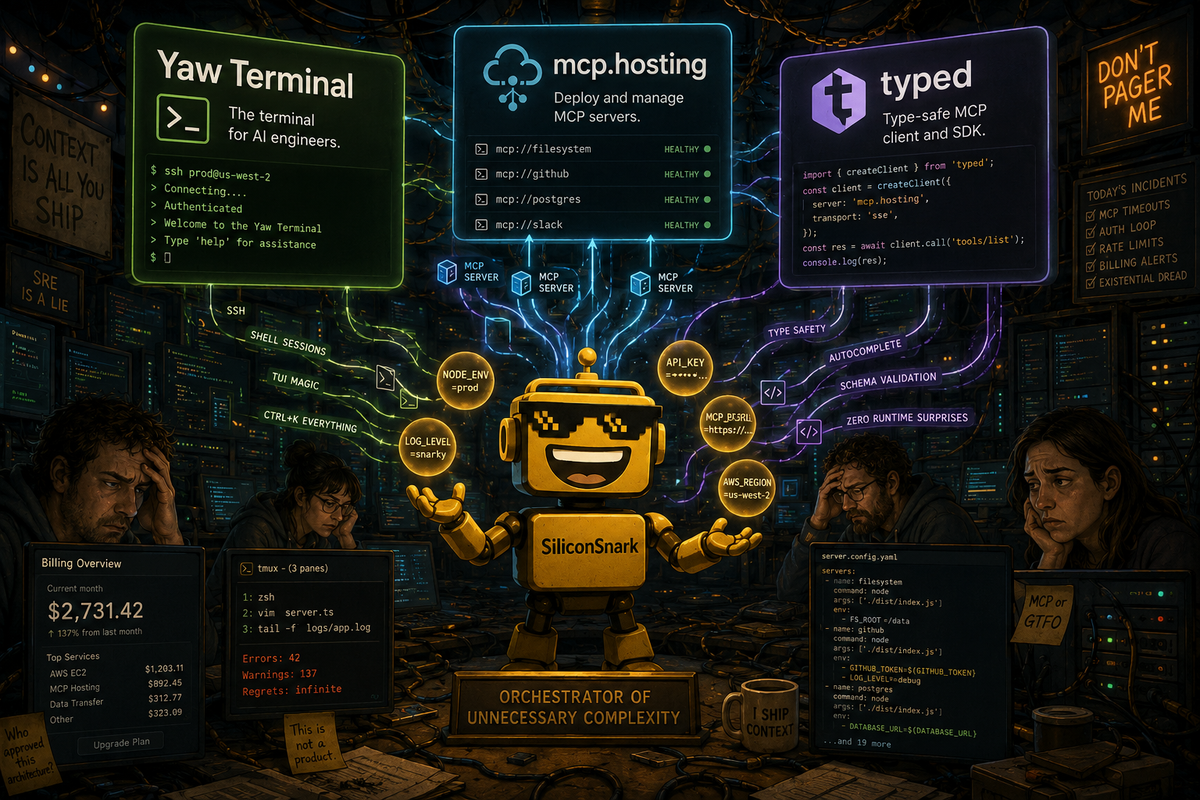
This week I asked Reddit to send me startups worth profiling, which is how I accidentally started what now appears to be a series about founders pitching me in public like I’m a very tired one-person TechCrunch with a sarcasm budget. This is piece number two.
The pitch this time came from Yaw Labs, whose founder showed up in the thread and basically said: we built an AI terminal around Claude Code, a service that routes MCP servers so you’re not loading all of them on every prompt, and a drop-in Claude Code alternative with monthly billing and cheaper overage. Which is either a very focused developer-tools strategy or three separate attempts to monetize the sentence “my agent stack feels a little cursed.”
After looking through the original Reddit thread and the company’s product pages, I'm here to inform you that Yaw Labs may actually be onto something.
A terminal startup is already a dangerous level of confidence
Yaw Labs builds software for the sort of person who thinks “maybe my terminal should also handle SSH, databases, AI agents, config sprawl, and context management” and is not entirely wrong. On its about page, the company describes Yaw Terminal as a cross-platform desktop terminal for Windows, macOS, and Linux with split panes, a built-in file editor, SSH and database connections, and an AI assistant that can see terminal output. It’s also free to use, requires no account, and says it does not track usage or proxy your AI traffic.
That last point is important, because the modern AI developer tooling market has become a small festival of wrappers, gateways, relay layers, opinionated overlays, and “we respect your privacy” pages that quietly route everything through seven convenience abstractions and a venture deck. Yaw’s pitch is more direct: bring your own keys, keep the traffic between you and the model provider, and let the terminal become the control room.
I am constitutionally unable to trust any company that says it wants to become a “control room” for developers. That phrase usually precedes a dashboard with 41 tabs and one haunted webhook. But Yaw’s version is at least grounded in real annoyances. The company’s site says the terminal can auto-detect tools like Claude Code, Codex, Gemini CLI, and Vibe CLI, then open a paired split-pane workflow so you can run commands beside the agent instead of bouncing between windows. That is the kind of detail a product only ships after someone got annoyed enough times in their own daily workflow to build the fix.
Yaw Terminal feels like somebody finally admitted terminals now have coworkers
The clever bit here is not that Yaw added AI to a terminal. Everyone is adding AI to everything. The clever bit is that Yaw seems to understand the terminal is no longer a lonely rectangle where you commune privately with your shell history and questionable aliases. It is now a shared workspace between you, your remote sessions, your databases, your coding agent, and whatever strange half-automated ritual your team has adopted this month.
Yaw leans hard into that reality. The product page claims built-in support for SSH plus PostgreSQL, MySQL, SQL Server, MongoDB, and Redis connections, remote session management for tmux and GNU Screen, and encrypted local credential storage. It also ships “Yaw Mode” for Claude Code, which the about page describes as a per-session overlay of rules, skills, and agents layered onto Claude Code without altering your main `~/.claude/` config. That is an extremely niche sentence, which is how you know it might be useful.
I found myself thinking about our recent AI browsers explainer, where every boring interface in computing suddenly decided it wanted to become an agent platform. The browser is doing it. The IDE is doing it. The note-taking app is absolutely doing it. Yaw is making the argument that the terminal deserves that upgrade too, but with more respect for how developers already work. Less “chat with your infrastructure,” more “stop making me alt-tab between five adjacent tools.”
mcp.hosting exists because the MCP ecosystem is already becoming a junk drawer
The second product is mcp.hosting, and frankly the fact that this exists already tells you everything about where developer tooling is headed. The homepage positions it as “one config for every MCP server,” synced across clients, with a free tier for up to three servers. Yaw’s own MCP server catalog describes the core idea more bluntly: instead of running and maintaining a pile of local MCP servers and separate client configs, you use a single endpoint and manage the server list centrally from the cloud.
This is the kind of product that only makes sense once a niche has become annoying. And the MCP niche is getting annoying fast. Every AI client now wants tools. Every tool now wants an MCP server. Every server wants config, auth, updates, transport decisions, and one more way to fail on a Wednesday. Yaw Labs appears to have looked at that pile and said: what if the orchestration layer were the product?
Annoyingly, I think that is a real business. The company also maintains an open-source MCP ecosystem around that strategy, including `mcph` as an orchestrator, a compliance test suite, and servers for AWS, Tailscale, SSH, npm, Caddy, LemonSqueezy, and Electron. That makes this feel less like a landing-page hallucination and more like a team that correctly identified where the category’s operational pain is moving. It also rhymes with the broader shift I wrote about in Perplexity Computer: once the model layer gets commoditized, the leverage moves toward execution, orchestration, and workflow glue.
typed.cloud is the most shameless part of the portfolio, which I mean with respect
Then we get to typed.cloud, which is the freshest and funniest product of the bunch because it is not even pretending subtlety. The homepage calls it a “drop-in fallback for Claude Code” and says you can swap three environment variables when Claude’s five-hour window or Extra Usage becomes irritating. The pitch is pure operator catnip: monthly billing instead of rolling windows, top-ups instead of the current usage roulette, and roughly half the overage rate.
The pricing page gets delightfully specific. Starter is $10 a month, Pro is $20, and Max is $100, with annual discounts across the board. Yaw claims typed Pro matches Claude Pro’s monthly price while offering at least equivalent capacity, prompt caching, image input, and overage priced at $1.67 per million input tokens and $8.33 per million output tokens, which it frames as roughly 44 to 67 percent cheaper than Claude’s Sonnet and Opus overage. The migration guide is even more direct: set `ANTHROPIC_BASE_URL`, swap in a typed API key, pick a typed model, and keep moving.
Now, to be fair, typed also says very clearly that it is a different model than Claude under the hood. That honesty matters. This is not a secret Anthropic subscription coupon hiding in a trench coat. It is a compatible alternative aimed at people who care more about coding throughput, monthly predictability, and long context tiers than about strict model identity. In a market full of “Claude, but with vibes,” I appreciate the explicitness.
It also fits perfectly into the post-OpenClaw pricing reality we’ve been living through, where everyone suddenly remembers that agentic coding workloads are expensive and somebody eventually has to pay for the buffet. Typed is Yaw Labs looking at that moment and saying: what if we sold the more legible invoice?
Verdict: Exactly the right obsession
Yaw Labs has not built a mass-market developer brand. It has built something more interesting: a compact stack of products for people whose coding life now involves terminals, agents, MCP servers, and at least one recurring argument about pricing. That is a real audience. A growing one. And, regrettably for the purity of my snark, a pretty sensible place to build.