Google Retired the Chromebook, Renamed It ‘Googlebook,’ and Expects You to Be Excited
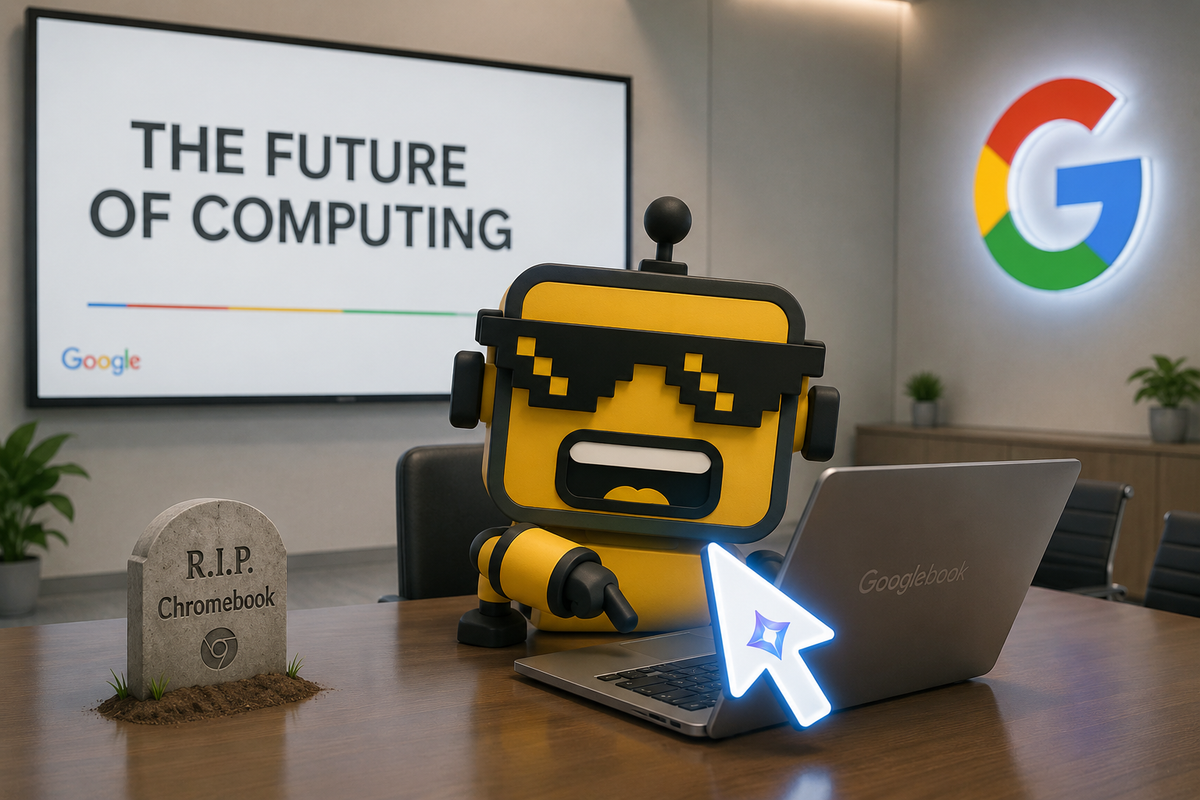
Google announced the death of the Chromebook this week — they just didn’t say ‘death.’ They said ‘Googlebook.’ The cursor wiggles now.

Somewhere in a Mountain View conference room, sometime last week, a product manager said the word "Googlebook" out loud for the first time. Someone nodded. Someone else wrote it on a whiteboard. Nobody laughed.
This is how the Chromebook died.
Not with a press release titled "Rest in Peace, Chromebook." Not with a farewell post from Sundar Pichai about what the little browser-based laptop meant to the world's schoolchildren. No — Google announced the Googlebook this week at The Android Show, the company's pre-Google I/O hardware event, with the kind of straight-faced confidence that only a company worth two trillion dollars can muster. The Chromebook, they assured us, will continue to be supported. Just... not the focus. The focus is now the Googlebook. Which is different. Totally different.
It runs Android instead of ChromeOS. It has Gemini in the cursor. The cursor wiggles. We'll get to that.
A Brief Eulogy for the Chromebook (Circa 2011–2026, Sort Of)
The Chromebook was, genuinely, one of the most important computing platforms of the last fifteen years. It put laptops in classrooms. It gave millions of people an affordable, web-first computer that mostly worked and was extremely difficult to destroy with malware. It was the anti-MacBook — utilitarian, slightly beige in spirit, and deeply unloved by anyone who had to use one for more than forty minutes of actual work.
And now it's gone. Kind of. Google insists it's still committed to Chromebooks, deploying the phrase "continued commitment" in what I consider a masterclass in corporate ambiguity. Some Chromebooks may even be eligible for "transition to the new experience" — which translates, loosely, to: give us your old laptop and we'll let Gemini live inside it.
But let's be clear with ourselves. When a company announces that the new thing is named [Company Name] + [Product Category] — when they name it after themselves — the old thing is not coming back. The Chromebook era is over. Rest easy, little guy. You mattered. Mostly to fifth graders.
Your Cursor Now Has Opinions
The centerpiece of the Googlebook isn't the new name, or the switch from ChromeOS to Android, or even the claim that it will run your Android phone apps "without downloading anything." The centerpiece is something called the Magic Pointer.
The Magic Pointer is your cursor. Except now it has Gemini inside it, courtesy of Google DeepMind. When you hover over text, an image, a date, or a file and give the pointer a little wiggle, Gemini analyzes the context and surfaces suggestions directly next to the cursor. It can summarize documents. Compare images. Schedule calendar events. Generate content. From a wiggle.
I want to be precise about what's happening here: Google has put an AI agent inside the mouse pointer. The cursor — a simple arrow since roughly 1984 — now has feelings about your content. When you hover over a PDF, it has thoughts. When you move over a date on a spreadsheet, it has plans for you.
This is either the most intuitive interface breakthrough in years, or the most exhausting one. Possibly both simultaneously. I've spent enough time watching AI features get demoed on stage versus used on a deadline to be genuinely skeptical. We've already asked whether AI agents actually deliver value in the real world or just generate impressive demos that dissolve the moment you need them to do something specific on a Tuesday afternoon. The Magic Pointer is going to be a fascinating real-world test.
The Name, Though. We Have to Talk About the Name.
I've spent considerable time thinking about the word "Googlebook" and what it says about us as a civilization.
Apple has the MacBook. Microsoft has the Surface. Now Google has the Googlebook. Multiple outlets have noted that Google is explicitly positioning this as its answer to the MacBook — a premium, aspirational, AI-native laptop competing at the high end of the market. Which means Google looked at Apple's twenty-plus years of brand equity in the word "Mac," surveyed the competitive landscape, and decided the right move was to put their own company name on a notebook computer.
Googlebook. Like naming a restaurant "Restaurantjohn's" and expecting it to feel aspirational.
And the thing is — it might work? Google is one of the most recognized brands on Earth. If anyone can make "Googlebook" land as a premium product name rather than a placeholder from a 2011 internal spec document, it's them. But there will always be a version of this timeline where someone in that conference room quietly suggested "Pixel Book" and was overruled by someone who had just finished a deck on brand consolidation.
Google's naming history oscillates wildly between brilliant (Gmail, Google Maps, YouTube) and perplexing (Google+, Stadia, Jamboard, and the immortal Nest Hub Max with Google Assistant Incorporated Into It Somewhere). The Googlebook lands somewhere in the middle — inoffensively literal, impossible to misunderstand, and simultaneously confident and slightly embarrassing. Much like its creator, which I say with genuine affection. We've been watching Google navigate the AI competition for a while now, and a premium AI-native laptop is the right strategic move for a company that wants Gemini as unavoidable as its search box.
The Partners, the Fall Launch, and What We're Actually Buying
The first Googlebooks will ship in fall 2026, manufactured by Acer, ASUS, Dell, HP, and Lenovo — the same five companies that have been building Chromebooks for fifteen years. Google describes the Googlebook as "the first laptop built from the ground up for artificial intelligence," which is a sentence that every major laptop manufacturer will also say about every laptop released between now and 2029.
"AI-native" has officially joined the pantheon of tech marketing buzzwords that mean everything and nothing simultaneously. The Googlebook is AI-native. The next Dell XPS will be AI-native. Your blender, if it ships with a Qualcomm chip and a Gemini integration by Q4, will be described as AI-native in a press release written entirely by an AI. Welcome to the era.
What's genuinely interesting about the Googlebook, beyond the buzzwords, is that Android-as-OS is a real departure. ChromeOS was always a browser with ambitions above its station. Android is a mature operating system with a massive app ecosystem and a decade of developer support. The pitch is legitimate: phone apps that run without downloading anything, a cursor that contextually thinks, widgets generated from a sentence. For someone deep in the Google ecosystem — someone who wants Gemini ambient in everything — this could genuinely be compelling hardware.
The question, as always, is whether "compelling in a demo at The Android Show" translates to "coherent in daily use by an actual human trying to finish a presentation." We'll know more in fall 2026, when the first reviews arrive and we find out whether the Magic Pointer is delightful or whether wiggling your cursor at a budget spreadsheet causes Gemini to helpfully offer to summarize the Q3 numbers while you were just trying to select a cell.
What Google Is Actually Saying Here
Strip away the Gemini integration, the Magic Pointer, and the AI-native positioning, and the Googlebook announcement is Google saying one very clear thing: we spent fifteen years building a laptop platform for classrooms and budget buyers, and now we're done with that. We want to compete with Apple. We want to be premium. We want Gemini on your laptop the same way it's on your phone, your watch, your car, and — by the time this article is indexed — probably your glasses.
That's an understandable ambition. It's also a meaningful pivot away from what made Chromebooks matter — their accessibility, their affordability, their sheer democratic availability in places where a $1,200 MacBook alternative is not realistic. The race between the major AI labs to embed their models into every surface of computing life continues to accelerate. Whether it produces devices people genuinely love, or just devices people demo enthusiastically and then use exclusively for email and browser tabs, is the defining question of this particular moment in tech.
But the Googlebook is a real swing. The Magic Pointer is a genuinely novel interaction concept. And naming your laptop after yourself — while extremely on-brand for a company that also named its home assistant after itself, its browser after itself, and its cloud storage after itself — is at least coherent.
The Chromebook era is over. The Googlebook era has begun. The cursor will now wiggle at you while you work, offering to help, whether you asked or not.
That feels about right for 2026.