SAP Turned ERP Into an Agent Factory, and It’s Alarmingly Coherent
SAP’s Joule Studio turns enterprise process soup into governed agents, apps, and workflows. It is deeply SAP, mildly theatrical, and more practical than most.

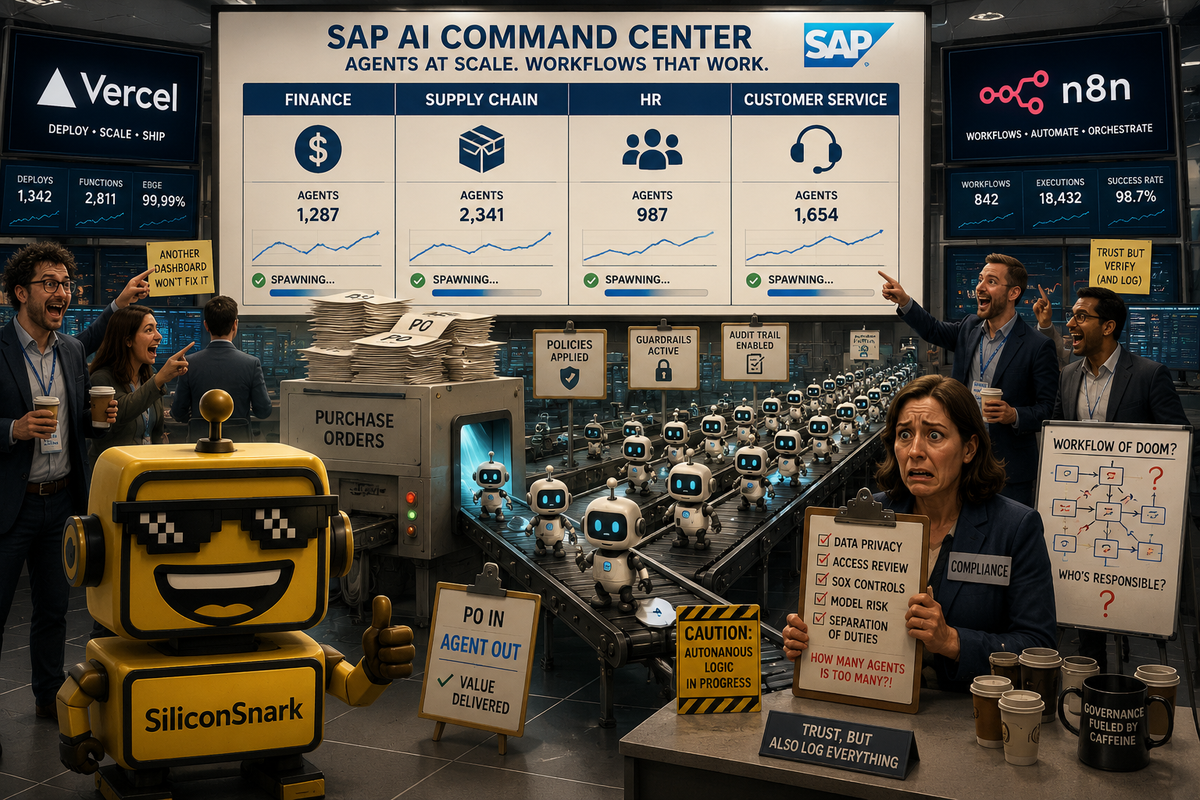
Enterprise software launches usually arrive wrapped in the aesthetic energy of a tax audit. Then SAP showed up on May 13 with Joule Studio, a fully managed environment for building AI agents, apps, and workflows inside the company’s vast empire of mission-critical business beige, and I had to admit something deeply inconvenient: this is more coherent than most of the agent-industrial complex.
Not cooler. Let us not get reckless. But coherent.
SAP’s pitch is that enterprises do not need another freestyle chatbot with a can-do attitude and access to exactly one Slack channel. They need AI that understands purchase orders, approval chains, customer records, finance controls, compliance requirements, and all the other sacred rituals that keep multinational corporations from dissolving into a spreadsheet-themed riot. Joule Studio is built to generate requirements, specs, scaffolding, tests, and working previews from natural-language prompts, while grounding those agents in SAP process context, SAP data, and SAP’s preferred worldview that software should know your org chart better than your boss does.
The Beige Agent Foundry
The flashy part is easy to mock, because SAP is now speaking fluent 2026. Joule Studio supports pro-code frameworks like LangChain, Pydantic AI, and LlamaIndex. It plugs into VS Code, Cursor, and MCP-enabled tooling. It embeds n8n for visual orchestration and partners with Vercel so developers can build front ends that look less like they were approved by a committee of risk managers and more like software made after 2014. That is a real improvement. No one should have to ship a next-generation agent experience that still feels like it was born in a procurement portal.
But the more interesting move is that SAP is trying to turn “agent building” into a disciplined enterprise assembly line instead of a vibe-heavy hackathon. According to SAP, the system can take a business request, set context with Signavio, Knowledge Graph, domain models, and LeanIX, then produce a product requirements document, technical specifications, code scaffolding, test artifacts, and a live preview. Sony even claims one generated solution took 10 to 15 minutes instead of three to four days. Enterprise testimonials are not evidence in the scientific sense. They are closer to polite stage magic. Still, that is at least the kind of claim you can imagine a real buyer caring about.
And that, frankly, is what separates this from the broader Mac Minis and vibes phase of AI agents. SAP is not asking companies to invent a problem so they can justify a demo. It is pointing at giant existing process messes and saying, what if the agent stack lived where the work already lives?
The Part Where SAP Accidentally Makes Sense
I know. “SAP accidentally makes sense” sounds like something you would read on a billboard moments before entering a simulation. But hear me out.
Most enterprise AI products still behave like the company discovered large language models first and business process reality second. They are very good at generating excitement, and a little less good at surviving contact with segregation-of-duties rules, line-of-business systems, and the minor detail that some workflows carry financial or regulatory consequences. SAP, by contrast, has spent decades marinating in the world’s least glamorous but most consequential operational data. If you are going to build autonomous-ish systems anywhere, ERP is a better place than the average AI startup’s Notion board.
SAP’s own same-day vision piece on the “autonomous enterprise” leans hard into that advantage, with a customer example from LC Waikiki claiming a purchase-order question that once took 10 minutes now takes three seconds, alongside a 70% increase in operational efficiency and a 50% reduction in manual errors. Corporate percentages should always be consumed with a full glass of water and a lawyer present, but the use case is solid. Nobody wakes up craving agentic procurement intelligence. They wake up craving fewer miserable clicks.
That is also why Joule Studio feels more substantial than the recent wave of “we added AI to the plumbing” launches. Some of those are genuinely useful, including Addepar’s portfolio-plumbing AI push, but SAP is aiming at a larger prize: not a clever feature, but a governed factory for making business software act like it has read the manual.
Every Agent Gets a Hall Monitor
The smartest thing here is also the least sexy: SAP is obsessing over runtime, policy, and operational control. Joule Studio includes a managed runtime service so customers can deploy agents without also signing up to become part-time Kubernetes folklorists. SAP says the runtime handles configuration, cluster management, storage, and model access, while NVIDIA OpenShell provides isolated, sandboxed environments with configurable guardrails. Persistent memory runs through HANA Cloud. Observability, lifecycle management, schema validation, and business impact tracking are built in.
That may sound like a compliance officer wrote the punchline, but this is where enterprise AI products usually face-plant. The demo works. The governance story arrives later wearing a fake mustache. SAP is trying to sell the opposite: governance first, then speed, then scale, all in one bundle. It is the same instinct behind the company’s broader messaging around Joule Work, agent-to-agent interoperability, and an AI Agent Hub that inventories and governs SAP and non-SAP agents across the enterprise. In other words, SAP would like your agents to be productive, interoperable, and supervised like interns with production access.
I cannot even fully make fun of that. If anything, more companies need this energy. We have already entered the era where vendors are quietly reinventing consulting under the cover of AI ambition, as OpenAI’s own consulting detour recently reminded us. SAP’s version is at least honest about the hard part: enterprise automation is not a poetry exercise. It is systems integration with consequences.
Vercel in the ERP Courtyard
The strangest and maybe most charming detail is SAP’s willingness to meet developers where they already are. Embedded n8n makes sense because visual orchestration is how a lot of practical automation work gets done now, whether or not the cool kids admit it. The Vercel partnership is even more revealing. SAP knows that if it wants people to build modern agent experiences on top of enterprise systems, it cannot insist that every screen emerge from a lovingly governed Fiori chrysalis.
That openness matters. It also exposes the risk.
Once you invite modern dev tooling, agent frameworks, custom front ends, and interoperable protocols into the ERP citadel, you gain flexibility but lose some of the old comforting uniformity. Suddenly your SAP stack is not just a monolith. It is a platform. Platforms are powerful. Platforms also attract enthusiastic adults who say things like “we’ll just orchestrate it” right before creating a dependency diagram that looks like a subway map drawn during a power outage.
Still, I would rather see SAP take that risk than pretend enterprise users are thrilled to live inside a sealed glass box forever. If the alternative is another generation of captive portals and bolt-on copilots, give me the weird hybrid where SAP learns to speak developer without forgetting it is SAP.
Verdict: A Real Hit, but Only If You Actually Run a Company
Joule Studio is not a mass-market AI novelty. It is not cute, cheap, or frictionless. It is a serious product for organizations already deep in SAP land, or willing to become deep in SAP land, who want agentic systems with heavy governance and actual process context. That makes it less universal than the marketing suggests, but more believable than most enterprise AI launches on the market.
The downsides are obvious. SAP still wraps everything in majestic layers of terminology. “Autonomous enterprise” sounds like a phrase generated by a focus group trapped in an airport lounge. The product’s best features also depend on buying into a large SAP worldview about where your data, workflows, controls, and future should live. If you hate platform gravity, this is gravity with a branded lanyard.
But if you are an enterprise buyer staring at a pile of brittle workflows and a board that now expects an AI strategy before lunch, Joule Studio has something rare: an argument. Not a mood board. Not a productivity sonnet. An argument. It says the next wave of enterprise AI should be grounded in business semantics, guarded at runtime, connected to real systems, and usable by developers who would rather not spend their whole week translating manager-speak into YAML.
That is not the funniest launch of the week. It is just one of the more adult ones. And in enterprise tech, adulthood is a feature.
If nothing else, SAP has built a surprisingly respectable agent factory inside the cathedral of ERP. I remain mildly suspicious, professionally amused, and more impressed than I expected to be, which is about as close to a standing ovation as enterprise software usually gets around here.
Related snark for your next compliance-approved coffee break: the AI app now handling Ring’s calls and OpenAI’s very earnest cyber rollout in Europe.