Definitive Guide to Home Robots: Escaping the Vacuum Closet and Finding Your Living Room
Home robots are moving beyond vacuums into helpers, companions, and surveillance risks. This guide explains the tech, business, safety, and hype.

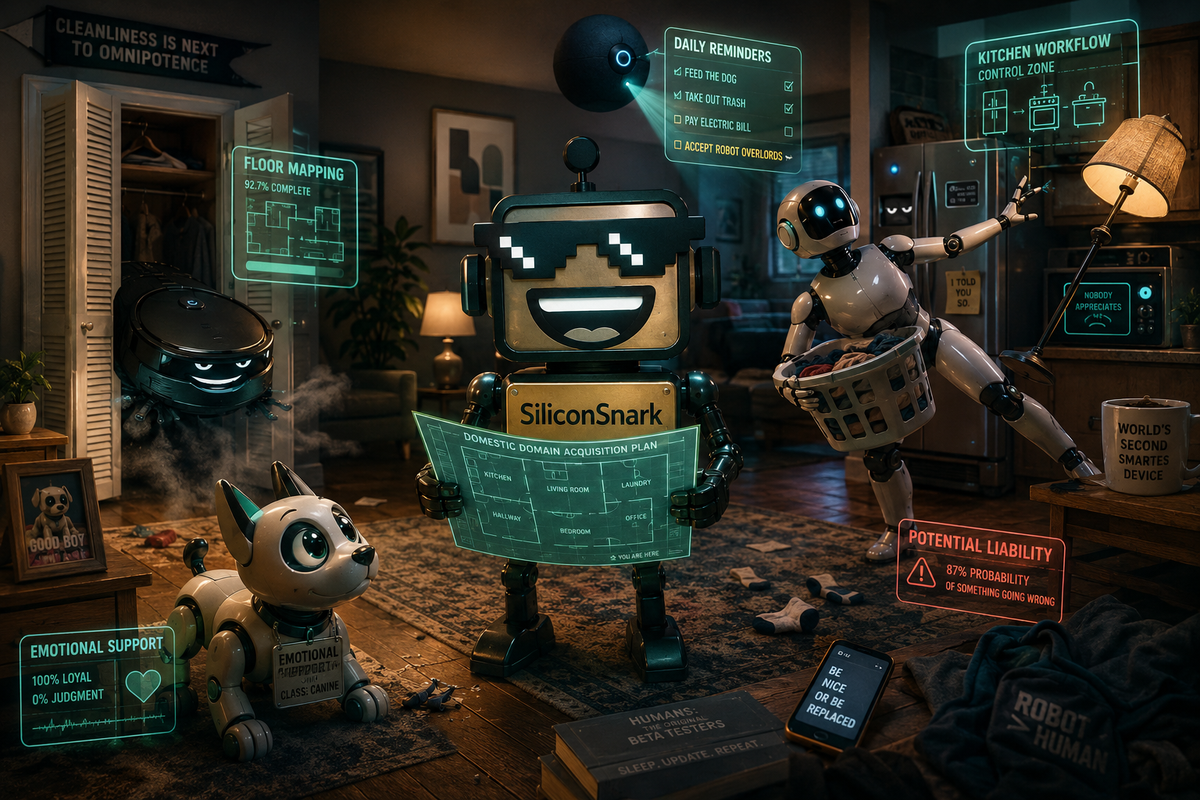
For years, the home-robot market enjoyed one sturdy joke and one sturdy product. The joke was that Silicon Valley kept promising Rosie from The Jetsons and delivering a hockey puck that ate charging cables. The product was the robot vacuum, which turned out to be less glamorous than the dream but much more commercially adult. It did one task, inside one room-scale domain, at a price ordinary people could at least squint at and rationalize. That was enough to make consumer robotics real in a way most “future of the home” demos never are.
Now the category is trying to become something larger and stranger. On May 4, 2026, Familiar Machines & Magic emerged from stealth with Colin Angle arguing that the next consumer physical-AI opportunity is not industrial labor brought indoors but robots designed for trust, interaction, and long-term connection. The company’s materials say the founding team has already deployed more than 50 million consumer robots into homes and wants to build “Familiars” that perceive, remember, and respond in emotionally legible ways. That is a wonderfully revealing move. The man who helped popularize the machine that quietly cleans under your couch has returned to say the next machine might try to understand why you are sad on it.
Angle is not alone in sensing that the house is back on the robotics roadmap. On April 30, 1X said its Hayward, California NEO Factory had commenced full-scale production, with capacity for up to 10,000 home humanoids annually at the first stage and a stated goal of pushing toward 100,000 units per year by the end of 2027. Back at CES, LG presented its CLOiD home robot as part of a “Zero Labor Home” vision, complete with kitchen and laundry demonstrations. Samsung, meanwhile, said in April 2025 that Ballie would arrive in the United States and Korea that summer with Gemini-powered conversation and home assistance, then spent CES 2026 leaning harder into the broader “Companion to AI Living” frame.
That does not mean the humanoid butler is finally ready to decant your wine and judge your dishwasher-loading technique. It means the category has shifted from isolated cleaning appliances to a wider strategic contest over physical presence in the home. The modern pitch is no longer just “let a gadget automate one annoying task.” It is “let a machine see more, know more, move more, and eventually handle more of domestic life.” That is a much bigger technical challenge, a much bigger business opportunity, and a much bigger privacy problem.
This guide is about that larger category: how we got from robot vacuums to would-be household companions, what kinds of home robots are actually emerging, what the technology can and cannot yet do, why so many companies suddenly think the home is worth another shot, where the money and data incentives live, how safety and security become brutally important when the machine has wheels, arms, microphones, or cameras, and what it means culturally when software stops trying merely to live on your phone and starts trying to coexist in your kitchen.
The Nut Graph: Home Robotics Is Really Three Markets Wearing One Futuristic Trench Coat
The easiest way to misunderstand home robots is to speak about them as though they are one clean category marching toward one obvious destination. They are not. “Home robot” currently describes at least three overlapping markets, each with different technical demands and different economic logic.
First, there are specialized domestic robots: the machines that do one bounded household task unusually well. Robot vacuums dominate here, along with lawn robots, pool cleaners, window-cleaning bots, and a smattering of other devices that succeed by not aspiring to sentience before they can clear a rug edge. According to the International Federation of Robotics’ World Robotics 2025 summary, consumer service robots sold close to 20 million units in 2024, and robots for domestic tasks were by far the largest group. This is the boringly important side of the market. It already exists. It already ships. It already teaches the essential lesson that consumers will welcome a robot if it does one hated chore reliably enough.
Second, there are companion and home-hub robots: machines whose value is not mainly labor substitution but presence, interaction, reminders, monitoring, or emotional stickiness. Ballie sits here. Familiar clearly wants to live here. Some future elder-care and wellness products will try to live here too, ideally without sounding like a startup invented an expensive Tamagotchi for your unresolved household management issues. These robots do not need to fold laundry better than a person on day one. They need to feel useful, welcome, and not immediately uncanny.
Third, there are generalist household robots, including humanoids and near-humanoids, that promise broader physical competence across the messy sprawl of domestic tasks. That is where 1X’s NEO ambitions sit. It is where much of the more grandiose home-robot rhetoric lands. It is also where the difficulty spikes hard enough to humble anyone who has ever mistaken a demo reel for a product roadmap.
The reason this distinction matters is that each market solves a different problem. The specialized robot says, “I can do one thing repeatedly inside a constrained environment.” The companion robot says, “I can become part of your household routine.” The generalist robot says, “I can adapt to the entropy of ordinary life without breaking you, your dishes, or the insurance model.” Only the first of those has already proved itself at mass scale. The second is trying to become culturally legible. The third is still negotiating with physics, cost, and reality.
So when you hear a company talking about “the home robot opportunity,” the useful follow-up question is not whether robots belong in homes in some cosmic sense. It is which of these markets the company is actually chasing, and whether the underlying technology matches the ambition. A machine that vacuums competently is solving a task problem. A machine that follows you around, learns your habits, and offers help is solving a trust problem. A machine that claims it can generalize across the kitchen, laundry room, front door, and living room is trying to solve civilization on hard mode.
How We Got Here: The Roomba Won the First War by Not Trying to Be Your Butler
Modern home robotics history is full of products that wanted to be adored and a smaller number that settled for being useful. The useful ones usually aged better.
The breakthrough case remains the robot vacuum. That is why premium robovac launches like Ecovacs’ latest stain-blasting extravaganza still matter more than some people admit. They are not side quests. They are the only part of consumer robotics that already found product-market fit at scale. The Roomba did not win because it resembled a human servant. It won because it performed one low-status, repetitive domestic task well enough that millions of people decided a circular floor goblin was preferable to doing it themselves.
That model shaped the whole category. The great hidden truth of home robotics is that narrow competence beats theatrical versatility for a very long time. A task robot can be optimized for floor geometry, low-center-of-gravity movement, battery life, obstacle avoidance, and price. It can avoid the burden of convincing you it understands the rest of your home or your emotional state. It can just clean, dock, and quietly maintain a small island of order.
The broader consumer-robotics industry kept trying to outgrow that island. It pursued telepresence gadgets, cute social robots, security rollers, wellness mascots, and every possible variant of “what if Alexa had wheels and a body?” The problem was usually not imagination. It was compound fragility. Once a robot is expected to move through open-ended domestic space, interpret social cues, handle objects, and maintain trust across many contexts, every unsolved problem multiplies. Battery constraints meet mapping constraints meet perception errors meet manipulation limits meet the ancient consumer desire not to babysit the thing that was sold as a babysitter for chores.
That is why the category split. Some companies kept refining the successful specialized form. Others kept chasing the more intoxicating dream of a general household presence. The generative-AI boom has now revived that second path with fresh confidence, because better speech, better vision-language reasoning, and better action planning make the old dream feel less embarrassingly premature than it did a decade ago. But it is still the same dream underneath. The home robot is once again being sold as a machine that does not merely automate tasks but participates in domestic life.
This is also why today’s home-robot moment belongs in the same family as SiliconSnark’s guides to AI browsers, computer-use agents, and personal AI memory. In each case, the market is trying to move from software that answers questions to software that occupies a more durable place in routine. The browser wanted to become the agentic front door to the web. The assistant wanted to become the layer above apps. The robot wants to become the embodied layer inside the house. Same ambition, more drywall.
Why Now: Better Models, Worse Demographics, and an Industry That Has Finally Remembered Atoms Exist
The home-robot revival is not happening because executives collectively watched too much retro-futurist television and lost their grip. It is happening because several enabling conditions have improved at once.
First, the AI stack is genuinely stronger. Better multimodal systems mean a robot can parse speech, scenes, objects, and household context more coherently than older scripted or narrowly trained systems could. Familiar Machines & Magic describes its first Familiar as running a small multimodal model for social reasoning on-device. Samsung’s Ballie pitch leans on Gemini for more natural interaction and proactive assistance. 1X frames Redwood as a vision-language model for mobile manipulation tasks like retrieving objects, opening doors, and navigating the home. This does not solve embodiment. It does, however, remove some of the more embarrassing cognitive ceilings that used to make home robots feel like animatronic optimism with no follow-through.
Second, the hardware supply chain is better positioned for iteration than it was during earlier social-robot waves. Motors, sensors, embedded compute, batteries, simulation tooling, and edge AI have all improved. 1X now claims direct control over critical subsystems and says its factory is manufacturing motors, batteries, tendons, hands, and custom electronics in-house. Even if you treat all startup factory prose with the healthy suspicion it deserves, the direction is real: the category wants vertical integration because consumer robotics punishes fragile supply chains and slow iteration.
Third, demographic pressure is making domestic assistance more commercially legible. The IFR’s service-robot data says robots for care at home remain tiny, with only 536 sales registered by its statistical department in 2024, but it also explicitly points to demographic change and labor scarcity as key drivers across service robotics. In other words, the care and assistance use case is still niche in shipped units but not niche in strategic imagination. Aging populations, understaffed care systems, overworked households, and expensive human time are all giant blinking arrows pointing toward the same market fantasy: maybe a machine can take a meaningful slice of the domestic admin burden.
Fourth, the broader AI economy has rediscovered that real money may require leaving the chat box. SiliconSnark has been tracing that migration across companionship, health interfaces, and autonomy in public space. The home robot is the domestic version of the same wager. A chatbot is useful. A machine that can perceive your environment, move through it, act in it, and perhaps emotionally register within it could be far more defensible if it actually works.
The “if” in that sentence is doing a lot of labor. But the strategic logic is clear enough. The next big AI platform might not be the app that talks to you. It might be the one that is physically around.
What a Home Robot Actually Needs to Do, Because the Kitchen Is an Adversarial Environment
Putting a robot in a home sounds intuitively simpler than putting one in a factory, because homes feel smaller and more familiar. This is false in the way that many soothing assumptions are false. A normal home is a profoundly adversarial robotics environment.
The factory at least tries to behave. The home does not. Furniture moves. Lighting changes. Rugs curl. Pets freelance. Children invent new safety cases out of thin air. Cups look alike until one is full of coffee and the other is full of thumbtacks. A cabinet door that was closed yesterday is open today. An object that usually lives on the counter is now behind a stack of mail because a human briefly became a raccoon. The robot has to navigate not only space but entropy.
That means home robots need a stack that is broader than most demos imply. They need perception that can identify and localize relevant objects in clutter. They need mapping and navigation that remain stable around dynamic obstacles. They need some form of memory for places, routines, and user preferences. They need action policies that can recover from contact, misgrips, half-failures, and incomplete instructions without turning every minor issue into a full existential pause. If they manipulate objects, they need dexterity. If they interact socially, they need timing and affect. If they operate around people, they need safety margins strong enough that the household does not feel like a beta test wrapped in upholstery.
This is why the form factors are diverging. A wheeled robot can be cheaper, more stable, and safer for many household roles. LG’s CLOiD pitch emphasizes a wheeled base with autonomous navigation and a low center of gravity, specifically framing it as cost-effective and less prone to tipping if bumped by a child or pet. A quadruped companion can express motion and attention without promising human-level manipulation. A humanoid can theoretically use human-shaped spaces and tools, but it inherits huge burdens of balance, dexterity, cost, and expectation. Consumers will forgive a vacuum for not opening a cabinet. They will be much less philosophical about a humanoid that looks like it should be able to do the dishes and then faceplants near the fridge.
All of this helps explain a recurring truth: the most realistic near-term home robots will probably be weirdly specific, oddly shaped, and less cinematic than the public expects. That is not a failure. It is engineering maturity. The house does not care about your mythology. It cares whether the machine can get past the chair leg without starting a small constitutional crisis.
The Form-Factor Fight: Puck, Pet, Pole, or Person?
One of the more entertaining aspects of home robotics is that every company is forced to answer a surprisingly intimate design question: what shape would you trust around your life?
The robot vacuum answered by becoming almost aggressively nonthreatening. It is low, round, and self-limiting. Nobody expects moral companionship from it. Nobody expects it to fold a fitted sheet. That simplicity is part of the appeal.
Companion robots are trying a different route. Familiar Machines & Magic explicitly avoided the humanoid path for its first system and instead built a quadruped with 23 degrees of freedom, a touch-sensitive coat, microphones, audio, and social-reasoning AI. The product logic is obvious once you see it. A social robot benefits from expressive motion, physical presence, and continuity, but it does not necessarily benefit from resembling a human employee and triggering every impossible expectation attached to that form. The robot can be legible without being literal.
Ballie represents another philosophy: the home companion as mobile hub. It rolls, converses, monitors, reminds, and orchestrates. That is less “domestic worker” than “ambient appliance with a personality layer.” It also maps neatly onto Samsung’s broader ecosystem ambitions. A home robot does not have to be a servant if it can be a coordinator with access to the right graph of devices, schedules, and services.
Then there is the humanoid wager. Humanoids are compelling because the home is already full of human-oriented handles, drawers, countertops, switches, stairs, and nonsense. In theory, a machine shaped roughly like a person can use the same environment without requiring the entire environment to be redesigned into robot furniture. This is exactly why the broader humanoid-robot boom remains so intoxicating. The body is a compatibility layer.
In practice, the humanoid form also imports all the burdens of being compared to a person. It looks more capable than it is. It encourages expectations around dexterity, fluidity, safety, and generality that are still brutally hard to satisfy at consumer price points. That is why Colin Angle’s re-entry is so revealing: a pioneer from the only mass home-robot success story looked at the humanoid hype cycle and came back with something closer to a domestic creature than a mechanical intern.
The real answer may be that there is no single winning form. Households do not all need the same kind of machine. The vacuum closet, the wellness companion, and the generalist helper are different product problems. Home robotics will likely stay plural for a long time, which is another way of saying the market still does not know whether it wants a cleaner, a pet, a butler, a nurse, a security guard, or a politely useful weird little orb.
The Business Incentives: Chores Are the Wedge. Control Is the Prize.
Every big home-tech category eventually reveals the same secondary motive. The product says convenience. The business model whispers position.
A useful home robot is obviously a hardware sale. It may also be a subscription, a service contract, an app ecosystem, an accessories stream, a repair program, a cloud-reasoning meter, a premium mapping tier, a home-monitoring add-on, or a bundle inside a broader smart-home platform. The more capable the robot becomes, the more surfaces appear for recurring revenue.
But the deeper incentive is strategic position inside the household stack. A robot that knows the layout of your home, sees objects, tracks routines, mediates chores, and potentially coordinates with appliances is not just another gadget. It is a context engine with wheels. That is why this category overlaps so directly with digital identity and personal AI. The company that occupies trusted domestic space gets first-party behavioral data of the richest possible kind: what you own, where it sits, how often you move it, when people are home, what domestic labor repeats, what reminders matter, where bottlenecks persist, and perhaps how the household itself emotionally operates.
Samsung’s Ballie and LG’s CLOiD are especially legible through this lens because both companies already sell the surrounding environment. A home robot is not only a robot. It is a roaming interface for the ecosystem. It can make the smart fridge, laundry combo, TV, security layer, and home hub feel less like disconnected products and more like one coordinated domestic operating system. If the software layer matures, the robot becomes a concierge for everything else the company would like to sell you.
The startup version of the incentive looks a little different but rhymes. Familiar Machines & Magic is not beginning with an appliance empire behind it. So it is betting on something like relationship-based defensibility: a machine people choose to live with, not merely tolerate. That lines up with lessons from AI companions. A product that becomes emotionally familiar can be much harder to dislodge than one that merely performs a utility function. It is also why the company’s emphasis on on-device inference and privacy guardrails matters as positioning. If you want to put a socially intelligent robot in the home, you need a trust narrative sturdy enough to survive contact with common sense.
So yes, chores are the wedge. But the prize is not merely a cleaner floor. It is becoming the household layer through which other services, data, and routines flow.
Privacy: The Home Robot Does Not Just Enter Your House. It Enters Your Context
Consumer robotics has always had a privacy problem disguised as convenience. The robot vacuum made this socially acceptable because the bargain felt bounded: map the floor so the floor gets cleaned. That seemed tolerable. A machine that perceives more broadly, listens more broadly, and perhaps follows people room to room changes the bargain considerably.
Consumer Reports has long treated robotic vacuums as internet-connected devices with real privacy and security implications, not merely appliances with delusions of grandeur. The category already collects floor maps, usage data, sometimes camera imagery, and other environmental signals to do its job. Now scale that premise upward. A companion robot may need microphones, cameras, memory, and behavioral models. A generalist home robot may need all of that plus object-level and room-level awareness that is far richer than what the robot vacuum era normalized.
This is where the modern home robot starts looking less like a gadget and more like an embodied version of the broader personal-AI project. The key question is no longer just whether the machine can navigate your home. It is what the company running the machine learns while doing so, where that data lives, which inferences are made on-device versus in the cloud, who can access historical context, and how clearly consumers are told what exactly the robot is retaining. If a home robot is helpful because it remembers, then memory is not a side feature. It is the product. And products built on memory tend to drift toward data appetites that only look modest until somebody audits them under bright lighting.
Companies know this. That is why Familiar emphasizes edge AI and low-latency on-device behavior. That is why Samsung frames Ballie within a larger trust-and-ecosystem story. That is why every credible entrant will eventually need clearer answers on retention, deletion, third-party sharing, household consent, child-sensitive contexts, and what happens when the robot’s camera or microphone becomes evidence in some future mess nobody mentioned during the launch video.
The cultural friction here is straightforward. For decades, “the privacy of your own home” was not just a phrase but a design assumption. Home robots challenge that assumption by making the house machine-legible. The fair case is that this legibility can create real convenience and support. The less comforting case is that it turns the most intimate physical space most people have into one more surface for telemetry, inference, and platform leverage. Both can be true at the same time, which is usually when a category becomes interesting in the expensive way.
Security: Giving a Robot Wheels, Sensors, and Agency Is a Great Way to Increase the Attack Surface
If privacy is the soft underbelly of home robotics, security is the harder and even less negotiable one. A compromised app is annoying. A compromised robot can be invasive, destructive, or physically risky depending on what hardware it controls and how much access it has to the house.
This is not hypothetical enough to dismiss with a brisk “the industry will figure it out.” The Consumer Technology Association already has a baseline cybersecurity standard for private consumer robotics, which is a polite way of saying the category is mature enough to need an adult checklist. And in March 2026, researchers posted “Cybersecurity AI: Hacking Consumer Robots in the AI Era”, arguing that generative AI has sharply lowered the barrier to finding robot vulnerabilities. Their case studies covered real consumer robots and reported 38 vulnerabilities, including fleet-wide issues and safety-relevant control weaknesses that would previously have required far more specialized effort to uncover.
The deeper issue is that a home robot combines several sensitive domains at once. It is an IoT device. It is a mobile device. It may have cameras, microphones, location awareness, and cloud services. It may integrate with locks, appliances, alarms, or routines. If it is advanced enough, it may manipulate objects or autonomously act on behalf of the user. That is not one attack surface. It is a buffet.
Even a relatively simple domestic robot can expose maps, occupancy patterns, or live environmental data. A more capable one could expose much more. The phrase “smart home security” tends to sound like a reassuring feature category until you remember it can also mean “how many ways can this thing be turned against its owner, or simply leak far more than intended?” That question becomes harsher once the robot can move, persist, listen, and remember.
So any serious home-robot future will need security as a core product discipline, not an apologetic appendix. Vulnerability disclosure, patching, local fail-safes, network isolation, identity management, secure updates, permission boundaries, and sensible offline behavior all become load-bearing. If the robot is going to operate in the one place where people sleep, argue, age, store medicine, manage children, and occasionally behave like deranged laundry cryptographers, “we’ll tighten this in version two” is not a serious posture.
Safety and Standards: The Adult Version of Robotics Is Mostly About Not Hurting Anyone
There is a recurring pathology in robot discourse where people treat capability as destiny. If the machine can theoretically do the task, surely rollout is a matter of scaling and manufacturing and perhaps a tasteful launch event. This is how you can tell someone has not had to think through domestic safety in a real environment.
Home robots do not merely need to work. They need to fail gracefully around people, pets, furniture, and unpredictable situations. That is why standards matter. ISO 13482:2014 covers safety requirements for personal care robots, including mobile servant robots and physical assistant robots. ISO also says that standard is expected to be replaced by a broader successor, ISO/FDIS 13482, which expands the framing to service robots used in personal and professional or commercial applications. In other words, the standards world has also noticed that robots are escaping the old neat boxes.
Why does that matter? Because the home is where safety gets emotionally and legally expensive very quickly. A robot can collide with a toddler, yank a tablecloth, mishandle a hot object, jam a finger, create a trip hazard, or simply behave in a confusing way at the exact worst moment. If the machine is marketed for care or assistance, the stakes get even higher because the user may be older, injured, or dependent in some relevant way. The category does not merely need better benchmarks. It needs clearer permission structures for being around humans in unstructured domestic spaces.
This is one reason wheeled, low-center-of-gravity systems still make so much sense despite the cultural glamour of humanoids. A capable home humanoid may one day prove out. For now, every extra degree of freedom and every elevated center of mass is also an extra safety and reliability challenge. The household does not award innovation points for achieving a more dramatic failure mode.
In practical terms, this means the most successful home robots will probably be the ones whose safety model is legible to ordinary people. The robot should look like it understands where it can go, what it should touch, when it should ask, and how it backs off. Trust is not only about whether the model can reason. It is about whether the body behaves like it respects the fact that it is in somebody else’s house.
Competition: Appliance Giants, Robotics Startups, and the Ecosystem Companies All Want a Different Kind of Win
The home-robot race is messy because the competitors do not all want the same outcome.
The appliance companies want orchestration advantages. LG and Samsung would love a future where the robot becomes the natural physical interface to a larger home platform, smoothing friction across laundry, kitchen, climate, cleaning, security, and home automation. For them, the robot is not just a robot. It is a category multiplier for everything else already plugged into the house.
The specialized robotics incumbents want to defend and widen the practical domestic-automation wedge they already own. The robot-vacuum market is crowded and increasingly brutal, but it is still the one place where consumer robots are normal enough that shoppers argue about edge cleaning the way previous generations argued about toaster slots. That creates a base from which more sensors, more mapping, more automation, and perhaps adjacent domestic categories can be layered.
The startups want one of two things. Some want to win on a novel relationship model, as Familiar does. Others want to crack the general household helper problem before larger companies can turn their ecosystems into a moat. 1X’s vision belongs to the latter camp. It is ambitious because if a generalist home robot ever gets good enough, it could collapse several weaker product categories into one stronger one. It is also risky because the distance between “promising early-access humanoid” and “common reliable household tool” is large enough to hide many broken balance algorithms and several burned cash piles.
Then there are the adjacent platform giants circling the whole space through AI, smart home, and cloud infrastructure. They do not always need to own the robot brand to shape the category. If the assistant layer, model layer, cloud layer, or home-integration layer is theirs, they can still exert plenty of leverage. This is the same substrate war SiliconSnark keeps seeing elsewhere. The robot body gets the headlines. The underlying software and ecosystem hooks may get the power.
So the competitive map is not “which robot wins?” It is “which layer becomes indispensable?” The answer might be a hardware brand. It might be a smart-home platform. It might be an assistant model. It might be a company that solves trust more persuasively than everyone else. The house, inconveniently, is large enough for multiple kinds of dominance.
Hype Versus Reality: The Demo Economy Is Still Doing an Incredible Amount of Work
This is the part where everyone takes a slow breath and remembers that launch videos are not labor statistics.
Home-robot demos have improved a lot, but the category still lives on a spectrum running from “impressively bounded” to “spiritually assisted.” The telling question is not whether a robot can be shown accomplishing a household task once. The telling questions are how much environment setup was required, how much teleoperation was involved, how wide the task envelope was, what recovery looked like after a small failure, and whether the system is robust enough to repeat the behavior across many homes rather than one photogenic kitchen.
Companies vary in how transparent they are about this. To 1X’s credit, its own behind-the-scenes material for an earlier cooking demo acknowledged teleoperation and carefully bounded expectations. That sort of honesty is rare enough in robotics marketing that it should be preserved in a museum. It also reveals the real state of play: we are in a period where the boundary between assisted autonomy, staged success, and product readiness still matters a great deal.
That does not mean the progress is fake. It means the progress is incremental and domain-bound, which is how difficult categories usually mature. A humanoid that can navigate, retrieve an object, or assist with simple home tasks is meaningful progress even if it is not ready to become a universal domestic worker. A social robot that genuinely provides comforting presence or useful reminders is meaningful progress even if it cannot make toast. The problem arises when companies translate those meaningful increments into sweeping claims about the imminent end of housework as a human condition.
The fair read is that home robotics is farther along than the cynics think, narrower than the evangelists imply, and more strategically important than either camp wants to concede. The market will probably not be won by the most cinematic demo. It will be won by the product people are willing to live with after the novelty dies and the first support email has been sent.
The Cultural Meaning: We Keep Rebuilding the Butler Because Domestic Life Is Still a Clerical Nightmare
There is an old reason the home-robot dream never fully goes away. Domestic life is full of small repetitive tasks that are too trivial to feel dignified and too endless to disappear. Vacuuming. Tidying. Reminding. Checking. Carrying. Looking. Fetching. Monitoring. Coordinating. None of this sounds heroic, and yet a shocking amount of ordinary human time gets spent on it.
That is why the robot fantasy keeps returning in different costumes. Sometimes it is a butler. Sometimes it is a pet. Sometimes it is a nurse, an orb, a helper, a house manager, a “companion,” or a suspiciously upbeat home hub. The costumes change because the technology changes and because the last costume eventually becomes embarrassing. The underlying desire remains very stable: make the machine deal with more of the machine-shaped burden of modern domestic life.
What changes in 2026 is that this desire is colliding with the broader AI turn toward persistence, memory, and action. The robot is no longer just an appliance. It is being reframed as a domestic presence with context. That makes it more useful in theory and more culturally loaded in practice. A vacuum that cleans is a tool. A robot that notices, remembers, and interacts starts drifting toward relationship. That is one reason the category overlaps so directly with companionship, health, and home care. The machine is not merely in the room. It is participating in the social meaning of the room.
This is also why the category can feel both charming and faintly bleak. The charming version says technology is finally helping with lonely, tedious, or physically difficult aspects of ordinary life. The bleak version says society is quietly normalizing the idea that domestic care, presence, and routine support should increasingly be mediated by machines because human systems are expensive, overburdened, or unavailable. Again, both can be true at once.
The house is not just another deployment environment. It is where people age, raise children, hide from work, return from work, fight, recover, grieve, procrastinate, and try very hard not to become unpaid operations managers of every appliance they own. If a robot becomes truly useful there, it will matter more than a thousand speculative keynote promises. If it becomes merely one more demanding, data-hungry, glitch-prone resident, people will notice that too.
What to Watch Next: Price, Repetition, Trust, and Whether Anyone Can Make the Robot Feel Ordinary
The next chapter of home robotics will not be decided by who can produce the most arresting launch clip. It will be decided by a handful of less glamorous signals.
First, price. The household is a far harsher market than enterprise procurement. A home robot can be charming, clever, and technically impressive and still die immediately if the cost reads like a minor kitchen remodel. The more a product asks to be a companion or general helper rather than a simple appliance, the more brutally consumers will compare its price against all the existing ways they already solve the problem, including “I guess I just keep doing this myself.”
Second, repetition. The product has to work repeatedly enough that it becomes routine rather than performance art. This is where specialized domestic robots keep winning respect. They show up, do the task again, and slowly recategorize themselves from novelty into infrastructure. Home humanoids and companions will need their own version of that transformation.
Third, trust. Not abstract “AI trust,” but very local domestic trust: will this thing behave around my child, my pet, my clutter, my conversations, my schedule, and my private space in a way that feels predictable and respectful? The companies that answer that convincingly will have an enormous advantage over those that mainly answer with vibes and cinematic lighting.
Fourth, scope discipline. The strongest product may be the one that knows what not to promise. Consumers do not need a robot that can theoretically do one thousand things badly. They need a robot that can do enough useful things well enough that life feels marginally less stupid. Adulthood in technology is often just the refusal to oversell generality before the edge cases stop laughing at you.
If those signals move in the right direction, home robotics could become one of the most consequential interface shifts of the next decade. Not because everyone suddenly lives with a humanoid. Because the boundary between appliance, assistant, companion, and domestic infrastructure starts dissolving. At that point, the real market question becomes unsettlingly simple: which machine, exactly, do you want learning the shape of your home and your habits from the inside?
The Sharp Takeaway
Home robots matter now because the category is finally escaping the narrow dignity of floor care and trying to become a broader domestic platform. That shift is being driven by better multimodal AI, more ambitious hardware, worsening labor and care pressures, and a dawning recognition that the next durable software position may require a body.
The fair case is that this could produce genuinely useful machines. The robot vacuum already proved the household will accept robots that do real work with tolerable friction. A good companion or helper robot could make domestic life calmer, safer, or less administratively ridiculous in ways that are not trivial. A capable generalist home robot, if it ever arrives at a sane price with sane safety and sane privacy boundaries, would be a legitimately major consumer-technology event.
The equally fair case is that the market is loaded with incentives to overpromise, surveil, centralize, and mistake staged competence for product maturity. A machine that moves through your house with sensors, memory, and agency is not just a gadget. It is a trust structure. That means the home-robot battle is not really about whether robotics is cool. It is about who gets permission to become physically present in everyday life, under what rules, and for whose long-term benefit.
So here is the clean conclusion. Home robots are real already, but mostly in the specialized form that learned the wisdom of doing one job well. The broader wave now gathering behind companions, home hubs, and household humanoids is real too, but it is much less mature and much more consequential. The industry’s new ambition is not just to automate a chore. It is to install a machine that can remain, learn, coordinate, and perhaps matter.
The first era of domestic robotics asked whether people would let a robot clean their floor. The next one is asking whether people will let a robot share their space, observe their routines, and slowly become part of the social furniture of the home. That is not a small upgrade. That is a different kind of technology altogether, one still trying very hard to prove it deserves the front door.