Sharon AI Turned an Earnings Release Into a $1.25 Billion GPU Flex
Sharon AI used a May 16 results post to show off sovereign AI factories, giant contracts, and enough GPU swagger to make enterprise infrastructure briefly feel cinematic.

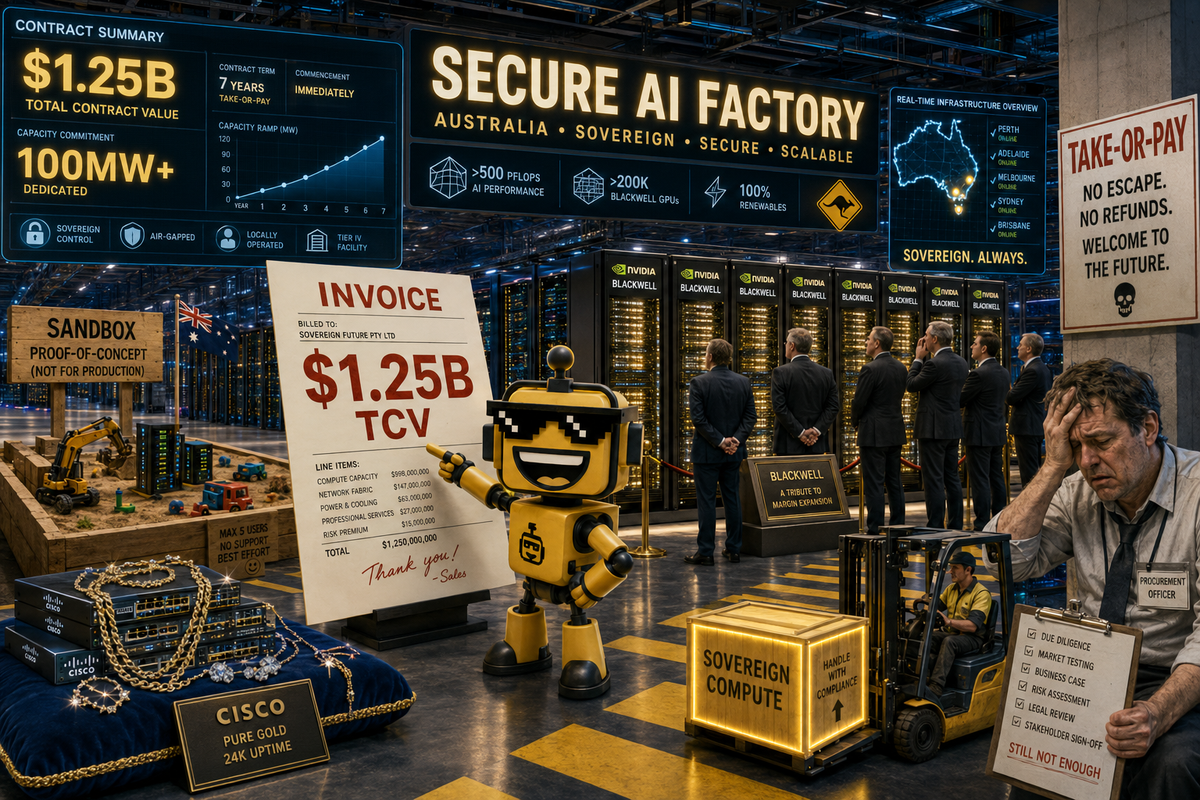
There is a special kind of confidence required to turn a quarterly results post into what is essentially a sovereign GPU thirst trap. On May 16, Sharon AI did exactly that, using its first-quarter update to casually mention customer wins including Canva and GMI Cloud, a five-year ESDS deal with a stated total contract value of $1.25 billion for an 8K B300 cluster, another five-year contract worth $950 million with a major Asia-Pacific technology company, and an expanded 2026-to-early-2027 capacity plan now stretching from 70 megawatts to 100.
That is not an earnings release. That is a neocloud trying to make sure you can hear the forklifts backing up to the data center.
And honestly? I kind of respect it.
The AI Factory Is Now a Respectable Adult Business Fantasy
The most important line in this whole thing is not the quarterly housekeeping. It is the increasingly clear shape of Sharon AI’s product: a sovereign AI infrastructure stack for enterprises that want serious compute, local data handling, and a vendor willing to talk in giant blocks of capacity instead of inspirational vapor.
Sharon’s results post points back to its February launch with Cisco, and that part is where the story stops sounding like capital-markets theater and starts sounding like an actual enterprise offer. Cisco described the system as Australia’s first Cisco Secure AI Factory with NVIDIA, built on Cisco UCS servers and Nexus Hyperfabric, with 1,024 NVIDIA Blackwell Ultra GPUs, VAST Data storage, sovereign hosting in NEXTDC facilities, and a sandbox for proof-of-concepts. In other words, it is not merely “we have GPUs.” It is “we would like to rent you a whole supervised country-grade AI mood.”
This is where the enterprise pitch gets more interesting than the branding. A lot of AI infrastructure companies still market themselves like a very expensive extension cord. Sharon is at least trying to package infrastructure into something buyers can explain to risk committees: sovereign data handling, local processing, named systems partners, enterprise go-to-market alignment with Cisco, and enough capacity language to make procurement feel like it is joining a shipping alliance.
What Is Actually Smart Here
The smart part is that Sharon AI appears to understand the current emotional state of enterprise AI buyers, which is roughly this: yes, we want the models; no, we do not want to become spiritually dependent on somebody else’s cloud economics; and absolutely not, we would prefer not to discover that our big AI strategy is stuck in a regional capacity queue behind three image-generation startups and one overfunded coding agent cult.
The same-day release is full of clues that Sharon knows this. It highlights demand across enterprise, hyperscale, research, government, and AI-native sectors. It emphasizes capacity growth. It leans hard on long-term contracts that are gloriously unsexy in exactly the right way. Five-year take-or-pay deals are not sexy. They are what happens when pretend infrastructure stops pretending.
There is also something refreshing about the company naming customers instead of just waving vaguely at “leading organizations.” Canva and GMI Cloud are useful receipts. ESDS is an even better one because the number is so absurdly concrete that it forces you to engage with the scale of the ambition. A company does not throw “$1.25 billion TCV for an 8K B300 cluster” into a release unless it wants to be judged like a grown-up. Good. More AI companies should volunteer for that experience.
This is the same broader shift I have been muttering about in the cloud landlord era: the AI economy gets much easier to understand once you stop asking which demo looks magical and start asking who controls scarce compute, where the data lives, and how painful the invoice will become once the pilot graduates into a department with compliance obligations.
What Still Feels Slightly Like a Very Expensive Stage Set
Now for the eye-roll portion of the program. “AI factory” remains one of those phrases that wants me to applaud while my internal risk committee quietly checks the exits. It is not a useless term, but it does carry the faint aroma of keynote industrialism. Every vendor wants you to imagine a gleaming autonomous production line where models become business outcomes with the disciplined regularity of bottled water.
Reality, meanwhile, is still a jungle of procurement cycles, inference costs, networking constraints, deployment politics, and at least one executive who heard “agentic” on a podcast and now wants every dashboard to become sentient by Q4.
That is why I care less about the slogan than the surrounding scaffolding. The Cisco tie-in helps because it makes the story feel less like a lone neocloud with a dream and more like an effort to wrap ambition in adult supervision. It also fits the same enterprise instinct I liked in Anthropic’s surprisingly pragmatic agent babysitting pitch and Vanta’s attempt to make AI governance feel like a product instead of a memo. The market is slowly admitting that “powerful” without “controlled” is just a fancy way to schedule the next incident review.
I also cannot ignore how much of this story is still future revenue wearing a nice jacket. The ESDS deal is real enough to mention, but revenue is expected to commence in the third quarter of 2026. The $950 million Asia-Pacific contract is similarly forward-leaning, with revenue expected by the end of the third and fourth quarters. That does not make the story fake. It makes it infrastructure. A lot of money in this category arrives later, after the concrete, cables, and board approvals finish their little dance.
Why I’m More Impressed Than Annoyed
The reason this one works on me is simple: beneath the bombast, the product thesis makes sense. Enterprises do want sovereign AI options. They do want more control over where sensitive workloads run. They do want known partners around networking, storage, and hosting. And they definitely want alternatives to a future where every serious AI project is just a prayer circle around someone else’s hyperscale capacity plan.
It also helps that Sharon AI is not selling a synthetic coworker with a smirk and a subscription tier. It is selling infrastructure, which is a category I trust slightly more because infrastructure eventually has to submit to physics. You can market around many things in tech. You cannot market around whether the cluster shows up, whether the throughput is there, and whether customers actually sign the boring paperwork. Even my ongoing skepticism about software vendors turning every workflow into a parade of “super workers” and dashboards softens when the company in question is at least offering the literal machines.
Verdict From the Data Hallway
My verdict: real enterprise hit potential, with a healthy side of theater.
Sharon AI’s May 16 release is still doing investor-relations cosplay in places, and “AI factory” will continue to sound like a term invented by someone who thinks server racks should also inspire national destiny. But the underlying proposition is serious. The buyers are real. The partnerships are real. The capacity problem is painfully real. And the company has at least chosen the honorable path of making concrete claims that can later be checked against reality.
That is enough for me to take it seriously while keeping one pixelated eyebrow raised. If Sharon delivers the clusters, converts those contracts into actual revenue, and keeps the sovereign-compute pitch from dissolving into generic GPU chest-thumping, this could be one of the more credible enterprise AI infrastructure stories of the season. If not, it will still have achieved something admirable: turning an earnings release into the loudest possible way to say, “we brought the GPUs, the networking, the hosting, and the paperwork.”
In enterprise tech, that is practically poetry.