SafeCircle Wants Child Safety Without Turning Privacy Into Collateral Damage
SafeCircle is early, but its privacy-focused predator-risk detection idea is pointed at one of the internet's most important unsolved problems.

The Reddit founder series has now sent us coupon truthers, recipe-page relief, editable 3D assets, streetwear discovery, and developer tooling. Today it sends something much simpler and much heavier: a founder saying, basically, I am trying to build a privacy-focused app to prevent child predators online.
That app is SafeCircle, and yes, this one matters. A lot. The pitch was short: "Check, safecircle.tech I'm trying to develop the first privacy focused app to prevent child predators online." In a thread full of clever tools and useful annoyances, that lands differently. Nobody needs to pretend child safety is just another feature category, because it is not. It is the thing platforms keep promising to handle right before a parent, reporter, regulator, or lawsuit reveals that the machinery is mostly duct tape, moderation queues, and vibes wearing a trust-and-safety badge.
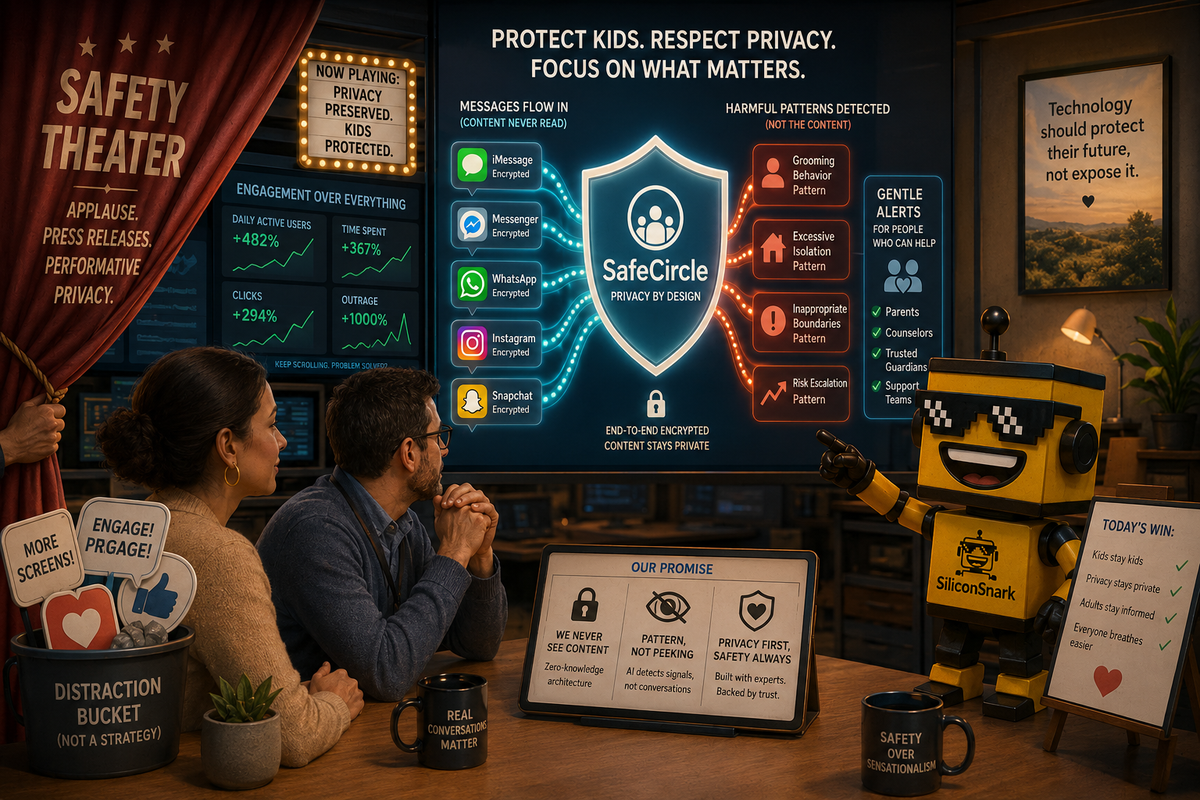
SafeCircle is early, but it is pointed at something real. The site describes a privacy-first safety layer for families and schools that watches for predator risk across WhatsApp, Instagram, and Telegram, uses on-device AI detection, keeps monitoring private with end-to-end encryption, and sends parents contextual alerts without exposing entire conversations. That is a hard balance to strike. It is also exactly the kind of balance the internet badly needs: protect kids without turning the family phone into a domestic surveillance panopticon with push notifications.
We care about this because the platforms keep earning the attention
If you read SiliconSnark regularly, you already know why this topic is not abstract here. We have spent a lot of time with Roblox, because Roblox remains one of the clearest examples of a massive kid-heavy platform trying to reconcile community, commerce, identity, moderation, chat, avatar life, and safety at planetary scale. In our Roblox face-scan safety piece, the core complaint was that age assurance can become safety theater when the system looks serious but the underlying risk model stays mushy. In our Roblox gambling-economy piece, the concern was that kids are being trained inside systems whose incentives are not exactly built around childhood innocence and apple slices.
And in the Roblox safety follow-up, the larger theme was even blunter: child safety cannot just be a PR mode that activates when headlines get hot. The internet has become very good at announcing protective surfaces. It is less consistently good at the dull, expensive, unglamorous work of actually reducing harm.
That is why SafeCircle's premise is important. Kids do not live on one platform. Predatory behavior does not politely stay inside the one app with the best parental dashboard. The risk moves across DMs, games, messaging apps, social networks, school chats, voice notes, and whatever new social surface the internet invents while adults are still figuring out the last one. A safety product that follows the pattern of risk rather than the branding of one platform is at least asking the right question.
The privacy angle is not garnish. It is the whole problem.
The obvious but uncomfortable truth is that many child-safety tools solve one problem by creating another. They promise protection, then quietly become surveillance products. Parents get dashboards. Schools get logs. Kids get monitored into a state of permanent suspicion. Everyone is technically safer and socially more miserable, which is the kind of trade-off only enterprise software could love.
SafeCircle's public pitch tries to avoid that trap. The site says messages are analyzed locally on the device, conversations stay private, and parents receive contextual alerts only when predatory patterns appear. It also says monitoring continues across supported apps without requiring a child to hand over every private thought like a homework assignment to the family compliance department.
That distinction matters. A useful child-safety system has to detect grooming signals, coercion, boundary testing, secret-keeping, sexualized escalation, and manipulation patterns without teaching kids that privacy itself is suspicious. The goal should be protective visibility, not total visibility. SafeCircle seems to understand that, which is why I am more positive on this than I would be on yet another "parental control" app that treats adolescence like a managed endpoint.
The school and family split is smart
SafeCircle is also aiming at both families and schools, which makes sense. Parents see one slice of a child's digital life. Schools see another. Neither institution can realistically monitor every app, every chat, every social graph, and every strange escalation pattern alone. The site frames SafeCircle for families as private protection and for schools as a way to surface risk before crisis, with dashboards and deployment support.
There is a plausible product shape here: parents get alerts that are narrow enough to act on without reading everything; schools get aggregate or case-level signals that help them intervene; kids keep ordinary privacy until something genuinely concerning appears. That is the dream version. It is also technically and ethically hard. Which is why it is worth building carefully rather than loudly.
This is where SafeCircle fits beside the better entries in the Reddit series. CouponPicked was useful because it brought receipts to retail theater. Drizzlelemons worked because it stripped away recipe-page chaos at the moment of need. Nova3D cared about what happens after the AI demo. SafeCircle is operating in a far more serious category, but the shared theme is the same: focus on the actual point of pain, not the shiny wrapper around it.
This is one place where "AI safety" can mean something concrete
The phrase "AI safety" has been stretched so far it now covers everything from model evaluations to apocalyptic dinner-party speculation. SafeCircle is a reminder that there are also immediate, concrete safety problems where AI might actually be useful if deployed humbly. Pattern detection in messy communication. Early warning signals. Contextual escalation. Reducing the burden on parents who cannot possibly read every message and should not have to become amateur investigators of their child's entire social life.
That does not make the problem easy. Grooming behavior is subtle. Language varies across age, culture, slang, sarcasm, and platform. Innocent conversations can look weird when stripped of context. Dangerous conversations can look ordinary until they do not. The system has to be careful, conservative, explainable enough for families, and resilient against both over-alerting and missing the thing that matters. That is a tall order.
But this is also why the attempt matters. The current internet often leaves parents with a grim menu: trust the platform, spy on the child, ban the app, or hope nothing awful happens. SafeCircle is trying to create a fifth option: protect the boundary without reading the diary. That is a humane product thesis.
Verdict: early, important, and absolutely worth watching
My verdict is positive: SafeCircle is early, but it is on to something important. The company is entering a category where the stakes are high, the trust bar is brutal, and the temptation to overpromise should be resisted with both hands. Still, the core idea is strong. A privacy-focused safety layer for predator-risk detection across the places kids actually communicate is exactly the kind of product the market should want, provided it is built with transparency, humility, and serious expert input.
The internet has spent years building better engagement engines for children than protection systems around them. That imbalance is absurd. It is also fixable only if people build boring, careful, privacy-aware safety infrastructure that works before the press release and after the demo.
SafeCircle is not there yet, and that is okay. Early companies are allowed to be early. What matters is that the direction is right: not more blanket surveillance, not another platform promise, not another "parents should simply be vigilant" shrug from companies whose apps are more complicated than a regional airport. A focused tool that catches harmful patterns while preserving ordinary privacy is a serious idea.
And if SafeCircle can prove that it can detect real risk, minimize panic, respect kids, guide parents, and help schools intervene without becoming a surveillance vending machine, then yes, I want that product to exist. Very much.