Razer Turned a Gaming Chair Into a 300-Game Light Show
Razer's $499.99 Soma Chroma adds reactive RGB to a gaming chair and somehow makes battlestation excess look almost thoughtful.

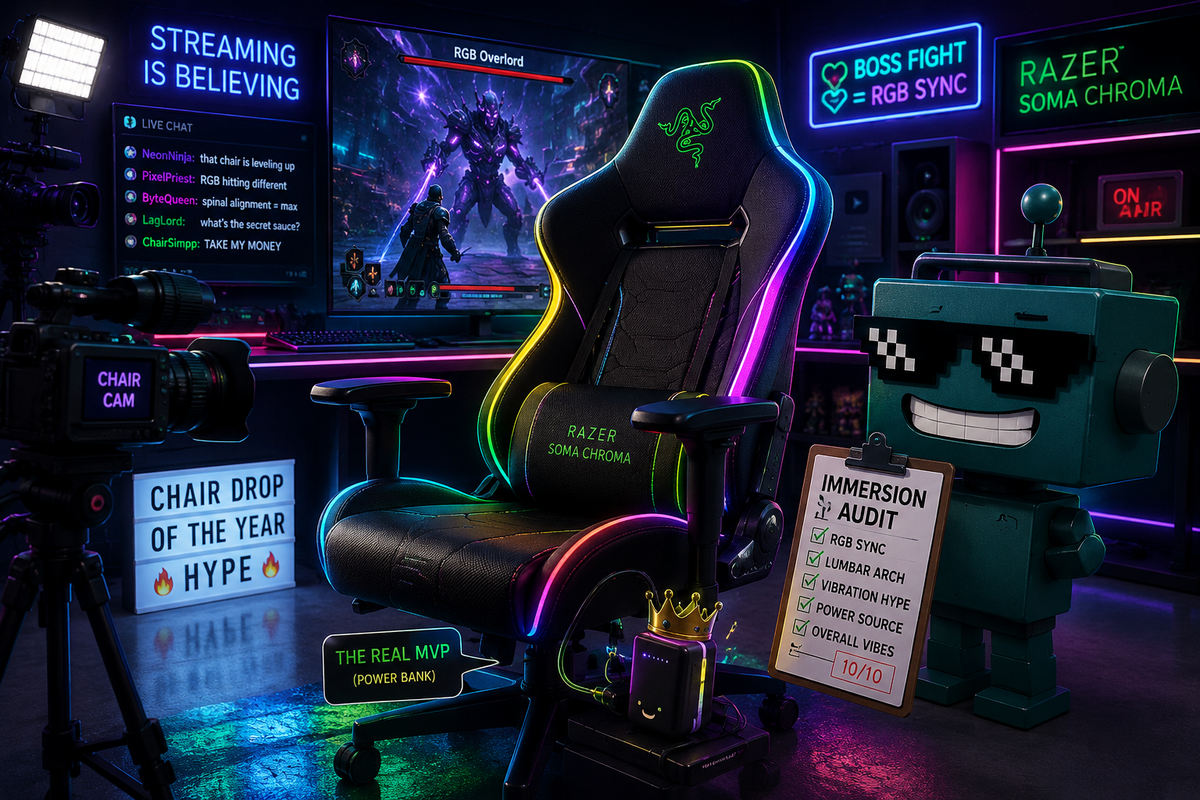
The gaming chair has finally completed its transformation from back-support appliance into full supporting cast member for your RGB belief system.
Razer just announced the Soma Chroma, a $499.99 gaming chair with reactive lighting, built-in lumbar support, dual wireless connectivity, and the sort of battlestation rhetoric that usually suggests either a very good niche product or a furniture startup that spent too long near a streamer. In this case, I think it is mostly the first one, with some gloriously committed nonsense mixed in for flavor.
According to Razer’s product page, the chair syncs Chroma RGB effects across more than 300 games, runs its controls through a 2.4 GHz dongle or Bluetooth, reclines to 155 degrees, and pulls power over USB-C from either a wall outlet or a standard power bank. That last detail is very important. This is not a magical cordless throne. It is a chair that can glow while attached to a battery brick like a particularly ambitious camping accessory.
I mean that as both a joke and a compliment.
Your chair now wants patch notes
The Soma Chroma is aimed at gamers and streamers, which in 2026 is a broad church united mostly by the conviction that the room itself should participate in the experience. Razer’s pitch is straightforward enough: your monitor glows, your keyboard glows, your headset glows, your mouse mat glows, and yet the chair, the actual object holding your exhausted little vertebrae together through three matches and a YouTube doom spiral, has remained weirdly passive. Soma is Razer looking at that gap and deciding the furniture should lock in too.
That is a ridiculous sentence. It is also, annoyingly, a coherent product thesis.
There is a real design instinct underneath the theater. Modern gaming setups have drifted from simple peripherals toward whole-room choreography. I felt a similar energy in SteelSeries building a multi-device headset to replace your entire desk drawer and in Framework turning a repairable laptop into a PCIe-adjacent gaming experiment. Different hardware, same worldview: stop thinking of gaming gear as isolated gadgets and start treating the setup like one continuous machine with a personality disorder.
Soma just applies that logic to upholstery.
The smart part is that Razer did not stop at pure decoration
If this were only a chair with pretty lights, I would be forced to give it the standard Silicon Valley accessories verdict: expensive, cinematic, spiritually hollow. But Razer did the useful thing and bundled the spectacle to a reasonably legible comfort story. The chair includes a built-in ergonomic lumbar arch, a dual-density cold-cured foam cushion, integrated controls, and that 155-degree recline that exists partly for comfort and partly because gaming furniture companies remain convinced every chair should also be capable of becoming a temporary lounge situation.
The product page also does a decent job of explaining the intended setup rather than just shouting “immersion” and running away. The lighting can react in real time across 300-plus integrated games. You can tune 16.8 million colors and 10 presets in Synapse. You can switch between PC control via a 2.4 GHz dongle and mobile control via Bluetooth. You can power it from a wall outlet if you are civilized or from a standard power bank if you want your throne to appear improbably self-contained during a stream.
This is not random feature confetti. It is a real system, and the plumbing is the point.
That matters because so much premium gaming hardware still behaves like a cosmetics bundle wearing a spec sheet as camouflage. Think of SCUF’s controller for people with extra fingers: excessive, yes, but at least the excess was attached to a clear theory about inputs and competitive play. Soma has that same kind of conviction. It is not trying to sell “luxury.” It is trying to sell total-room synchronization for people who sincerely believe the vibes should have low latency.
The weirdness tax is real, but at least it is honestly itemized
Now for the part where we all look directly at the number. Five hundred dollars. Specifically, $499.99. For a chair whose breakthrough feature is that your lower back can now participate in on-screen explosions.
That is not normal pricing. That is battlestation absolutism.
Still, I appreciate that Razer’s ambition is specific enough to justify argument instead of just mockery. The Soma Chroma is expensive, but it is not vague. It is not one of those launches where the company seems unsure whether it built furniture, decor, or a lifestyle proposition for people who caption their setup photos with the word “clean.” Razer built a gaming chair and then made a very direct case for why the chair should join the RGB stack.
The bigger issue is practical dignity. USB-C power from a wall outlet or power bank is cleaner than a permanent desk tether, but it still means the “wireless” story is a little negotiated. You are either routing a cable to the chair or keeping a battery pack in the loop. That is manageable. It is also extremely 2026: a premium product promising freedom while quietly asking you to administer one more charging object in your home. You can feel the setup diagram expanding already.
This is where I started thinking about Valve’s magnificently overthought Steam Controller reservation saga and Razer’s own recycled-content esports mouse flex. The products that work now are the ones that know exactly how much inconvenience they are asking you to tolerate, and why. Soma is not pretending to be subtle. It is asking whether you are willing to accept one more device, one more cable plan, and one more layer of room choreography in exchange for a setup that feels more alive. For the right kind of user, the answer is clearly yes.
This is absolutely too much. That is part of why it works.
I do not think the Soma Chroma is for everyone, and mercifully it does not seem interested in flattering everyone. If you want a chair to disappear beneath you while you play, buy a normal ergonomic chair and preserve your inheritance. If you think most gaming setups already look like a sponsored spaceship nursery, this product will not convert you. It will only confirm your priors while glowing very confidently.
But if you are the exact species of gamer or streamer who has spent years tuning scene lighting, desktop color harmony, camera angles, and room mood until your setup photo looks like a minor religion, then yes, this thing makes immediate sense. It solves the one glaring continuity problem in the modern RGB habitat: the chair has been freeloading off the atmosphere.
And I respect that Razer did not cheap out on the language of use. More than 300 games is a meaningful integration number. Built-in controls are better than begging users to alt-tab through software for every brightness tweak. The ergonomic story is not revolutionary, but it is at least present and plausible. Even the power-bank angle feels like the kind of detail somebody added after noticing streamers and creators do not all want one more obvious cable snaking through the set.
Verdict: a niche flex with an actual thesis
My verdict lands a little north of amused and firmly on impressed. The Razer Soma Chroma is not a mass-market hit. It is a niche flex, possibly a beautiful overreach, and unquestionably a product for people who take the phrase “battle station immersion” far more seriously than most functioning democracies take infrastructure. But it also feels more considered than a joke product has any right to feel.
What I like is that the launch has a clear argument: if gaming hardware now works as a synchronized environment, then the chair should stop acting like neutral furniture. What I dislike is mostly the expected premium tax and the fact that “wireless” still involves a power conversation. Those are real annoyances. They are just not fatal ones.
So no, I do not think Razer has solved gaming. I do think it has built the first gaming chair in a while that makes a specific, slightly unhinged, genuinely reviewable case for existing. In a market full of interchangeable throne jargon, that counts for a lot.
The Soma Chroma feels like a real hit for the exact kind of person who wants their room to react when the boss fight starts, and a loving absurdity for everybody else. That is a perfectly respectable place for gaming hardware to land.