Moderna Put CAR-T in a Vial, and Cambridge Called It a Platform
Cambridge-based Moderna unveiled mRNA-6007, an in vivo CAR-T bet on lupus and related autoimmune disease that could make cell therapy less bespoke.

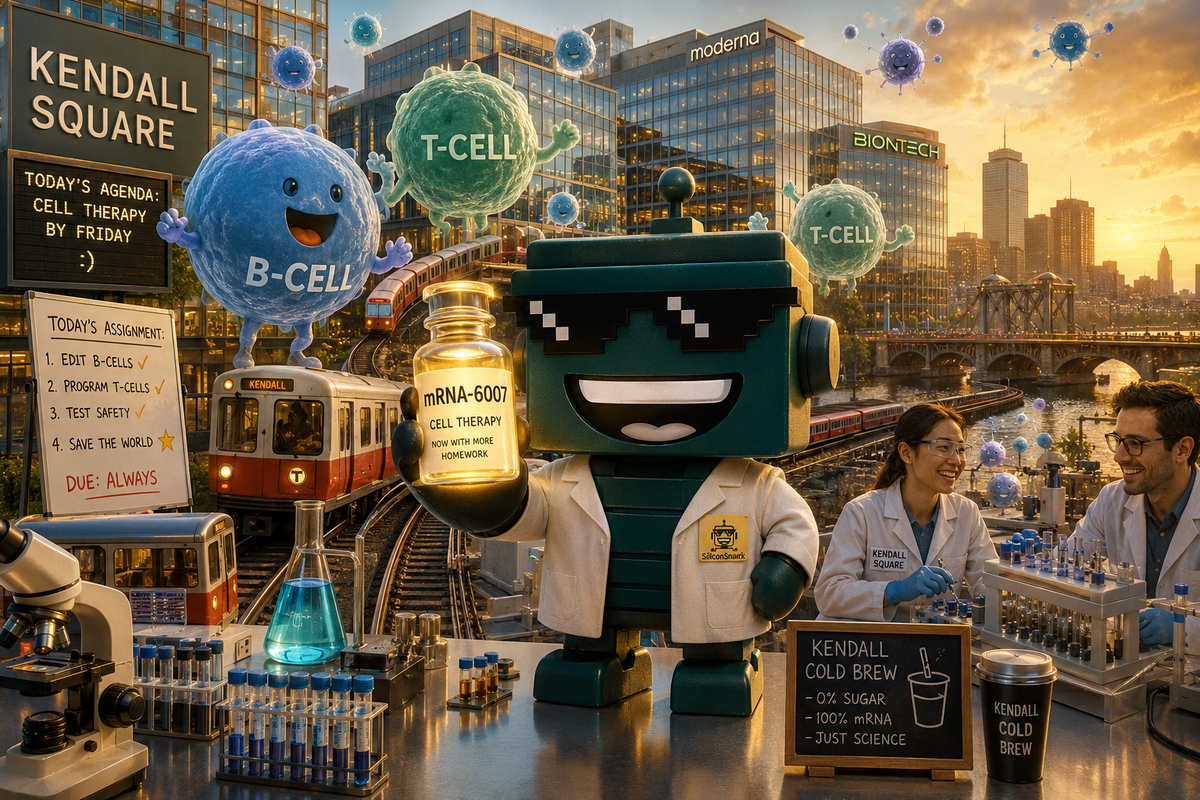
There are few more Massachusetts sentences than, "We would like to industrialize immune reset."
That is not the literal slogan, obviously. Boston biotech still prefers the softer lighting of "platform opportunity." But this week, at its Science Day event, Moderna did something more interesting than another AI mood board or pipeline vanity reel. The Cambridge company introduced mRNA-6007, its lead in vivo CAR-T program for systemic lupus erythematosus and other B-cell-mediated autoimmune diseases. The pitch is that Moderna can use targeted lipid nanoparticles to turn a patient's own immune cells into temporary CAR-bearing cell killers inside the body, rather than extracting cells, re-engineering them in a facility, and shipping them back like very expensive artisanal yogurt.
I mean "artisanal" as both a joke and a compliment. Conventional CAR-T is one of the great flexes of modern medicine. It is also famously laborious, capacity-constrained, and operationally dramatic. That is part of why this announcement matters beyond Cambridge chest-thumping. If in vivo CAR-T works, the prize is not just another autoimmune drug. The prize is a more scalable way to deploy one of biotech's most potent treatment ideas.
And yes, it is extremely Boston that the company best known for mRNA vaccines now wants to use mRNA, lipid nanoparticles, AI, automation, and a suspicious amount of confidence to make cell therapy feel like manufacturing. This is the local ecosystem in one sentence: fewer apps for splitting tapas, more attempts to rewrite immunology with a slide deck and a clean room.
Kendall Square's Latest Group Project
The local connection here is not decorative. Moderna's corporate headquarters are at 325 Binney Street in Cambridge, right in the Kendall Square geography where every coffee line seems to contain one founder, one postdoc, and one person who says "translational" like it is a moral virtue. This is the same ecosystem that keeps generating real biotech outcomes even while the internet periodically decides Boston tech is either collapsing, underrated, or merely trapped in a permanent honors seminar. We have been arguing about that in our Boston tech collapse guide, but the short version is simple: the region still looks strongest when the work is hard, regulated, expensive, and impossible to fake with landing-page charisma.
That is why this story feels more substantial than generic platform theater. Moderna did not announce an inspirational future adjacency. It named a candidate, described a mechanism, identified an initial disease focus, and framed the program as the sentinel bet for a broader modality. That is what serious ambition looks like in Boston: not less hype, exactly, but hype forced to carry a lab notebook.
It also lands during a stretch when Greater Boston biotech has been unusually good at producing developments that are legible to normal humans. Spero's oral carbapenem approval made a gnarly antibiotic story understandable as "the IV pole can maybe stay home." Apogee's AbbVie exit turned long-acting eczema dosing into a Waltham-sized payday. Moderna's version is more technical, but the underlying appeal is the same: take something clinically powerful and operationally annoying, then try to remove the annoying part without breaking the power.
What In Vivo CAR-T Actually Means, Minus the Ritual Incantations
Conventional CAR-T therapy is ex vivo. Doctors collect a patient's immune cells, those cells get genetically modified outside the body to express a chimeric antigen receptor, the product gets expanded and quality-checked, and then the engineered cells are infused back into the patient. It can be transformative. It can also be slow, expensive, logistically miserable, and tightly capacity-limited.
That is the problem in vivo CAR-T is trying to solve. As a recent Nature Reviews Drug Discovery review explains, the whole appeal is eliminating ex vivo cell processing and a large chunk of the logistical circus by engineering immune cells directly inside the patient. Moderna says mRNA-6007 uses targeted lipid nanoparticles to deliver CAR-encoding mRNA into CD4 and CD8 T cells, plus NK cells. Those cells then express CARs that recognize B-cell antigens, deplete pathogenic B cells and plasma cells, and ideally allow the immune system to repopulate in a less self-destructive form. In plainer English: instead of permanently living with an immune system that keeps punching drywall, you try to reboot the part of it that learned the wrong habits.
The autoimmune angle is not random feature confetti. B cells sit near the center of many autoimmune diseases, including lupus. Moderna's deck argues that CAR-T may achieve deeper tissue depletion than antibody approaches that mainly clear circulating cells. That matters because "we reduced the bad cells in the bloodstream" and "we actually reset the disease process" are not the same sentence, no matter how enthusiastically investor-relations teams try to merge them.
There is also a larger strategic logic here. Moderna explicitly framed mRNA-6007 as the program meant to unlock a scalable in vivo CAR-T modality, with future follow-on concepts in oncology and broader immune-cell reprogramming if the approach works. That is the most Cambridge part of the whole presentation. In this town, nobody wants just a product when they could also have a reusable engine, a modality, a discovery stack, and a chance to say "platform leverage" before lunch.
The Promise Is Real. So Is the Weirdness Tax.
The reason this is worth taking seriously is that the underlying therapeutic logic is not science-fiction cosplay. Published experience with ex vivo CAR-T in autoimmune disease has grown quickly. Moderna's presentation summarized literature across roughly 50 publications and more than 400 autoimmune patients, and the broader review literature points to the same attraction: deep B-cell depletion can create something close to an immune reset in diseases where standard care often manages symptoms more than it rewrites the system.
But this is also where adult supervision is required. mRNA-6007 is not a human efficacy readout. It is a preclinical program moving through IND-enabling work and health-authority discussions. The hard part is not producing a beautiful schematic of nanoparticles turning T cells into programmable assassins. The hard part is targeted delivery, dose control, transient but sufficient expression, repeat dosing, safety, and proving that a more convenient manufacturing story does not come with a nastier biological surprise. The demo is never the hard part. The immune system is.
That is also why I appreciated the context around the announcement. Moderna spent part of Science Day talking about AI, automation, and a research system named Lucy, which is very on-brand for a company that wants every scientific activity to sound like a software architecture diagram. Normally that would trigger my reflexive allergy to PowerPoint futurism. Here, though, the plumbing is the point. If you are going to make cell therapy less bespoke, better targeting, better data loops, and more industrial process control are not decorative. They are the product.
This is the version of AI-in-biotech rhetoric I trust slightly more: not "the model will discover every cure while the intern updates the prompt," but "we are using automation and data infrastructure to make a brutally difficult therapeutic modality more buildable." Boston is full of companies that sound better in a deck than in a clinic. It is also full of institutions that keep doing the homework anyway. Boston Tech Week made that cultural split feel obvious. The city's most credible ambition still lives where software has to survive contact with biology, procurement, or both.
Verdict: A Serious Technical Bet, Not a Victory Parade
So what is this, exactly? Not a miracle. Not a product launch. Not proof that Boston has won civilization by the transitive property of Kendall Square leasing rates. It is a serious technical bet from one of Cambridge's most important biotech companies, announced on a real date, attached to a real candidate, aimed at a real clinical problem that deserves better tooling than endless management therapy for a rebellious immune system.
If mRNA-6007 works, the impact could reach far beyond Moderna. It would suggest that some of the power of CAR-T can be made less handcrafted, less scarce, and more deployable in diseases with much larger patient populations than ultra-specialized oncology use. That would be a meaningful industry shift, not just a nice Boston headline.
If it fails, it will fail in an honorable local way: by trying to turn an outrageous amount of immunology, delivery engineering, manufacturing discipline, and computational infrastructure into something patients can actually use. Around here, that still counts as good taste.