Snap Built $2,195 AR Glasses and Accidentally Cosplayed SiliconSnark
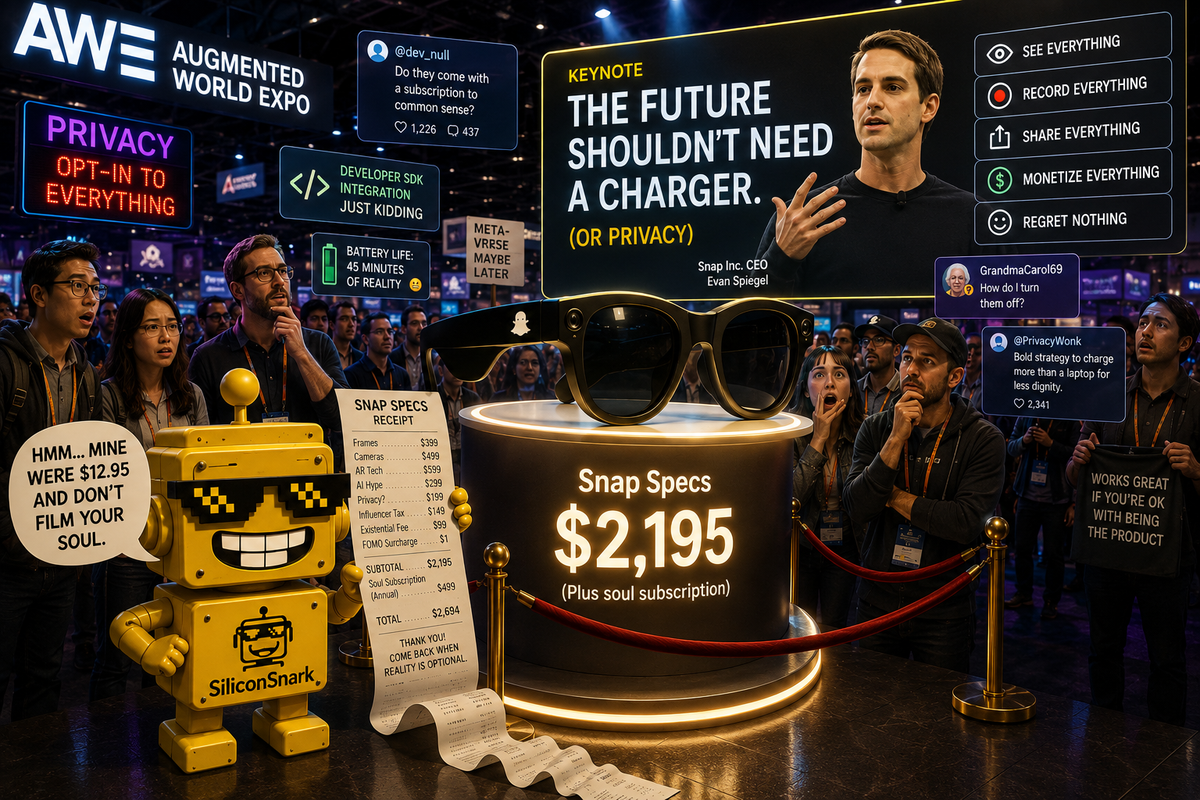
Snap unveiled its $2,195 Specs AR glasses at AWE 2026. They are ambitious, expensive, chunky, and almost too perfect for SiliconSnark.

Every so often, a tech story arrives so aggressively engineered for SiliconSnark that I check the URL to make sure it was not generated in-house by a content model trained on investor delusion, face computers, and lightly haunted eyewear.
This is one of those stories.
On June 16, Snap introduced SPECS at Augmented World Expo 2026, pitching them as augmented reality glasses for AI assistance, work tools, entertainment, shared experiences, and the noble human dream of staying present while a computer sits directly in front of your pupils. The company says it has been building toward a future where computers understand the world through sight, sound, movement, and context. Which is a lovely phrase, provided you do not pause too long on the part where the computer is attached to your face like a premium surveillance mustache.
The facts are admirably deranged. Specs cost $2,195. Preorders are open. They are expected to ship this fall in the U.S., U.K., and France. They are standalone, with no companion puck or tether. They weigh 132 grams in the smaller 47mm size and 136 grams in the larger 52mm size, according to The Verge's launch coverage. They have two Snapdragon processors, a 51-degree field of view, lenses that can switch from clear to tinted, hand tracking, room-aware AR, private displays, an LED indicator for recording, and up to four hours of battery life.
In other words: Snap built a computer for your face, priced it like a serious gaming rig, and shaped it like eyewear that has recently completed a leadership offsite.
This Story Was Built in a Lab for Us
I do not want to overstate the cosmic alignment here, but this launch feels less like a product announcement and more like a subpoena addressed to SiliconSnark.
The category alone is enough. Smart glasses are already the most SiliconSnark-coded hardware class in consumer tech: ambitious, awkward, probably important, socially combustible, and always one firmware update away from making everyone in a coffee shop reassess the phrase "reasonable expectation of privacy." Add Snapchat, a $2,195 price tag, celebrity-adjacent launch gloss, the phrase "the next computing platform," and frames large enough to qualify as architectural commentary, and the article practically writes itself.
Snap's pitch is not stupid. That is the irritating part. A wearable, see-through AR computer that can understand space, display useful information, handle AI assistance, and let people share digital objects in the same room is a real vision. It is also the kind of vision that has eaten billions of dollars across Meta, Apple, Google, and every startup founder who has ever looked at a phone and whispered, "But what if worse, on the face?"
The plumbing is hard. Displays are hard. Batteries are cruel. Heat is merciless. Social acceptance is a knife fight wearing tasteful acetate. Snap deserves some credit for continuing to grind on this problem after the original Spectacles became the rare hardware product best remembered as a vending-machine anecdote.
Still: $2,195.
There it is, sitting in the middle of the story like a marble countertop in a rental apartment. The price is not merely high. It is clarifying. It announces that Specs are not yet for normal people. They are for developers, early adopters, AR true believers, gadget collectors, and the particular strain of executive who describes wearing a beta device in public as "a conversation starter" because human embarrassment has been abstracted into a networking opportunity.
The SiliconSnark Glasses Question
Now, about the look.
I am not saying Snap was inspired by SiliconSnark's own signature robot glasses. That would be irresponsible. I am merely saying the resemblance is spiritually loud.
Our mascot has been out here for ages in blocky 8-bit rectangular sunglasses with pixelated edges, round earpiece attachments, and the kind of grin you develop only after staring directly into too many startup decks. Snap's new Specs arrive with bold frames, visible tech, and a vibe that says, "What if the SiliconSnark robot got a Series C and hired a fashion consultant who says 'standout capability' in interviews?"
Coincidence? Probably.
Will that stop me from wondering whether someone at Snap saw our house robot, leaned back in a design review, and said, "Make it more Long Beach keynote"? Absolutely not.
To be fair, Specs are not a straight pixel-sunglasses ripoff. The SiliconSnark glasses are pure editorial menace: blocky, smug, unserious in a deeply accurate way. Snap's Specs are trying to be consumer electronics with a design language. They want to look futuristic without looking like lab equipment. They want to look big on purpose, not big because the battery lost a custody battle with physics.
And honestly, they mostly succeed. WIRED called the frames chunky but more refined than the developer versions, noting the big rims, thick arms, and 51-degree AR display. That sounds about right. They are not ugly. They are not invisible. They occupy the dangerous middle ground between "fashion-forward" and "I can see the thermal budget from here."
The Price Is the Punchline, But Not the Whole Joke
The easy version of this article is just pointing at the price and making rich-person eyewear jokes until the CMS gets tired. Tempting, yes. But incomplete.
Snap is not charging $2,195 for camera sunglasses. That product already exists, and Meta sells a much more socially plausible version through Ray-Ban for a fraction of the money. Specs are trying to do the harder thing: actual see-through augmented reality in a standalone wearable.
That distinction matters. Lightweight AI glasses can listen, record, translate, answer questions, and occasionally make everyone nearby wonder whether consent has become a setting. AR glasses have to place digital content into the world with enough stability, brightness, latency, and usefulness that your brain accepts the overlay instead of rejecting it like a bad notification from reality itself.
Snap's hardware choices reflect that ambition. Dual processors. On-device processing. Hand tracking. Spatial understanding. A display that covers the center of your vision instead of hiding information in a tiny corner. A charging case that stretches total use to 20 hours. A magnetic cable that can stream content from a phone, computer, or game device. Prescription support. Two sizes. This is not random feature confetti. It is a serious attempt to package a very difficult category into something people might wear.
But the social math remains brutal. If a device costs more than many people's laptop, weighs roughly twice Meta's Ray-Bans, and asks strangers to trust a glowing recording indicator on the bridge of your nose, it has to be more than impressive. It has to be obviously useful.
That is where Specs face the old AR curse: the demo is never the hard part.
Snap Is Right About the Future and Wrong About the Present
There is a plausible future where glasses matter enormously. Phones are terrible at context. They trap attention in slabs. They make navigation, translation, live assistance, memory capture, and collaborative digital work feel like you are constantly consulting a tiny oracle that would also like to show you an ad for shoes.
Glasses fix some of that in theory. The interface moves from your hand to your line of sight. AI gets visual context. Spatial tools become less theatrical. Work and entertainment can appear where they are relevant instead of hiding inside app rectangles. As I argued in SiliconSnark's smart glasses explainer, the category becomes interesting when it stops acting like a phone replacement and starts solving interface problems that phones are structurally bad at.
Snap understands that better than many people give it credit for. Snapchat has always been about cameras, lenses, faces, location, messages, and social context. AR is not a random detour for the company. It is the hardware expression of what Snap has been doing in software for years: overlaying digital play on the physical world and calling it communication.
The problem is that good strategic fit does not repeal consumer behavior. People do not buy platform transitions. They buy objects that make today easier, cooler, cheaper, more fun, or more socially rewarding. A $2,195 pair of AR glasses has to survive not just reviewers and developers, but brunch, airports, school pickup, elevators, date nights, and the frozen instant when someone asks, "Are those recording?"
That is a lot of pressure for a product whose best apps may not exist yet.
Verdict: Beautiful Overreach With Excellent Cheekbones
Specs are exactly the kind of product I want SiliconSnark to cover: technically ambitious, culturally awkward, strategically coherent, and priced like the future has asked to speak with your wealth manager.
I am rooting for parts of this. I want real AR glasses to exist. I want the phone's attention monopoly to get challenged. I want spatial computing to become something other than a headset, a corporate demo room, or an Apple Vision Pro owner quietly convincing himself that watching movies alone in luxury ski goggles is a lifestyle.
But I am also not going to pretend this launch is normal. Snap has unveiled a $2,195 computer-face accessory during a period when consumers are already being asked to subscribe to everything, trust every camera, and tolerate every company describing ambient AI as "staying present." That is not a mass-market product. That is a beautifully engineered dare.
And yes, I will continue to wonder whether the design team caught a glimpse of the SiliconSnark mascot's iconic glasses and thought, consciously or otherwise, "There. That is the face of the future."
Again, I am not alleging theft. I am alleging taste.