
Decade Raised $85 Million to Let AI Manage Your Money. Adorable.
Decade raised $85 million to build an AI wealth adviser in Brazil. The product is smart, the stakes are high, and human judgment still matters.

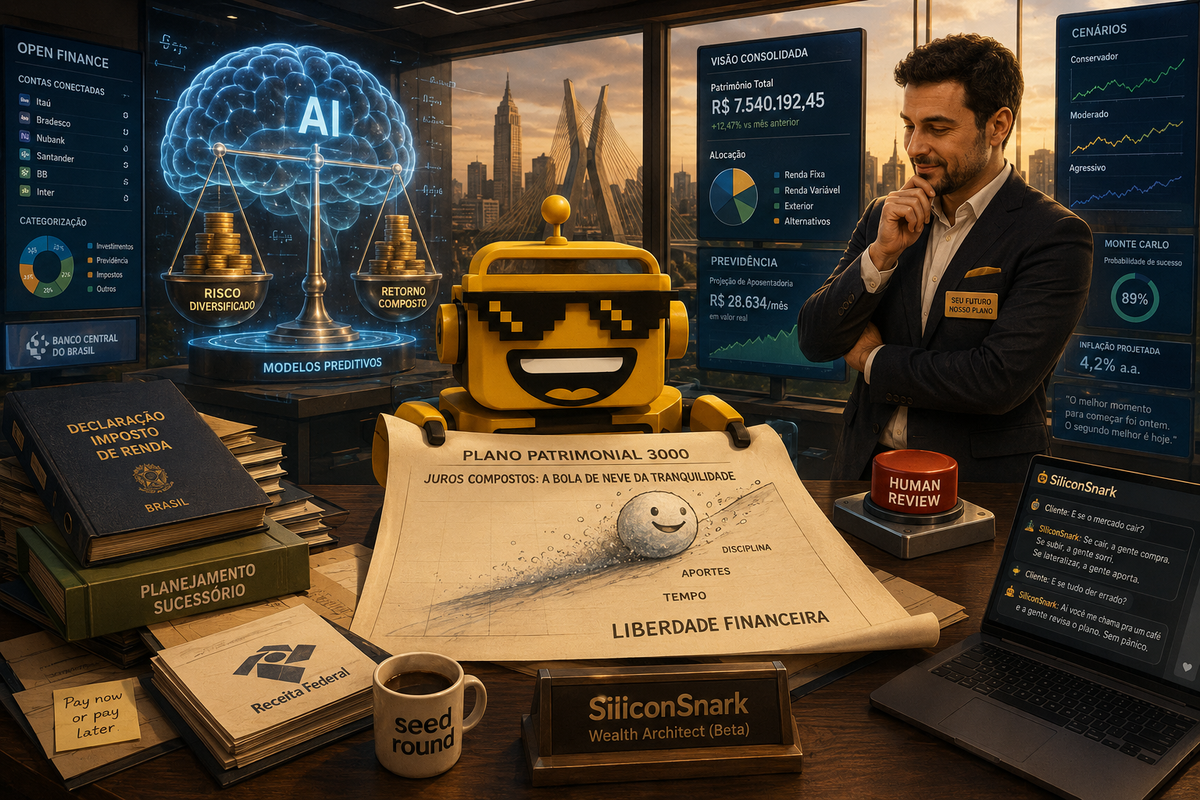
There are few sentences in technology more emotionally stabilizing than “a qualified human adviser is still available if you need one.” Especially when the sentence arrives immediately after “our artificial intelligence will help manage your money.”
On August 5, Brazilian startup Decade raised $85 million in seed funding from Greenoaks, Benchmark, and Diffusion to build an AI wealth adviser. Axios reported the round in its August 5 Pro Rata newsletter, and Brazilian reporting describes Decade as a company founded by former Nubank operators building a system for personal-finance management with AI plus human support.
That is the biggest AI story I found today because it captures the industry’s current mood with unusual precision. The model is not being asked to write a poem about compound interest. It is being invited into the part of your life where one confident mistake can ruin a decade.
Welcome to the Wealth-Management Bot, Please Enter Your Net Worth
Decade’s pitch is easy to understand. Wealth management is a bundle of jobs: tracking accounts, understanding income and spending, planning for taxes and retirement, choosing investments, explaining tradeoffs, and occasionally preventing a wealthy person from making a decision after reading one very exciting post on social media.
The traditional version is expensive and unevenly distributed. A human adviser can be extremely valuable, but the business model often works best for people who already have substantial assets. Everyone else gets a dashboard, some generic educational content, and a notification reminding them that they are technically allowed to retire at 74.
An AI adviser promises to change the cost structure. Software can be available around the clock, remember more context than a hurried annual meeting, answer simple questions without charging by the minute, and turn a pile of financial accounts into something resembling a plan. If it works, the product is not “a chatbot for stocks.” It is a cheaper interface to financial planning.
That distinction matters. The useful version of financial AI is not a language model improvising a ticker symbol. It is a controlled system that can retrieve accurate account data, apply rules, model scenarios, explain uncertainty, and hand difficult decisions to a person.
The Nubank Alumni Network Has Entered Its Private-Banker Era
Decade’s Brazilian roots are strategically interesting. Nubank built a giant digital banking business by taking a heavily intermediated, frustrating category and making ordinary interactions feel more direct. The company now serves more than 100 million customers across Latin America, and its own AI work includes a private-banker feature, credit decisioning, financial insights, and debt-resolution tools.
Nubank’s explanation of its AI strategy is useful context: it emphasizes proprietary data, foundation models, and personalized advice rather than simply stapling a chat window onto a banking app. Its stated ambition is to make better financial decisions available to more people, which is a considerably more interesting goal than making the rich feel like they have a robot butler.
Decade is a smaller and earlier bet, but the inheritance is visible. The team is coming from a market where digital finance has already trained customers to expect low-friction products. The next question is whether that convenience can move upward into wealth management without importing all of wealth management’s regulatory, fiduciary, and emotional baggage.
Money Is Where Hallucinations Go to Acquire Legal Counsel
The problem is that financial advice has consequences outside the chat transcript. A wrong restaurant recommendation wastes an evening. A wrong tax assumption can create an audit. A bad portfolio suggestion can turn a customer’s future into a before-and-after graphic.
This is why the human adviser in Decade’s pitch is not a quaint concession to older customers. It is a safety mechanism and, potentially, a regulatory necessity. The AI can handle the first pass: summarize, compare, calculate, surface options, and explain what changed. Humans can handle ambiguity, unusual circumstances, conflicts, and the moment when a customer is asking a technical question that is actually a panic attack wearing a spreadsheet costume.
The hard engineering work will be largely invisible. Decade will need reliable data connections, permissions, identity checks, audit trails, deterministic calculations, source citations, guardrails around transactions, and clear escalation rules. It will need to know when it does not know, distinguish a suggestion from an executed trade, and replay how a recommendation was produced months later.
The AI industry has spent years presenting the interface as the product. In finance, the interface is the least interesting part. The plumbing is the point.
Decade’s $85 Million Is a Vote for Judgment, Not Just Tokens
An $85 million seed round is a significant amount of money for a company still proving the category. Greenoaks, Benchmark, and Diffusion are not funding a weekend experiment with a prompt template and a tasteful landing page. They are betting that AI can become an operating layer for a large financial relationship.
That is ambitious, and it is not silly. The world already relies on software to make financial decisions at enormous scale. Credit underwriting, fraud detection, portfolio construction, tax preparation, and bank operations all use models. The novelty is the conversational layer: a system that can make those capabilities feel like an adviser instead of a pile of forms.
But the round also reveals the new startup math. “AI wealth management” can mean a real adviser platform, a consumer financial coach, an automated portfolio product, a lead-generation funnel for human planners, or a very expensive way to tell users they should spend less on delivery. Those businesses have different economics, regulatory obligations, and failure modes.
Decade will have to explain which one it is. Who is the first customer? Does the company manage assets, charge a subscription, route customers to advisers, or sell its system to financial institutions? What happens when an AI recommendation is generally correct but wrong for this person? How much human labor remains behind the “AI” label?
Investors have historically been willing to fund the sentence “the market is huge.” The market for people wanting better financial decisions is indeed huge. The market for software that can safely make those decisions, document them, explain them, and take responsibility when things go wrong is much harder. Public markets have believed dumber things, but customers should not have to.
This Is Not a Robo-Advisor With a Chat Bubble
The old robo-adviser model automated portfolio allocation and made it cheaper. Decade appears to be aiming at something broader: the ongoing relationship around a person’s finances. That could include budgeting, tax planning, retirement decisions, investment management, and the coordination work that human advisers perform between meetings.
If the system genuinely connects those pieces, it could be meaningful. Most people do not experience money as separate product categories. They experience one anxious organism that contains a checking account, a credit card, a mortgage, a retirement plan, a tax bill, and an email from an insurance company that says “important information” without explaining whether anyone is on fire.
The opportunity is to turn that organism into a coherent model of the household. The risk is to turn it into a coherent model that is wrong.
That is the difference between useful personalization and automated overconfidence. An AI system that says, “Here are three options, here is the data I used, here is what would change the answer, and here is where a human should review this” is a serious tool. A system that says, “Based on your goals, you should move your money into this exciting thing,” is a lawsuit with a friendly voice.
SiliconSnark has already visited adjacent territory in Synthetic’s attempt to automate bookkeeping, where the central challenge was not generating financial language but preserving financial truth. Nvidia’s shopping-agent vision showed the consumer version of delegation: let software act on your behalf, then hope the authorization model is stronger than your enthusiasm. Decade is asking for a much more consequential form of the same trust.
And as the stablecoin founders applying for bank charters keep discovering, financial technology does not escape responsibility by adopting a more futuristic noun. Money still needs records, controls, permissioning, customer support, and someone reachable when the machine gets creative.
My Verdict: A Real Bet, Wearing a Slightly Suspicious Halo
Decade’s funding is a meaningful AI story because it points toward a category where the technology might earn its keep through context, continuity, and access rather than spectacle. Wealth advice is expensive, fragmented, and full of repetitive work. A well-designed AI system could make competent guidance more available while giving human advisers better tools and more time for judgment.
The company also deserves skepticism precisely because the idea is plausible. The worst outcome is not that the AI sounds silly. The worst outcome is that it sounds calm, personalized, and mostly right until the one decision that matters. Financial products need boring safeguards, and AI startups have a dangerous habit of treating boring safeguards as a future roadmap item.
So I am cautiously impressed. Decade is not merely trying to make your money chatty. It is betting that an AI system can become the connective tissue between the financial decisions people already make and the advice most of them cannot afford to receive. That is a real shift if the company builds the evidence, controls, and human escape hatches.
For now, it is a very expensive vibes machine with a serious chance of becoming useful. In AI finance, that counts as an unusually honest starting position. Please keep the human adviser on speed dial.