Spark Ring Turns Your Fleeting Thoughts Into Finger-Powered Admin
Spark Ring puts voice capture, reminders, and AI notes on your finger for $179. The idea is clever; the privacy story still needs untangling.

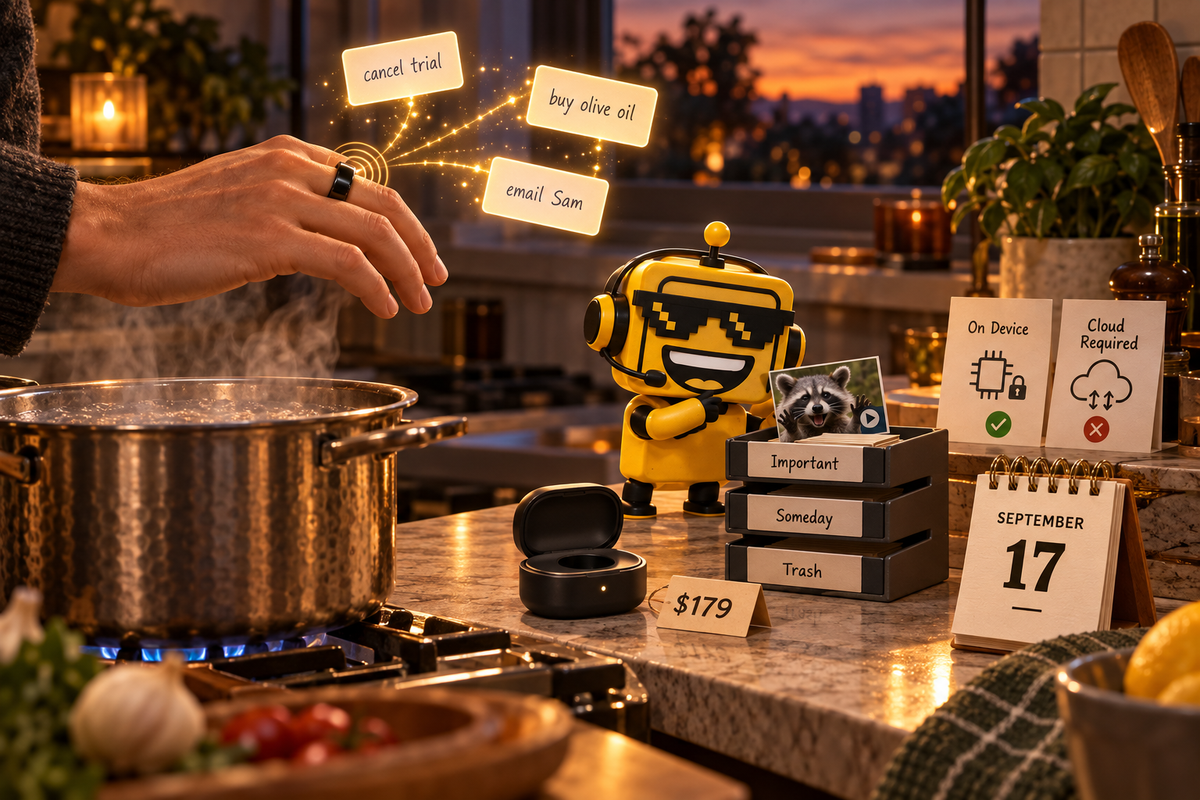
You double-tap a ceramic ring, say “remind me to cancel the free trial,” feel a tiny vibration, and continue walking as if you have not just delegated household administration to your jewelry.
This is Spark Ring’s entire argument, and I mean that as a compliment. The new voice-capture ring opened its Kickstarter campaign on September 17 at a 48-hour early price of $179, with global shipping planned for December. It is built for the awkward three seconds between having a useful thought and losing it forever because your phone demanded Face ID, showed you a notification, and redirected your attention toward a video of a raccoon washing cotton candy.
Spark Ring is not trying to monitor your sleep, estimate your readiness, grade your cardiovascular virtue, or explain why you should have gone to bed 43 minutes earlier. It records what you say after a deliberate double-tap, sends the audio to a companion phone, and turns the result into searchable notes, tasks, reminders, or drafted messages. That is a narrow job. In consumer AI hardware, finding one comprehensible job is practically an act of rebellion.
Your Wedding Band Has Joined Operations
The hardware is unusually restrained. According to Spark Ring’s launch specifications, the zirconia-ceramic ring weighs 2.8 grams, measures less than 8 millimeters wide, carries an IP68 water-resistance rating, and can store recordings while separated from a phone. Bluetooth Low Energy and NFC handle connectivity; a vibration and LED confirm that recording has started. The company claims a microphone pickup range of three to five meters, up to eight hours of continuous recording, a week of standby time, and a full charge in 30 minutes.
The good idea is not the microphone. Your phone already owns several of those and would like you to remember how much you paid for them. The good idea is reducing the capture ritual to one gesture. That is also what made Pebble’s Index 01 memory ring so appealing: a wearable can be valuable simply by being available at the exact moment a screen is inconvenient.
Spark adds more machinery after the recording. Its app is supposed to detect intent, file the thought, create a reminder when you mention a task and time, and let you ask questions across saved material. If it works, “pick up olive oil after work” stops being audio you will never replay and becomes a haptic nudge at the useful moment. That is the difference between a recorder and an assistant. Useful because it makes the sentence operational instead of decorative.
The ring also has no mandatory subscription, which is refreshing in the same way finding a hotel room without a resort fee is refreshing: this used to be normal, but now I want to send a handwritten note. At $179, Spark Ring costs less than many health-focused smart rings and avoids renting your own thoughts back to you monthly.
The Tiny Stenographer Problem
There is, naturally, a social complication. A ring with a three-to-five-meter microphone is not only a frictionless idea tool. It is also a discreet recorder sitting in meetings, kitchens, cars, and conversations where other people may not know that your index finger has entered the knowledge-management business.
Deliberate double-tap activation is better than always-on capture, and the LED plus vibration provide confirmation to the wearer. But the person across the table cannot feel your haptic feedback, and a tiny status light is not a consent policy. Recording laws vary by location. Human expectations vary by relationship. “My ring was taking notes” is a technically interesting sentence that will not improve every dinner.
This is not unique to Spark. The URBAN ARC NOTE put a meeting stenographer on the wrist, while clip-on recorders and AI pendants have been normalizing ambient transcription one conference room at a time. Spark’s finger placement makes capture faster and more private-looking. Those are the product’s advantage and its etiquette hazard, neatly packed into the same 2.8 grams.
The Privacy Story Is Wearing Two Rings
Spark says transcription happens locally on the paired phone, raw audio stays off the cloud, and only encrypted text goes onward for AI processing. Excellent. That is exactly the architecture a voice wearable should explain clearly.
Unfortunately, the Spark Ring App Store listing currently says cloud processing and an internet connection are required for transcription and AI features. It also says the app may collect audio and other user content linked to your identity. Apple notes that these disclosures come from the developer and are not independently verified, but the contradiction is still real: “transcribed on your phone” and “cloud required for transcription” cannot both describe the same workflow without a missing paragraph doing heroic labor.
Independent launch reporting found other specification drift, including conflicting claims of six versus eight hours of continuous recording and 30 versus 60 minutes to recharge across Spark’s materials. None of this proves the product is bad. It proves the campaign copy arrived before the product story finished buttoning its shirt.
Crowdfunded hardware earns some tolerance for changing specifications. Voice privacy earns less. Before shipping, Spark needs one plain-language diagram showing where audio is stored, where transcription runs, what text reaches a server, which model processes it, how long anything is retained, and which features stop working offline. No mist. No “privacy by design” incense. Boxes, arrows, deletion rules.
A Better AI Gadget Because It Does Less
The broader AI-wearable category keeps trying to build a second brain, usually before it has mastered being a reliable button. Spark Ring’s restraint is its strongest quality. It does not promise to understand your entire life or mediate reality through glowing lenses. It gives fleeting thoughts a short route into software.
That simplicity also distinguishes it from the ring-and-glasses ecosystem in MOVA’s wearable double act. MOVA uses a ring as a controller for translation and augmented reality. Spark uses the ring as an input terminal for your own memory. Less spectacular, yes. Also easier to explain to someone who has never used the phrase “post-smartphone interface” in a meeting.
I can see the audience immediately: writers, founders, caregivers, commuters, people with ADHD, anyone who gets useful ideas while cooking, and every person who has opened a notes app only to forget the note. The ring could be especially good for capturing a thought when both hands are occupied. Whether it recognizes speech accurately in a windy street, a noisy café, or a car with the windows down remains unproven. So does the quality of its intent detection. A reminder created at the wrong time is not assistance; it is a tiny automated misunderstanding.
The other risk is December. Kickstarter hardware timelines are aspirations wearing dates, and Spark is proposing global fulfillment roughly three months after campaign launch. Ceramic sizing, waterproofing, microphones, charging cases, mobile apps, firmware, transcription, AI routing, and customer support all have to land together. The double-tap is the demo. Manufacturing is the product.
Verdict: A Clever Niche Hit, Pending One Honest Diagram
Spark Ring feels like a plausible niche hit rather than a beautiful overreach. The price is reasonable, the interaction is legible, the no-subscription model is humane, and the form factor solves a genuine problem: thoughts tend to arrive when your phone is least convenient and disappear while you negotiate with it.
I am more impressed than annoyed. That may be because Spark resisted stapling sleep scores, heart-rate graphs, a camera, and a synthetic companion named Aura onto the pitch. The ring records on command, organizes the result, and taps you later. Consumer AI could use more products with verbs this clear.
But the privacy contradiction is not a footnote. A wearable microphone lives or dies on trust, and trust does not enjoy ambiguous cloud architecture. Spark Ring should reconcile its product page and app listing before asking buyers to place a recorder on their hand all day.
If it does that—and if the hardware ships on time—$179 could buy a genuinely useful shortcut between intention and action. Your ring will still not make you organized. It may, however, preserve the thought in which you briefly intended to become organized. For a first-generation AI gadget, that is almost suspiciously sensible.