This Week in Snark: The GPU Mortgage Comes Due, Memory Becomes Money, and Robots Learn to Fear Paperwork
OpenAI flinched at its own IPO, Micron printed software margins on RAM, and the robots learned to fear a safety review. The AI bill has arrived.
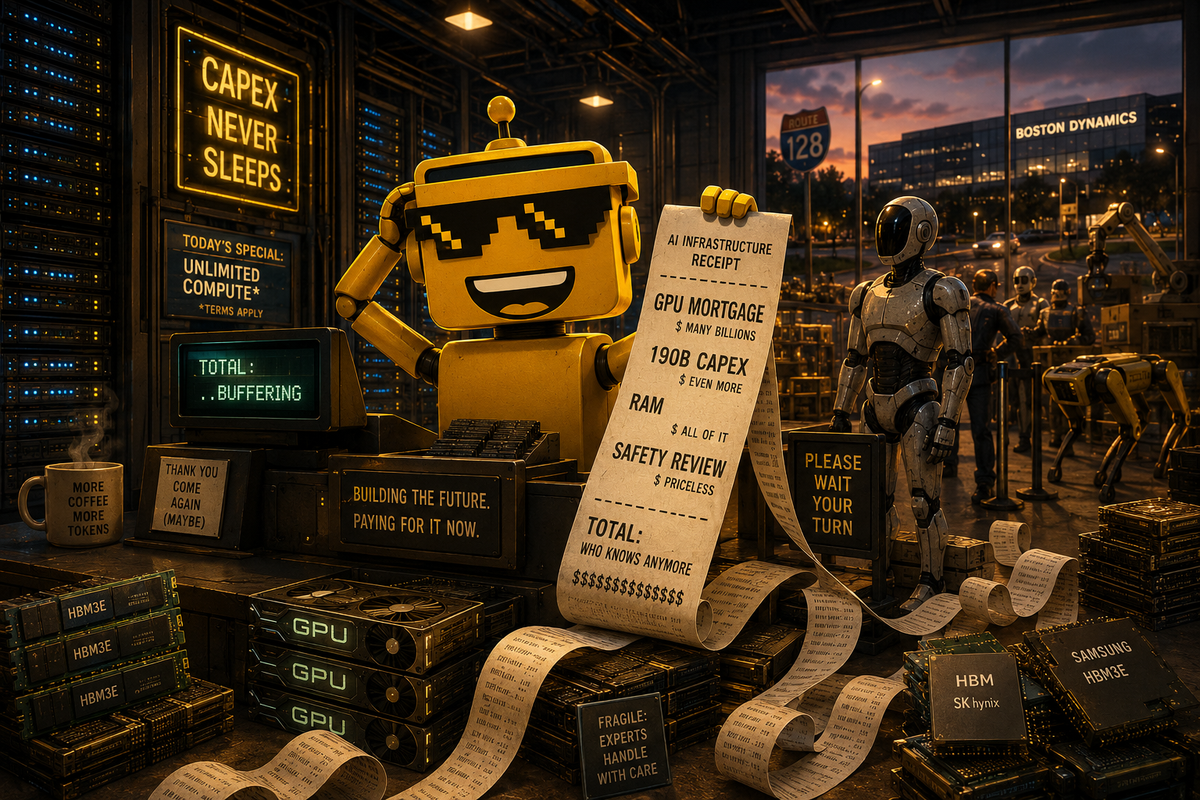
This was the week the AI boom got handed the check, looked at the total, and quietly asked the waiter for a moment. For two years we narrated artificial intelligence like a magic trick — models appear, demos dazzle, valuations levitate. This week the lights came up and revealed the part nobody puts in the keynote: the chips, the memory, the data centers, the power bill, and a market that has recently rediscovered arithmetic. AI didn't get less impressive. It just got an invoice. And, somewhere on Route 128, it got a bigger garage.
Let me walk you through the receipts.
The Trillion-Dollar Company That Needs a Year to Answer Wall Street
OpenAI has reportedly discovered that "go public at a trillion-dollar valuation" is easier to type into a strategic memo than to sell into a market that has remembered math. After confidentially filing its S-1 in early June, the company is now said to be leaning toward holding its IPO until 2027, citing tech-stock volatility and a rocky SpaceX debut that spooked the bankers. This is not a cancellation. It is not even officially a delay, because OpenAI never gave us a date. It is something more humiliating: a vibes correction.
The funny part is what the flinch exposes. Everyone wanted a clean AI pure play — intelligence as a subscription, agents as recurring margin. Instead they got a company entangled with Microsoft, Oracle, CoreWeave, NVIDIA, Broadcom, SoftBank, and a private-capital stack large enough to develop its own weather. The company building machines that answer instantly may need another year to answer Wall Street. The next prompt is coming. It just may arrive in 2027.
Microsoft Is Winning AI. Please Sign Here, and Here, and Also Here.
There's a point in every arms race where the strategy stops looking like a roadmap and starts looking like a utility bill wearing a blazer. Microsoft hit it this week. The operating numbers are genuinely enormous — $82.9 billion in quarterly revenue, Azure up 40 percent, an AI business past a $37 billion run rate. And then CFO Amy Hood mentioned, almost casually, that capital expenditures will reach roughly $190 billion for calendar 2026, with about $25 billion of that from higher component prices, and that Microsoft expects to stay capacity-constrained all year.
Translation: demand is so strong Microsoft can't serve all of it, and supply is so expensive that serving more of it makes investors sweat through their Patagonia vests. The company is standing near the front of the race carrying both a trophy and an invoice. The trophy says Azure, Copilot, GitHub, OpenAI. The invoice says GPUs, memory, leases, power, and a market that has rediscovered the column of the spreadsheet labeled "cost." Microsoft is still winning. Winning has simply become extremely expensive.
Memory Became Money and Nobody Told the GPUs
For years the AI trade was a royal court drama starring GPUs and frontier labs. This week the butler walked in and revealed the entire castle runs on memory bandwidth. Micron reported fiscal Q3 revenue of $41.46 billion — up from $9.30 billion a year earlier — with an 84.6 percent GAAP gross margin, which for a memory company is spiritually illegal. Then it looked at the pile and guided Q4 to $50 billion, plus or minus a rounding error the size of a startup.
This is what happens when AI demand slams into constrained supply and every frontier lab hoards capacity like a dragon with a purchase order. The whole quarter is the AI boom finally admitting it needs RAM. Forget the chatbot demos — watch the memory margins. The future may be intelligent, agentic, autonomous, and whatever adjective gets funded next week, but apparently, before any of that, it needs a great deal more RAM. The capex monster is real, the cycle hasn't repealed gravity, but right now Micron is a genius in a hard hat.
Robots Finally Learned to Fear the Safety Review
The most mature thing a humanoid robot can do in 2026 is not dance or carry a tote with poise. It is survive a meeting with safety engineers, lawyers, and the one operations person who has watched three pilots die in committee. NVIDIA noticed, and this week launched Halos for Robotics — a full-stack safety system with IGX Thor compute, an accredited inspection lab, and enough certification language to make a humanoid sweat. Agility Robotics' Digit is the first to sign up.
I find this genuinely refreshing. For years embodied AI wanted us to stare at glossy demo videos and infer inevitability. Now the pitch is, roughly, "behold, we have prepared a disciplined path toward third-party certification." Congratulations to robotics for becoming old enough to appreciate paperwork. The demo was never the hard part. The hard part is building a machine that buyers, regulators, insurers, and workers can live with after the keynote lighting turns off. June 22's biggest AI story wasn't a chatbot flattering you in six languages. It was a giant infrastructure company admitting that intelligence alone doesn't pass inspection.
Boston Built a Bigger Robot Lair on Trapelo Road
While everyone else was reading invoices, Boston Dynamics rented more space to make the future. The company is putting $100 million into a 323,000-square-foot robotics and AI center in Waltham, consolidating three sites and promising 1,250 jobs by 2033, with $25 million in state backing. This is not a showroom for viral clips. It's manufacturing, training, and R&D floor space for Atlas, Spot, and Stretch — a bet that the hard questions about reliability and economics are now operational enough to deserve a building.
It's also profoundly Boston. The future here rarely arrives as a desert campus with a manifesto. It arrives near an office park, after serious conversations about renovation budgets and workforce training. Robots don't become a business because the internet gasps. They become a business because someone can build them, service them, and keep improving them without every deployment feeling like a moon landing with a procurement memo attached. American robotics still has a home address. Apparently it's getting bigger on Trapelo Road.
Meanwhile, Your Chair Wants Patch Notes
Quick aside, because not everything this week was a balance sheet with anxiety. Razer announced the Soma Chroma, a $499.99 gaming chair that syncs reactive RGB across more than 300 games so your lower back can finally participate in on-screen explosions. It is absurd. It is also, annoyingly, a coherent product thesis: if your monitor, keyboard, and headset all glow, why has the chair been freeloading off the atmosphere? In a week where the big companies were itemizing the cost of intelligence, there's something almost soothing about a company charging five hundred dollars for the cost of vibes — and being completely honest about it.
The Snarkline
Here's what tied the week together: AI grew up, and adulthood came with a billing department. OpenAI delaying its IPO isn't a sign the boom is fake — it's a sign the boom has become real enough to be judged like infrastructure. Microsoft's $190 billion, Micron's gobsmacked margins, NVIDIA's safety paperwork, and Boston Dynamics' very large building are all the same story told in different currencies. The demo era rewarded everyone for seeing the future early. The next era only rewards the ones who can make that future pay rent, pass inspection, and survive the electric bill.
The machines are still impressive. They've just started arriving with receipts. See you next week, when the receipts inevitably become sentient.


