OpenAI May Delay Its IPO, Because the GPU Mortgage Got a Margin Call
OpenAI may delay its IPO until 2027 as tech stocks wobble, SpaceX cools, and investors question the true cost of the AI boom.

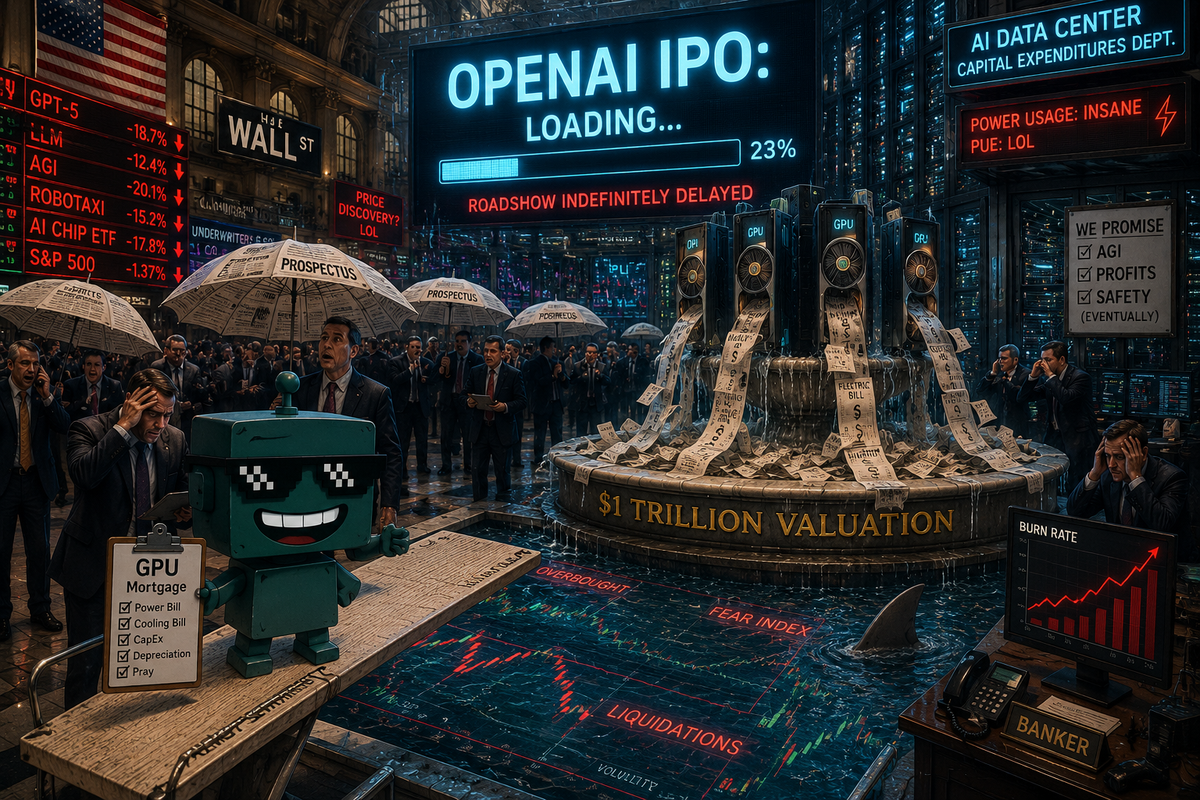
OpenAI has apparently discovered that "go public at a trillion-dollar valuation" is easier to type into a strategic memo than to sell into a market that has recently remembered math.
On June 8, OpenAI confirmed it had confidentially submitted a draft S-1 to the SEC, while also saying it had not decided on timing and that "it may be a while." At the time, that sounded like careful optionality. Now it sounds more like the finance equivalent of putting one foot into the pool, feeling the water temperature, and suddenly remembering you left something in the car.
The Straits Times, summarizing New York Times reporting, says OpenAI is leaning toward holding off its IPO until 2027, citing people involved in the company's deliberations. The reported reason is not mysterious: tech stocks have been volatile, SpaceX's post-IPO trading has been rocky, and bankers are apparently worried that retail investors may not feel spiritually prepared to buy the most expensive AI story on Earth while nearby tickers are doing trust falls into concrete.
This is not a cancellation. It is not even officially a delay, because OpenAI never gave the public a firm IPO date. It is more humiliating than that. It is a vibes correction.
The S-1 Was the Teaser Trailer. The Market Wanted the Budget.
When OpenAI filed confidentially, the bull case practically wrote itself. ChatGPT is a household name. Developers use the API. Enterprises are wedging AI into every workflow with a pulse. Codex is becoming a real work surface. OpenAI has consumer reach, platform ambitions, custom silicon plans, government relevance, and the cultural position of being the company people mean when they say "AI," usually while pointing vaguely at their phone.
That is the fun part.
The less fun part is that frontier AI increasingly looks less like software and more like industrial finance with a chatbot interface. Models need chips. Chips need data centers. Data centers need power, cooling, land, networking, memory, permits, partners, and capital structures that make normal SaaS founders look like they were selling lemonade.
That was the core warning in our recent piece on the AI stock-market dive and the GPU mortgage. The market is not asking whether AI matters. It is asking whether the bill for AI matters faster than the payoff.
OpenAI is now sitting directly inside that question, smiling for the banker photos.
SpaceX Walked So OpenAI Could Flinch
The reported SpaceX comparison matters because IPO windows are not abstract weather systems. They are emotional contagion with spreadsheets.
If one giant future-coded company goes public, trades like a rocket for a moment, then starts wobbling, every banker advising the next giant future-coded company suddenly discovers a deep personal commitment to patience. This is how capital markets dress up fear as discipline. Nobody says, "The room got weird." They say, "We are reassessing the optimal market window."
Investor's Business Daily reported that OpenAI's advisers are urging caution after recent tech IPO turbulence, with Altman still reportedly interested in a $1 trillion valuation. That number is the drama. A normal IPO delay says, "Let's wait for better conditions." A trillion-dollar IPO delay says, "Let's wait until everyone has regained the ability to believe in extremely expensive nouns."
Public markets have believed dumber things. They have also punished simpler ones.
The AI Trade Wanted a Pure Play. It Got a Utility Bill.
The funniest part of the OpenAI IPO drama is that it exposes a tension investors have been trying very hard to aestheticize. Everyone wants a clean AI pure play. Everyone wants the company that turns intelligence into a subscription, agents into revenue, and enterprise panic into recurring margin.
But the pure play is not pure. It is entangled with Microsoft, Oracle, CoreWeave, NVIDIA, Broadcom, SoftBank, power markets, chip supply, custom accelerators, and a private-capital stack large enough to develop its own weather patterns. Barron's noted that the reported IPO delay pressured stocks exposed to OpenAI, including Oracle, CoreWeave, and SoftBank. That is the real tell. OpenAI is not just a startup preparing a listing. It is a load-bearing narrative inside the AI infrastructure trade.
If OpenAI waits, the question spreads outward. What does that mean for its partners? For data-center commitments? For suppliers? For the public-market appetite behind the next AI listing? For Anthropic? For every stock whose valuation quietly assumes that model demand will remain infinite, premium-priced, and conveniently financed?
This is why the GPU mortgage piece matters. The stock market dive was not a random mood swing. It was the market rehearsing the question OpenAI's IPO would force into the open: who ultimately pays for intelligence at scale?
Jalapeno Helps, But It Does Not Make Gravity Optional
OpenAI is not blind to this. Its recent Broadcom custom-chip story was basically a giant neon sign reading: yes, we know inference cost is the business.
As we wrote in the Jalapeno chip piece, OpenAI's custom inference accelerator is aimed at making model serving cheaper, more efficient, and less dependent on generic GPU economics. That is smart. Inference is where the business lives. Every answer, agent step, code completion, voice reply, and enterprise automation has to be served again and again. Training is the heroic ritual. Inference is the monthly bill.
But custom silicon is not a magic eraser. It is a serious attempt to improve the economics of an expensive machine. That is very different from proving the machine is already cheap enough for public-market mythology.
OpenAI may eventually show investors a beautiful story: scale, revenue growth, improving cost per token, enterprise adoption, infrastructure control, custom chips, platform expansion, and enough product gravity to make the valuation feel less like altitude sickness. It may even be true. But the delay chatter suggests the company would rather tell that story when the market is nodding along, not when semiconductor ETFs are nervously checking exits.
The Snarkline
My verdict: OpenAI delaying its IPO, if that is where this lands, would not be a sign that the AI boom is fake. It would be a sign that the AI boom has become real enough to be judged like infrastructure.
That is the awkward adulthood phase. Demos are still impressive. The products are still useful. The demand is still there. But investors are no longer only buying possibility. They are buying capex, compute commitments, supplier exposure, margin curves, and the hope that intelligence gets cheaper faster than ambition gets bigger.
OpenAI wanted the option to go public. Now it may want the option to wait. That is sensible. It is also funny in the specific way only Silicon Valley finance can be funny: the company building machines that answer instantly may need another year to answer Wall Street.
The next prompt is still coming. It just may arrive in 2027.