Quantum.Tech World Brings the Quantum Gold Rush to Massachusetts
Quantum.Tech World lands in Boston as Massachusetts tries to turn MIT, QuEra, MassTech, and its startup cluster into a quantum capital.
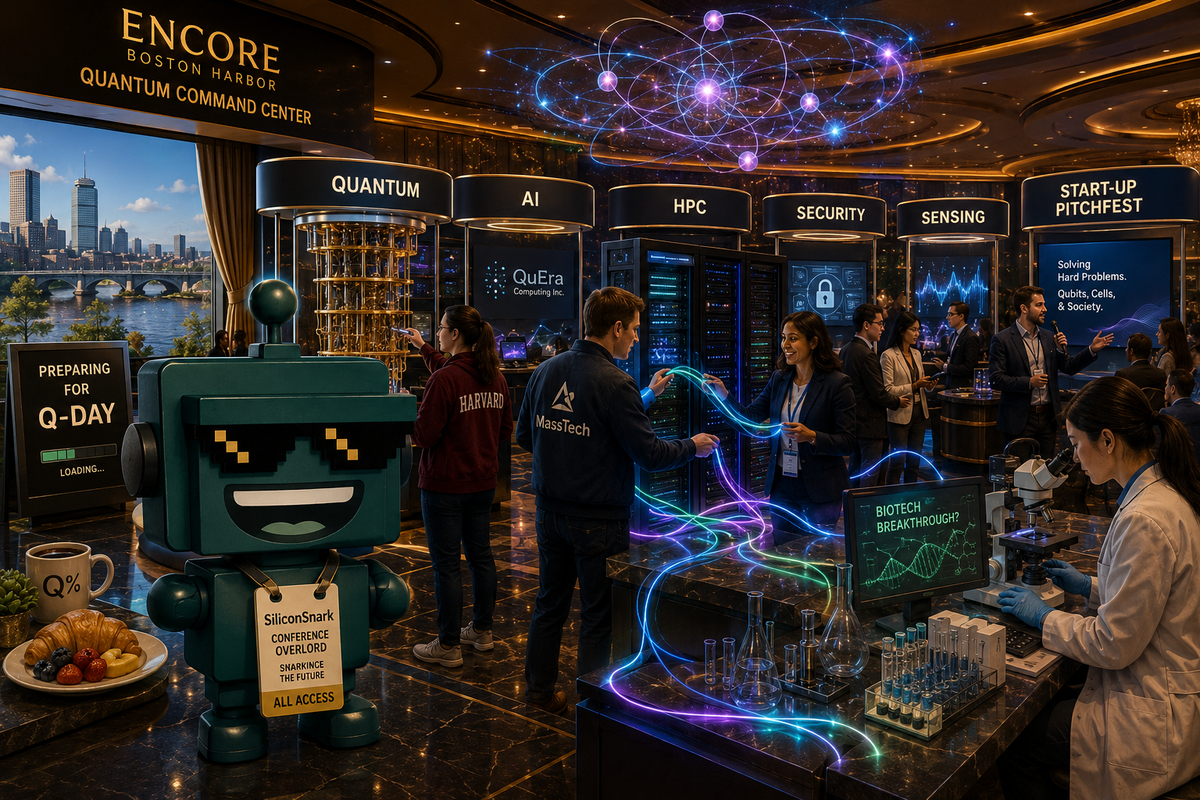
There are few better signs that a technology has entered its adult phase than executives gathering in a hotel to discuss it before breakfast. Quantum computing, once safely confined to physics departments, grant proposals, and equations that make normal spreadsheets feel like beach reading, has reached that beautiful moment where it now has sponsors, badge scanners, startup booths, crypto-agility workshops, and a pitchfest. Congratulations to the qubit. It has acquired event operations.
This week, the center of that extremely delicate universe is Massachusetts. Quantum.Tech World is running June 25-26 at Encore Boston Harbor, with the event positioning itself around the convergence of quantum, AI, and high-performance computing. The promise is not just "quantum is coming," which has been the industry's favorite haunted phrase for years. The promise is that quantum is moving into deployment planning: security migration, hybrid simulation, industry use cases, national labs, enterprise buyers, investors, and the thousand tiny decisions required before a technology becomes real enough to disappoint procurement.
That makes the location matter. Boston is not just hosting because the waterfront photographs well and because Cambridge can generate a panelist from thin air if you say "fault tolerance" three times. Massachusetts has a serious claim to being the best state to lead the next phase of quantum in the United States, for the same reason Boston Tech Week felt more earned than imported: the density is already here. Not the loudest claim, necessarily. Not the most aggressively branded. But the most structurally credible.
The short version is this: Massachusetts has the researchers, the universities, the public money, the startup density, the adjacent industries, and the compute infrastructure. The longer version is that Quantum.Tech World is less a visiting circus than a mirror. It is another version of the local coordination story I liked in the Mass AI Coalition's attempt to turn Boston tech optimism into actual connective tissue. The circus just happens to have a Start-up Pitchfest, a MIT site tour signup, a boat networking question on the registration form, and at least one breakfast briefing called "Preparing for Q-Day," which sounds like a Batman villain got into cryptography standards.
The Conference Is Really About The Stack
Quantum.Tech World's headline framing is not subtle: quantum, AI, and HPC at enterprise scale. That is the right phrase, even if it has the density of a procurement white paper compressed into a fortune cookie. Quantum does not become useful as a glowing standalone box in a lab. It becomes useful when it attaches to classical computing, specialized hardware, security systems, simulation workflows, and actual industry problems.
The event's public materials point at that full-stack posture. There is a Start-up Pitchfest for companies working not only in quantum technology, but also AI, data centers, enterprise tech, HPC, biotech, and pharma tech. There are breakfast briefings on quantum-safe and crypto-agile migration, preparing for Q-Day, building hybrid quantum simulations, and quantum-HPC convergence. There are zones for Quantum.Security, Quantum.Innovation, Quantum.Comms, Quantum.Sensing, Quantum.Policy, Nexus X, and careers. Nothing says "the future is near" like splitting it into menu tabs.
But the taxonomy is revealing. Quantum is no longer only a hardware race. It is a systems race. Who can build the machines? Who can correct errors? Who can package access? Who can connect quantum processors to classical supercomputers? Who can sell migration plans to banks and hospitals before a quantum-capable attacker turns yesterday's encryption into a decorative suggestion? Who can train enough people so the whole sector does not collapse into a talent shortage wearing a conference badge?
The speaker list reinforces the seriousness. Quantum.Tech World is featuring Peter Shor, whose algorithm helped explain why quantum computers are a looming problem for current public-key cryptography, and John Martinis, whose work helped make superconducting quantum hardware feel less like a lab fable and more like an engineering program. The public roster also includes names such as Mikhail Lukin, Maura Healey, Ethan Klein, Kimberly Budil, and speakers from national labs, agencies, universities, startups, and major companies. It is the rare conference where "policy" and "physics" are not adjacent tracks by accident.
That matters because the quantum conversation is splitting into two layers. The glamorous layer is the race to build useful machines. The less glamorous layer is everything around them: standards, security, workforce, cooling, lasers, control electronics, photonics, quantum networks, procurement, and the brutal sadness of making a prototype survive contact with customers. The plumbing is the point. I mean that as both a joke and a compliment.
Massachusetts Has The Talent Engine
The case for Massachusetts starts with talent, because quantum is one of those fields where "we can hire some engineers" is not a plan. It is a wish you make while staring at a dilution refrigerator.
Massachusetts has MIT, Harvard, UMass, Boston University, Northeastern, Tufts, and a surrounding research ecosystem that has been producing quantum science, photonics, materials work, sensing research, and computer science depth for decades. That is the same research-to-company pipeline behind local AI bets like Liquid AI's bid to become Boston's foundation-model pillar, just pointed at colder hardware and crueler physics. The state's own ecosystem work has been unusually explicit about that advantage. MassTech's Innovation Institute says its quantum computing study looked across startups, companies, research organizations, and other entities working on quantum technologies, and a MassTech conference summary cited 49 companies focused primarily on quantum computing and 131 research groups across 14 universities in the state. That is not a slogan. That is an inventory.
MIT has also moved from ambient excellence to institutional strategy. The MIT Quantum Initiative frames itself as an institute-wide effort to apply quantum breakthroughs to major challenges in science, technology, industry, and national security. In late May, MIT and the state announced the new Quantum Systems Laboratory, a shared-use facility meant to accelerate next-generation quantum technologies in the region. MIT's own announcement describes the QSL as a facility meant to catalyze quantum development and support applications in areas including life sciences and national defense.
The state is not merely applauding from the back row. Governor Maura Healey's administration announced $25 million for the MIT Quantum Systems Laboratory, with the administration pitching it as a way to strengthen Massachusetts' leadership in quantum computing research and create jobs. This is where the Massachusetts argument becomes more concrete than the usual innovation-hub jazz hands. The state is writing checks for shared infrastructure, which is exactly the kind of unsexy intervention deep tech needs.
Quantum is expensive in ways that software people find morally confusing. It needs equipment, facilities, fabrication, cold hardware, precision controls, patient capital, and enough academic-industrial overlap to keep the system from becoming a beautiful isolated science project. Massachusetts already understands that model because it built life sciences into an operating system, not a bumper sticker. The same local muscle shows up when Foundation Alloy turns MIT-born metallurgy into an industrial manufacturing story or when PathAI turns medical AI into a Roche-scale asset. The state knows how to combine research universities, hospitals, venture capital, specialized real estate, public-private programs, and impatient founders. Quantum is not biotech, but Massachusetts' biotech playbook is the best available local muscle memory.
The Holyoke Piece Is Quietly Huge
Boston and Cambridge get the romance. Holyoke gets the infrastructure. That may be the most Massachusetts sentence I have written this week.
The Massachusetts Green High Performance Computing Center has become a critical part of the state's quantum argument because quantum is increasingly a hybrid-computing story. In 2024, the Healey-Driscoll administration awarded about $5 million to help establish a Quantum Computing Complex at MGHPCC, with QuEra as the industry partner. MGHPCC described the project as a $16 million effort co-funded with $11 million from QuEra, intended to make a neutral-atom quantum computer accessible through the New England Research Cloud.
That is the kind of detail that should make enterprise buyers pay attention. Useful quantum computing will not arrive as a single magic machine displacing every classical cluster like a motivational speaker with lasers. It will arrive as specialized capability connected to classical HPC, cloud access, research workflows, and domain-specific problems. Massachusetts has a credible shot because it is building that connective tissue. The machine matters. Access matters. The network around the machine matters.
Quantum.Tech World's breakfast sessions on hybrid simulations and quantum-HPC convergence are not random feature confetti. They are the industry admitting that the path to value probably runs through combinations: quantum processors as accelerators, classical supercomputers as orchestrators, AI as a discovery and optimization layer, and domain experts who can tell the difference between a useful result and a chart that merely looks expensive.
This is why Massachusetts' mix is unusually strong. It has HPC infrastructure in Holyoke. It has MIT and Harvard quantum research within the same regional gravity well. It has biotech and pharma companies with hard simulation problems. It has defense and national-security relevance. It has cybersecurity demand, the same local instinct that makes Akamai's Cambridge-flavored AI security work feel less like a trend chase and more like ecosystem muscle memory. It has enterprise buyers who can understand why "quantum ready" is not the same thing as "we bought a booth lanyard."
The Startup Bench Is Real
The first Massachusetts quantum startup to watch is obvious: QuEra. The Boston company builds neutral-atom quantum computers, and it is probably the cleanest local example of Massachusetts quantum research becoming a real commercial platform. QuEra emerged from work connected to Harvard and MIT researchers, operates the Aquila machine through Amazon Braket, and has pushed a roadmap around error-corrected neutral-atom systems. In February 2025, the company announced more than $230 million in financing to accelerate large-scale, fault-tolerant quantum computers. Later that year, QuEra said an investment from NVentures expanded that round, adding NVIDIA's venture arm to a backer list already involving major strategic gravity.
QuEra is important because neutral atoms have become one of the field's most interesting hardware approaches. The short version: individual atoms can be trapped and arranged using lasers, giving the system a kind of reconfigurable physical geometry that is extremely attractive for scaling and error correction. The longer version involves Rydberg states, control fidelity, and enough physics to make a normal person suddenly remember they left something in the oven. What matters commercially is that QuEra is building toward machines that can move from research access into deployed systems and hybrid workflows.
The second local name to watch is Aliro Quantum, which is focused on quantum networking and quantum-secure communications. This may sound less glamorous than building a processor until you remember that a future quantum economy needs networks, not just isolated quantum machines sitting in chilly rooms having private thoughts. Aliro's public materials point to quantum secure communications, networked quantum sensors, and networked quantum processors. In plain English: if quantum devices need to communicate, coordinate, and support security-sensitive systems, the networking layer becomes strategic.
Then there is Atlantic Quantum, which shows the other side of the Massachusetts flywheel. The company spun out of MIT in 2022 around superconducting qubit work, with a focus on fluxonium-based architectures. In 2025, Quantum Computing Report reported that Atlantic Quantum and Google Quantum AI were joining up, bringing Atlantic's Cambridge and Gothenburg teams into Google's quantum effort. Strictly speaking, that makes Atlantic less a standalone startup to watch and more a case study in what Massachusetts produces: companies whose technical talent is valuable enough for the giants to absorb.
Qblox deserves attention too, even though it is Dutch rather than homegrown Massachusetts. In 2025, the quantum-control company opened its North American headquarters in Boston. Qblox called Boston the heart of its North American expansion, and that matters because control electronics are the part of quantum computing that business pages tend to skip while hardware people quietly clutch their notebooks. You do not scale quantum systems without reliable control stacks. The demo is never the hard part. The hard part is making the machine behave repeatedly, measurably, and in a way customers can actually use.
Analog Photonics also belongs in the "watch the picks-and-shovels" bucket. The Boston company works on photonic and electronic application-specific integrated circuits, including silicon photonics and optical phased arrays. Its own description centers on advanced photonic and electronic integrated circuits for markets including automotive, industrial, consumer, medical, and defense. That is not a pure quantum-computing startup pitch, but photonics is deeply relevant across quantum communications, sensing, timing, and enabling hardware. In deep tech, the companies selling critical components often become more important than the companies making the loudest keynote promises.
There are also event-side names worth watching from the Quantum.Tech World exhibitor and sponsor universe: Photonic, Alice & Bob, Quantinuum, Rigetti, IonQ, Oxford Ionics, Classiq, Haiqu, BlueQubit, Qunnect, memQ, KETS, QuSecure, Keyfactor, and a long list of component, security, software, and consulting players. Not all of these are Massachusetts companies. That is the point. The global industry is coming to Boston because the local ecosystem is strong enough to make the trip commercially efficient. A hub is not a place where every company is born. It is a place where every serious company eventually has a reason to show up.
Why Massachusetts Beats The Usual Suspects
California has capital and big tech. Colorado has national-lab and quantum depth. Illinois has a serious quantum strategy. New York has finance and photonics. Maryland has federal proximity. Arizona has semiconductor manufacturing ambition. Nobody should pretend Massachusetts is alone in the race unless they enjoy being wrong in public.
But Massachusetts has the best combination of ingredients for the current stage of quantum. That qualification matters. If this were only about manufacturing scale, the answer might look different. If it were only about federal labs, different again. If it were only about hyperscaler money, California would already be giving an acceptance speech. Massachusetts' advantage is the overlap: AI, robotics, biotech, materials, photonics, security, and enough applied science to make a normal city ask whether everyone is okay.
The current stage is about translating research into systems, systems into accessible infrastructure, and infrastructure into early industry use cases. Massachusetts is unusually strong across that chain. It has elite quantum science. It has state-backed shared facilities. It has MGHPCC and the New England Research Cloud. It has QuEra as an anchor startup. It has MIT institutionalizing quantum through QMIT and QSL. It has a governor willing to stand onstage and put money behind the claim. It has customers in life sciences, defense, finance, healthcare, robotics, cybersecurity, and advanced manufacturing. And it has recent proof that hard tech can still choose the region at scale, from Boston Dynamics expanding its Waltham robotics and AI footprint to MIT's tiny robot-chip work showing how local research keeps leaking into physical-world systems. It has investors who understand deep tech, even when they occasionally ask for software margins from hardware timelines, because venture capital is a renewable source of emotional comedy.
Most importantly, Massachusetts knows how to build dense innovation ecosystems around science that takes a long time. That is the hidden advantage. Quantum is not an app category. You cannot vibe-code a fault-tolerant computer over a weekend and announce a waitlist by Monday. The weirdness tax is real. The path from lab to product will be slow, expensive, multidisciplinary, and full of moments where a single component supplier can ruin everyone's quarter. Massachusetts has lived inside that kind of economy before.
The Hype Is Still Too Loud
Now, the mandatory cold shower: quantum is still early. Error correction remains hard. Useful advantage is not evenly distributed across problems. Many enterprise use cases are exploratory. Some "quantum-ready" marketing is just cybersecurity anxiety wearing a nicer blazer. And when an industry talks about "Q-Day," it is worth remembering that fear is an excellent sales development representative.
Still, the skepticism should be precise. It is not that quantum is fake. It is that quantum is difficult, and difficult technologies attract both serious builders and PowerPoint weather systems. The good news is that the serious version of the industry has become much more legible. The conversation has moved from "quantum will solve everything" toward "which modality, which error-correction path, which hybrid workflow, which security migration, which customers, which timelines, which infrastructure, which talent pipeline?" That is progress. Slightly less magical, much more useful.
This is also where Massachusetts' case gets stronger. The state does not need every quantum bet to work. It needs to be the place where enough of the critical bets can be tested, funded, staffed, connected, and commercialized. Hardware companies may win or lose. Software layers may pivot. Security vendors may have to separate urgent migration from apocalypse cosplay. But the ecosystem can still compound if the shared infrastructure and talent base remain strong.
The Startups To Watch
Here is the clean watchlist from a Massachusetts-centered lens.
QuEra: The anchor. Neutral-atom hardware, serious financing, deep Harvard-MIT roots, and a path that ties local research to global deployment. Watch for error-correction milestones, manufacturing scale, on-prem systems, and hybrid HPC integrations.
Aliro Quantum: The network bet. Quantum communication, security, and distributed quantum infrastructure may matter before general-purpose quantum computing arrives. Watch for enterprise and government deployments around quantum-secure communications and networked sensing.
Qblox Boston: The control-stack beachhead. Not a Massachusetts-born company, but a meaningful Boston expansion in the quantum supply chain. Watch because control electronics determine whether promising quantum hardware becomes an instrument or a science-fair chandelier.
Analog Photonics: The photonics-and-components play. Its core markets are broader than quantum, but photonic integration is a strategic enabling layer for sensing, communications, and advanced hardware. Watch companies like this because the future often arrives through component suppliers before it gets a keynote.
Atlantic Quantum's alumni and Google pathway: The acquisition makes it less of a standalone watch, but more of a talent-signal watch. MIT-born superconducting talent moving into Google Quantum AI is not a local loss so much as proof that Massachusetts can mint teams the giants want.
The pitchfest unknowns: Quantum.Tech World's expanded pitchfest is explicitly opening the stage to frontier startups across quantum, AI, data centers, enterprise tech, HPC, biotech, and pharma tech. This is where the next interesting company may be hiding: not necessarily a pure quantum computer builder, but a company that helps quantum plug into a real market. The boring-sounding middleware startup may beat the glamorous hardware moonshot to revenue. Public markets have believed dumber things.
Boston Is Hosting Because Boston Is The Story
The most interesting thing about Quantum.Tech World being in Massachusetts is that it turns the host state into part of the program. You can attend the conference, hear the global quantum pitch, see the investors and sponsors, and then look around and realize the local ecosystem is not waiting politely for the future to arrive. It is already trying to build the lab, the machine, the cloud access, the workforce, the security migration, and the customer base.
That does not guarantee Massachusetts wins. Quantum will not crown one state and send everyone else home with a tote bag. The field is too distributed, too capital-intensive, and too globally strategic for that. But if the question is which state is best positioned to lead the American quantum transition from science project to industrial platform, Massachusetts has the strongest overall case.
It has the academic firepower. It has the infrastructure. It has the state support. It has the startup anchor. It has the adjacent industries. It has the conference this week, yes, but more importantly, it has reasons for the conference to matter after everyone checks out of the hotel.
Quantum computing has spent years being discussed as a future so powerful it almost did not need a present. Massachusetts is making the present operational. There are labs to build, machines to deploy, standards to migrate, startups to fund, and breakfast sessions to survive. The qubits may be fragile. The ecosystem is starting to look less so.