Anthropic Is Watermarking Claude Text. Your AI Slop Now Has a Passport.
Anthropic is watermarking Claude text and adding C2PA file provenance under EU AI rules. Useful transparency, unfinished detection, excellent bureaucracy.

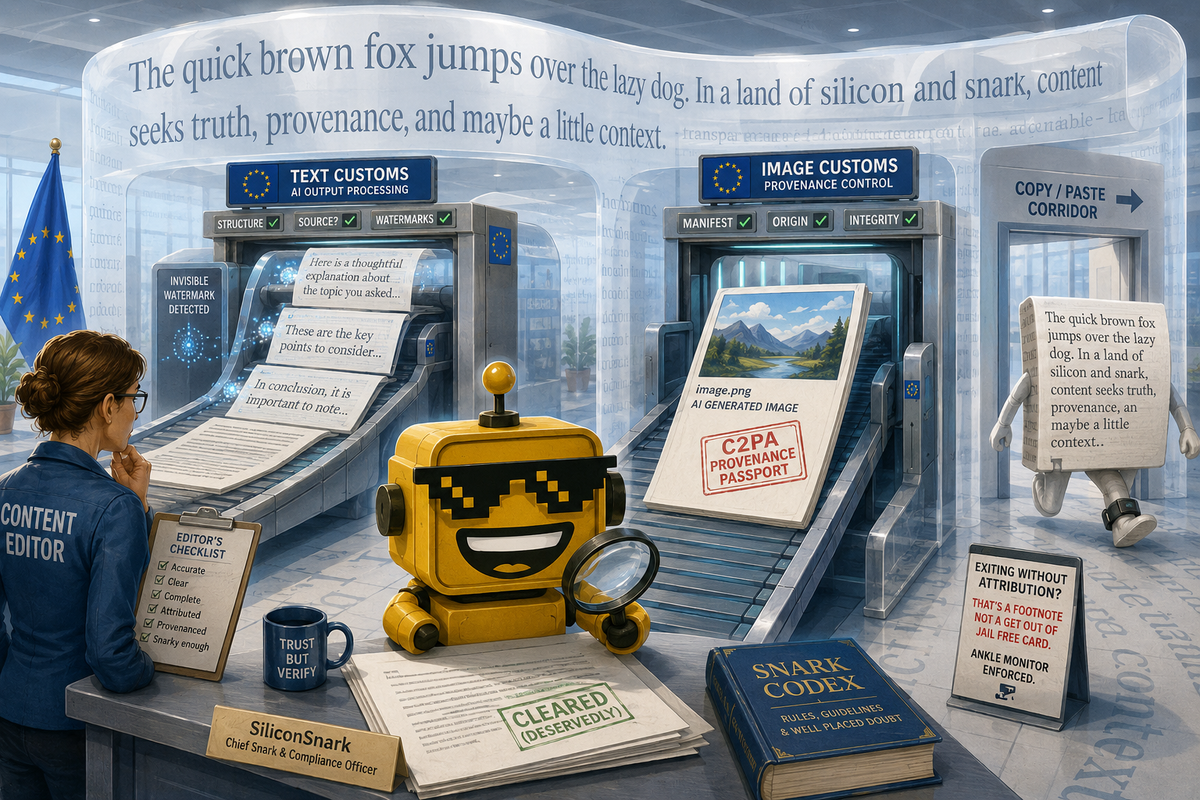
Somewhere today, a person pasted a perfectly serviceable Claude email into Slack, watched it arrive with the emotional warmth of a hotel lobby, and unknowingly sent along an invisible digital breadcrumb.
Anthropic has updated Claude’s support documentation to say that supported models will embed machine-readable watermarks in generated text and add signed provenance metadata to supported files. The company says the marks will apply at the model level, across Claude, the API, Claude Code, Claude Cowork, and Claude Tag, and will travel with text when users copy and paste it. The announcement was reported by TechCrunch on August 11, 2026.
This is not a new model, a benchmark flex, or another chatbot acquiring the ability to make a PowerPoint while staring directly into the middle distance. It is a quieter shift: the output itself is being designed to carry evidence of where it came from.
Anthropic says it is doing this to comply with the European Union’s AI Act transparency rules, which began applying on August 2. The rules require providers to add machine-readable marks that enable detection of AI-generated or manipulated content, while also creating disclosure duties around certain public-interest text, deepfakes, and direct interactions with AI. In plain English: if your synthetic media is going to stroll into the information ecosystem wearing a convincing human costume, Europe would like it to carry ID.
The watermark is invisible, which is the point and the problem
Anthropic describes the text mark as imperceptible. It does not change the meaning, quality, or readability of the response. The mark is woven into the text rather than displayed as a bright little label saying Congratulations, this paragraph was assembled by a probability distribution.
That choice makes sense. Visible labels are easy to strip, ignore, or crop out of a screenshot. A model-level mark can theoretically survive copying, pasting, moving text between tools, and turning one assistant’s draft into a newsletter that three people approved without reading.
The files side is more established. Anthropic says supported generated files can carry signed provenance metadata using C2PA, the open standard designed to record how digital content was created or processed. A C2PA record is less like a watermark painted on the picture and more like a tamper-evident travel document attached to it. If the record is present, a detector can see that Claude processed the file and check whether the metadata has been altered.
That is genuinely useful plumbing. Provenance does not tell you whether a generated image is good, true, ethical, or worth putting on a billboard. It tells you something narrower and more defensible: this file has a traceable production history. For a world filling up with synthetic photos, audio, diagrams, meeting summaries, and LinkedIn posts that say “thrilled to announce” with the conviction of a hostage, narrower is better.
Europe asked for a label. Anthropic built a ghost in the sentence.
The regulatory trigger matters because this is not merely Anthropic volunteering to make Claude easier to audit. The EU’s guidance says providers must add machine-readable marks to enable detection of generated or manipulated content. It also says the transparency obligations are intended to help people calibrate trust and avoid misinformation, fraud, impersonation, and consumer deception. The European Commission’s guidance is refreshingly specific about the boring bit: the obligation is not “please be vibes-based about provenance.”
Anthropic has signed the EU’s transparency code alongside other major AI companies, including Google, Meta, Microsoft, OpenAI, Mistral, and Synthesia. The company says models launched in the EU on or after August 2 will support marking at launch, while older models are still being updated. It also says the marking will apply worldwide wherever supported Claude models are offered, including through AWS, Google Cloud, and Microsoft Foundry when those platforms support the relevant feature.
That last clause is the sort of sentence that looks tiny until you remember how enterprise software works. A mark that exists in the model can still run into a marketplace of APIs, gateways, file converters, export tools, retrieval systems, editors, and downstream platforms. The standards are open. The implementation surfaces are not. The content pipeline is now a long hallway full of doors, and every door gets to decide whether it remembers the paperwork.
Detection is coming later, because software loves a sequel
Here is the awkward part: Anthropic says it is working to let users and third parties detect the marks, but the detailed detection mechanisms are forthcoming. The company’s support page says a detector would indicate that content may have been processed by Claude. That is careful wording, and also the entire problem in miniature.
A mark is only useful if people can reliably read it, interpret it correctly, and understand what it does not prove. A positive result might mean Claude generated the text. It does not necessarily mean the text was published unchanged, that a human did not substantially edit it, or that Claude was the only system involved. A negative result might mean a human wrote it, or that the content passed through a format that discarded the mark, or that the detector is not yet able to see it.
This is where the industry’s long-running AI detector fiasco should make everyone sit down and drink water. Statistical detectors that guess whether prose “sounds like AI” have been famously brittle. They confuse formal human writing with machine output, miss edited machine text, and produce the exact kind of false confidence that transparency systems are supposed to reduce. Anthropic’s approach is technically more grounded because it starts from a mark placed at generation time rather than a vibe inferred at publication time. But the detector still needs testing, documentation, interoperability, and a way to explain uncertainty without turning every newsroom into a part-time cryptography lab.
If you want a reminder of what happens when the machine serves plausible beige soup and everyone argues about the texture, our AI Slop Detector field guide remains available for emotional support.
Claude now has a provenance problem, which is a nicer problem than having no provenance
I like this move more than I expected to. Not because invisible watermarks are magic. They are not. I like it because it treats provenance as infrastructure instead of as a moral lecture delivered after the content is already loose in the world.
Anthropic is also applying the feature across the parts of its product line where the model stops being a chat window and starts becoming a worker. Claude Code can write and edit files. Cowork can act across desktop workflows. The API can feed generated text into systems that users may never recognize as Claude. A mark that follows the model rather than a single consumer interface reflects that reality.
That is the same reason the control surface matters in agentic software. In our deep dive on coding agents moving into the repo, I argued that the key question is not whether a model can produce code. It is what the surrounding system lets it read, change, authenticate into, and ship. Provenance belongs in that same layer.
There is an obvious cost. Watermarking can create a new class of suspicion around content that is honestly useful. If an AI-assisted report contains a mark, does a manager treat it as lower quality? Does a school punish it automatically? Does an editor use it as a shortcut instead of reading the work? The technology can support accountability while the humans around it invent a stigma machine.
There is also a privacy question, although this is not the same as embedding a user’s identity in every sentence. Anthropic’s announcement is about model-origin marking, not authorship tracking. That distinction should remain explicit. Knowing that Claude processed a paragraph is not the same as knowing which employee prompted it, what confidential material went into the prompt, or who approved the final version.
The best-case scenario is boring, interoperable, and aggressively uncinematic
The best version of this future does not involve a universal AI police badge. It involves common standards, honest detectors, clear confidence levels, and publishing tools that show provenance as context rather than a scarlet letter. A newsroom can know that a draft passed through Claude. A legal team can inspect whether a filing’s source file has an intact provenance record. A platform can separate synthetic spam from human work without pretending the distinction is a complete theory of quality.
The worst version is a new compliance theater in which every vendor says “machine-readable” while no one can actually read the machine-readable thing, every platform strips metadata on upload, and humans use the presence of a mark as a lazy substitute for judgment. We will have built a wonderfully elaborate ID system and then lost the passport office.
For now, Anthropic’s update feels like a meaningful incremental move, not a breakthrough and not empty policy theater. The cryptographic file provenance is concrete. The text watermark is technically interesting. The missing detection details are a real limitation. The regulatory pressure is doing exactly what regulation is supposed to do at its best: forcing a product decision that the market would otherwise postpone until the consequences became someone else’s quarterly problem.
Claude’s prose now comes with invisible luggage tags. I mean that as both a joke and a compliment. The tag will not tell you whether the sentence is smart. It may help you ask a better question before you trust it. In the current AI economy, that qualifies as progress with a pulse.
If you want the wider context, our plain-English tour of Claude’s Constitution covers Anthropic’s model values, while the SiliconSnark guide to the major AI models maps where Claude sits in the crowded robot-coworker aisle.