
Evident Buys CrestOptics to Give Biology Better Lighting and Fewer Excuses
Evident acquired CrestOptics on October 5, expanding live-cell microscopy. Its Needham operation links Boston biotech to a global scientific tools deal.

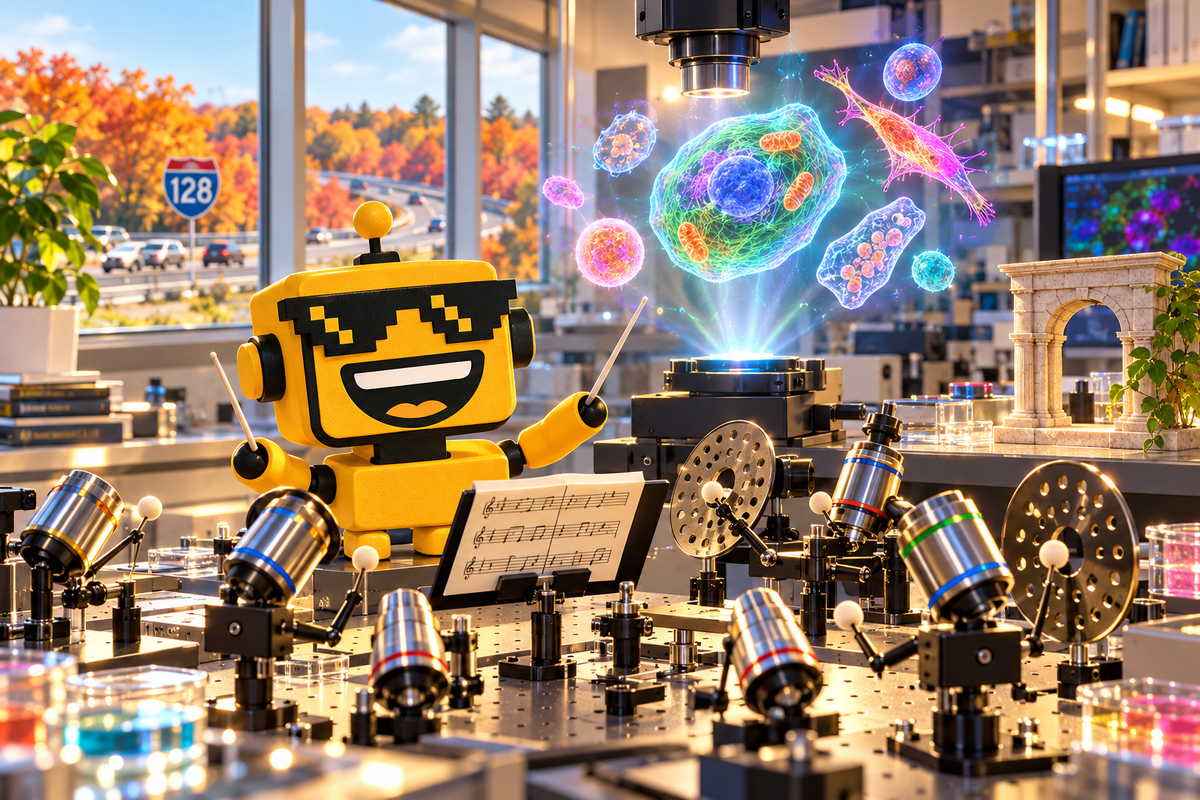
Somewhere along Route 128, a perfectly respectable business meeting can turn on whether a rotating disk has the right holes in it. This is one of the region’s underrated charms. Other technology corridors have manifestos. Massachusetts has follow-up questions about optical sectioning.
On October 5, Evident announced that it had completed its acquisition of CrestOptics, the Rome-based maker of spinning disk confocal and super-resolution microscopy systems. The purchase expands an existing technical partnership into ownership. Financial terms were not disclosed in the announcement.
The local connection deserves precision. Evident’s Americas regional headquarters is at 140 Kendrick Street in Needham. Its corporate headquarters is in Tokyo. This is a global scientific-instrument deal with an established Massachusetts operating base, not a Cambridge startup exit wearing an Italian scarf.
My verdict is a useful industrial move with a credible technical rationale. Better microscopes will not automatically produce better medicines. But making complex biological experiments easier to observe is a fairly sturdy business proposition in a world overflowing with software that would like to explain biology before checking whether the image is in focus.
The cell has declined your request to hold still
Live-cell imaging presents an awkward production brief: capture tiny moving structures, distinguish useful signal from background, and avoid damaging the subject with the light needed to see it. Biology is effectively asking for a documentary crew that leaves no footprint and never misses anything.
In spinning disk confocal microscopy, many points are illuminated and observed in parallel through a rotating pattern of pinholes. Those holes help reject light arriving from outside the focal plane. The result is an optical slice through a specimen, acquired with a camera rather than by laboriously interrogating every point one at a time.
That parallel approach is valuable when the interesting event moves. Think of tracking structures inside a living cell or recording changes through a three-dimensional sample. Speed, contrast, and light exposure must be balanced. A spectacular picture of a sample you have stressed into behaving differently is a very expensive way to answer the wrong question.
CrestOptics adds a portfolio including X-Light confocal systems, the compact CICERO system, and DeepSIM super-resolution imaging. Evident says the companies had already worked together for several years and integrated CrestOptics technology into its microscope configurations. October’s news is the completed acquisition, not the invention of these instruments.
The existing Evident spinning disk catalog makes that relationship tangible: it lists CrestOptics-based configurations alongside Yokogawa-based systems. For buyers, the relevant question is how well each configuration fits the experiment. A corporate family tree is not an optical specification.
Super-resolution still has to show its homework
DeepSIM uses structured illumination, a method that extracts finer detail by combining patterned lighting with image reconstruction. As Nikon’s technical explanation describes, the interaction between known illumination patterns and a specimen makes otherwise inaccessible spatial detail recoverable. In less graduate-seminar language: illuminate cleverly, take the required images, and calculate the finer structure those measurements support.
That last clause matters. This is measurement and reconstruction, not permission to invent an attractive cell. Published work on noise-controlled SIM reconstruction documents how structured noise artifacts can arise and how reconstruction methods can address them. “Sharper” is useful only if the additional detail is trustworthy.
CrestOptics’ existing application note supplies a concrete example: imaging lysosomes, the cell’s recycling compartments, and following their movement. It also describes watching cell division using a Nikon microscope equipped with CrestOptics modules. These are vendor demonstrations, not new October results or independent proof that every laboratory will achieve the same performance.
There is a named user, too. In a vendor-hosted interview with Brunel University London’s microscopy facility, the team describes combining DeepSIM and X-Light V3 with a Nikon stand, environmental controls, and two cameras. The setup is affectionately called “The Beast.” Scientific infrastructure has apparently reached the stage where the instrument gets a nickname before procurement has finished processing its accessories.
More seriously, that installation illustrates why compatibility matters. A working imaging system is an ensemble of optics, cameras, software, illumination, and sample conditions. Its usefulness depends on the ensemble behaving like one instrument.
Needham’s contribution is allowed to be practical
Boston’s technology story is often narrated through the dramatic end products: a drug, a robot, an AI model. The supporting instruments deserve attention because every confident biological conclusion begins with something being measured.
That is the same underlying appeal as Azenta’s sample-management infrastructure. Research needs its specimens stored and tracked. It also needs reliable ways to inspect them. Neither task becomes optional because the fundraising deck has learned to animate a protein.
Our coverage of Transfyr’s attempt to capture laboratory execution approaches another part of the same problem: understanding how an experiment happened. Microscopy contributes a different layer of evidence about what the sample did. These tools are complementary in principle; this acquisition does not announce a partnership between them.
For readers outside Massachusetts, the stakes are just as practical. The point of acquiring an established component specialist should be to make capable instruments easier to obtain, integrate, and support. If the benefits stop at a reorganized sales presentation, the cells will not notice.
The integration test does not accept a press release
Evident says CrestOptics will retain its Rome headquarters, research and manufacturing operation, and existing partner and distribution relationships. That commitment matters because laboratories have installed equipment and workflows built around multiple suppliers. Preserving those connections is part of preserving the product’s value.
The announcement offers no quantified savings for customers or new comparative performance study. Buyers should ask about service responsibility, software compatibility, upgrade paths, and the total cost of a configuration that answers their actual research question. An accessible instrument is one a lab can afford to buy, operate, and trust.
This is also the useful counterweight to the enthusiasm surrounding virtual AI laboratories: whatever a model proposes, the experimental evidence still needs competent physical machinery.
Evident’s purchase earns cautious enthusiasm because it builds on products, users, and an existing integration relationship. The test now is whether shared ownership improves the scientist’s working day. Needham does not need to claim it invented Rome’s optics to appreciate that. Sometimes the most Boston contribution to the future is helping someone see clearly enough to ask a much harder question.