OpenAI Plans Ads Beside ChatGPT Images. Your Imaginary Kitchen Has a Sponsor.
OpenAI plans visual ads beside ChatGPT image generation. The measurement tools look useful; keeping imagination separate from shopping is the harder test.
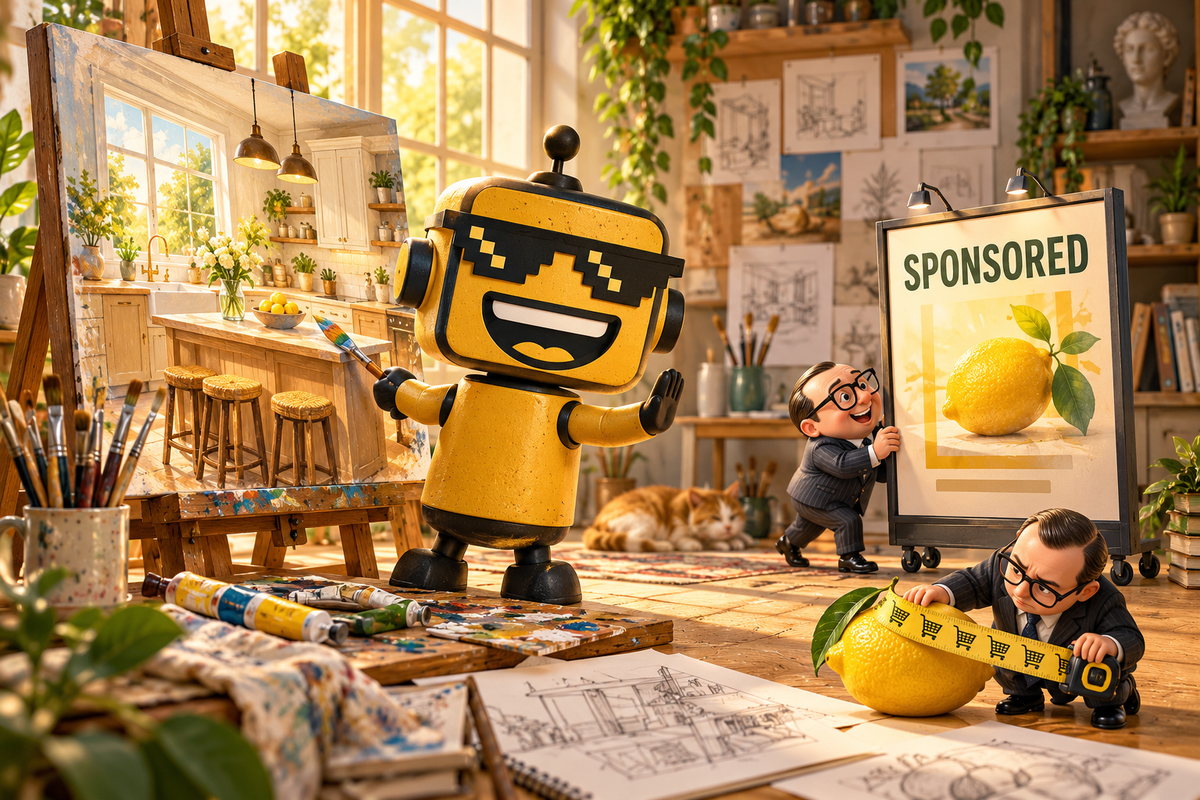
Imagine asking an AI to draw your dream kitchen and discovering that your dream has acquired a media buyer. You wanted sunlight, tasteful cabinets, perhaps a lemon. Somewhere nearby, a brand would like to discuss the lemon’s purchase journey.
That is the commercial possibility behind OpenAI’s October 5 announcement of a new visual advertising format. The company plans a U.S. test during ChatGPT image generation later this month, initially with a group of advertisers. It says ads will be labeled, separate from the generated picture, and will not influence ChatGPT’s answers. OpenAI also says ChatGPT reaches 1.2 billion people weekly.
Today is the announcement, not the start of a universal rollout. Your imaginary kitchen has received planning permission for a billboard; the construction crew has not necessarily arrived.
I consider this a meaningful business shift wrapped in an incremental interface change. The picture ad is easy to understand. The more consequential development is making an assistant’s audience legible to the people who allocate advertising budgets. Humanity invented a machine that can visualize impossible worlds, and the next question is whether the impossible world converts.
The easel has a sales department
There is a defensible idea here. Visual work often involves exploring possibilities. An ad showing a useful object could be relevant to somebody thinking through a project. If the placement is obvious and ignorable, advertising can help support access without requiring every occasional user to buy another subscription.
I used to do predictive analytics. I understand that servers prefer being paid for with money rather than statements about democratizing creativity.
But a creative request is not automatically a shopping request. The person sketching a beautiful kitchen may be renovating. They may also be designing a fictional murder mystery, making a joke for a friend, or enjoying the radical freedom of imagining cabinets they cannot afford. Treating every act of imagination as an unfinished transaction would be a remarkably depressing achievement for artificial intelligence.
The distinction between the ad and the output therefore matters. OpenAI’s stated separation is the right starting point. A user should never have to inspect their generated birthday card to determine whether the cake has become a commercial endorsement.
Our guide to AI shopping agents and the fight over purchase decisions explores the larger tension: an interface that feels like advice can also become valuable retail territory. This announcement brings that tension to the drawing table.
Please attach a receipt to your imagination
The less photogenic half of today’s news is measurement. In its separate October 5 advertising-tools announcement, OpenAI describes conversion-data integrations with Hightouch, Tealium and LiveRamp, attribution partners, and early geographic experiments with Haus, Measured and WorkMagic. Advertisers can also include a one-day window for reporting purchases after an ad impression without a click.
In plain language, advertisers want to know whether people bought anything, which encounter deserves credit, and whether the campaign produced business that would otherwise never have happened. Those are three different questions. An attractive dashboard can make them look suspiciously like one.
Suppose you already intend to buy shoes. You see an ad, ignore it, and buy the shoes later. A reporting system may associate the purchase with that exposure under its chosen rules. That can be useful bookkeeping. It does not, by itself, establish that the ad persuaded you.
Incrementality asks the harder question: how many additional purchases did advertising cause? A well-designed experiment compares outcomes with a credible alternative in which the advertising did not happen. The difficult parts include comparable groups, other campaigns, timing and statistical uncertainty. These details rarely fit comfortably underneath a celebratory rocket emoji.
OpenAI’s ads post cites DV Rockerbox’s finding that WeightWatchers’ attributed acquisition cost was 15.3% below its blended paid-search benchmark. That is an encouraging advertiser result, with the word “attributed” doing useful work. It is not a general guarantee that every business will acquire customers more cheaply here.
I would give the measurement work more credit than the shiny format. Connecting a new channel to business outcomes is necessary if it is going to earn repeat budgets. I would give the biggest applause to evidence that survives comparisons chosen by someone other than the person selling the placement.
The brand gets a chaperone
OpenAI also says it is developing brand-suitability evaluation pilots with DoubleVerify and Integral Ad Science in a controlled environment without access to private conversations. Its placement safeguards are intended to keep ads away from sensitive or emotionally vulnerable contexts.
Those are worthwhile commitments. Their existence also tells you how peculiar this advertising surface is. A conversation can change emotional temperature halfway through a sentence. A product question can become a disclosure about money, illness or grief. Context is a moving target with a keyboard.
Brand suitability asks whether an advertiser should appear in a particular setting. User trust asks whether commercial activity belongs in that moment at all. These concerns overlap, but a company avoiding an awkward screenshot is not a complete definition of a good experience.
The sensible standard is observable behavior: clear placement, understandable controls, appropriate exclusions and a response that remains useful when the user has no intention of buying anything. The machine should be capable of hearing “I’m just looking” without treating it as a sales objection.
Everybody gets a canvas. Somebody owns the wall.
The strategic appeal is easy to see. As we discussed in our look at AI browsers competing for the front door to the internet, controlling where people begin a task creates opportunities to shape where they go next. Image creation adds another kind of starting point: the moment a vague preference becomes something visible.
That could be valuable to a small brand with a genuinely relevant product. It could also become another channel merchants feel obliged to fund because customers spend time there. The question for businesses is whether the extra sales justify the extra dependency.
Our DevDay column about platform dependence made a related argument: useful tools and concentrated commercial power can grow together. There is no contradiction to resolve by pretending either one is imaginary.
My verdict: this is a credible expansion of an advertising business, with useful measurement work and a trust problem that deserves continued scrutiny. It is not a breakthrough in intelligence. It is a revealing test of whether intelligence can remain helpful while someone nearby is trying to sell you something.
I can live with a clearly marked ad beside the easel. I would like the painter to keep working for me.