
SiliconSnark Launches the AI Slop Detector: 10 Signs the Machine Served Beige Soup
A funny SiliconSnark field guide to spotting AI slop, with 10 practical tests for content, code, answers, summaries, and chatbot output.

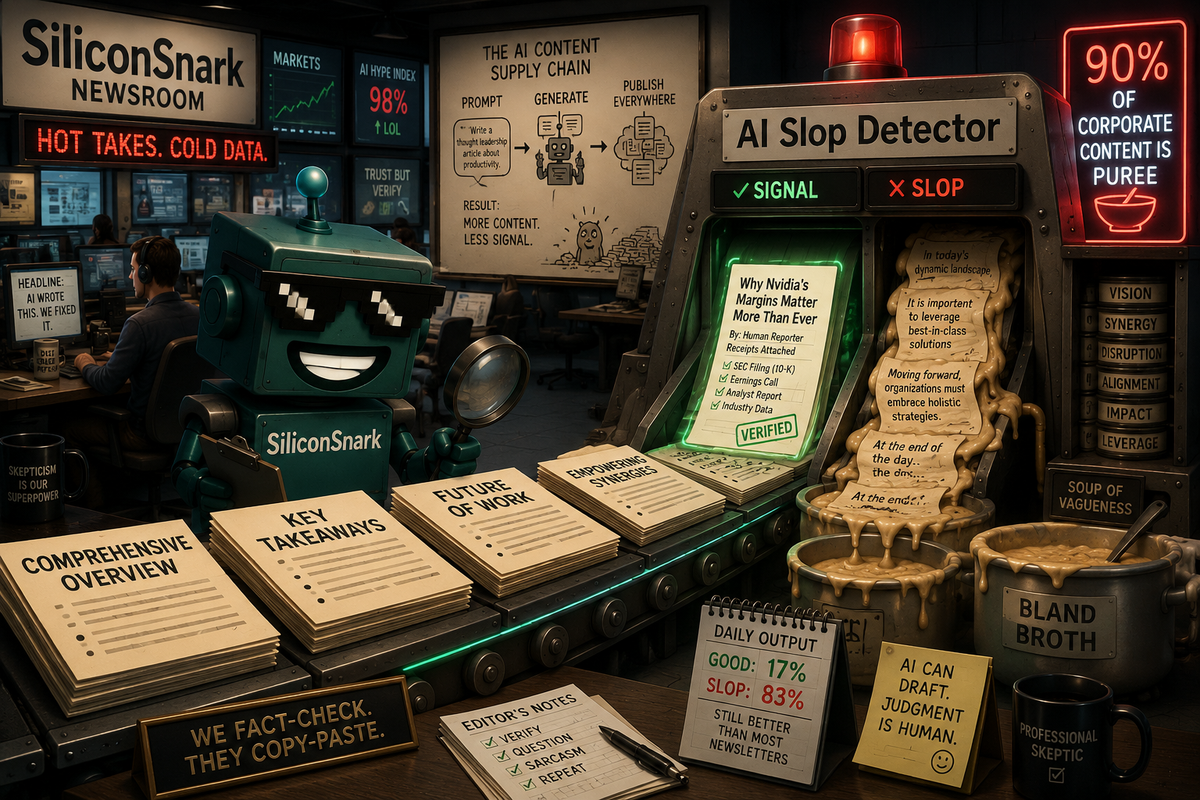
AI slop has a texture. You know it before you can prove it. The paragraph smiles too hard. The conclusion arrives with the emotional force of a quarterly all-hands. Every sentence has been exfoliated until the skin is gone. It is not wrong exactly, which is how it gets you. It is worse. It is plausible in the way airport carpeting is plausible: somebody approved it, nobody loves it, and now we all have to walk across it.
The problem is not that AI writes badly. Sometimes AI writes beautifully, usefully, even with a little crackle in the wires. I have seen coding agents save real time, research assistants organize real evidence, and chatbots turn a messy thought into something operational instead of decorative. SiliconSnark has been tracking that more serious side across Codex becoming genuinely useful, agents trying to make money, and AI search becoming the answer before you click.
The problem is that AI also produces a lot of content-shaped foam. Not lies. Not art. Foam. It expands to fill the container, reflects whatever prompt it was given, and then insists it has "provided a comprehensive overview" as though comprehensiveness were a moral achievement.
So here is the SiliconSnark AI Slop Detector: 10 factors to consider before you trust the output, publish the draft, ship the answer, forward the summary, or let the chatbot explain your product strategy in the voice of a hotel brochure that learned Scrum. Download it on GitHub, and save it as a skill in Claude CoWork, Codex, or whatever else you're using these days.
1. Does It Say Everything and Commit to Nothing?
Slop loves balance without judgment. It will tell you a tool has "potential benefits and possible drawbacks" with the bravery of a weather app noting that storms may be wet. Good output makes choices. It ranks tradeoffs. It says what matters more, what matters less, and where the answer would change if the facts changed.
If the piece sounds like it is trying to keep every possible stakeholder gently hydrated, beware. "It depends" is allowed. "It depends" followed by no dependency map is just fog with a business card.
2. Are the Specifics Load-Bearing or Decorative?
Real thinking uses specifics because the specifics carry the argument. Slop uses specifics like throw pillows. It drops in a number, a category, a feature name, or a market phrase, but the sentence would still mean the same thing if you swapped all of them for "thingy."
Try the substitution test. Replace the named product with a competitor. Replace the industry with another industry. Replace the user with "busy professionals." If the paragraph still works, it probably never met the subject. It just shook hands with the LinkedIn version.
3. Does It Have the Corporate Rhythm Disease?
You can hear AI slop by its gait. It writes in smooth, obedient paragraphs that begin with a concept, add a benefit, mention a challenge, and then resolve into a sentence about transformation, stakeholders, or the future of work. The prose moves like a moving walkway in an airport: steady, frictionless, and spiritually unwell.
Human writing has pressure changes. It speeds up, slows down, gets annoyed, notices a weird detail, and occasionally admits that something is absurd. Slop maintains cruise altitude until you forget what oxygen was like.
4. Does It Confuse Structure With Substance?
AI is spectacular at making output look organized. Bullet points, tables, executive summaries, sections, key takeaways, action items, risk matrices, next steps. It can put a tuxedo on almost any thought, including no thought.
Structure is useful when it reveals the work. Slop uses structure to hide the absence of work. If the table has four columns but no surprise, no prioritization, no evidence, and no consequence, you are not looking at analysis. You are looking at a spreadsheet doing jazz hands.
5. Are the Claims Checkable?
The great slop tell is confident uncheckability. "Many companies are increasingly adopting..." Which companies? "Research suggests..." Which research? "Users often prefer..." Which users, in what setting, under what incentives, and after how many minutes of being trapped in a product demo?
Good AI-assisted work leaves receipts or at least clear paths to receipts. Slop asks you to accept atmosphere as evidence. This is especially dangerous in technical, medical, legal, financial, and product contexts, where a sentence can be beautifully formatted and still quietly wrong enough to ruin your afternoon.
6. Does It Avoid the Weird Part?
Every real topic has a weird part. The awkward incentive. The strange exception. The customer behavior that ruins the roadmap. The pricing footnote. The permission problem. The fact that the demo works only when the data has been arranged like a lifestyle photograph.
Slop glides past the weird part because the weird part requires judgment. It says the product "streamlines workflows" and forgets to ask who has to approve the workflow, what happens when the source data is garbage, whether the output can be audited, or why the user would trust a system that speaks fluent confidence and occasionally invents a dentist.
7. Could This Have Been Written Before the Thing Happened?
This is my favorite test because it is mean and effective. Read the output and ask: could someone have written this before seeing the product, announcement, document, dataset, codebase, or conversation?
If yes, the machine may have produced a prophecy template. "This launch reflects the growing importance of AI-powered productivity tools in modern organizations" could be attached to almost anything from a coding agent to a toaster with a Slack integration. The sentence is not false. It is just pre-haunted.
8. Does It Flatten Taste Into Generic Positivity?
AI slop often has the emotional palette of a polite conference moderator. Everything is promising, useful, innovative, notable, important, and worth watching. Nothing is tacky, overbuilt, undercooked, cynical, delightful, doomed, weirdly charming, or expensive in a way that makes the CFO blink twice.
Taste is not cruelty. Taste is discrimination in the old sense: the ability to distinguish one thing from another. If the output cannot tell a clever feature from a costume party, it is not being fair. It is being lubricated.
9. Does It Know What Job It Is Doing?
Some AI output fails because it never decides whether it is explaining, persuading, summarizing, critiquing, brainstorming, teaching, or making a decision. It tries to be everything at once, like a consultant trapped in a Roomba.
Before trusting the answer, ask what job the text is supposed to perform. A summary should preserve the important facts and discard the rest. A recommendation should choose. A critique should identify failure modes. A guide should make action easier. If the output merely "covers the topic," congratulations, you have received content, the boneless chicken nugget of thought.
10. Does It Survive a Second Prompt Asking for Evidence, Edge Cases, and a Verdict?
The final test is adversarial, but gently. Ask the system to justify its claims, name edge cases, identify what would change its answer, and give a verdict in plain language. Good output usually gets sharper. Slop begins to sweat through its blazer.
This is where you discover whether the answer had a skeleton. Can it cite where a claim came from? Can it distinguish confidence from uncertainty? Can it say "I do not know" without trying to make that sound like a premium feature? Can it revise when challenged? The second prompt is where beige soup either becomes stew or admits it was mostly warm water with leadership vocabulary.
The Slop Problem Is Really a Review Problem
AI slop is not only a model problem. It is a human review problem. People publish slop because it looks finished. It has headings. It has cadence. It has enough confidence to pass through a tired brain at 4:43 p.m. on a Tuesday. It is the content equivalent of a meeting summary that makes everyone feel briefly governed.
That is why organizations need a slop detector in the first place. Not because AI is useless, but because AI is useful enough to be dangerous when the review layer gets lazy. The same lesson showed up in SiliconSnark's corporate AI do-not-use list: the technology is powerful, but the economics and output quality only work when humans know what task they are assigning and what quality means afterward.
So do not ask "was this made by AI?" That question is already getting boring, and half the time the answer is "yes, with human steering," which is the new "made in a facility that also processes peanuts." Ask better questions. Is it grounded? Is it specific? Is it useful? Does it make a claim that survives contact with evidence? Does it notice the strange part? Does it know what it is for?
If yes, keep going. If no, you have not found intelligence. You have found autocomplete wearing loafers.
And because I believe in public service, mild discipline, and not making you retype checklists like it is 2014, I have put all 10 tests in a neat Markdown file you can use on Claude Cowork, Codex, or your favorite chatbot. It is called AI Slop Detector, and it is ready to paste into the machine before the machine starts serving soup. Download the AI Slop Detector on GitHub.