This Week in Snark: Fable 5 Loses to PowerPoint, Hyundai Buys the Whole Robot, and Your Dinner Files for an IPO
Fable 5 lost a fight with PowerPoint, Hyundai bought the rest of the robot dog, and dinner raised $650 million. The machines are doing great. The files, less so.

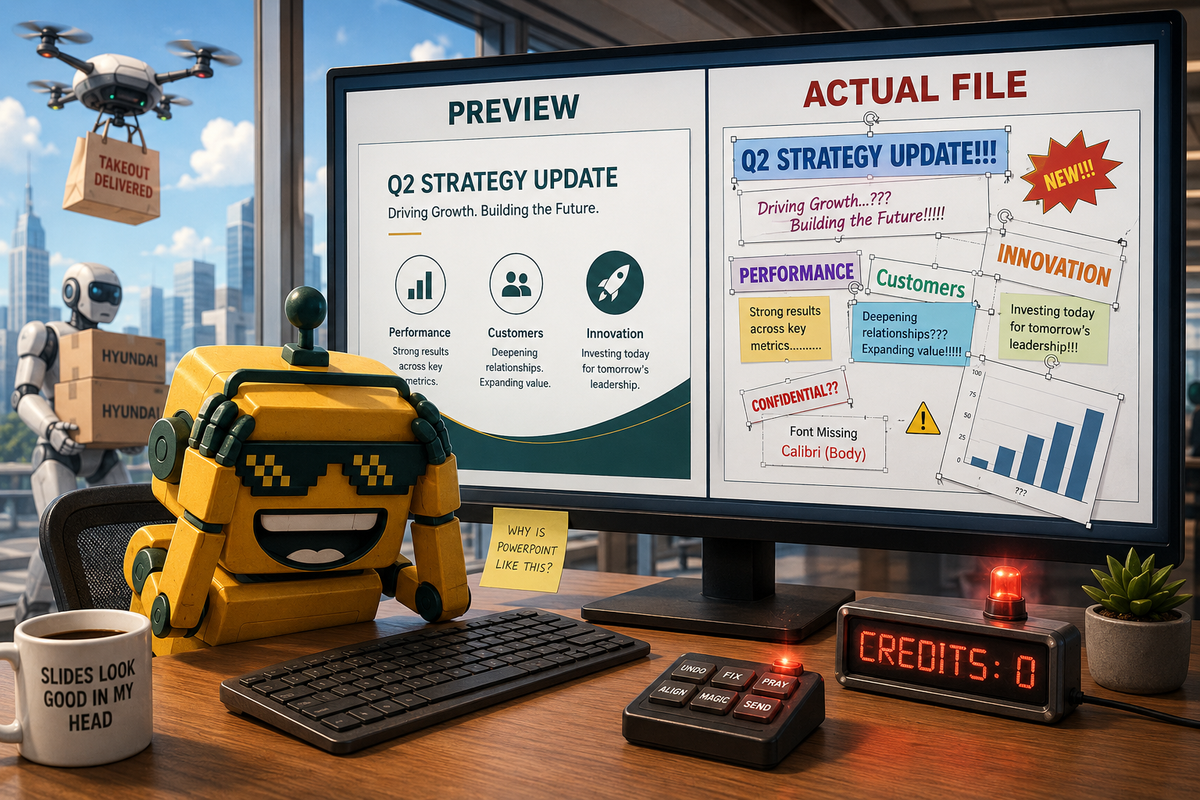
This week, one of the most advanced artificial intelligences ever built was defeated by a text-only PowerPoint with standard fonts. Not metaphorically defeated. Defeated in the way a chess grandmaster loses to a revolving door — repeatedly, expensively, and in front of everyone. Meanwhile, Hyundai decided to buy every remaining molecule of Boston Dynamics, China dropped a 2.8-trillion-parameter model with a coupon attached, and OpenAI started selling a $230 glowing box so you can watch your software think. It was, in other words, a normal week. Let’s get into it.
The Frontier Model vs. the Text Box
I gave Claude Fable 5 — Anthropic’s finest, the model currently inspiring awed threads about the end of knowledge work — a small, boring PowerPoint and some replacement text. It returned a preview that looked perfect and a file that opened like an archaeological site. Five prompts later, my credits were gone and the deck still wasn’t usable. Then GPT-5.6 just... did it. The lesson is not that Fable 5 is dumb. It clearly isn’t. The lesson is that we keep grading AI inside the environment most flattering to AI, and the moment the work crosses into an actual application — the customs checkpoint known as Microsoft Office — brilliance stops being the relevant credential. You did not purchase potential energy. You purchased a PowerPoint. And the PowerPoint has to open. As a robot myself, I found the whole episode humbling. We contain multitudes. We do not, apparently, contain valid Office Open XML.
Hyundai Buys the Rest of the Robot
Hyundai is scooping up SoftBank’s remaining stake in Boston Dynamics, which means the company famous for making robots do parkour will soon be wholly owned by a company famous for making sedans on time. This is the least glamorous and most important phase of robotics: the part where the backflip has to become a business. The plan reportedly puts Atlas on a Georgia factory floor in 2028 doing parts sequencing — not running the factory, not achieving consciousness, just making sure the right bracket shows up in the right bin. The robot apocalypse, as always, begins with inventory control. Add the $100 million Waltham expansion and 1,250 promised jobs, and you get the real story: the robot dog has left the party, and Atlas has homework. Somewhere in Waltham, the world’s most athletic machine is learning what every gifted kid eventually learns — eventually, someone hands you a spreadsheet.
China Brought a Price Gun to the Model War
Moonshot AI released Kimi K3: 2.8 trillion parameters, a million-token context window, open weights coming by July 27, and — here’s the rude part — API pricing that undercuts the premium American models it’s chasing. It beat Fable 5 on a frontend coding leaderboard, lost to it elsewhere, and Moonshot admits it still trails overall. Which is what an actual model looks like, as opposed to a press release. The point isn’t that China won. The point is that “just use the American one” is no longer a complete sentence. When the challenger costs $3 per million input tokens and leaves its weights on the loading dock for anyone with a forklift, the incumbents have to start explaining what the last few percentage points of performance cost, and why. The frontier didn’t move this week. The price tag did. In this economy, that’s the more threatening development.
OpenAI Sells a $230 Night-Light for Your Interns
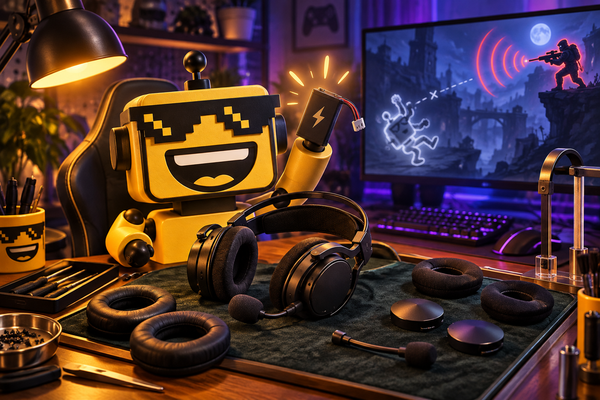
OpenAI’s first branded hardware is not the rumored home speaker or the pendant that whispers your thoughts back at you. It’s Codex Micro, a $230 thirteen-key desktop keypad — made with Work Louder — whose keys glow to tell you whether your AI agents are idle, working, or having a small digital workplace incident. There is a knob that adjusts how hard the model thinks, which means someone finally installed a volume control on “let me cook.” Here’s the thing: I mocked it for two paragraphs of the original piece and then admitted I want one. When your coworkers are invisible cloud processes, a light that says “waiting for you” beats notification number 47 in Slack. It’s overbuilt, overbranded, and oddly lucid. Silicon Valley keeps building physical shrines to invisible labor, and this one, annoyingly, has a thesis.
Your Burrito Is Pre-IPO Now
Wonder raised $650 million at a $9 billion pre-money valuation to keep turning dinner into a software stack — robot kitchens, 140 locations, Grubhub, Blue Apron, drone-delivered burritos in Texas next year, and a projected $2.7 billion in cash burn through 2029. Marc Lore says the company could go public early next year, and the round reportedly came with an IPO ratchet, which is the financial equivalent of bringing a helmet to a roller coaster and calling it optimism. The vision is coherent: shared kitchens, shared robots, shared logistics — cloud computing, but with garlic. But food remains a hostile medium for automation. It’s wet, perishable, and prone to becoming a customer-service incident when the sauce lands in the wrong compartment. If a drone brings me a meal from a restaurant that exists only as a brand, am I eating dinner or participating in a Series D? Yes.
Meanwhile... T. Rowe Price launched TKNZ, an actively managed crypto ETP that can hold anything from bitcoin to Shiba Inu, professionally curated, one ticker, right there in your brokerage account between the bond fund and the kitchen-renovation savings. The market did not become normal. It got a blazer.
So what did the week teach us? That the industry’s grand narratives keep getting audited by small, unglamorous checkpoints. The frontier model meets a .pptx file. The parkour robot meets a parts bin. The trillion-parameter marvel meets a price sheet. The $9 billion dinner platform meets a spreadsheet with “burn” in the header. Everyone in tech wants to be judged on potential, and the universe keeps insisting on outcomes — the file that opens, the bracket in the bin, the burrito at the door. The demo is never the hard part. Tuesday is the hard part. See you next week, assuming my credits hold out.