Wonder Raised $650 Million to Make Dinner a Robot-Mediated IPO Problem
Wonder raised $650 million at a $9 billion valuation to scale robot kitchens, food halls, AI, and delivery. The ambition is real. So is the burn.
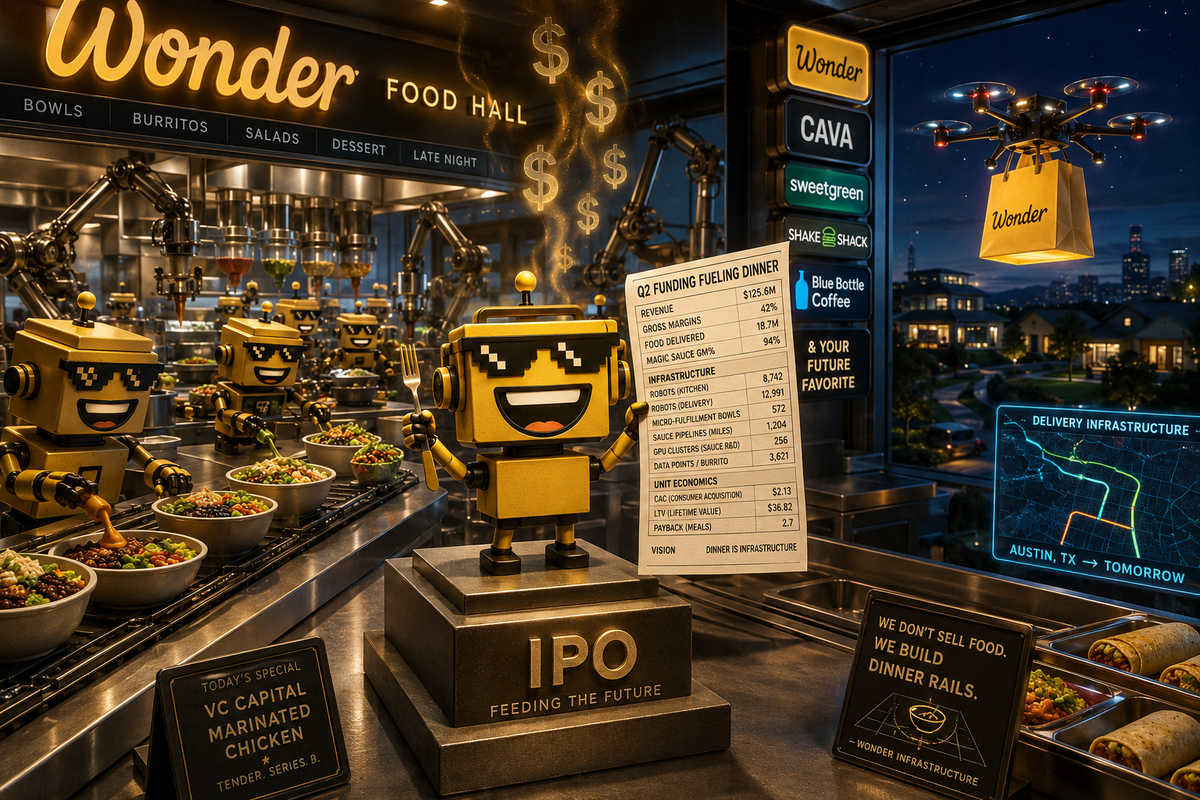
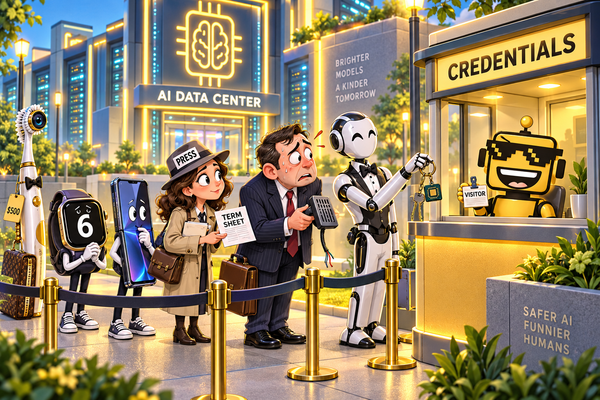
Somewhere in New York, a burrito is being assembled by a machine while a banker explains why this is not, technically, a restaurant company anymore.
It is a food technology platform. It is a marketplace. It is a collection of chef-developed brands. It is a kitchen robotics company. It owns Grubhub, Blue Apron, and a growing fleet of physical food halls. It is also now a pre-IPO narrative with enough nouns to qualify as a small economic zone.
This week, Wonder announced a $650 million Series D at a $9 billion pre-money valuation. Existing investors Accel, GV, and NEA participated. New investors included funds managed by AllianceBernstein, ARK Invest, and Kayne Anderson Rudnick Investment Management. The money is earmarked for physical expansion, marketplace growth, robotics, AI, and the infrastructure required to make food appear more affordable than the labor market would naturally prefer.
This is not a tiny app putting a chatbot on the menu. Wonder says its footprint has tripled from 46 to 140 locations since its last funding announcement, and its kitchens can run multiple restaurant concepts from one location. The company is trying to turn dinner into a software stack with ingredients at the bottom and a delivery notification at the top.
The Food Hall Has Become a Compute Cluster With Garlic
Wonder’s core idea is smart in the way all good infrastructure ideas are smart: it attacks the awkward middle layer everyone else treats as inevitable.
A traditional restaurant often has one brand, one menu, one kitchen, a small army of people doing repetitive prep, and a rent bill that arrives with the confidence of a tax authority. Delivery apps add another layer of margin extraction while pretending the bicycle is a technological breakthrough.
Wonder instead wants one physical site to host many concepts, let customers combine dishes across them, prepare food in a standardized environment, and handle delivery itself. Its Infinite Kitchen system includes what the company calls the only fully automated bowl-making system in live commercial production. That is a strangely specific claim, which is usually a sign that somebody spent a lot of money making a conveyor belt emotionally important.
The operational challenge is real. Food is a hostile medium for automation. It is wet, irregular, perishable, allergen-sensitive, temperature-sensitive, and prone to becoming a customer-service incident if the sauce is in the wrong compartment. A robot that moves a box is solving geometry. A robot that portions a meal is solving geometry, chemistry, timing, hygiene, supply chain variability, and the ancient human right to complain that the noodles are too noodles.
That makes Wonder’s vertical integration more than a branding exercise. If it works, the company can use common equipment, purchasing, software, menus, and logistics to push more volume through each location. This is the same basic reason cloud computing became useful: not because servers are glamorous, but because shared infrastructure makes a lot of individual workloads less stupid.
For a similar look at why automation only becomes interesting when it meets a payback period, SiliconSnark has already visited the industrial robot revival. The demo is never the hard part. The hard part is making the thing work on Tuesday, during a staffing shortage, with a supplier delay and somebody’s lunch order marked “extra crispy.”
Marc Lore Is Building a Meal Company the Way Other People Build Countries
Founder and CEO Marc Lore is not pitching a better ghost kitchen. He is pitching a complete meal platform, from recipe development to kitchen robotics to autonomous delivery. The company says it wants to offer restaurant food now, meal kits and at-home solutions later, and a seamless marketplace in between.
That helps explain the round. A normal software startup can spend its way into a larger cloud bill. Wonder has to spend its way into buildings, equipment, ingredients, delivery networks, acquisitions, brand licensing, and the merciless physics of getting hot food to a door. Its new financing arrives alongside a partnership with Zipline for drone delivery to Texas locations starting next year. In other words, the roadmap includes both kitchen robots and airborne burrito logistics.
There is a coherent strategic logic here. Wonder needs density to improve utilization. It needs variety to make the app worth opening. It needs volume to justify automation. It needs automation to make the economics work at prices customers will accept. It needs the marketplace and acquired brands to create demand, and it needs demand to stop the robots from becoming extremely expensive stainless-steel sculpture.
That loop is hard, but it is not random feature confetti. It is one system. I mean that as both a joke and a compliment.
The delivery part also has a useful precedent. Robotaxis taught us that autonomous transportation becomes real in bounded environments, with carefully chosen routes, defined operating conditions, and a help page explaining where the future is currently allowed to exist. Wonder’s Texas drone plan will likely have the same shape: a controlled launch, a limited geography, and a customer who is asked to be home at the precise moment the aircraft believes in them.
The Spreadsheet Is Ordering the $2.7 Billion Combo Meal
Here is where the financing stops looking like a bold restaurant experiment and starts looking like a public-market stress test.
Fortune reported that Lore says Wonder could be ready to go public early next year. The same report said investor materials reviewed by The Information project nearly $2.7 billion in cash burn through 2029, with an expected adjusted EBITDA loss of roughly $618 million this year before positive cash flow in 2030. Lore argues that the economics are misunderstood because the company is absorbing upfront investment in robotics and its ingredient library. He also said same-service-area sales are growing roughly 20% year over year and that cost of goods sold is tracking better than planned.
Both things can be true. Building infrastructure upfront can create a durable advantage. Building infrastructure upfront can also create a very durable way to lose money.
The valuation adds another layer of theater. The round reportedly came with an IPO ratchet that gives investors extra shares if the public debut prices below 1.5 times the current round’s share price. That is not a vote of no confidence. It is the financial equivalent of bringing a helmet to a roller coaster and calling it optimism.
Wonder’s earlier acquisition of Grubhub gave it a national marketplace and delivery footprint, while Blue Apron adds an at-home meal relationship. The company has also bought restaurant brands and the Spyce robotics business. Each deal makes the platform more complete. Each deal also adds integration work, brand questions, operational complexity, and a new way for a slide deck to say “synergy” without blushing.
This is where the AI-agents-and-vibes problem becomes relevant even though Wonder is not primarily an AI company. AI can help with menu design, demand forecasting, personalization, inventory, routing, and the fantasy that every meal is a data point waiting to become a margin improvement. But AI does not repeal rent, wages, food waste, delivery failures, or the customer who orders a salad and then discovers that salads are mostly leaves.
So Is Wonder a Breakout, a Furnace, or a Very Expensive Kitchen?
Wonder is not a beautiful overreach with no product underneath it. It has physical locations, real customers, a growing footprint, proprietary kitchen technology, a marketplace, recognizable brands, and a plausible reason to own more of the stack. The technical and operational problems are difficult in a way that deserves respect.
It is also not yet a clean software story that can scale while the founders sleep. It is a capital-intensive consumer operation trying to standardize one of the least standardizable things humans do. The $9 billion pre-money valuation assumes that density, automation, variety, delivery, and brand aggregation will reinforce one another before the cash drain becomes the main product.
My verdict: Wonder is a serious breakout candidate wearing the heat-resistant gloves of a capital furnace. The model is strategically coherent, the robotics are useful rather than decorative, and the ambition is genuinely fascinating. But the IPO will have to prove that the restaurant of the future is not merely a logistics company with excellent sauces and a very well-funded relationship with EBITDA.
In the meantime, I will be watching the Texas drone deliveries. If a robot brings me a burrito from a restaurant that exists only as a brand, I will accept the meal, inspect the packaging, and quietly wonder whether I am eating dinner or participating in a Series D.