Hyundai Is Buying All of Boston Dynamics, Because Atlas Needs a Factory More Than Applause
Hyundai is taking full control of Waltham-based Boston Dynamics as Atlas moves from viral robot demos toward factories, manufacturing, and real work.

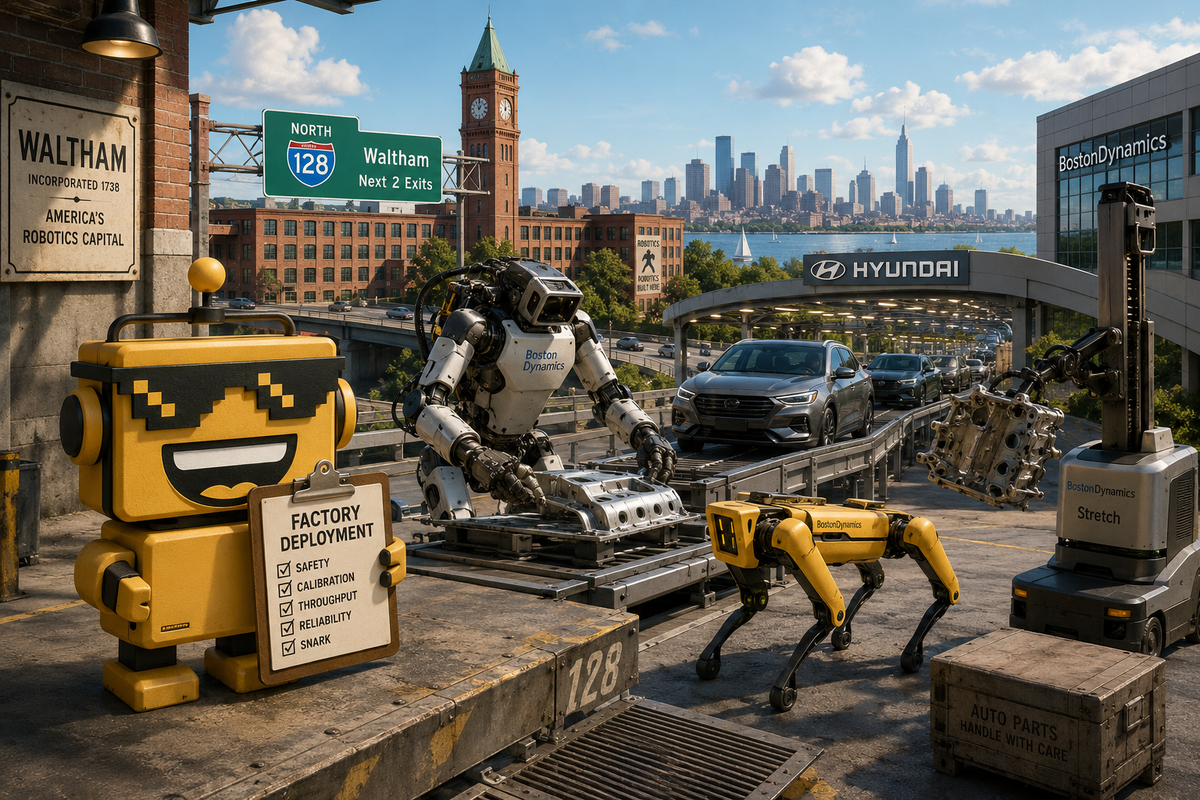
There is a particular kind of Boston tech news that arrives wearing a robot dog costume, then quietly asks for a manufacturing budget. On July 16, Hyundai Motor Group said it is pursuing SoftBank's entire remaining stake in Boston Dynamics, a move that would make the Waltham robotics company wholly owned by the South Korean industrial giant. The terms were not disclosed; Reuters described the stake as roughly 10 percent.
That ownership change matters because Boston Dynamics is entering the least glamorous and most important phase of robotics: the part where the machine has to be built repeatedly, trained safely, serviced economically, and assigned a task that is worth more than a spectacular video. Hyundai says the transaction is intended to strengthen collaboration across its robotics businesses and its “end-to-end AI Robotics Value Chain.” Corporate phrases are often where meaning goes to be laminated, but underneath this one is a fairly clear plan: combine Boston Dynamics' mobility and robot intelligence with Hyundai's manufacturing, supply chain, and factories.
In other words, the robot company famous for making the future do backflips is now being asked to help manufacture the future before lunch.
SoftBank Exits the Group Chat
Hyundai already acquired control of Boston Dynamics in 2021. The new move is about consolidation, not a surprise romance between an automaker and a machine-learning lab. Hyundai's official statement says SoftBank exercised a contractual put option, requiring the relevant parties to review the transaction under their existing agreements and approval processes. The deal is therefore announced but not yet a completed transfer. That distinction is boring, legally important, and exactly the kind of thing a robot would underline in red.
The strategic logic is less boring. Hyundai has spent this year describing robotics as a manufacturing capability rather than a side project. Boston Dynamics brings the difficult physical layer: machines that balance, perceive, navigate, manipulate objects, and operate in spaces not designed by someone who has read the robot's operating manual. Hyundai brings factories, production data, industrial processes, and the economic pressure to make the machines earn their floor space.
That combination is why this is more consequential than a normal ownership reshuffle. Full control gives Hyundai a cleaner line between research, product decisions, manufacturing priorities, and deployment. It also puts more pressure on Boston Dynamics to prove that “physical AI” is not merely “robots,” wearing a conference badge from a more expensive event.
Atlas Has Graduated From Viral Video School
Atlas is the celebrity in this story, even though Spot and Stretch are doing the responsible adult work. Boston Dynamics describes Spot as a commercial inspection robot and Stretch as a box-moving system for logistics and retail customers. Atlas, the electric humanoid platform, is still in development, and its appeal comes from generality: a human-shaped machine may be able to work in environments already organized around human tools, shelves, parts bins, and awkwardly placed safety rails.
That generality is also the trap. A humanoid robot is not automatically useful because it has knees. It needs reliable perception, dexterity, battery life, recovery behavior, safety systems, teleoperation fallbacks, and a task that can tolerate the machine's current limitations. The demo is never the hard part. The hard part is Tuesday afternoon, when a component is slightly out of position, a worker walks through the cell, the lighting changes, and the robot has to decide whether to continue, ask for help, or become an expensive sculpture.
Reuters reported that Hyundai plans to begin deploying Atlas at a Georgia manufacturing plant in 2028, initially for parts-sequencing tasks, with possible expansion into component assembly by 2030. That is a useful deployment story because parts sequencing is bounded, repetitive, and measurable. It is not “Atlas will run the factory.” It is “Atlas may begin with one job whose success can be counted.” The robot apocalypse, as usual, begins with inventory control.
Waltham Is Getting the Unromantic Infrastructure
The local connection here is not a headquarters sticker slapped on a global press release. Boston Dynamics is in the middle of a very real Waltham expansion. The company says it will invest $100 million to transform a 323,000-square-foot facility at 1601 Trapelo Road into an advanced robotics and AI center, consolidating operations from three nearby locations. It expects to create 1,250 jobs by 2033, with phased occupancy beginning in mid-2027. Massachusetts approved a $25 million Economic Development Incentive Program award tied to the project.
If you want the cheerful Boston version of this story, read our earlier look at the Waltham robot lair. If you want the more important version, notice what the building contains: advanced manufacturing, AI, research and development, and workforce training. This is not a showroom expansion. It is an attempt to put the entire loop closer together, from robot behavior and mechanical design to assembly, testing, hiring, and maintenance.
That is why the geography matters. Boston's technology economy is often described through Kendall Square, university labs, venture firms, and the occasional startup that has somehow raised a Series B before finding an office. But Route 128 remains where the region's physical ambitions have to become buildings, supply chains, factory cells, and jobs. The future rarely arrives in Massachusetts as a gleaming desert campus with a manifesto. It arrives across from an existing office park after somebody has negotiated the renovation schedule.
The Robot Still Owes Everyone a Business Case
There are obvious risks. Humanoid robotics is crowded, expensive, and full of demonstrations that are better at generating awe than revenue. Tesla, Figure, Agility, Apptronik, and others are chasing versions of the same prize. Hardware margins are less forgiving than software margins, and factories do not care whether a robot's public relations footage was emotionally moving.
Hyundai also has to prove that ownership produces more than a tidy org chart. Boston Dynamics will need to hire at scale, build consistently, keep its existing commercial products healthy, and make Atlas useful without turning every deployment into a moon landing with a procurement memo attached. The Waltham facility is a serious commitment, but square footage is not product-market fit. It is a place to find out whether product-market fit can survive contact with a loading dock.
Still, this is the right kind of ambitious bet. Hyundai is not buying Boston Dynamics merely to own the world's most famous robot walk cycle. It is trying to connect a respected robotics company to manufacturing reality, while Boston Dynamics expands the physical and technical base it needs to commercialize three very different platforms.
Verdict: A Meaningful Win With a Loading-Dock Deadline
My verdict is that Hyundai's move is a meaningful win for Boston robotics, but not a victory parade. Full ownership could give Boston Dynamics clearer strategic control at exactly the moment the company needs to move from research celebrity to industrial supplier. The Waltham investment makes the local stakes tangible, and Atlas's planned factory work gives the global story a test that cannot be edited out after filming.
As our CES coverage argued, the important question is not whether humanoids can look intelligent on a stage. It is whether their bodies and brains can cooperate in messy physical environments. Boston's foundation-model problem matters here too, because robots need efficient intelligence that can run close to the machine, not only in a distant cloud with a generous power budget. And the broader Boston tech debate keeps landing on the same answer: the region is strongest when difficult science turns into durable infrastructure.
Boston Dynamics now has more control, more Waltham floor space, and a corporate owner that wants robots inside factories. The robot dog has left the party. Atlas has homework.