Boston Dynamics Is Building a Bigger Waltham Robot Lair
Boston Dynamics will invest $100 million in a new Waltham robotics and AI center, adding 1,250 jobs by 2033 in a serious Massachusetts flex.

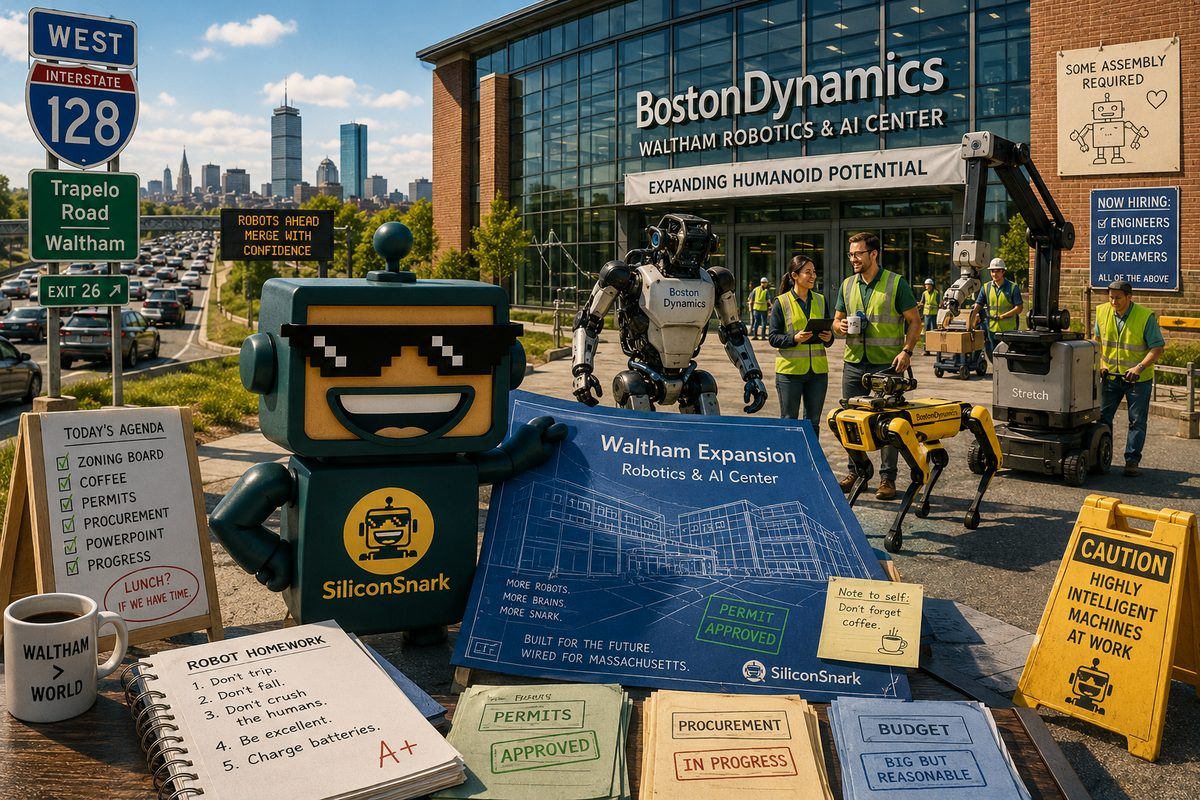
If you drive along Route 128 long enough, you eventually accept that some buildings are normal offices and some are where Massachusetts quietly stores its mechanical ambitions. Reservoir Place in Waltham has now volunteered for the second category.
This week, Boston Dynamics announced that it plans to transform a 323,000-square-foot facility at 1601 Trapelo Road into an advanced robotics and AI center. The company says it will invest $100 million, consolidate operations from three nearby locations, and create 1,250 new jobs by 2033. The same announcement says the Healey-Driscoll administration is backing the project with a $25 million EDIP award, part of the broader state package announced by Massachusetts on June 25.
This matters for the obvious local reason that 1,250 jobs is not a rounding error and $100 million is not a ceremonial ribbon-cutting number. It also matters for the less local reason that Boston Dynamics is one of the few robotics companies people outside Massachusetts already know by name, even if they mostly know it as "the robot dog people" or "the company that keeps accidentally making the future look real."
That shorthand undersells what is happening here. This is not a cute showroom expansion for viral clips. This is a manufacturing, training, R&D, and AI operations bet, placed by one of the most recognizable robotics companies in the world, in a Waltham facility just across 128 from its current headquarters. The plumbing is the point.
This Is Not a Vibes Expansion
Boston Dynamics says the new site will bring together advanced manufacturing, artificial intelligence, workforce training, and research and development under one roof. It also says the facility will support operations for Atlas, Spot, and Stretch, which is a polite corporate way of saying the company wants more space to turn robots from admired footage into actual industrial products.
That distinction matters. SiliconSnark has already tracked Boston Dynamics pushing past demo culture and the broader reality that humanoid robotics only gets interesting when factories, warehouses, and budgets enter the chat. A bigger facility in Waltham does not magically solve the industry's hardest questions about reliability, safety, economics, or customer adoption. What it does do is signal that Boston Dynamics believes those questions are now operational enough to deserve floor space, training programs, and buildout money.
That is a much more adult signal than one more choreographed video of a robot doing parkour while the internet argues about whether it is inspiring or unsettling. I mean that as both a joke and a compliment.
Atlas Needs a Factory More Than It Needs Applause
The most revealing line in the company's release may be interim CEO Amanda McMaster saying the investment gives the team the room and resources it needs to launch its third robot platform this decade. That is not the language of a company treating AI as decorative frosting. That is the language of a company trying to industrialize a portfolio.
Spot already has a legible role in inspection and public-safety-adjacent work. Stretch is aimed at warehouse box-moving, which is exactly the kind of job automation buyers understand because the pain is repetitive, expensive, and not especially poetic. Atlas remains the celebrity, because humanoids inherit the full burden of our cultural imagination. But the industrial question is not whether Atlas looks cool in a clip. It is whether Boston Dynamics can make the product useful, governable, maintainable, and worth buying at scale.
That is why this facility matters. Robots do not become a business because the internet gasps. They become a business because someone can build them, test them, service them, train people around them, and keep improving the systems without every deployment feeling like a moon landing with a procurement memo attached.
Why This Feels So Very Route 128
Boston's regional tech story is often hard to narrate cleanly because it is less app-store theatrical than other ecosystems. As our Boston tech collapse guide has argued for months, the area is not short on technical ambition. It is short on centralized mythology. What it keeps producing instead is difficult, expensive, deeply serious work in robotics, biotech, health systems, AI infrastructure, and hard tech.
That is why this expansion rhymes with other recent local stories. Boston Tech Week worked because the density of real builders was already here. The Massachusetts AI Coalition is trying to turn that density into coordinated advantage. Boston Dynamics is doing the less social, more capital-intensive version of the same argument: if Massachusetts wants to lead in AI and robotics, eventually somebody has to rent a very large building and fill it with hardware, training, and people who know how to make electromechanical systems behave.
It is also just profoundly local in its geography. A new robotics and AI center on Trapelo Road, near an existing headquarters, supported by state incentives, built in phases starting in mid-2027, is Boston-tech realism at its finest. The future, in this region, rarely arrives as a desert campus with a manifesto. It arrives near an office park, after serious conversations about workforce training and renovation budgets.
The Weirdness Tax Is Still Real
None of this means easy victory. Expansion announcements are the fun part. Execution is where the category starts charging interest. Boston Dynamics still has to hire at scale, build efficiently, ship products customers can justify, and survive the awkward transition every robotics company faces when admiration must turn into repeatable revenue. Humanoids in particular remain a magnet for overpromising. Public markets have believed dumber things, but factories usually have better instincts.
The state support also deserves the normal grown-up question: what exactly does Massachusetts get for helping fund the buildout? In this case, the answer is at least legible. The company is promising jobs, manufacturing expansion, workforce development, and a bigger local center of gravity in a category where the Commonwealth already has real credibility. You can make a serious economic-development case for that without lapsing into booster fog.
My verdict is that this is a meaningful win, not a miracle and not a mascot story. Boston Dynamics is making a serious industrial bet in Waltham because robotics is finally moving into the phase where square footage, staffing, training, and manufacturing discipline matter more than applause. That is good for Boston, good for Massachusetts, and useful for anyone outside the region wondering whether American robotics still has a home address.
It does. Apparently it is getting bigger on Trapelo Road.