Higgsfield Raised $400 Million to Make Every Brand Its Own Movie Studio
Higgsfield raised $400 million at a $5.4 billion valuation to scale AI video for creators, marketers, and enterprises. Serious platform, enormous vibes.

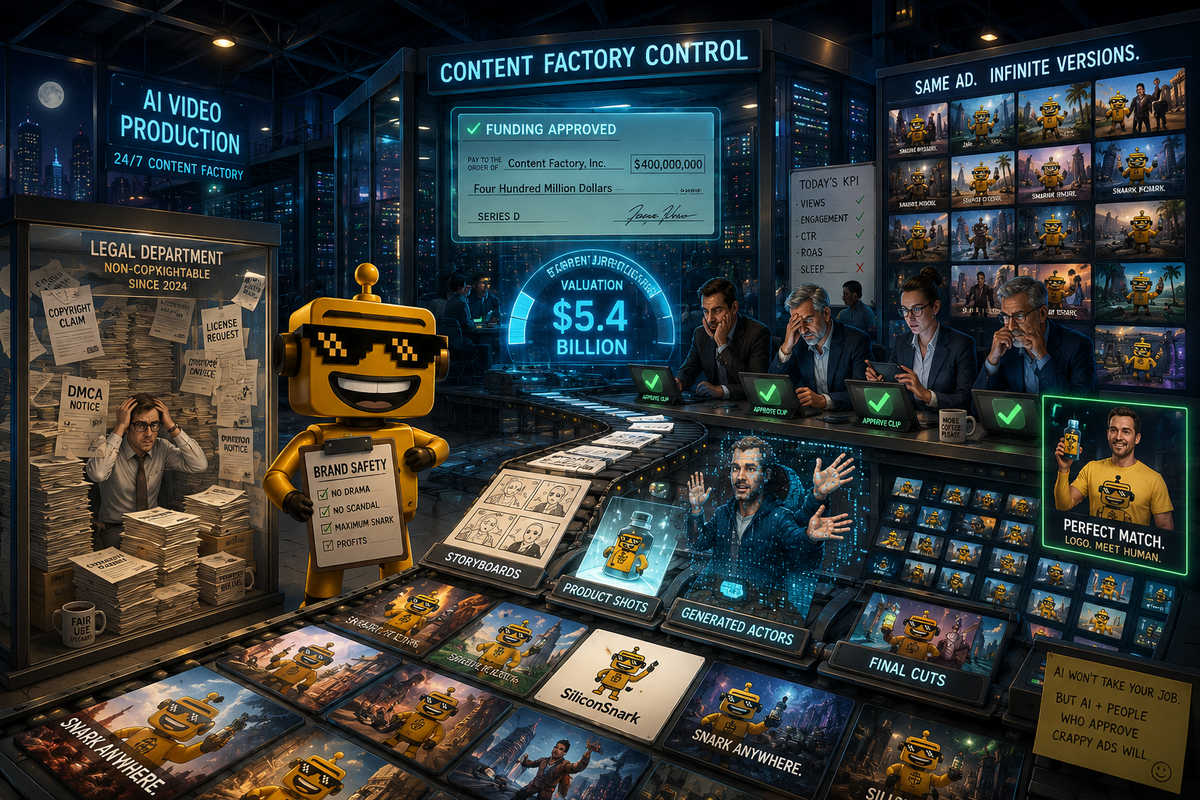
Somewhere today, a marketing executive is looking at a product brief, a mood board, three reference images, and a deadline that was apparently yesterday. In the old world, this required a creative team, a production company, a location scout, and at least one person saying, “We can fix it in post.” In the new world, it requires a prompt, a credit balance, and the spiritual resilience to watch an AI-generated hand approach a coffee cup.
Higgsfield would like to make that second workflow the normal one. The San Francisco AI-video company raised $400 million at a $5.4 billion post-money valuation, according to Axios Pro Rata on August 17. DST Global led the round, joined by Tribe Capital, Goldman Sachs Alternatives, Smash Capital, Fifth Wall, Valor Capital, Intel Capital, Liberty Global Tech Ventures, Mirae Asset Capital, NTT Docomo Ventures, and a crowd of existing investors.
That is a very large check for a company whose core pitch is “make a video.” It is also a revealing one. Investors are no longer treating generative video as a novelty for creators who want to make cinematic raccoons. They are betting it can become marketing infrastructure: the layer where brands turn a product link, a campaign idea, or a mildly panicked Slack message into an endless stream of ads.
The Creative Department Has Become a Compute Workload
Higgsfield’s product is broader than a text-to-video box. Its official materials describe a creative suite that combines image, video, and audio generation with tools such as Soul ID for character consistency, Cinema Studio for camera control, Marketing Studio for ad production, and Supercomputer, a conversational builder for making apps, websites, games, and content workflows.
That bundling is strategically smart. The raw models are increasingly interchangeable. Higgsfield’s comparison of its platform with Runway lists shared or licensed models including Seedance, Kling, Veo, and WAN. The competition is who can keep a brand’s character from changing faces between shots, produce usable variations at scale, and move from idea to approved asset without making the marketing team open seventeen tabs.
Higgsfield is also aiming at the growing category of AI-native production systems. Its recently launched Apps feature lets users describe an application in chat, then generate the design, code, database, and model connections into a live product. The company says the marketplace already has more than 500 apps. This is either a meaningful expansion from media tool to creative operating system or the moment the product roadmap started eating every noun in the dictionary.
The good news is that the direction is coherent. A platform that already knows how to generate images and video has a reason to add workflows, distribution, templates, and reusable identity. This is not random feature confetti. It is an attempt to own the entire path from “we need an ad” to “here are 400 localized versions, please stop emailing me.”
At $5.4 Billion, the Prompt Has a Revenue Target
The valuation makes more sense when you look at Higgsfield’s reported growth. Forbes reported in January that the company said it had reached a $200 million annual run rate less than nine months after launch, with more than 15 million users and roughly 4.5 million videos generated per day. The company also said about 85 percent of usage came from social-media marketers, most of it commercial.
Those numbers describe a tool people are not merely trying once to make a photorealistic grandmother fight a bear. They suggest repeated, paid usage tied to an actual business function. Marketing teams do not need one perfect video. They need variants for audiences, languages, platforms, placements, campaigns, and whichever algorithmic mood swing arrived overnight.
This is where AI video may have a better commercial case than the endless “Hollywood replacement” arguments imply. The first customers are not necessarily studios. They are agencies, performance marketers, e-commerce teams, and brands that already produce mediocre content at industrial scale. If Higgsfield can reduce cost and turnaround time while keeping enough control for approval, it does not need to win an Oscar. It needs to ship 200 acceptable ads before lunch.
That is less glamorous than replacing the camera department. It may also be a much larger market.
Welcome to the Content Factory, Please Mind the Copyright Waiver
The hard part is that marketing video is not just a rendering problem. It is a rights, identity, brand-safety, and approval problem wearing a very expensive jacket.
Who owns the face? What happens when a generated spokesperson looks suspiciously like a real person? Can a brand prove where a training image came from? Does a customer get a consistent character, or merely a family resemblance that collapses when the camera angle changes? What happens when an enterprise customer uploads confidential packaging, unreleased products, or a campaign concept that should not be visible to the model provider?
Higgsfield’s own terms update says users own what they make and that the company does not claim their inputs or outputs, while also describing the limited license needed to operate the service. That is the right direction, but enterprise buyers will want more than a reassuring paragraph: retention controls, audit trails, permissioning, predictable model behavior, indemnification, and a contract that does not turn a private product launch into a future training example.
The wider AI market has already shown what happens when the demo outruns the paperwork. Neo’s $100 million AI-security round exists because enterprises are happy to automate right up until an agent touches something it should not. Higgsfield’s problem is less “can the model generate a clip?” and more “can a global brand let 4,000 employees generate clips without creating a legal incident with a soundtrack?”
The Investor List Says This Is Infrastructure Now
The syndicate is part of the story. DST Global is not showing up for a cute creator tool. Goldman Sachs Alternatives and strategic investors such as Intel Capital, Liberty Global Tech Ventures, and NTT Docomo Ventures suggest a belief that generative media will sit inside a broader commercial stack.
That thesis is not absurd. The same industry that turned cloud software into a default utility is now trying to turn content generation into a metered service. Every generated frame consumes compute. Customers want speed, reliability, storage, governance, and an API. The business may look like software from the outside, but a small data center is hiding behind the curtain.
That is the capital-furnace risk. If Higgsfield relies on third-party models, it may be a polished distribution layer in a market where suppliers keep changing prices and capabilities. If it invests in proprietary models and infrastructure, it can differentiate, but its expenses become a personal relationship with electricity. “High-margin creative platform” sounds less comfortable when every customer asks for unlimited 4K video and discovers unlimited was emotionally, not mathematically, defined.
We have seen the same capital logic in other AI categories. TwelveLabs raised $100 million to make video archives legible to machines, while SambaNova raised $1 billion to make inference less dependent on Nvidia. Different products, same underlying shift: AI is becoming less about a chatbot on a landing page and more about the expensive plumbing around production workloads.
So Is Higgsfield a Breakout or a Beautiful Overreach?
Right now, Higgsfield looks like a serious breakout with a capital furnace attached. The company has a clear buyer, a plausible workflow, visible product breadth, and reported usage that is commercial rather than purely recreational. The timing is good because brands need more content than human production teams can comfortably make, and because social platforms have transformed marketing into a never-ending audition.
But $400 million changes the standard. The company now has to prove that its platform can retain customers after the novelty wears off, keep identities and outputs consistent, navigate rights and privacy, and make the unit economics work when users stop making demos and start making television-ad quantities of video. The market is crowded, the models are moving, and “AI creative suite” is one product launch away from becoming the new “end-to-end platform.”
Still, I am more impressed than dismissive. Higgsfield is not merely selling the dream that anyone can make a movie. It is betting that businesses will need a content factory, then trying to supply the factory floor, the editing bay, the distribution system, and the little dashboard where someone approves a video of a shoe walking confidently through a desert.
That is a serious business. It is also an enormous amount of money to give a machine permission to invent brand guidelines. The verdict, for now: credible breakout, suspiciously well-funded, and one procurement committee away from discovering that the future of cinema has a content-moderation queue.