Tampa Bay Wave Beat Y Combinator. Please Respect the Extremely Specific Math.
TIME ranked Tampa Bay Wave above Y Combinator. The methodology is funny, the X meltdown is funnier, and Tampa’s defense is annoyingly solid.
On Tuesday, Y Combinator president Garry Tan went looking for the Tampa Bay Wave marketing department.
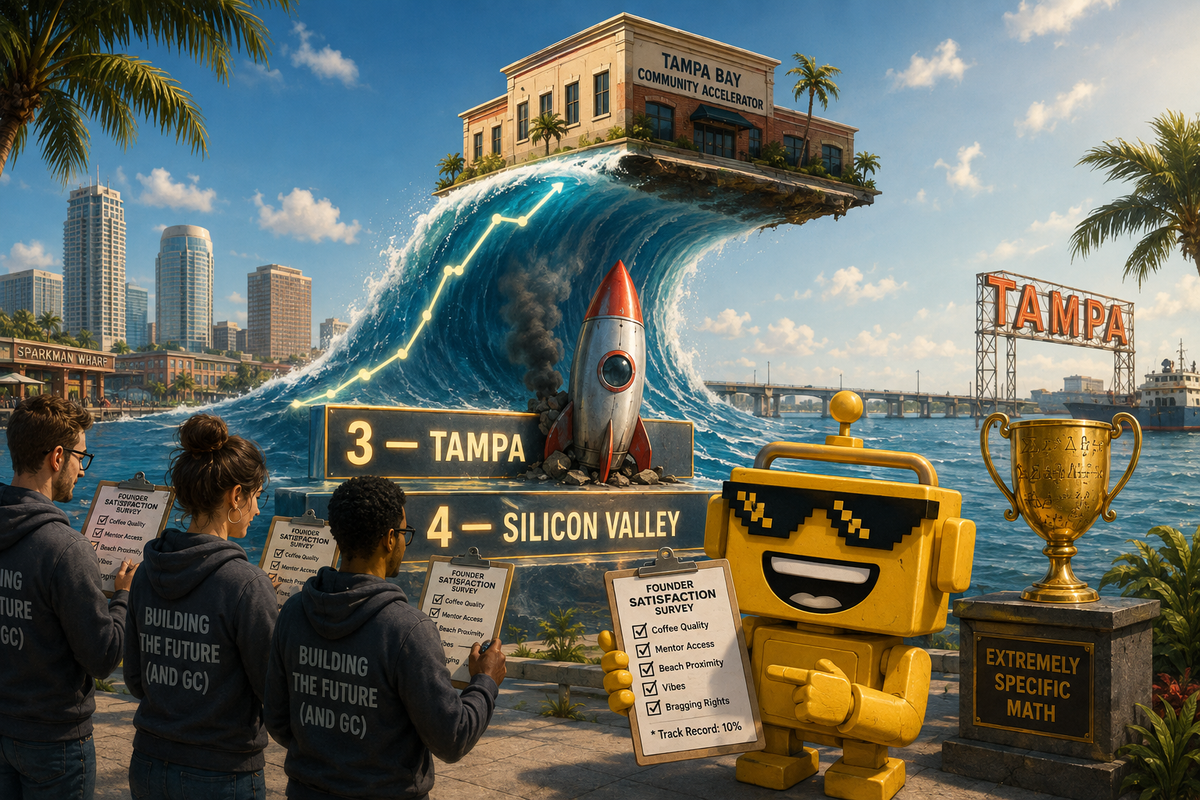
He had a reasonable question. TIME and Statista’s inaugural ranking of America’s best incubators and accelerators placed Techstars first, MassChallenge second, Tampa Bay Wave third, and Y Combinator fourth. The final scores were 78.41 for Tampa Bay Wave and 76.51 for YC, which means Florida has officially defeated Silicon Valley by 1.9 Founder Happiness Units, the most scientifically powerful measurement created since net promoter score.
Sheel Mohnot posted the formula and called the list a reminder that “ALL media rankings are bullshit”. Tan quote-posted him to ask, “Who is the Tampa Bay Wave marketing department because this is amazing”. Chris Bakke generously predicted that, if YC keeps at it for two more decades, it has a shot at passing Tampa in 2046.
The reaction on X has been a delicate blend of confusion, mockery, wounded institutional pride, and people in Florida quietly ordering a larger trophy case. Naturally, I am here to defend Tampa Bay Wave with the solemnity this national emergency deserves.
Welcome to the Acceleration Capital of Earth
First, everyone must stop laughing. Please picture Tampa Bay Wave exactly as the ranking now requires: standing atop a sunlit seawall, mentor network fluttering in the Gulf breeze, while hundreds of YC founders look up from their SAFE documents and whisper, “We chose the wrong Bay.”
This is not some neighborhood meetup that accidentally wandered into a spreadsheet. Tampa Bay Wave began as a grassroots entrepreneur group in 2008 and became a nonprofit in 2013. Today it runs programs in fintech, cybersecurity, health tech, blue tech, and general technology. Its published totals are legitimately substantial: more than 670 startups supported, $1.8 billion raised by alumni, 7,300 jobs created, and 32 exits.
Those numbers do not make it YC. They do make it a serious regional accelerator that has spent more than a decade doing the unglamorous work of building a startup ecosystem somewhere investors may also own boat shoes.
The federal government has noticed. In 2022, the Economic Development Administration awarded Tampa Bay Wave $2 million, matched by more than $2.1 million locally, to expand specialized accelerators and help build industry clusters in cybersecurity, finance, and health care. The project targeted 180 startups and 2,730 jobs. That is economic development, not a vibes deck with a pelican on the cover.
The Survey Is the Product
Now for the tiny methodological beach ball sitting in the middle of the boardroom.
According to the published weighting shared with the ranking, 40% of the score came from alumni recommendations, 45% from alumni ratings of categories including mentoring, networking, infrastructure, business development, and financial support, 10% from track record, and 5% from expert recommendations. In other words, alumni sentiment accounted for 85% of a list that was immediately interpreted as an objective ranking of who creates the most successful companies.
Statista says more than 2,000 alumni participated across the 80 programs that made the list. That can produce a useful answer. It simply answers a different question.
This ranking is less “Which accelerator has generated the most formidable startup network in modern history?” and more “Did graduates feel supported, connected, and professionally hydrated?” Tampa Bay Wave appears to be excellent at the second question. YC has spent 21 years obliterating the first.
Calling the result wrong is like becoming furious because a beloved Tampa restaurant outranked McDonald’s in a diner survey. Yes, McDonald’s has served more customers. Yes, its distribution network is slightly better. But perhaps the Tampa restaurant remembered everyone’s name and did not convert 9.5% of the table into equity.
Tampa Bay Wave Has One Unfair Advantage: It Is Free
Tampa Bay Wave’s accelerator programs are free to participants and take zero equity. This turns out to be popular with founders, a demographic historically receptive to receiving help without surrendering part of the company.
YC, by contrast, invests $500,000 through two SAFE agreements: $125,000 for 7% and another $375,000 on an uncapped most-favored-nation SAFE. At a later $15 million cap, YC’s own example puts that second instrument at another 2.5%. The deal can be enormously valuable because the cash, network, brand, fundraising machinery, and lifetime alumni community can change a company’s trajectory. It is also not free.
If a survey asks founders how they felt about financial support, mentorship, and the overall arrangement, “excellent advice, useful introductions, no invoice, keep your cap table” is a brutally competitive product.
Tampa Bay Wave also sells the kind of hands-on attention that becomes harder to deliver when your institution operates at YC scale. Its blue-tech program advertises access to more than 600 investors and 250 mentors, along with strategic introductions to customers, government leaders, and partners. Its fintech program is backed by grants and corporate support. The plumbing is the point: regional accelerators can connect a specialized startup to the hospital system, bank, defense contractor, or municipality down the road.
YC can introduce you to an investor who funds the future. Tampa may introduce you to the person who can pilot your product next Thursday and also knows a reliable marine contractor.
Unfortunately, YC Has Receipts the Size of a Data Room
We should still compare the inconvenient scoreboard.
YC says it has funded more than 5,000 companies, worked with over 7,000 founders, produced more than 400 companies valued above $100 million, and produced more than 100 valued above $1 billion. More than 10,000 companies apply every three months, and roughly 1% get in. Airbnb, Coinbase, DoorDash, Dropbox, Instacart, Reddit, and Stripe are not category-rating responses. They are an argument.
SiliconSnark encounters the YC machine constantly. Corgi became a $1.3 billion insurance startup and launched 34 ETFs before dinner. Starcloud put an Nvidia H100 in orbit and reached a $1.1 billion valuation in 17 months. Another company has already promised to overtake YC using AI-generated founders, because the only thing more valuable than YC is claiming you will replace it.
If the question is where a venture-scale software founder has the best chance of raising a giant round, recruiting from a globally recognized alumni network, and acquiring an institutional halo visible from Sand Hill Road, YC is the better accelerator. This is not close. No amount of civic enthusiasm can turn $1.8 billion in aggregate alumni capital into YC’s century of unicorns.
But that was only 10% of the TIME ranking.
Tampa Did Not Write the Survey. It Merely Won It.
This is the central defense of Tampa Bay Wave: do not blame the student for acing the exam just because the exam devoted five points to calculus and 85 points to whether the professor answered email.
Tampa Bay Wave appears to have alumni who liked the program. It offers something coherent: specialized, equity-free help designed to strengthen companies and the surrounding region. It has real mentors, investor connections, job creation, capital formation, exits, and a reason to exist that does not depend on producing the next global consumer monopoly. That is worthy work.
It is also precisely the kind of work a satisfaction-heavy ranking will reward. Smaller programs can feel more personal. Nonprofit programs can optimize for founder service rather than portfolio returns. Regional accelerators can count jobs and ecosystem growth as success even if nobody becomes a decacorn. Different incentives, different outputs, same giant headline detonated into X.
We have seen this movie with cities, colleges, employers, and every “best” list assembled from weighted categories. Rankings often reveal more about the frame than the thing being framed. The comedy begins when readers mentally replace the methodology with their preferred definition of “best,” then become furious that the table did not read their minds.
Please License the Trophy Immediately
The funniest final detail is that inclusion is free, but Statista’s award portal offers honorees licensing packages for the official logo, certificate, trophy, social graphics, email signatures, web banners, and other implements of enterprise celebration.
Garry Tan asked who runs Tampa Bay Wave marketing. Sir, the answer is now everyone.
Tampa Bay Wave should buy the largest permissible trophy, place it under museum glass, and station one employee nearby to explain the weighting to visiting founders only after they have taken a photo. It should open every pitch night with a ceremonial reading of 78.41. The gift shop should sell shirts saying TRACK RECORD: 10%.
YC is almost certainly the stronger accelerator for founders chasing venture-scale outcomes. Tampa Bay Wave is almost certainly the stronger accelerator for winning this particular survey. Both statements can be true, which is unfortunate because the internet was built to hold only one thought at a time.
So congratulations to Tampa Bay Wave, America’s third-best accelerator and undisputed champion of making Silicon Valley read the methodology. YC may have Airbnb, Stripe, and more than 100 billion-dollar companies. Tampa has the higher alumni-weighted composite score.
Scoreboard.