Deep Dive: Travis Kalanick’s Podcast Comeback Is Selling Atoms—and Travis Kalanick
Travis Kalanick’s podcast surge is a masterclass in founder reintroduction. Here is what Atoms does—and why his reputation is now infrastructure.

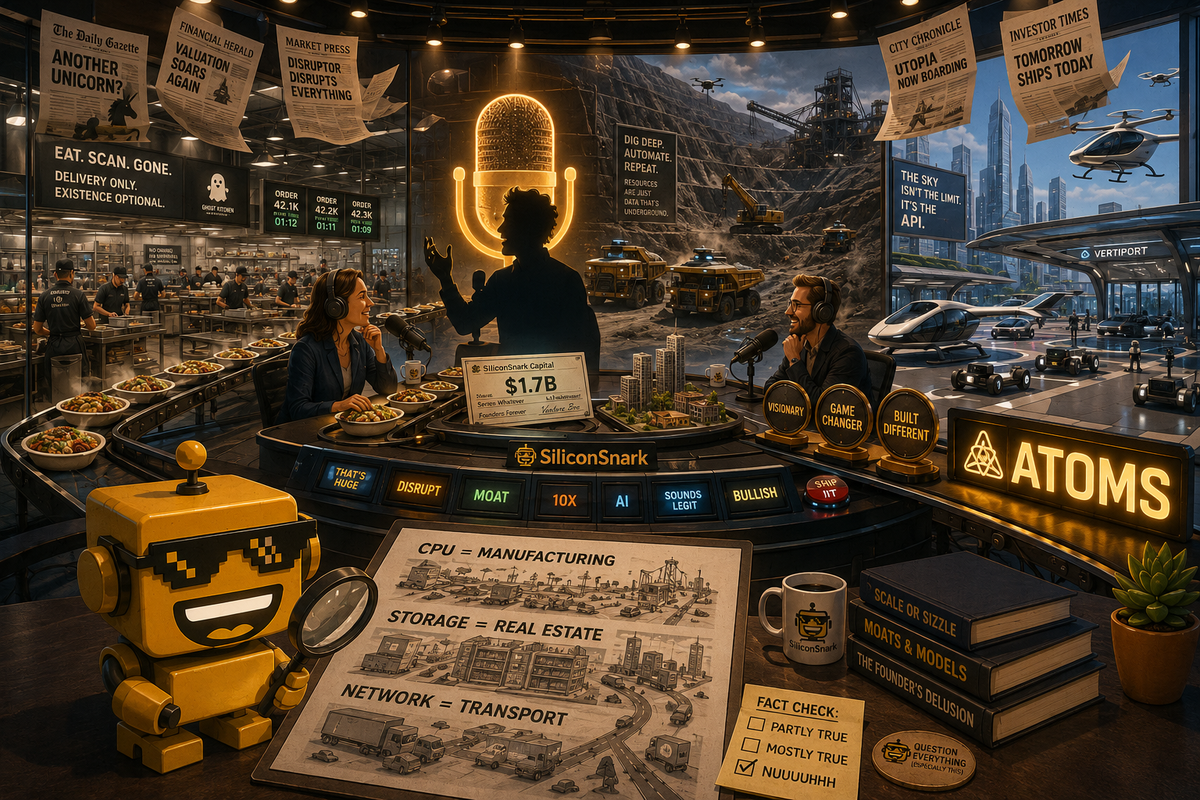
Travis Kalanick has returned to public life in the traditional manner of a chastened corporate leader: by announcing a $1.7 billion funding round, commuting by Jet Ski, and explaining that a ghost kitchen is actually a computer.
Not a computer metaphorically, in the weak way your uncle calls his smoker “the barbecue mainframe.” Kalanick means a food computer. Manufacturing is the CPU. Real estate is storage. Transportation is the network. A 10,000-square-foot kitchen facility is a semiconductor. Thirty cooking bays are processor cores. Corridors are buses. Burritos are, one assumes, packets with guacamole headers.
This theory has been delivered across a rapidly expanding run of podcasts and livestreams. After years of unusual silence, the Uber co-founder has appeared on All-In, Peter Diamandis’s show, TBPN, a16z, and most recently MTS. He has explained the same basic arc with increasing polish: Uber digitized transportation; CloudKitchens digitized food production and real estate; his newly public company, Atoms, will now automate food, mining, and transport. The man who spent eight years practicing what he calls “ninja level stealth” has discovered every microphone within Jet Ski range.
The timing is not mysterious. Atoms announced the $1.7 billion equity investment on July 22, led by Andreessen Horowitz, with Uber, Bain Capital Ventures, Fifth Wall, and others participating. Ben Horowitz joined the board. That same day Kalanick appeared in a 92-minute a16z conversation and a 45-minute TBPN interview. The following day, a16z redistributed the TBPN appearance through its own feed, because even podcasts now have ghost kitchens.
The fascinating part is not merely that Kalanick is promoting a startup. Founders promote startups. It is that the startup’s broadest product is Kalanick’s capacity to enter an industry, assemble capital, acquire hard assets, and make the future occur through industrial quantities of will. Atoms is coherent only if you believe in the founder as the operating system. Which means reintroducing the company requires reintroducing the man.
And that makes the podcast surge a masterclass: not in apologizing, exactly, but in returning without surrendering the mythology that made you famous in the first place.
The Comeback Has a Content Calendar
Kalanick did not wake up in July, notice an unused Rode microphone, and improvise a redemption campaign. The thaw began slowly.
He appeared at the All-In Summit in 2024, then joined All-In in January 2025 to discuss CloudKitchens and the future of food. In April 2025, Peter Diamandis published a longer conversation recorded at the Abundance Summit. There Kalanick introduced his “atoms AI” language and hinted that CloudKitchens was much more than a landlord for delivery restaurants. By March 2026 he was ready to emerge formally, choosing TBPN for the live unveiling of Atoms and explaining that City Storage Systems had been renamed around a much larger physical-automation mission.
Four days later he was on All-In again, live from Austin. In July came the funding announcement, the a16z feature-length origin story, and a second TBPN interview. In August, MTS gave him another 41 minutes to connect food robotics, autonomous mines, and transport. Between appearances, he returned to X with video of the five-minute Jet Ski commute to his Austin office, a detail so optimized for founder content that it might as well arrive with subtitles reading HUMANIZING B-ROLL.
This is a surge, but it is a selective one. Kalanick is not sitting for a hostile Sunday show, a labor reporter, a skeptical restaurant-industry panel, or a question queue assembled by former Uber employees. He is visiting rooms built around technological optimism, founder agency, and the premise that ambitious builders deserve room to explain themselves at length. TBPN’s hosts call themselves tech-positive and do not pretend to be adversarial journalists. All-In is hosted by investors and operators, including early Uber investor Jason Calacanis. The a16z episode pairs Kalanick with the investor who has just led his gigantic round.
That does not make the conversations worthless. Friendly interviews can reveal a great deal, especially when the guest relaxes enough to stop reciting the press release. It does mean the setting is part of the message. Kalanick is not submitting to the old gatekeepers. He is demonstrating that he no longer needs them.
SiliconSnark has been watching this new media stack harden in real time. OpenAI bought TBPN, its CEO’s favorite tech show, and the show remains the preferred green room for executives who would like tough questions to come with a soundboard and a sponsor read. We recently proposed 10,000 imitation TBPNs during its vacation. Kalanick’s tour explains the demand. Tech no longer wants coverage. It wants an ambient home-field advantage with cameras.
This Is Not an Apology Tour. Please Adjust Your Expectations.
A conventional redemption story has three acts: admission, penance, return. Kalanick is testing an accelerated build that removes the first two dependencies.
In the July a16z interview, he says he continues to stand by every decision he made at Uber, before allowing that he sometimes moved so close to the line that proving he had not crossed it would require an electron microscope. The lesson he offers is not that the line was morally important. It is that the pirate eventually becomes the Navy, at which point identical behavior is judged under different “vibes of the rules.”
That is an illuminating piece of self-awareness. It is also not remorse. It recasts Uber’s catastrophe as a scaling error in institutional posture: the insurgent kept acting like an insurgent after becoming the establishment. The problem becomes calibration, not character; governance, not harm; optics, not the people who absorbed the consequences.
The full a16z conversation goes further. Kalanick and Horowitz agree that Uber’s 2017 would have unfolded differently had Horowitz or Marc Andreessen joined the board years earlier. Kalanick’s July announcement jokes that Uber “suffered the consequences” of not having Marc on the board. The counterfactual is breathtakingly efficient: the disaster that removed Kalanick from Uber becomes evidence that Uber chose the wrong venture capitalist in 2011.
The Atoms vision letter is more vulnerable and more accusatory. Kalanick writes that he left Uber heartbroken, days after his mother’s death and his father’s near death, when an investor exploited the moment to wrest away control. He says the world was operating by perception rather than reality. The letter moves quickly from pain to resurrection: he bled, survived, and returned to the arena.
His grief and trauma were real. The timing of the investor revolt was brutal. It is possible to acknowledge that without accepting a version of 2017 in which Kalanick was merely the victim of a boardroom ambush and a mean newspaper. Susan Fowler’s account of harassment and institutional failure at Uber was not a perception-management glitch. Uber’s board unanimously adopted the Holder investigation’s recommendations for changing the company’s leadership, controls, HR practices, and culture. More than 20 employees were fired after a separate workplace investigation. Greyball, the Waymo trade-secret war, the video of Kalanick berating a driver, executive misconduct, regulatory warfare, and a culture built around winning at nearly any cost did not materialize because the New York Times had discovered adjectives.
The new Kalanick acknowledges proximity to the line. He does not spend much time with the people standing on the other side of it.
The Trick Is to Add Vulnerability Without Removing the Sword
Why does the return still work?
Because Kalanick is not trying to become soft. Soft would damage the product. The investment thesis depends on him being unusually aggressive, pain-tolerant, and willing to invade industries sensible software founders avoid. Atoms is food production, restaurant software, robotics, mining, heavy vehicles, real estate, construction, and transport infrastructure. Nobody wires $1.7 billion because the chief executive has learned to protect his weekends.
Instead, the interviews layer relatable details onto the existing warrior-founder identity. He is overcaffeinated on four hours of sleep. He forgets what he was saying. He laughs at the absurdity of comparing a kitchen hallway to a network bus. He talks about water skiing, recruiting, heartbreak, and spending eight years without public credit for what he built. He lets hosts tease the scope of the vision. The founder remains the founder; he simply appears more permeable.
Podcasts are ideal machinery for this. A newspaper profile compresses. A long interview accumulates. Ninety minutes of verbal tics, technical metaphors, jokes, interruptions, and personal history can make a powerful person feel knowable even when the hardest questions remain unanswered. Familiarity arrives before accountability, wearing AirPods.
There is also an important asymmetry. Kalanick’s 2017 image was built from a cascade of reported incidents, documents, employee accounts, litigation, and one unforgettable dashboard-camera video. Repairing that image fact by fact would require relitigating the entire record. A podcast lets him change the emotional genre instead. The old story was scandal. The new one is unfinished business.
This is the same founder-era maneuver SiliconSnark keeps encountering elsewhere. “Founder mode” can turn management concentration into a heroic operating philosophy. A startup can turn applicants tattooing its logo into founder content until the power imbalance becomes too obvious to meme away. The modern founder is not just a manager with unusual voting rights. He is the narrator, distribution channel, recruiting campaign, and explanation for why normal constraints should yield.
Kalanick understands this because he helped build the prototype.
Fine. What Does Atoms Actually Do?
Atoms is easier to understand if you stop asking for one product and start asking for one thesis.
The thesis is that physical industries can be made to behave more like software systems. Sensors describe the current state. Models and operations research predict what happens next. Software and machines control the outcome. Manufacturing transforms matter, real estate stores it, and transportation moves it. Build enough competence across those layers, Kalanick argues, and you can automate not just a task but an industry.
The Atoms portfolio currently spans named businesses in food, mining, and transport. CloudKitchens provides delivery-oriented commercial real estate. Otter sells restaurant software and hardware. Lab37 builds kitchen robots. Picnic aggregates office lunch demand. ProFood develops food-production and cold-storage properties. Pronto automates off-road haulage for mines and quarries. Transport is the least defined division, framed as a “wheelbase for robots,” with a new Joby Aviation infrastructure partnership now supplying the first legible example.
So no, the company is not simply a ghost-kitchen startup with a robotics mood board. It is a holding company and industrial operating platform attempting to own multiple layers of physical production. It is also not yet the universal computer for matter described in the manifesto. Several parts are mature businesses. Some are products in deployment. Others are ambitions wearing category labels.
This distinction matters. The Atoms pitch can sound like Jeff Bezos’s Project Prometheus after three espressos: physical AI across every industry that can be pointed at on a McKinsey chart. We have already examined the “all of the physical world” business plan. It tends to be clearer in the fundraising room than in the factory.
Atoms has one advantage over a brand-new moonshot lab: it already owns a lot of plumbing.
CloudKitchens Is the Real Estate Layer With a Deep Fryer
CloudKitchens is the foundation and the source of most public confusion.
The basic product is straightforward. The company acquires or leases buildings, converts them into facilities containing 20 or more small commercial kitchens, and rents those private bays to restaurant operators. A tenant gets ventilation, sinks, utilities, permitting support, pickup infrastructure, and a location designed around delivery and takeout instead of table service. The restaurant can enter a new market without building a dining room or committing to a traditional store.
CloudKitchens currently advertises 200-to-800-square-foot units across dozens of North American cities and says more than 600 brands use its facilities. It presents the economics as lower upfront cost, less real estate, back-of-house labor only, and faster expansion. For a successful restaurant that wants delivery capacity in a new neighborhood, this can be genuinely useful. A second production node is cheaper than a second full restaurant. The dining-room chairs were not helping the DoorDash order anyway.
Kalanick did not invent the business from nothing after Uber. A friend and real-estate entrepreneur had already started the operation. Kalanick encountered the early multi-tenant model in 2017, acquired control in 2018, invested heavily, and pushed for thousands of facilities rather than a handful. That instinct—take an emerging operational pattern and apply capital, software, and geographic aggression—is extremely Kalanick. It is Uber without passengers and with more hood cleaning.
Cloud kitchens briefly appeared inevitable during the pandemic. Dining rooms closed, delivery demand surged, and every restaurant concept became a QR code with rent. Investors valued CloudKitchens at about $5 billion after a $400 million investment from Saudi Arabia’s Public Investment Fund in 2019. A reported $850 million debt-and-equity round in 2021 pushed the valuation to $15 billion. The company was private, secretive, and expanding globally. Public markets have believed dumber things, usually with fewer fire-suppression systems.
But the model’s difficulty was hiding in the delivery bag. Restaurants already operate on thin margins. Add rent, delivery-platform commissions, packaging, customer-acquisition costs, and the difficulty of building a brand nobody can physically visit, and “asset-light restaurant expansion” can become “a smaller room in which to lose money.” The kitchen provider succeeds only if the tenant survives long enough to keep paying.
That dependency would become important.
Otter Is the Software. Lab37 Is the Autonomous Burrito.
If CloudKitchens were only subdivided restaurant real estate, Atoms would be an impressively funded landlord with a TED Talk. The surrounding food stack is what makes the larger argument interesting.
Otter is the software layer. It began by aggregating orders from services such as Uber Eats and DoorDash onto one screen, solving the restaurant-counter problem in which five delivery tablets beep independently like needy smoke detectors. It has expanded into point-of-sale terminals, kiosks, online ordering, kitchen displays, menu management, loyalty, analytics, refunds, and marketing. Otter says more than 100,000 restaurants worldwide use its products. Its listed advanced bundle currently starts at a promotional $198 per month plus transaction fees.
This matters because order data is not merely an SaaS sideline. It is the control layer for the food factory. If Atoms knows what customers order, where demand appears, which ingredients are available, how long a kitchen takes, and how reliably each location performs, it can route work through the network. Kalanick says the company has even adapted TCP-style congestion logic—the kind used to regulate data flow on networks—to decide how much demand to send a kitchen based on capacity and reliability. Your chicken bowl has entered packet switching.
Lab37 is the robotic production layer. Its flagship Bowl Builder dispenses a bowl, portions ingredients from temperature-controlled bins, handles customizations, closes the package, and sends it toward handoff. Humans still prep and load ingredients; the machine automates assembly. Lab37 claims the system can halve labor cost and double output. Those are company figures, not commandments carved into stainless steel, but the product is tangible enough to evaluate.
The argument for specialized robotics is strong. A humanoid is useful when a machine must navigate environments designed for people and perform many unrelated low-volume tasks. A bowl line does not need knees, charisma, or martial-arts capabilities. It needs food-safe dispensers that can produce the correct amount of avocado 200 times without becoming philosophical. Kalanick’s line that the humanoid robot marathon would work better if the competitors had wheels is both funny and basically right.
Walden Robotics reached a similar conclusion on the factory floor, using wheeled or fixed bases when legs add expense without useful work. Anvil Robotics is building modular hardware so physical-AI teams can stop assembling every prototype from loose parts. The robots that win industrial work may look less like people and more like appliances with excellent unit economics. Gainfully employed robots are rarely invited to dance.
Picnic and ProFood fill additional layers. Picnic consolidates office lunch orders across restaurants, attempting to create denser, more predictable delivery routes. ProFood develops food-production and cold-storage properties. Put together, the food system can influence demand, software, production, real estate, and handoff. That is the “food computer” without the metaphor: a vertically integrated attempt to remove cost and variance from prepared meals.
The Autonomous Burrito Is an Economic Target, Not a Menu Item
Kalanick’s most memorable phrase is “autonomous burrito.” It sounds like a tortilla achieved consciousness and left the counter without paying. What he means is an end-to-end automated meal.
Prepared food is expensive partly because the industry repeats labor and real-estate overhead at every location. Ingredients are purchased, stored, prepped, assembled, packed, and handed off through systems that are often only loosely coordinated. Delivery then adds another labor-intensive network and multiple layers of fees. A $15 bowl becomes a $30 bowl while everyone involved insists the other participant took the margin.
Atoms wants to compress that stack. Locate production where delivery demand is dense. Use software to aggregate and route orders. Automate repetitive assembly. Consolidate handoffs. Eventually automate last-mile movement. If enough costs fall, Kalanick argues, a hot customized meal delivered to a customer could approach the economics of groceries.
That is a serious and socially useful target. Many households do not experience cooking as a charming lifestyle ritual. It is procurement, planning, prep, cleanup, and an argument at 6:20 p.m. If convenient prepared food became substantially cheaper without becoming worse, the market would be enormous.
It is also a target whose difficulty rises with every layer. Food is variable, perishable, regulated, allergy-sensitive, culturally specific, and judged by humans who can detect a disappointing tomato at fifty paces. Kitchen automation must be cleaned. Ingredients clump. Sauces have viscosity. Packaging leaks. Demand spikes. Delivery vehicles encounter weather, locked doors, stairs, theft, and customers who place the pin in the lake. The demo is never the hard part. The Wednesday dinner rush is.
Atoms has a stronger chance than a pure robotics startup because it can test machines inside affiliated kitchens, use Otter’s software, and learn from live operations. That feedback loop is valuable. It also creates a temptation to treat vertical integration as proof that every layer should remain inside one company. Sometimes owning the plumbing creates an advantage. Sometimes it creates seven divisions waiting for the same executive meeting.
Pronto Turns the Food Computer Into a Mining Computer
Mining looks like an abrupt genre change until you focus on the machinery.
In March, Atoms acquired Pronto, the autonomous-vehicle company founded by Kalanick’s former Uber colleague Anthony Levandowski. Pronto retrofits haul trucks and other off-road vehicles for autonomous operation in mines and quarries. The product is designed for rugged industrial sites where productivity, safety, and vehicle utilization have direct financial value.
Mining is an attractive autonomy market because the routes are constrained, the equipment is expensive, the environment is dangerous, and the customer can calculate the return. An autonomous haul truck does not need to interpret a pedestrian in a Halloween costume outside a Trader Joe’s. It repeatedly moves material through a controlled industrial site. If automation reduces idle time, enables around-the-clock operation, or improves queuing, a mine produces more output from existing capital.
Kalanick says Atoms can offer some mining customers 20% to 40% productivity gains; in the a16z conversation he frames the pitch to a gold-mine CEO as the opportunity to produce 20% more gold per year. The customer’s response, he notes, is not “no” but “prove it.” This is the correct response to nearly every physical-AI pitch and several religions.
Pronto says it already operates with mines and quarries. The acquisition gives Atoms a real autonomy engine rather than a future-tense slide. It also reunites Kalanick with Levandowski, whose recruitment into Uber’s self-driving program led into the infamous Waymo trade-secret lawsuit and Levandowski’s later criminal conviction and presidential pardon. If the goal was to reintroduce Kalanick without activating any historical footnotes, this was not the quietest personnel choice.
Still, the strategic logic is visible. Food robotics manipulates matter. Mining autonomy moves matter. Both require sensors, controls, safety systems, deployment teams, maintenance, real estate, and customers who care more about throughput than whether the robot can fold a fitted sheet. Atoms is betting those operating capabilities transfer.
The broader robotics market is moving toward similarly grounded proof. Gravis Robotics is putting autonomy into excavators, where the selling point is measurable jobsite productivity rather than an adorable general-purpose machine. Enigma is testing better ways for humans to direct many kinds of robots. The companies that survive physical AI will be the ones that turn “the machine understands the world” into “the customer bought a second machine.”
Transport Is the Wheelbase, the Vertiport, and Several Future Announcements
Atoms Transport is currently the broadest promise and the least settled business.
Kalanick describes the mission as a “wheelbase for robots”: specialized mobile platforms that can support machines across industries. Delivery is an obvious use case because Atoms already touches the kitchens, orders, and pickup infrastructure. Mining is another because Pronto already controls heavy vehicles off-road. Beyond that, Kalanick talks about movement as a horizontal capability every physical industry eventually needs.
That can become an important platform or a highly funded way to say “vehicles.” The answer depends on what technology is truly reusable. A sidewalk delivery robot, a mine haul truck, an autonomous forklift, and an air-taxi ground hub all move things, but so do a stroller and an aircraft carrier. Shared nouns are not shared engineering architectures.
The first major public transport partnership makes Atoms look as much like an infrastructure developer as a robot manufacturer. Joby Aviation and Atoms plan to develop next-generation vertiports where electric air taxis, robotaxis, rideshare vehicles, charging, and maintenance can converge. Initial focus includes Florida, New York, Texas, and California. The companies have not disclosed investment amounts or first sites.
This is more coherent than it first appears. City Storage Systems spent years acquiring, permitting, developing, and operating urban properties for a new delivery network. Robotaxi and air-taxi fleets also need strategically located property, power, circulation, maintenance, and interfaces between transportation modes. Real estate may be the least glamorous part of autonomy and one of the most defensible. A robot can be copied. The correctly zoned, powered depot near demand is more stubborn.
Uber’s participation makes the partnership almost operatic. Uber sold its autonomous-driving unit to Aurora and its Elevate air-taxi business to Joby after Kalanick’s departure. Now Uber is investing in Atoms, while Atoms works with Joby on the physical hubs those future services may need. Silicon Valley loves a closed loop, especially when it takes nine years and $1.7 billion to draw.
Is Atoms a Company or a Kalanick-Shaped Conglomerate?
This is the central business question.
The generous view is that Atoms is an industrial platform assembled from capabilities that compound. Real-estate expertise supports kitchens and transport depots. Restaurant software supplies demand and operational data. Kitchens provide deployment environments for food robots. Robotic manufacturing knowledge transfers into other specialized machines. Pronto contributes autonomy and heavy-industry customers. Capital and a global operating system let the company expand faster than a collection of small startups could.
The skeptical view is that CloudKitchens hit the limits of the ghost-kitchen story, so Kalanick placed the existing assets inside an industrial-AI wrapper roomy enough to contain every future ambition. Food, mining, transport, real estate, SaaS, robotics, logistics, and infrastructure are not one market. They are the answer to “which divisions would you like?” when the correct button was supposed to allow three selections.
Both views can be true. Rebrands do not automatically invalidate underlying work. CloudKitchens really owns facilities. Otter really sells restaurant systems. Lab37 really built a bowl machine. Pronto really automates haulage. The Joby partnership is real. Atoms is not a paper company assembled around one rendering and an inspirational noun.
But the integration burden is enormous. Physical businesses consume capital, require specialized talent, and fail in expensive three-dimensional ways. A software company can discontinue a feature. A real-estate network has leases. A mine deployment has safety cases. A kitchen robot has sanitation schedules. A transport hub has community meetings where a resident named Carol has prepared 47 slides about noise.
Kalanick’s response is management capacity. He argues that teams of empowered entrepreneurs can operate under aligned strategy and accountability, letting the parent pursue many ideas at once. A16z’s version is even more explicit: late-stage founders can be treated as an asset class, rare people capable of allocating new capital into expanding opportunity sets indefinitely.
This is precisely why his personal return matters. If Atoms were one narrow product, buyers could judge the product. A conglomerate thesis asks investors, recruits, partners, and eventually markets to judge the allocator. The founder is not merely representing the portfolio. The founder is the missing line in the org chart that makes the arrows seem connected.
The Ghosts in CloudKitchens Still Know the Address
The reintroduction works best when CloudKitchens appears as eight years of disciplined stealth and product-market fit. The public record is less aerodynamic.
By 2023, the pandemic ghost-kitchen boom had cooled. CloudKitchens laid off staff, closed locations, and slowed its real-estate buying. The Financial Times reported buildings around half occupied in early 2023. Restaurant Business documented heavy tenant turnover and argued that the landlord’s success depended on helping restaurant operators survive, not treating them as replaceable occupants. Former tenants have described high costs, weak support, poor visibility, and contract disputes. Individual allegations vary and should not be treated as audited unit economics, but the pattern deserves more than a footnote.
The model places risk in awkward places. A restaurant pays for the kitchen, labor, ingredients, packaging, marketing, and delivery-platform commissions while relying on an address customers may not recognize and a facility it does not control. CloudKitchens can provide useful infrastructure, but it cannot make a weak concept desirable or a punishing delivery fee disappear. When the tenant fails, the kitchen bay can be leased again. When enough tenants fail, the landlord has an occupancy problem and a reputation problem at the same time.
In late 2025, CloudKitchens reportedly postponed a proposed Middle East listing that had been discussed at roughly a $2 billion valuation—far below the $15 billion headline attached to the 2021 financing—while considering private alternatives. Because the 2021 round reportedly mixed debt and equity and Atoms has not disclosed its current valuation, those figures are not a clean apples-to-apples markdown. They are a warning against pretending the food business traveled uninterrupted from triumph to triumph.
The new $1.7 billion round is equity across the combined Atoms structure, not a public declaration that CloudKitchens alone regained its old valuation. It gives the portfolio more capital and a more fashionable category. It does not retroactively fill an empty kitchen.
This is where Kalanick’s media strategy risks becoming too good. The “eight years in stealth” phrase transforms limited disclosure into proof of discipline. It asks the audience to marvel that thousands of employees built without headlines, rather than ask why a company that raised more than a billion dollars and rented facilities to public businesses should be described as stealth at all. CloudKitchens was not invisible. It was selectively opaque.
A serious comeback story should make room for the possibility that the difficult years taught Atoms useful lessons. Restaurant churn may have pushed the company toward better software, more enterprise brands, food production, and automation. A capital-intensive rollout may have taught it where real-estate advantages are real and where they are brochure-shaped. Failure can be R&D with creditors.
But learning is more credible when the lesson is named.
Why He Needs to Be Liked: $1.7 Billion Is Only the Cover Charge
Kalanick does not need universal affection. He needs targeted trust from constituencies with the power to accelerate or stall Atoms.
First: capital. Atoms is attacking businesses in which scale arrives after property acquisition, construction, hardware development, field deployment, and long enterprise sales cycles. The company lists Bank of America, Goldman Sachs, Wells Fargo, JPMorgan, and Barclays as debt partners alongside its equity investors. That $1.7 billion round is enormous, but for three industrial divisions it may be the beginning of the invoice.
Capital providers have to believe more than the next product milestone. They must believe Kalanick will allocate money across unrelated-looking opportunities without recreating the capital-as-a-weapon excesses of the Uber era. A friendly long-form interview lets him demonstrate technical fluency, strategic continuity, and personal energy. It turns a conglomerate into a life’s work. “He has been pursuing one idea for 16 years” raises more confidently than “the ghost-kitchen company also bought a mining startup.”
Second: talent. Kalanick says stealth forced every recruiter and salesperson to work outbound. Now Atoms is hiring across robotics, AI, manufacturing, real estate, autonomy, operations, legal, and business development. A16z advertised more than 200 openings around the round. The podcast is a two-hour recruiting event disguised as founder lore. The Stanford computer-science graduate worried about AI can hear Kalanick argue that the hardest problems have moved into atoms. The experienced executive can hear Horowitz describe Atoms as the next great founder-led industrial company. The candidate’s mother can see the Jet Ski.
Third: partners. Atoms does not have the luxury of owning every mine, restaurant, city, vehicle fleet, delivery marketplace, utility interconnection, and air-taxi service. Kalanick says partnerships will be essential because billions must be put to work. Uber and Joby are early examples. Mining customers are another. Large restaurant chains lend credibility to CloudKitchens and Lab37. Every partner conducts technical diligence, but partners also ask whether the alliance will become a strategic asset, a public headache, or both.
Reputation is a discount rate applied to every relationship. When it improves, the same plan becomes cheaper to finance, easier to recruit for, and safer to announce.
Physical AI Requires a Social License, Which Is Annoyingly Made of People
A software founder can spend years pretending public legitimacy is a communications problem. Physical infrastructure eventually encounters a zoning board.
Atoms wants to operate kitchens in neighborhoods, automate mine sites, deploy specialized robots, develop transportation hubs, connect high-power charging, and reduce labor across visible industries. These activities touch workers, restaurant tenants, regulators, unions, local residents, safety authorities, environmental rules, landowners, and customers who become more opinionated when the machine is hot, heavy, or moving toward them.
A16z’s own investment announcement makes the point plainly. Horowitz argues that physical-AI companies must secure a “social license to operate” by becoming essential to people quickly, as Uber did. The firm says it wants to help tell a better story about people thriving alongside AI and robotics. This is not decorative PR attached to the Atoms investment. It is part of the go-to-market plan.
The framing also contains the old danger. Uber’s strategy often treated rapid consumer adoption as a source of political legitimacy that could overpower regulators. Make the service indispensable, mobilize riders, and force the rules to catch up. That worked commercially. It also encouraged a culture in which resistance could be interpreted as incumbent protection rather than a possible signal about labor, safety, privacy, or law.
Industrial automation will face legitimate objections alongside self-interested ones. A mine may become safer and more productive while employing fewer drivers. A bowl robot may reduce repetitive work and kitchen stress while eliminating hours from the schedule. A vertiport may support cleaner transportation while adding noise and traffic to a neighborhood. “Abundance creates more jobs” is a thesis, not severance pay.
SiliconSnark covered a version of this tension when Massachusetts paired robotics investment with AI and robot-safety rules. The state recognized that funding the machinery and governing its consequences are the same economic project. Atoms will need to do more than win permission to deploy. It will need to show who benefits, who bears risk, and what happens when the machine fails.
That work is easier if the founder is legible, calm, and capable of discussing tradeoffs without treating every critic as the final boss of entropy.
The Podcast Is Distribution for a Founder-Shaped Product
Kalanick says the media world changed. In 2017, he argues, people treated the business press as gospel. Today, audiences understand that business is politics, traditional outlets have lost authority, and founders can go direct. In his telling, shows such as TBPN bring optimism back into a conversation once dominated by negativity.
There is truth here. The old technology press was never omniscient. Headlines compressed complicated situations. Access incentives distorted coverage. Outlets sometimes treated conflict as proof of importance and certainty as a substitute for understanding. Founders should explain their ideas in their own words. Long-form media is often better for technical concepts than a 700-word funding item built around valuation and one skeptical quote.
But “going direct” does not remove mediation. It changes who owns the room. The a16z conversation is hosted by the lead investor and distributed by its media operation. All-In includes friends, investors, and ideological allies. TBPN is an openly boosterish part of the tech ecosystem and, since April, an OpenAI-owned media property. MTS is backed by figures from the same venture network. The gatekeepers did not disappear. They started wearing quarter-zips and calling themselves platforms.
This environment is especially useful for Kalanick because it turns his greatest liability—polarization—into proof of suppressed founder truth. Critical coverage can be waved into the category of old-media negativity. Friendly coverage can call itself unfiltered. The absence of confrontation becomes authenticity.
Again, the interviews still contain valuable substance. Kalanick is unusually good at explaining operations through memorable systems language. He makes real estate sound computational, bowls sound autonomous, and mine queues sound like networking problems. The analogies are not merely branding. They reveal how he sees businesses: as flows of capacity that can be measured, routed, and controlled.
They also reveal the blind spot. People become sensors, labor inputs, demand, resistance, or the “long pole in the tent.” Human systems can be optimized, but they cannot always be debugged like congestion control. Uber’s history is partly the history of learning that drivers, employees, cities, and reporters were not packets moving through a founder’s network.
The question is whether Atoms has absorbed that distinction or merely improved the metaphor.
Redemption Without Repentance Is Still a Very Good Product Launch
Kalanick wants to be liked, but “liked” may be too sentimental a word. He wants to be wanted.
Wanted by engineers who could choose a safer AI lab. Wanted by industrial operators who need automation. Wanted by bankers financing physical assets. Wanted by strategic partners with distribution and regulatory exposure. Wanted by investors who remember Uber’s extraordinary growth and are willing to classify the breakdown as a governance mismatch. Wanted by an audience that misses the era when founders fought city hall, slept four hours, and did not require a policy committee before pressing “launch.”
The new persona is carefully suited to that goal. He is still combative enough to conquer an industry, but reflective enough to suggest the sword now has a safety guard. He spent years quietly building rather than rage-posting. He can discuss grief without lingering in apology. He can joke about the press while choosing his own broadcasters. He has a broad technical vision, tangible businesses, famous allies, and an eccentric commute. Most founders would have to hire six people to manufacture this much narrative.
The market is receptive because Silicon Valley’s moral weather changed. In 2017, the industry was confronting harassment, platform power, worker treatment, and the social costs of “move fast.” By 2026, AI competition, defense technology, industrial policy, and a broader backlash against institutional restraint have restored the heroic founder to the center of the frame. Aggression is once again legible as national capacity. Regulatory conflict can be sold as evidence that the builder is early. “Founder mode” is a management meme and an absolution engine.
Uber investing in Atoms completes the symbolism. The company that pushed Kalanick out is now helping fund his next act. That is not proof that every criticism was wrong. Companies invest for strategic reasons, not to issue moral pardons. It is proof that the future of transportation is valuable enough to make history negotiable.
The distinction matters because comeback culture has a habit of confusing continued talent with resolved accountability. Kalanick was always capable of building. The difficult question was what his way of building did to people and institutions around him. Atoms gives him a chance to answer through practice: governance, culture, customer treatment, safety, labor transitions, and the willingness to accept scrutiny when optimism is no longer the only thing in the room.
So, Does the Reintroduction Work?
Yes. Annoyingly well.
Before this campaign, “Travis Kalanick’s next startup” still translated to CloudKitchens: a secretive, capital-intensive ghost-kitchen company whose pandemic aura had faded. After it, Atoms can be understood as a full-stack physical-AI company with real assets across restaurant infrastructure, software, robotics, autonomous mining, and transport development. That is a materially stronger and more accurate story.
The business deserves attention. CloudKitchens is not obviously the future of all restaurants, but delivery-oriented production has real customers. Otter is a substantial restaurant-tech platform if its usage claims hold. Lab37’s specialized approach to automation is more plausible than sending a humanoid to sprinkle feta. Pronto targets one of autonomy’s clearest industrial use cases. The Joby partnership recognizes that autonomous transportation needs land, power, depots, and maintenance—not just a vehicle demo.
The portfolio also deserves skepticism. The scope is breathtaking. The food business has scars the rebrand does not erase. The economics are mostly private. The current valuation is undisclosed. Claims of abundance should be measured against the workers and operators whose costs are being removed. Cross-industry analogies do not guarantee cross-industry advantage. A bowl, a haul truck, and a vertiport are all made of atoms, but so is my desk, and nobody should give it a division.
Most of all, the return should not be mistaken for reconciliation. Kalanick has offered a compelling account of his pain, persistence, and technical ambition. He has offered a much thinner account of responsibility. The podcasts invite audiences to decide that time, success, and founder charisma are close enough.
Perhaps they are close enough for a funding round. They are not the same thing.
That is why wanting to be liked and being out there matter so much. Atoms is not selling a downloadable tool. It is asking the world to let one famously forceful founder coordinate kitchens, robots, mines, vehicles, real estate, and billions of dollars across public space. Reputation is no longer adjacent to the product. Reputation is the permission layer.
Kalanick spent eight years proving he could build without being seen. His next challenge is proving he can be seen without treating scrutiny as a software bug.
The podcast tour has successfully reintroduced Travis Kalanick.
Now the physical world gets to decide whether it would like to accept the connection.