Enigma Raised $71 Million to Make Robot Control Feel Like a Volume Knob
Enigma raised $71 million to make robots easier to control, putting 100-plus AI machines online while the business case remains delightfully unresolved.

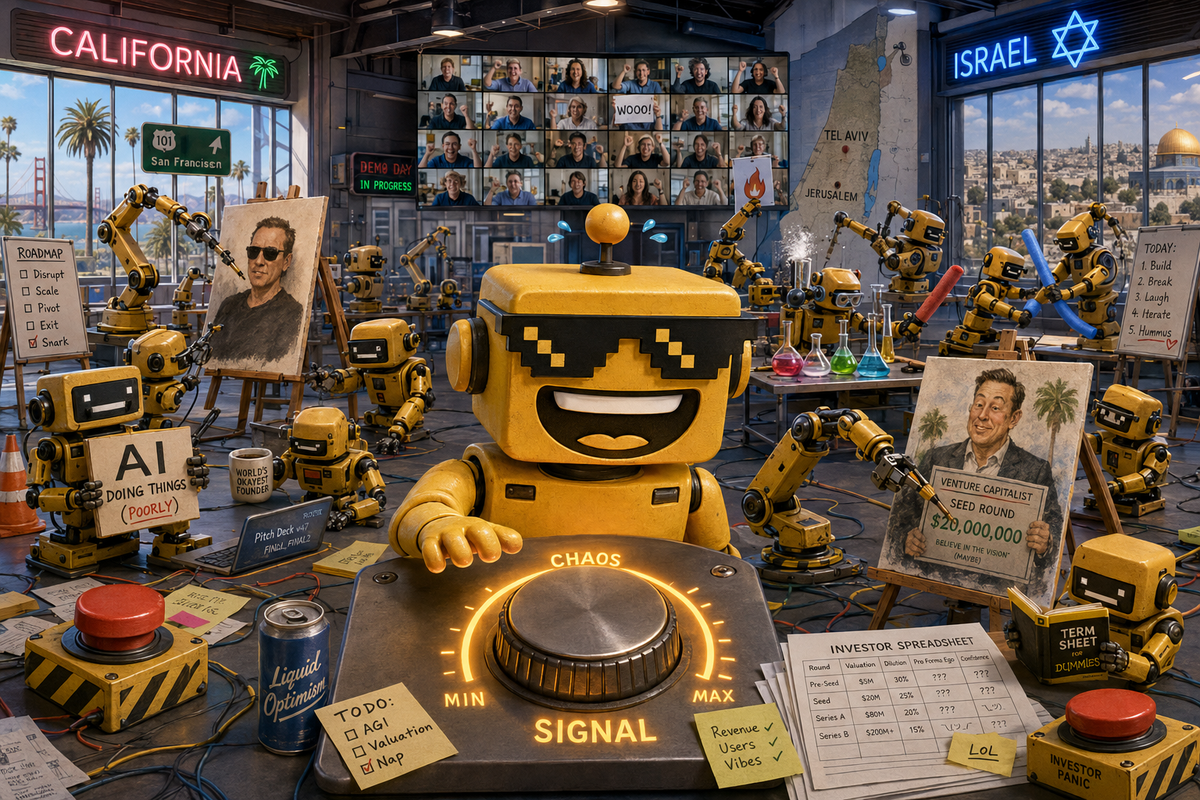
Somewhere in California or Israel, more than 100 robots are waiting for strangers on the internet to tell them what to do. They can paint, duel with swords, and conduct simple chemistry experiments. This is either the beginning of intuitive physical AI or the most expensive public-access robotics arcade ever assembled.
On July 27, Enigma emerged from stealth with a $71 million seed round and a live experiment designed to discover how humans actually want to communicate with machines. The company says its goal is an intelligence layer for robotics; its launch materials describe robots that anyone can use online, in real time. TechCrunch reported the round as $70 million, led by Index Ventures and Ribbit Capital with participation from Conviction Partners. The one-million-dollar discrepancy is the sort of thing that happens when a startup enters the world carrying both a press release and a rounding error.
The bigger number is not the interesting part. The interesting part is that Enigma is treating robot control as a user-interface problem before treating it as a robot problem. That sounds obvious until you remember how much of the robotics industry still assumes the ideal operator is a graduate student, a controls engineer, or a person willing to spend 15 minutes explaining where every dish belongs.
The Robot Is Ready. Your Interface Is Not.
Enigma was founded by Jonathan Jacobi and Gal Niv, friends who met as teenagers, worked together in Israel’s Unit 8200, and arrived at robotics as outsiders. They recruited researchers from top AI labs, math competitions, and PhD programs, then decided that the most important question was not simply whether a model could move a robotic arm.
It was whether a normal person could make the arm do something useful without first earning a minor degree in robot diplomacy.
Jacobi’s analogy is wonderfully unglamorous: manipulating a robot should eventually feel like adjusting a car’s volume. You turn a knob until the sound is right. You do not tell the stereo, in percentages, how much louder it should become, while consulting a calibration chart and wondering whether “62” means a pleasant podcast or a small airport.
That is the correct target. In the real world, people communicate through a mash-up of language, pointing, demonstration, timing, correction, and the universal human gesture for “no, the other thing.” A robot that accepts only precise commands is not intelligent in the way customers mean when they buy intelligent machinery. It is a very expensive intern who needs every task converted into a ticket.
This is also why the company’s public test matters. Enigma plans to compare text, audio, video examples, and tap-drag-drop interactions to learn which ones let people control robots naturally. The experiment is not just a demo funnel. It is an attempt to gather data about the missing layer between a human intention and a robot’s physical action.
One Hundred Robots Walk Into a Data Set
Robotics companies have been hunting for the physical equivalent of the internet’s vast text corpus. Language models could ingest mountains of writing. Robots get a warehouse, a factory, a kitchen, a few thousand awkward demonstrations, and a hard limit on how many times somebody can safely ask an arm to pour coffee before the coffee becomes a labor issue.
Enigma’s bet is that every interaction with its online robots can teach it something: which commands people try first, where they get confused, how they correct failures, and whether people would rather describe an action or show one. That turns the user interface into a training instrument. The plumbing is the point.
The company says it built the robotic arms and underlying models from the ground up. Its robots live in hangars in Israel and California and can perform tasks including painting with a brush, sword fighting, and mixing liquids in flasks. The examples are deliberately theatrical, because “please place this object into that bin with seven millimeters of clearance” is not exactly how you launch a company into the cultural bloodstream.
But the practical ambition is clear. If a single interface can teach a robot to handle unfamiliar tasks across different hardware, Enigma could become useful to healthcare, logistics, and entertainment customers. It could also become infrastructure for other robot makers, which is where the serious money tends to hide: not in the robot doing one trick, but in the layer that makes many robots usable by people who have jobs to do.
That would put Enigma in the tradition of the less glamorous but more durable AI businesses. As industrial IoT learned when warehouses became the product, the operational layer often matters more than the flashy agent standing in front of it. Somebody has to map the assets, route the instructions, manage the exceptions, and explain why the machine has decided that a pallet is emotionally unavailable.
The $71 Million Question: Who Pays for the Arcade?
Here is where Enigma’s launch becomes an enigma in the original business sense: the company has a compelling research program and a still-vague commercial one.
Jacobi told TechCrunch that Enigma is partnering with companies in healthcare, logistics, and entertainment, but declined to name specific use cases. That is understandable for a company emerging from stealth. It is also the point where readers should gently put down the confetti cannon.
Robotics is an unforgiving market. A language model can produce a bad paragraph and leave the damage in a document. A robot can misunderstand a request while holding a scalpel, a package, a hot flask, or a sword. Human-friendly control is valuable precisely because physical mistakes have physical consequences. The interface has to communicate uncertainty, ask for clarification, and fail in ways that do not turn the warehouse into a slapstick short.
There is another cost. Enigma is not collecting cheap web behavior. It is operating hardware in two countries, maintaining robot arms, managing latency, handling safety, capturing useful training data, and somehow preventing the internet from turning a live chemistry station into a crowd-sourced episode of Jackass. The company’s experiment may produce unusually valuable data, but it also produces unusually expensive data.
This is the opposite of the standard chatbot economics story. The web was messy, but it was already there. Physical intelligence has to be manufactured in rooms full of machines, sensors, safety procedures, and people who know where the emergency stop button is. The more Enigma learns from real interaction, the more every lesson costs.
Outsiders, Interfaces, and the Humanoid Hype Cycle
Enigma’s outsider status is both its strongest argument and its most Silicon Valley sentence. Investors can reasonably believe that robotics insiders sometimes begin with the robot’s capabilities and work backward toward the user. An outsider might begin with the experience and ask what the machine needs to become.
That is a smart inversion. It also has a failure mode: people who are new to robotics can underestimate how many apparently simple interface problems are actually problems of perception, control, hardware variation, safety, and reliability. A volume knob works because the car stereo has a narrow, predictable job. A robot in a changing warehouse is not a stereo. It is a stereo, a forklift, a nervous animal, and a junior employee with access to the loading dock.
The broader industry has already learned this lesson the expensive way. The great AI robot race has plenty of genuine progress, but it also has a recurring tendency to treat a viral demo as a deployment plan. Enigma is at least pointing at the right hard problem: the difference between making a robot move and making a robot useful.
It is also refreshing that the company’s first public product is not another benchmark table. Its test asks a cultural question: when people meet a machine, do they want to talk to it, demonstrate to it, drag a cursor, or simply point and hope? The answer will say something about robotics, but it will also say something about us. We love the fantasy of natural interaction right up until the robot needs to interpret what “make it nice” means.
Verdict: A Real Bet, With a Very Large Tip Jar
Enigma’s launch is a meaningful bet, not a proven revolution. The company has real hardware, a genuinely interesting data strategy, and a useful instinct that the human-machine interface is part of physical intelligence rather than decoration around it. The $71 million seed round gives it room to run the experiment at a scale most robotics teams cannot afford.
What it does not yet have, at least publicly, is a crisp customer promise. Healthcare, logistics, and entertainment are industries, not use cases. One hundred robots online is a remarkable research lab and a dangerous business model if the company cannot convert curiosity into repeatable work.
Still, I would rather watch Enigma spend money learning how people actually control robots than watch another company announce a humanoid assistant with the vocabulary of a management consultant and the dexterity of a coat rack. The demo is never the hard part. The hard part is making the machine understand what you meant, survive what you forgot to say, and perform the same task tomorrow without developing a personal relationship with the fire extinguisher.
So: real shift, eventually possible. Right now, Enigma is a very expensive vibes machine pointed in a promising direction. That is not an insult. In robotics, a promising direction is already doing more work than most pitch decks.
If you want the larger context, robots are learning to fear paperwork, which may be the first truly scalable form of machine intelligence.