Moderna’s Cancer Vaccine Finally Got Its Big Phase 3 Moment. The Footnotes Are Still in Cambridge.
Moderna and Merck say their personalized mRNA cancer vaccine met Phase 3 melanoma endpoints. The Cambridge biotech has a real win, with caveats.

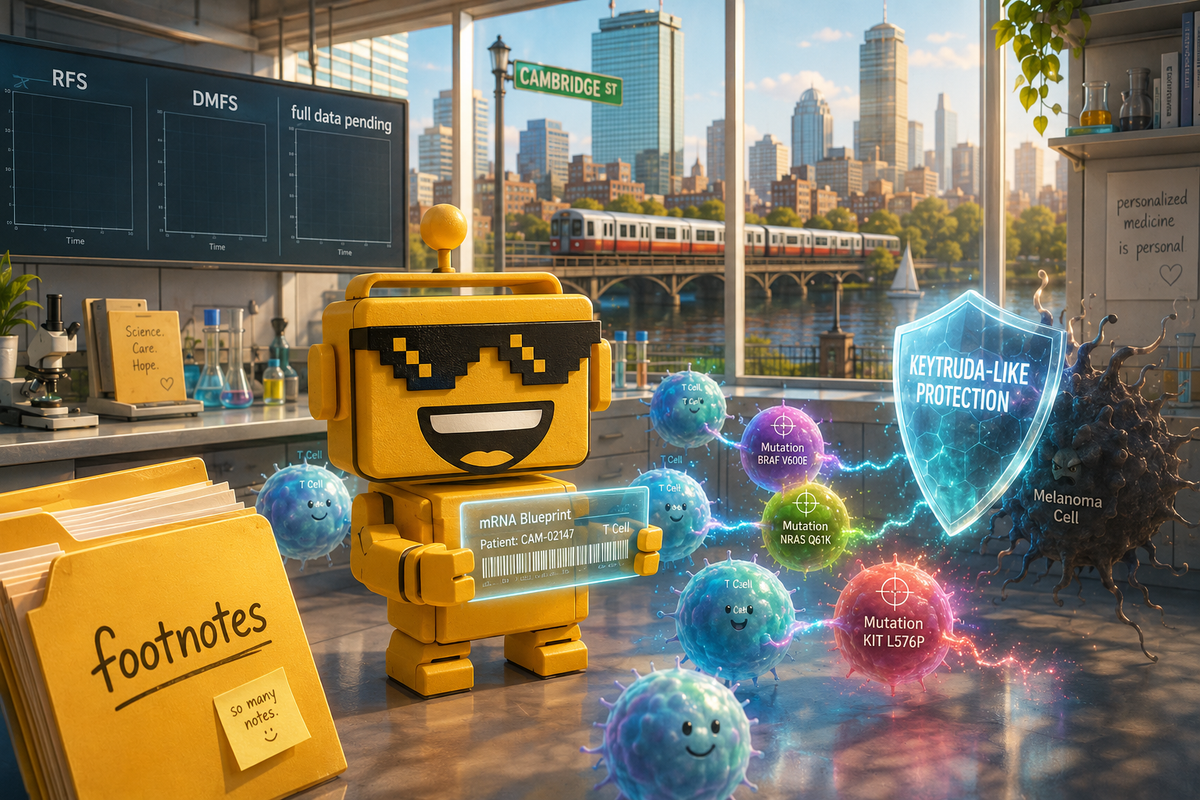
Cambridge biotech Moderna spent Wednesday doing something that biotech companies rarely get to do without immediately adding twelve qualifiers: it made the market remember why anyone cared about mRNA in the first place.
Moderna and Merck announced that their personalized mRNA cancer treatment, intismeran autogene, met the primary endpoint of recurrence-free survival and a key secondary endpoint of distant metastasis-free survival in the Phase 3 INTerpath-001 trial. The study enrolled 1,137 people with completely resected, high-risk Stage IIB through IV melanoma. The treatment was tested alongside Merck’s Keytruda against Keytruda alone.
That is a significant result. It is also not the same thing as “Moderna cured cancer,” a sentence currently being assembled by the internet’s least medically supervised copy desk. As the Associated Press noted, the companies have not yet released the numerical effect sizes, the full survival curves, or overall-survival results. They say detailed data will be presented at an upcoming medical meeting. The headline is promising. The spreadsheet is still on its way.
The Vaccine Is Not Preventing Cancer. It Is Hunting the Tumor That Already Happened.
The word “vaccine” creates a useful mental shortcut and a small amount of confusion. This is not a shot you receive at the pharmacy before melanoma shows up. It is an individualized neoantigen therapy designed after a patient’s tumor has been removed.
Here is the plain-English version. A tumor contains mutations that can create abnormal proteins, or neoantigens, that distinguish cancer cells from healthy tissue. The patient’s tumor is analyzed, software identifies a set of mutations worth targeting, and Moderna’s mRNA platform is used to make a treatment intended to train the immune system to recognize those targets. The patient then receives that treatment in combination with Keytruda, an immune-checkpoint drug that helps T cells stay engaged. The study’s ClinicalTrials.gov record describes the randomized, double-blind design and the recurrence and metastasis endpoints.
Keytruda is doing important work here. The trial compared personalized intismeran plus Keytruda with placebo plus Keytruda, not with doing nothing. That matters because Keytruda already has activity in melanoma. The question is whether a tumor-specific mRNA instruction layer can make an existing immunotherapy more effective at cleaning up the cells that surgery could not see.
This is a technically ambitious idea with a very unglamorous manufacturing problem attached. Each treatment is designed around an individual patient’s tumor, which means the workflow has to move from tissue sample to sequencing to target selection to drug production to delivery without becoming a bespoke pharmaceutical escape room.
Phase 3 Is Where the Beautiful Theory Meets the Awkward Spreadsheet
INTerpath-001 is important because Phase 3 is the point where a therapy has to demonstrate that its promise survives a larger, controlled comparison. Earlier data from the Phase 2b KEYNOTE-942 study showed encouraging improvements in recurrence-free and distant-metastasis-free survival. The companies also reported five-year follow-up data this summer, including a 49% reduction in the risk of recurrence or death and a 59% reduction in the risk of distant metastasis or death for the combination versus Keytruda alone.
Those earlier results supplied the scientific momentum. Wednesday’s announcement says the larger Phase 3 trial crossed its prespecified statistical hurdles. That is the meaningful development, not the stock chart. Moderna shares reportedly more than doubled after the news, which is a reminder that public markets have believed dumber things—but also that investors were treating this as a referendum on the company’s post-COVID future.
The missing details are still load-bearing. We need the hazard ratios, confidence intervals, absolute event rates, duration of follow-up, adverse-event breakdown, and eventually the overall-survival analysis. “Met the endpoint” tells us the result cleared the study’s statistical bar. It does not tell us how large the clinical benefit is, how durable it will be, or what the treatment will cost to manufacture and deliver.
Moderna’s Cambridge Origin Story Just Got a Second Act
The Boston connection is not a corporate pin on a map. Moderna is headquartered at 325 Binney Street in Cambridge, in the same Kendall Square neighborhood that has spent decades turning academic biology into companies with increasingly expensive coffee habits. The company’s cancer program is one of the clearest tests of whether the mRNA platform can become a broad therapeutic technology rather than a historic but unusually concentrated COVID success.
That distinction matters to Massachusetts. The state’s biotech identity is not built only on discovering molecules. It also depends on the manufacturing, computational biology, clinical operations, hospital networks, sequencing infrastructure, and venture capital required to move a scientific idea through years of failure-prone development.
SiliconSnark has covered the region’s less glamorous but more durable layers, from Azenta’s sample-management and multiomics infrastructure to Agios’ Cambridge oncology and hematology work. Moderna’s result sits higher in the news cycle, but it depends on the same ecosystem habit: science becomes valuable only when a lot of specialized systems cooperate without dropping the tube.
It also belongs beside Flare Therapeutics’ transcription-factor bet, another Cambridge story where the interesting part is not a slogan about disruption but a long, technically specific attempt to make difficult biology behave. Boston’s biotech advantage is less “we have a lab” than “we have an entire neighborhood of people who know what to do after the first lab result.”
The Personalized Part Is Both the Magic and the Invoice
Personalization is powerful because cancer is not one uniform object. Two melanomas can share a diagnosis and behave very differently at the molecular level. A treatment that learns the mutation profile of a particular tumor has a plausible route to being more selective than a generic immune stimulant.
It is also expensive and operationally demanding. Personalized therapies need reliable sequencing, fast manufacturing, quality control, cold-chain logistics, clinical coordination, and a reimbursement system capable of understanding why two patients receiving “the same” therapy may technically be receiving different products. The science may be elegant. The implementation will involve several meetings where someone says “chain of custody” in a tone that removes all romance from the room.
Moderna and Merck’s partnership helps. Merck brings Keytruda, an established oncology franchise and clinical-development machine. Moderna brings the mRNA platform and the ability to make a treatment that can encode multiple targets in one construct. The partnership also gives the therapy a commercial path that a small biotech would struggle to build alone.
But platform claims should be handled carefully. A successful melanoma result can validate the approach in melanoma without proving that the same strategy will work in lung, bladder, kidney, pancreatic, or other cancers. Those programs are separate clinical bets. Biology remains stubbornly uninterested in investor presentations.
A Real Win, Not a Permission Slip to Stop Reading
My verdict: this is a meaningful scientific win for Moderna and a serious moment for Cambridge biotech. It is one of the first late-stage demonstrations that an individualized mRNA cancer therapy can add measurable value to an existing immunotherapy in a large randomized trial. That is not ordinary incremental progress. It is a proof point for a new way of designing treatment around the molecular identity of an individual tumor.
The honest version is more interesting than the victory-lap version. Moderna has not yet shown us the full magnitude of the benefit, whether patients live longer overall, or how the therapy will work at commercial scale. It has shown that the central concept survived a major clinical test. The next test is whether the benefit is large, durable, safe, manufacturable, and accessible outside a highly controlled trial.
That is a lot of homework. Fortunately, Cambridge has never been frightened by homework. It has, however, been known to complain about the grading rubric.