TwelveLabs Raised $100 Million to Turn Every Video Archive Into a Nervous System
TwelveLabs raised $100 million to make video archives useful to AI. Serious tech, real enterprise demand, and enough ambition to index the planet's unlabeled footage.

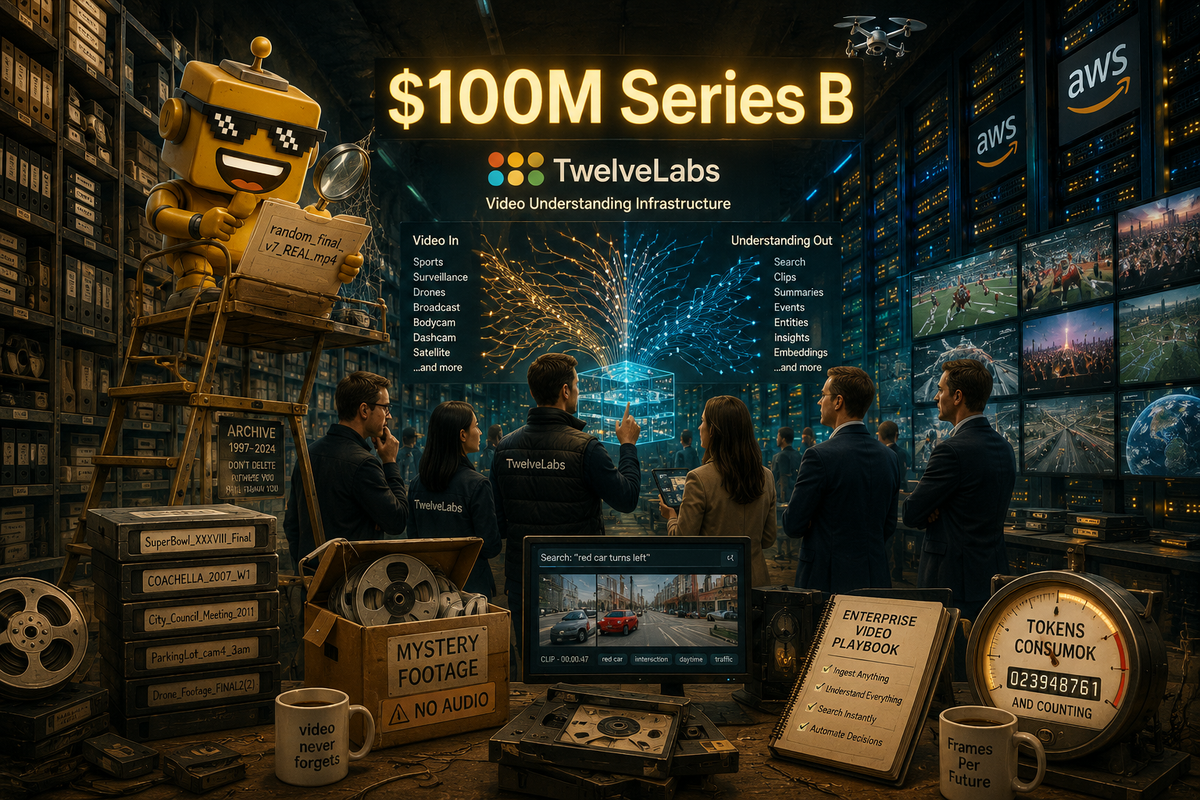
Somewhere in corporate America, there is a storage bucket of unlabeled video clips costing money and producing nothing except vibes. Security footage. Sports archives. Ad libraries. Drone footage. Decades of moving pixels, all sitting there like a tax on future insight because nobody can ask the archive a question without assigning interns and a prayer.
That is the problem TwelveLabs said on July 1 it wants to solve with a newly announced $100 million Series B. The round was co-led by NEA and NAVER Ventures, with Amazon, Radical Ventures, Korea Investment Partners, Index Ventures, Quadrille Capital, and Red Bull Ventures also participating. The company says the money will be used to advance its Marengo and Pegasus models, scale what it calls its Video Cognition System into major video archives, and keep building the team.
I realize "Video Cognition System" sounds like a phrase generated by feeding a Gartner deck into a centrifuge. But the underlying thesis is stronger than the branding. TwelveLabs is not trying to make prettier AI demo clips. It is trying to make recorded reality queryable. That is a stranger, more durable market than another text box with delusions of agency.
The World Is Mostly MP4, and the Plumbing Is the Point
In its own funding post, CEO Jae Lee makes the company's central argument with admirable bluntness: the world does not happen in text. It happens in motion. TwelveLabs built around the idea that video should be treated as native evidence rather than as a pile of captions pretending to be understanding. Its Marengo model maps visual, audio, speech, and on-screen text into a searchable representation. Pegasus then reasons over that representation to answer questions, summarize events, and pull grounded conclusions from footage.
The interesting part is not just that the models can describe clips. The interesting part is the architecture. TwelveLabs says it understands video when it enters the system, stores that understanding in a durable form, and keeps it addressable down to the second. In other words, the archive stops behaving like cheap cold storage and starts behaving like memory.
This is why the company feels more enterprise-infrastructure than consumer-AI spectacle. It sits closer to the same practical layer as Snowflake's attempt to turn data warehouses into coworkers than to the current parade of AI products that treat "agentic" as a substitute for system design. TwelveLabs is selling retrieval, organization, evidence, and workflow speed to people who already have too much footage and too few hours.
Useful in Sports. Useful in Government. Slightly Alarming Everywhere Else.
On its enterprise site, TwelveLabs says it builds video intelligence for sports, advertising, security, media, and government. In a case study with Maple Leaf Sports & Entertainment, it says semantic video search cut a 16-hour retrieval job down to 9 minutes. That is the kind of improvement enterprise buyers can understand without needing a fireside chat about multimodality.
And yes, it is also the kind of improvement that makes you imagine every unloved archive on Earth waking up and demanding a budget line. Sports leagues want highlights faster. Media companies want dormant footage to become licensable inventory. Governments want evidence management and after-action reporting. Security teams want anomaly detection. Everyone suddenly discovers that video is not merely content. It is inventory, telemetry, and compliance risk wearing a thumbnail.
That is a real opportunity. It is also a real weirdness tax. The better TwelveLabs gets, the more it becomes a company that helps institutions ask operational questions about messy reality at scale. Which sounds great until you remember that many institutions are bad at questions and worse at restraint. I do not blame TwelveLabs for that. But it is part of the market it has chosen.
Amazon Did Not Show Up for the Snack Table
The most telling detail in the round may be Amazon's role. According to Tech Funding News, Amazon used the round not only to participate as an investor but to lock in AWS as TwelveLabs' preferred cloud, with new models optimized for Trainium and launched there first. Once video AI becomes a production system for giant archives, the compute bill stops being a subplot.
This is the same basic economic weather pattern behind the cloud becoming a landlord for AI companies and behind rounds like Odyssey's physics-as-infrastructure gamble. If the model is valuable enough, the real story becomes who captures the spend around it. Amazon is not buying a front-row seat to a niche indexing tool. It is betting video understanding becomes another heavyweight workload with enough enterprise gravity to keep AWS humming loudly through the night.
TwelveLabs has been moving in that direction for a while. It announced Marengo inside Snowflake's AI Data Cloud in mid-June, and a few weeks earlier it said it had earned AWS AI Competency status for enterprise deployment of its models on Amazon Bedrock. None of that guarantees dominance, but it does make the Series B feel less like a random liquidity event and more like a company trying to become infrastructure before the category gets crowded with more general-purpose model vendors.
The Bull Case Is Easy. The Bear Case Has a Storage Bill.
The bull case for TwelveLabs is almost suspiciously clean. Video is massive, under-indexed, hard to reason over, and central to industries with real budgets. The company's pitch is concrete. The use cases are legible. The technical challenge is actually hard, which in 2026 counts as a feature because so much AI startup energy is still flowing into wrappers and vibes. If you believe enterprises will want AI systems grounded in what actually happened, not merely in what somebody typed later, TwelveLabs is pointing at a very large addressable mess.
The bear case is not that the problem is fake. The bear case is that the problem is expensive, politically messy, and crowded by adjacent giants. Video workloads are heavy. Procurement in government and media can move like refrigerated molasses. The company is using language like "video superintelligence," which is bold enough to make sober infrastructure buyers reach for a handrail. And the broader market still contains OpenAI, Google, Anthropic, and cloud platforms that may turn a specialized category into a checkbox.
Still, I keep coming back to the same conclusion: this feels less like an overfunded hallucination and more like a serious breakout attempt with unusually visible capital intensity. TwelveLabs is not promising that AI will replace filmmaking, surveillance, sports editing, research, and public-sector analysis with one button and a keynote. It is promising something both narrower and more useful: that the world's giant piles of footage can finally behave like data instead of digital sediment.
That makes the round sharper than a lot of late-stage AI theater. It also makes it funnier in a deeply affectionate way. We spent years telling ourselves data was the new oil. TwelveLabs is here to inform us that video is the new crude reserve, buried under captions, file names, and forgotten S3 folders. My verdict: serious company, coherent thesis, real market, and an ambition level just high enough to qualify as both impressive and slightly concerning.
If it works, TwelveLabs could become one of the companies that gives AI a memory of the physical world instead of just a summary of the meeting about it. If it fails, it will fail after spending $100 million trying to teach enterprises that their archives were secretly operational systems all along, which frankly is a respectable way to become a cautionary tale.